Environmental Forum: ‘Kailangan pa rin ang green spaces sa urban area’

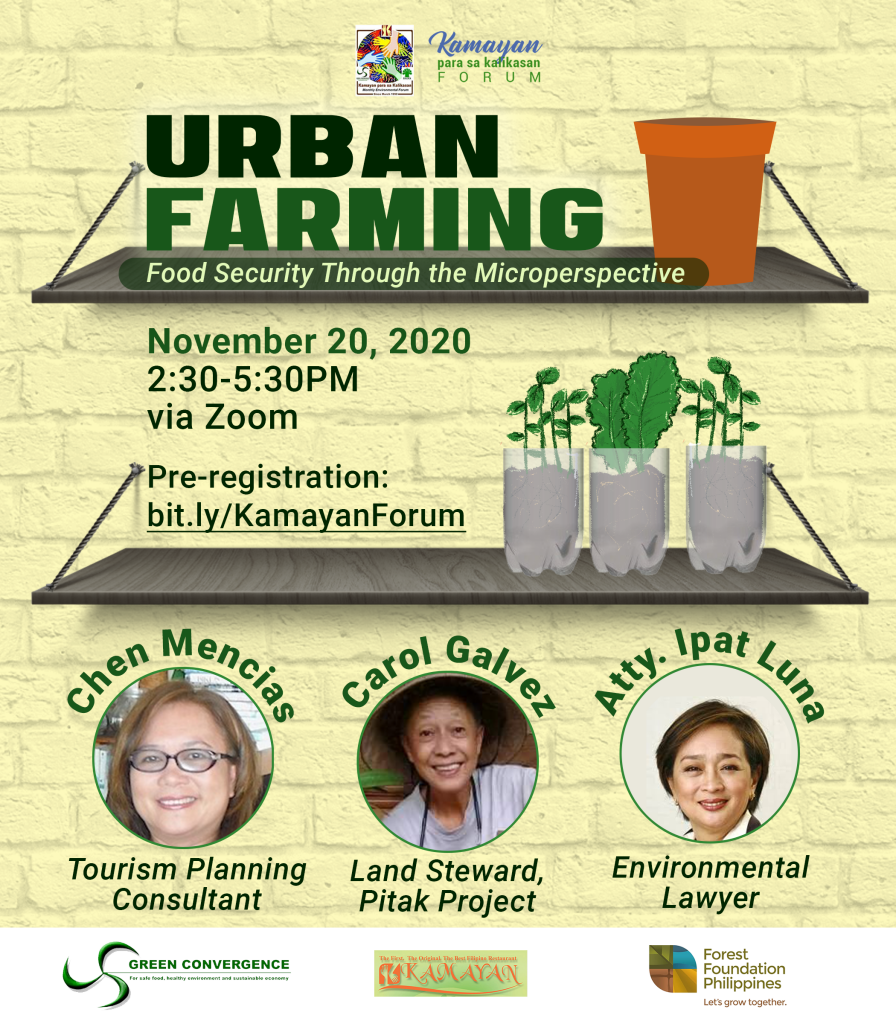
Urban farming was the subject of the 365th session of the monthly Kamayan Para sa Kalikasan Forum held last November 20, 2020 through an online webinar hosted by Green Convergence.

Environmental Lawyer Ipat Luna showed her rooftop garden to the forum participants and shared some of her planting endeavors. “I raised a lot of dapdap for streetside planting. I just bought a kilo of seeds pero sa palagay ko maraming puno’y pakikinabangan natin from that.”

As means of disaster preparedness, Atty. Luna shared that “kahit nabagyuhan at pinabayaan mo [ang garden], it’s still going to give you something. It’s not much pero kung alam mo may value, nakakatuwa rin…I will never run out of camote tops and regular sweet basil.” 

“This is good disaster preparedness.” she added. 

“Policy wise, I think the important thing is for LGUs to support home gardening not just by giving seeds not just by programs that they roll out, but actual technical support and subsidies.” said Atty. Luna.

Carol Galvez of Pitak Project shared the workings of her farm in La Union which promotes regenerative living. “Sa farm ang mantra namin is ‘Build, build, build healthy soil’. That is our wealth. We measure our wealth by how far we’ve regenerated the soil and how much capital we invest back into the land. That is the essence of regenerative living.”

“Rather than increasing the quantity of a certain form of capital, regenerative systems develop the quality of capital. Ang current extractive economy requires ever increasing quantities of capital. That is cancer.”

“Unless the system can be transformed, this will likely lead to overall collapse”, she added.

“Maraming benefits [ang regenerative living]” said Galvez. “It promotes biodiversity, climate change mitigation. We are resilient during disasters. Nung lockdown, may tanim kami.” 

“My point here is we have a choice. We have to choose to regenerate our planet. Let us stop destroying our ecosystems…Let us restore our ecosystems and help build a more equitable world for the future generations to come. I am telling you it is possible.” she concluded.


“It’s really innate for us to get attracted to pretty things or green things. Lalo nang ngayong pandemic, we crave for the outdoors and we want to be outside, and no other color will represent the outdoors like green” shared tourism planner Chen Mencias.

When Mencias started her urban garden, she noted “dumami yung mga ibon and insects. Dumami yung butterflies, bees, beetles.”

“Nung isang araw lang, nakakita ako ng Oriole, which is not very common sa urban area.” she added.

“Kaya kailangan pa rin sa urban area ang green spaces kasi it really provides a place for relaxation and communing with nature” she concluded.

Since March 1990, Kamayan Para Sa Kalikasan Forum has become an institutionalized platform that enables NGO and government representatives, the media, students, teachers, church groups, and concerned citizens to discuss pressing environmental issues in the country. This month’s forum is organized by Green Convergence and is supported by Kamayan Restaurant EDSA with the assistance of the Forest Foundation Philippines.

Watch the full November Kamayan Forum here:

October 2020 Kamayan Forum

Environmental forum: ‘Go for ecological agriculture practices!’

Environmental Coalition Green Convergence held the 350th installment of the monthly Kamayan Para sa Kalikasan Forum about alternatives to intensive agriculture and achieving food security on May 17, 2019 (Friday) at Kamayan Restaurant, EDSA, Mandaluyong City.

Green Convergence President Dr. Angelina Galang emphasized that “agriculture has almost permanently gone to mass farming methods.”

“While this has arguably contributed to food security,” Galang said, “it resulted in a common perception that plants used in farming and for food are for such purposes only.”

Intensive use of crops solely for mass farming led to “their fading role in maintaining the integrity of our ecology,” she further stressed.

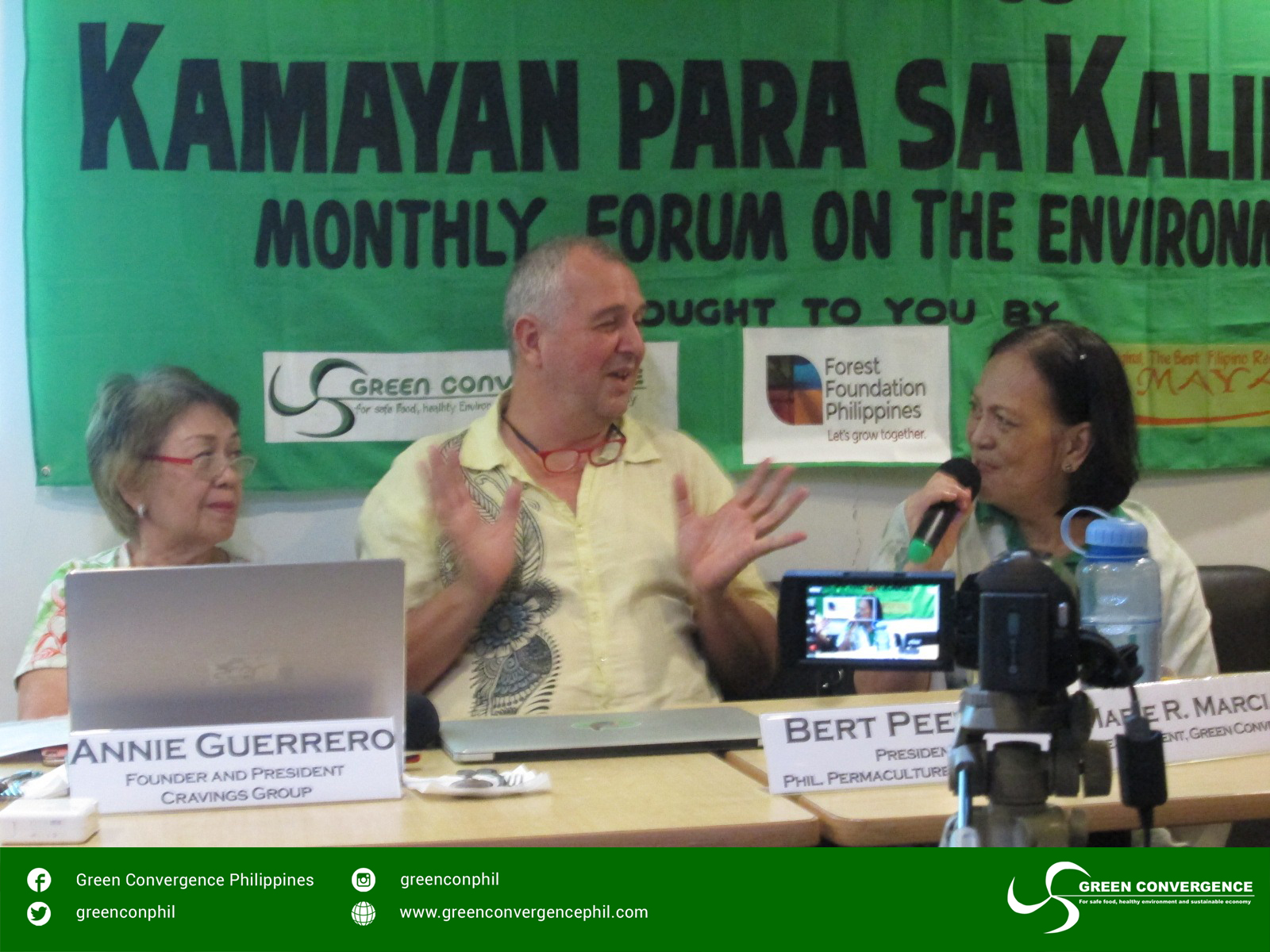
President Bert Peeters of the Philippine Permaculture Association described this phenomenon’s impacts to people, “We are becoming individually more and more separated…our society is a growing ego-system, but a shrinking eco-system.”

To help regain the crops’ ecological role and human connection to the ecosystem, Annie Guerrero, President of Cravings Group introduced the idea of ‘green chefmanship.’ She explained, “Being green means organic, local and sustainable.”

“[It includes the] use of Bokashi technology, an anaerobic composting by fermentation, [and] a process of mixing beneficial microorganisms into kitchen wastes to create powerful yet inexpensive fertilizers,” Guerrero further described the idea.

Green chefmanship coincided with Peeters’ view that “We have to go smooth with biodiversity by connecting to the places where nature thrives…studying the energy flow…and understanding the beautiful shapes of living things.”

Peeters added, “All we need is a little wilderness.”

Since March 1990, Kamayan Para Sa Kalikasan Forum has become an institutionalized platform that enables NGO and government representatives, the media, students, teachers, church groups, and concerned citizens to discuss pressing environmental issues in the country. This month’s forum is organized by Green Convergence and is supported by Kamayan Restaurant EDSA with the assistance of the Forest Foundation Philippines.

You must be logged in to view this content. Free Virtual Library Registration Here

2nd Philippine Environment Summit 2018 (Cebu) Progress Reports

The Environment Summit is a biennial undertaking of Green Convergence to celebrate important breakthroughs and advancements in environmental protection through private and public initiatives. It provides a platform where all sectors can share common challenges, collaborate on creative solutions, and replicate success stories. It is a call to government and the Filipino people to unite in accelerating the drive towards national sustainable development.

Green Convergence is a large coalition of organizations, networks and individuals. With its private partners and DENR, it successfully held the 1st Philippine Environment Summit at the SMX Convention Center, Mall of Asia in February 2016 and the 2nd Philippine Environment Summit at the Waterfront Hotel, Cebu IN February 2018.

Click the links below to know what happened in the summit:
Philippine Environment Summit 2018 Progress Report Day 1

Philippine Environment Summit 2018 Progress Report Day 2

Philippine Environment Summit 2018 Progress Report Day 3

The Philippine Plan of Action for Nutrition 2017-2022

Country’s plan to address malnutrition: Philippine Food and Nutrition Policies and Governance

What are the malnutrition problems being addressed in PPAN?


Other forms of Malnutrition:

◆Vitamin A deficiency

◆Iron deficiency anemia

◆Iodine deficiency disorders

◆Hunger and food insecurity


Guiding Principles: 

◆Attainment of nutritional well-being is a main responsibility of families but government and other stakeholders have the duty to assist those who are unable to enjoy the right to good nutrition

◆Participation of various stakeholders, including members of the community, in policy and plan formulation, implementation, monitoring and evaluation

◆Efficiency and effectiveness in resource allocation and implementation of programs and projects

◆Gender sensitivity


Adherence to the principles of engagement of the Scaling Up Nutrition Movement as follows: 

◆ Transparency about intentions and impact

◆Inclusiveness

◆Being rights based

◆Willingness to negotiate

◆Predictability and mutual accountability

◆Cost-effectiveness

◆Continuous communication

◆Acting with integrity and in an ethical manner

◆Mutual respectfulness

◆Doing no harm

You must be logged in to view this content. Free Virtual Library Registration Here

Palm Oil Expansion In The Philippines

Marami ang nagsasabi na mayaman ang Pilipinas subalit naghihirap ang mamamayang Pilipino. May katotohanan ito dahil kahit sagana sa mga likas na yaman ang ating bayan,
nananatiling mahirap, nagugutom at nagdudusa pa rin ang marami nating mga kababayan. Kabilang sa pinakamayamang lugar sa ating bansa ang Mindanao, tinatawag din na Lupang
Pangako. Subalit ngayon, nakapailalim ang Mindanao sa Martial Law at lalo pang tumindi ang nararanasang kahirapan ng ating mga kababayan doon.

Nasa isla ng Mindanao ang pinakamalalaking plantasyon sa Pilipinas. Libu-libong ektaryang lupain ang nasasaklaw bilang taniman ng goma, saging, pinya at oil palm.
Ang mga dating lupang sakahan at lupang ninuno na binubungkal ng ating mga magsasaka at tinitirhan ng ating mga katutubo ay napalitan na ng mga plantasyon na nasa kontrol ng
malalaking lokal at dayuhang agrokorporasyon.

Kung dati-rati ay pagkain – palay, mais, gulay ang nakatanim sa ating mga lupain, ngayon ay mga pananim na pang export na ang sumakop sa lupain ng mga magsasaka at katutubo.
Mga malalaking dayuhang kumpanya gaya ng Dole Philippines ng U.S., Del Monte at Sumifru ng Japan ang nakikinabang sa ating lupain at likas na yaman.

Malalawak na lupain pa ang tinatarget sakupin sa planong higit na pagpapalawak o ekspansyon ng mga plantasyon. Kabilang dito ang ekspansyon ng oil palm plantations.
Isang milyong ektaryang grasslands sa Mindanao ang unti-unting itinatransporma upang maging oil palm estates gaya ng ginagawa sa Sultan Kudarat, North Cotabato, at mga rehiyon ng CARAGA at Northern Mindanao.

You must be logged in to view this content. Free Virtual Library Registration Here


Private Agri Tourism: Malabing Valley Casibu, Nueva Viscaya

JOSEPHINE NAMUJHE is the founder of the Malabing Valley Sustainable Integrated Forest Farmer’s Association (MVSIFFA). The Malabing Valley Multipurpose Cooperative has ventured into non-traditional capacity building activities as a means to organize farmers in the valley, and as a way to protect its natural resources. The cooperative has joined forces with some NGOs and the government in preparing a land use framework for a community-based forest management program aimed at preventing uncontrolled conversion of open access forest lands into citrus and other agricultural activities.

The Malabing Valley Agritourism Project was started in 2013 and is being operated by MVSIFFA, Inc. Tied up with DENR under the NGP contract, the association was in- charge of establishing sustainable development plan to protect, enhance, and increase biodiversity and economic viability of the area. However, like any other association, the main constraint of MVSIFFA is its lack of financial resources to push through their short, medium and long-term plans. For now, the livelihood program of the association is focused on the production of fruit bearing trees like lanzones, durian, rambutan, and bugnay, among others. The medium and long-term projects will be focused on the production of high value crops and processing of forest products into furniture and other crafts.

Below is the presentation of Ms. Josephine Namujhe:


You must be logged in to view this content. Free Virtual Library Registration Here

Eel Industry

JUAN RAÑA is the chairman of Integrated Growers and Traders (IGAT), a private sector-led voluntary, self-help and selfregulating association composed of Philippine Eel Industry stakeholders. It is organized to promote the interest of the
Philippines in general and the eel industry in particular. The acronym “igat” is a Filipino word for eel.

The drop in the world’s eel stock tremendously favors the Philippine eel industry. The dwindling supply in Japan, the biggest market for eels, has increased its prices. To take advantage of this favorable situation, several public-private cooperation initiatives were done. It pushed for marketing, technology, conservation, value adding, financing, and benefits and incentives.

The Philippine eel industry has several comparative advantages. It has a year-round supply of glass eel. It has vast area available for aquaculture. The country’s tropical weather is ideal for eel culture. As such, the country is considered as the eel highway, a place where the spawning area of eels is located. With a strong government support in marketing, technology, financing and regulations, the country now supplies 30 – 40 percent of glass eel in Asia.


You must be logged in to view this content. Free Virtual Library Registration Here

Safe Food Manufacturing

I am not sure if you will agree with me that manufacturing might be a broad label for the food production realm or the industry of food production. The word manufacturing evokes factories and mass production every single time. It might not be that, because cottage industries also involve some level of manufacture. So I’d like to propose that we talk about production instead of manufacturing. That is closer to the ideals of small-scale, diverse, intensive agriculture. And that food production really has to do with not only making the food but also making it eventually available to the consumers.

I’d like to think about it in two ways: one is production and the other is on the eater. Most of the things that are discussed in many workshops and events are on the production side. But I keep going back to the notion that “bawat subo ay boto”. We are in an election every day of the year because when we choose what we eat when we make that decision, every 3 times to 5 times a day, we actually make a vote. Each fast-food joint is actually a window into a changing agricultural landscape, like potatoes in the rice terraces, for example.

I’d like us to look at the eater first. How the food reaches the homes is an issue of how manufacturers try to treat their production – trying to keep it stored, to keep it packaged. That dilemma of food producers has a lot to do with what the impacts on the food are. The decision of the buyer is at a single point in time and the decision is made for them if they don’t think ahead. So as an eater, kung bawat subo ay boto, we are obligated to meditate on the source of our food and on the eventual end of the food; so that we think of where it might have come from, where it might end after we eat it, after where our bodies dispose of it.

We also have to meditate on the positioning of our eating in the food chain because we think of the food chain as animals. We think of ourselves at the end of the food chain, when actually it is a food web. And if you meditate on the positioning of our decisions of eating in the food web, we may be able to connect with ourselves better, not only on our

communities and neighborhood but on the community of life, in general.

Many decisions though are individual. It really helps if there are policies that shape behavior. I learned a lot from the tobacco control advocacy. I think it was at this point when I had to say that education has come to mean different things to me. And if it’s argued about, I get very uncomfortable. If you go head to head educating, we are hopelessly at the mercy of large corporations that also educate through their advertising and through other means. It’s in tobacco control that you learn that no amount of education will work if the father smokes and it’s a normal thing. So we have to re-think what is normal. And in praying before meals or in meditating on the source and ends of our meals, maybe that is the time when we can also meditate on what has become normal for us.

The challenge is, in the past decade the illnesses of the planet have moved from infectious diseases to non-communicable diseases (NCD). NCDs, as the World Health Organization (WHO) call them, are basically diseases that spring from lifestyle choices. The major lifestyle choice is, of course, deciding what to eat. Since it’s a 3 times a day activity, or to some it’s five times a day, or a decision to cut it down to 3 or 4, which is an environmental decision as well, that decision has many, many environmental consequences. While each meal is important, it’s also important to think of staples and diets and cuisines.

One of the major works that are considered the bibles of safe production decisions, to-eat-what-type-of-food philosophy, is the omnivore’s dilemma which is the ecological history of our meals. So even if you make each decision count and even if your meals are ecological, if the cuisine itself has been lost, then that decision is all the harder. The decision becomes more and more difficult because you are not following a staple, you are not following a cuisine. It’s much easier if you follow a cuisine, then you treat yourself to high valuable added types of food once in a while. We also can’t just let go off of very well made, high value types of food that most people cannot afford. But if they are only treats that is inserted in cuisines, then probably the world could experience much more high- value types of foods that are high in nutrition and are traditional. It will also revive traditional ways which ensure that they are prepared ecologically. Because traditional ways of preparing foods, also part of the cuisine, may have clues as to how the ecology can be supported.

As to the decisions for each type, there’s also the notion of what is sufficient. I refer to the tagalog term, “Ano ba yung sapat?”, “Kailan ka mabubusog?”. In ecology the lion would sit right next to the gazelle if he is full. He would not go after the gazelle. Nagkataon, ang mga tao ay walanang kabusugan. This is very, very clear especially in what WHO is being alarmed about – the sugar-sweet of beverages. Because if you eat something that has five (5) tablespoons of sugar, you feel umay. Umay is no longer felt in the case of sugar-sweet beverage. You don’t get umay. Dumadaan lang yung sugar. The evolutionary ways by which our health is protected is being shortcut by the industry para uminom tayo ng uminom ng mataas na sugar.

We are also going towards mono-cultures. You cannot buy many vegetables anymore, except for pakbet. When in fact you can go to the back of your house where there are weeds that can sustain you probably for a week. Just the pancit-pancitan alone is a really good salad if you allow it to grow on your garden. The wild ampalaya and the wild pepino are really, really good, tasty and crunchy. Once you start to eat fresh, it will be

a treat each time.

As for producers, how can we keep the economic goals low volume? If its low volume it has to be high value, right? If its high value, it’s no longer available to the community. How can we keep quality high but still make it available to the most number of people? One of the answers to that is to keep high value foods produced by lots of people. Therefore, creating networks and webs of producers, instead of the mono- cultures, would be the answer to the counter-culture to food manufacturing that is mono- culture – single factory that is less nutritious. The moment that you need to preserve, it can be preserved locally in low volume like pickling, etcetera. But the moment you need to reach hundreds of millions of people, billions of billions served, that is when you threaten the food system. That is when you threaten the diets and cuisines of the people.


You must be logged in to view this content. Free Virtual Library Registration Here

Organic Agriculture Program of Negros Occidental

According to the Food and Agriculture Organization of the United Nations, organic agriculture is an effective strategy for mitigating climate change by building robust soils that are better adapted to extreme weather conditions associated with climate change.

The Organic Agriculture Program in Negros Occidental started with the Public- Private Initiative in Organic Agriculture which established the organic vegetable farm in the rear of Capitol Building in 2005 and the 15 pilot organic villages. The components of the program include: trainings and Information, education and campaign (IEC); production of organic products (agri and aqua); production of organic fertilizer; promotion and

marketing of organic products; research, development and extension; policy and advocacy; and support services & networking.

The Organic Agriculture Program has numerous accomplishments such as:

• Conversion of almost 15,000 hectares of land to organic agriculture.
• Established laboratory production centers for biological agents in five (5) of the six (6) targeted villages.
• Increased farmers’ average production and income by 25 to 30 percent through provision of inputs and hands-on trainings on different organic farming technologies
• Continuous assistance, collaboration and coordination with specific organized organic commodity groups of small farmers.
• Organized provincial, city, municipal technical committees on organic agriculture in 32 cities & municipalities
• Continuous hands-on trainings of field technicians & farmers on organic farming technologies and capacity building
• Annual celebration of “Negros Island Organic Farmers Festival” to link agri- fairs and fair-trade in the local and national level.
• Trained 1,500 farmers and people’s organizations (POs) and individuals on mushroom culture and production

Through the Organic Agriculture Program the province received numerous awards like the Outstanding Province on Organic Agriculture Program Implementation in 2013 and Regional Organic Agriculture Achievers Award in 2014.


You must be logged in to view this content. Free Virtual Library Registration Here

Organic Agriculture

Thank you for inviting me to participate in this event. I also convey the greetings of Archbishop Antonio Ledesma for the success of this undertaking and in the conduct of an objective social audit process of our concerns about the environment.

When Nina invited me to chair this session, I told her that I am not an expert on organic farming; but Nina said “don’t worry, just give an overview and help facilitate the discussions. There will be a
roomful of experts in attendance who will take care of the rest.” And those experts, my friends, are you. Before we start, may I propose the context of our deliberations today?

First, we are told that about 55 million years ago, in an event known as the Paleocene-Eocene Thermal Maximum, a series of extreme global warming released massive carbon dioxide estimated at about 60,000 billion metric tons over thousands of years and it took a period of over 100,000 years to remove the excess from the atmosphere. Mother Earth survived but all or almost all life did not. In other words, whatever happens and whatever we do or not do, Mother Earth will ultimately survive. It is us and those who will come after us who will not. Of course we will do everything we can to spare Mother Earth the pain and injury of our making and will join and lead, if possible, the voices of other developing countries for international solidarity in the right solutions.

However, and this is my second point, as a lay observer of the processes and outcomes of international negotiations on economic and legal issues and now on climate change, I hope that those who went to Paris will not take offense when I say that I do not believe there is much to celebrate yet in the recent Paris talks. And that eventually, short- term national self-interest in a world of gross inequalities in power and wealth, will trump the longer-term general welfare of humanity. And when self-interest is rationalized with self-righteousness, it is even more difficult to overcome as we know from our own underperformance at human development and social change in our country.

Third, I submit that since global warming is a reality that sooner or later will result in dire consequences to the world in the likely event of a failure of international solidarity, as stewards of God’s creation in our part of the world, to carry out that responsibility in the best interests of our own country with the greatest caring for those who cannot protect or defend themselves. That is after all, is what social justice is all about. In that regard, we may have a chance at national solidarity since the rich and the powerful have experienced

the direct effects of climate change in common with the poor and may see national interest as also their own. In other words, by upholding their identity more than their self-interest, who knows, by successfully working together to mitigate and adapt to climate change, we may open the doors to addressing not just its direct effects but the systemic causes that also stand in the way of the radical social change we promised the poor so that we can finally put things right in our country.

It is in this context that I hope we will talk about organic agriculture today. The articulated objectives of organic agriculture are among the deepest concerns of the Green Convergence Coalition and are the standards to which we can hold accountable not just the present and succeeding governments, especially the Department of Agriculture and the NOAB (National Organic Agriculture Board), but also ourselves, namely:

a. Better farm income and sustainable livelihood—Increased farm productivity, reduced expenses on imported farm inputs, better income for farmers, and reduction of poverty in the rural sector;
b. Improved Health—Protected health for farmers, consumers, and the public in general;
c. Environmental Protection—Enhanced soil fertility and farm biodiversity, reduced pollution and destruction of the environment, as well as prevention of further depletion of natural resources;
d. Disaster Risk Reduction and Resilience to Climate Change—Improved resiliency to disaster risks through diversification and less exposure to external inputs; and
e. Social Justice—Meeting the basic material needs and improving standard of living for all, upholding human rights, gender equality, labor standards, and the right to self-determination.

The Secretariat of the NOAB kindly briefed me on the program and I have asked that their powerpoint presentation and some other materials provided me be distributed to all the participants in our workshop today. I hope you got them and were able to familiarize yourselves with the official version of its history, objectives, the budgets since 2010, status of the programs and accomplishments to date, and its challenges, so I don’t have to dwell on these in detail. The new director of the program is also here today and can answer questions later.

I hope that those of you who may have a different appreciation from the official version of the facts, the issues and challenges ahead will share these with us during the deliberations so that we can have a balanced outcome report on this Summit.

After the passage of the law in 2010, the National Academy of Arts and Sciences, being the advisory body for science and technology policies and issues held a Round Table Conference to assess its status in the country. One of the papers1 that came out of this and the follow-up discussions had this to say about the state of organic agriculture in our country today which is a good frame for our discussions:
“Organic agriculture in its present state is still far from its full potential. Given the meager formal support throughout its supply chain, including input

1 How Sustainable Is Organic Agriculture in the Philippines? By Rodel G. Maghirang et al (Trans Nat Acad Sci & Tech (Philippines) Vol 33 (no. 2) ISSN 0115-8848)

supply, production and Research and Development on seeds, nutrient and pest management. Thus, direct comparison of organic agriculture with conventional agriculture does not appear to be valid. Overall, it is well accepted that organic agriculture is sustainable on the ecological aspect but sustainability on the financial and the social/cultural aspects are still being questioned. There is optimistic prognosis for organic agriculture, but the numerous challenges of agronomic, economic and cultural nature must be addressed more substantially. This would require long-term, support for research institutions, a strong extension system and a committed public in sharing with the costs of organic agriculture given its multi- functionality benefitting everyone.”

In the light of this assessment from experts, that is our task today. May I start it off with some preliminary questions to the experts in the room?

First: The target is to develop organic farming to five percent (5%) of our total agricultural lands or roughly 483,450 hectares, of which around 151,000 hectares, as of January 15, 2016, are already in place. If organic agriculture is the future of food security, competitiveness and sustainable agriculture, why is the target so small? Moreover, since the selected sites are primarily rooted in the private initiatives of farmers since the 1980s, the question is: Have these been validated in the light of later knowledge such as on vulnerabilities of the sites to climate change? Water needs of Organic Agriculture (OA)?

Second: Is the model we want to propagate that of small farms selling to their local communities? This is consistent with the findings of the IFAD (International Fund for Agricultural Development) that the future of global food security is some 450 million small farms of less than 2 hectares each in the world. That is also the model of our agrarian reform program with certain admissible permutations like cooperatives to address economic scale considerations.

Third: How important is the expensive 3rd party certification in the domestic market, of which there are only 46 farms and establishments covering 1,212 hectares, since government subsidy is only planned for 3 years?

Fourth: What are the nutritional advantages of organic agriculture and are these sufficient to justify the price differential between organic and non-organic products? Are the prices today of organic products within the reach of the non-farmer poor? Is it possible to put organic products within their reach as factors like regenerated soil and supply chain inputs materialize?

Fifth: Are the organizational and operational challenges that have arisen since 2010 being addressed? Delays in implementing guidelines, issues of continuity and institutional memory (6 heads in 5 years of the Secretariat, 11 out of 12 of its staff are contractual and co-terminus with the president).

Is there convergence with the DENR and the DAR and its 2.7 million farmer beneficiaries of which about half are not in Agrarian Reform Communities (ARCs)? Is there a political commitment at the LGU level and do they have the capable extension workers to carry it out?

You must be logged in to view this content. Free Virtual Library Registration Here