
‘Cheaper fuels may impact public health’

October 23, 2018 at 09:30 pm by Rex Arcadio R. San Diego II via Manila Standard

Is cheaper fuel the answer?

While there is a clamor for more affordable fuels to address inflation, it might be wise for the government and the public to consider its health impacts.

Speakers and participants to the recent Kamayan para sa Kalikasan Forum in Quezon City were one in this conclusion.

Environment Undersecretary Juan Miguel T. Cuna noted that while the intention to address inflation is noble, there is a need to review, even reconsider the approach due to a number of reasons―both legal and medical.

“We cannot regress and compromise air quality,” Cuna pointed out.

The Land Transportation Franchising and Regulatory Board’s recent approval to increase jeep, and bus fares in November was met with public displeasure.

The Department of Energy’s response is to reintroduce Euro-2 grade fuels―a move that runs contrary to the provisions in the Clean Air Act.

The highest concentration of pollution in Metro Manila is in EDSA, making it a dangerous place for hundreds of thousands who travel, work, study or stay along the thoroughfare.

“We might be killing, penalizing ourselves by regressing in terms of fuel quality. Why regress when we know that lower quality fuels can result in more health problems for the public,” Rene Pineda, president of Partnership for Clean Air, noted.

The group Green Convergence has written the Department of Health to take part in the discussion concerning the health impacts of the transition from Euro-4 to Euro-2.

Records of the Department of Environment and Natural Resources show that despite the presence of many vehicles that are not Euro compliant, air quality in Metro Manila has improved, “though not yet in the targeted levels as set in the parameters by law.”

“The law states that only Euro 4 fuels should be used and sold in the market. And we have actually upgraded our standards. We should do everything we can to sustain that position in view of the health impacts of reintroducing Euro-2 diesel fuels,” Cuna explained.

Since 2016, only Euro-4 fuels are allowed to be marketed in all gasoline stations, and all engines that have been imported, manufactured and installed in vehicles are required to be Euro-4 compliant as mandated by the Clean Air Act.

Euro-2 maybe cheaper, but it is a lower standard fuel that has been proven to be less safe in view of the pollutants it releases into the atmosphere.

Cuna said that while the Energy Department is tasked “to determine fuel mixes,” the DENR is the lead agency when it comes to implementing the Clean Air Act.

“The DOE’s plan may sound good, but it should only be a temporary stop-gap response. A thorough review maybe needed before this issuance is made national,” Cuna added.

The DOE released the order endorsing the return of Euro-2 fuels last August 10, which violates the provisions of the Clean Air Act which requires all fuels to be compliant with Euro 4 standards.

“The DOE in effect usurps the authority of the law, Congress and the DENR, by issuing the order, by technically amending the Clean Air Act thru a department order that goes against the mandates of the law,” Pineda noted.

Pineda added that selling dirty fuel in effect invalidates the Clean Air Act, and thus distorts and disregards the efforts of the DENR to do its job of cleaning the air.

“We cannot adopt a simple ‘business as usual attitude’ and continue improving air quality. There has to be consultation with all stakeholders,” Pineda said.

Cuna lamented that the Energy Department may have overlooked the efforts of the DENR to improve air quality in the DOE’s desire to make fuel prices affordable to the public.

The World Health Organization has declared that diesel exhaust fumes are cancerous and in response, a number of European cities have banned petrol and diesel cars as green initiatives spread across continents.

To date, other countries have transitioned to Euro 5, and no other country produces euro 2 engines.

Cuna attributed this to the hard work of policy makers led by the DENR’s Environmental Management Bureau, who in coordination with different groups, have installed 20 monitoring stations in the National Capital Region and key cities throughout the Philippines to monitor the production of particulate matter (PM5) in the atmosphere, most of which are traced as products of motor vehicles.

Dr. Angelina P. Galang, Green Convergence Convenor said that there is the need to help the poor, but warned that the DOE’s move will bring about environmental problems that will compromise the health of the public.

“We should not go back to the old days when vehicles contribute a lot to air pollution,” said Galang.
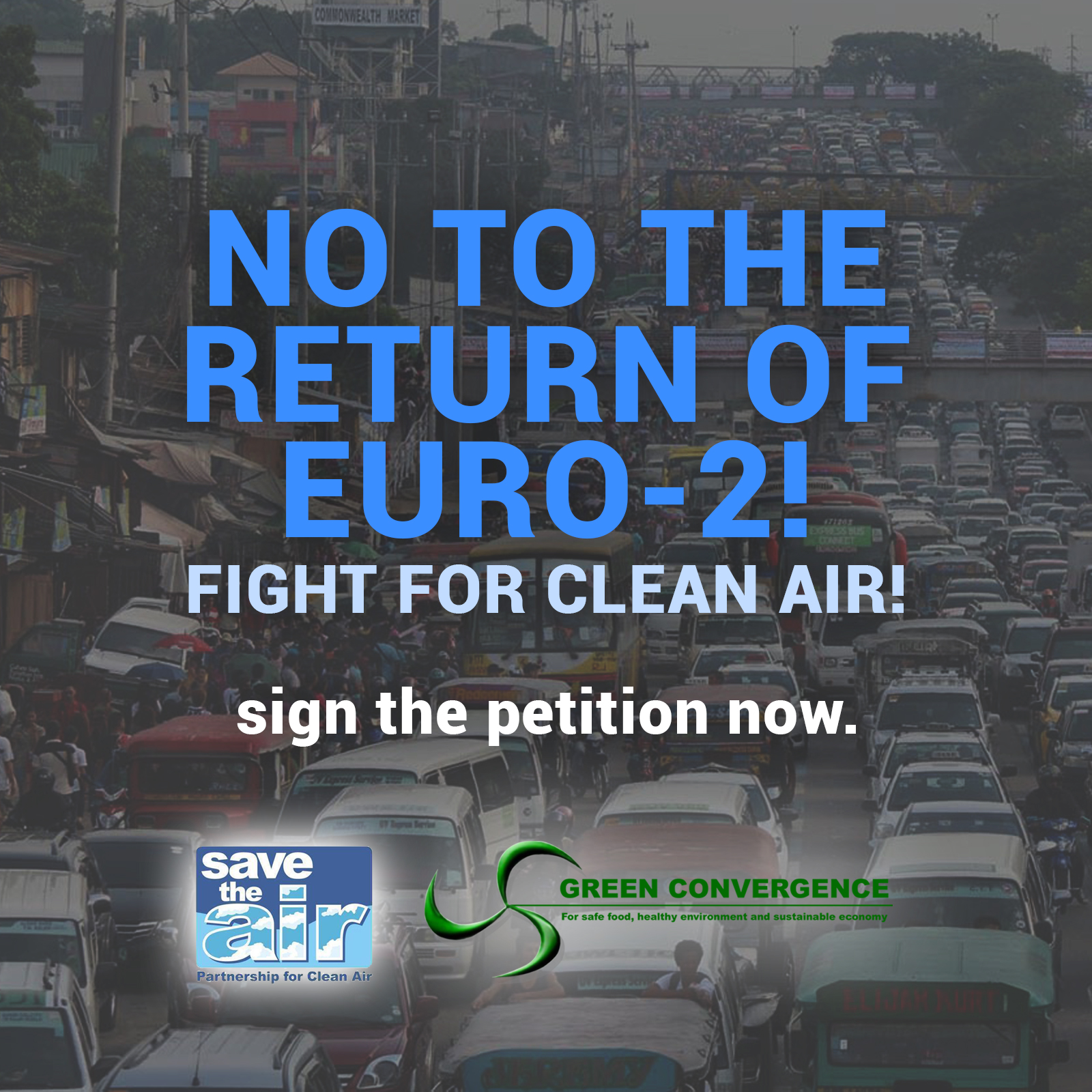

No to the Return of Euro-2 in the Philippines! Sign the Petition Now!

Just this August 2018, the Department of Energy released Department Order 2018-08-0012 “directing the Philippine downstream oil industry to offer Euro II-compliant diesel as a fuel option for the transport and industry sector to reduce the impact of rising oil prices in the world market.”

Euro II, a cheaper diesel than what the country is currently using (Euro IV) contains 500 parts per million sulfur. The latter only has 50 parts per million sulfur.

Posing lots of environment and health risks, the department order downplays the Administrative Order 2015-04 co-issued by both the Department of Environment and Natural Resources and Department of Energy in 2015 as part of the efforts to better uphold of every Filipino’s right for clean air as per the Clean Air Act of 1999.

Petition for the Recall of Department Order No. 002018-08-0012 of the Department of Energy

We, the undersigned, hereby urge the Department of Energy to recall its above stated order dated August 10, 2018 entitled “DIRECTING THE PHILIPPINE DOWNSTREAM OIL INDUSTRY TO OFFER EURO-II COMPLIANT DIESEL AS FUEL OPTION FOR THE TRANSPORT AND INDUSTRY SECTOR,” based on the following reasons:

1.     The said order, with the question of its publication still hanging, has no basis in law because it has not legally promulgated the invalidation and supersedence of its own published Department Circular No. DC2015-06-0004 on June 8, 2015, which mandated the vending and use of EURO-IV fuels only starting since January 1, 2016;

2.     The said order has no basis in law, directly usurping the authority and power of the Department of Environment and Natural Resources under the Clean Air Act, for reverting to a more pollutive EURO-II diesel when the DENR has already issued Department Administrative Order No. 2015-04 on March 24, 2015, requiring the emission standards of motor vehicles to be compliant with EURO-IV standards as provided for by the Clean Air Act. By virtue of this DAO of the DENR, the DoE was  enjoined and positively responded to issue its published Department Circular No. DC-2015-06-0004;

3.     The said order has no basis in law, directly usurping the authority and power of Congress for undermining and directly amending the very explicit provision of the Clean Air Act that requires the periodic improvement of the emission standards to mitigate the health effects of air pollution;

4.     The said order has no basis in law for failing to consult with all the stakeholders, particularly the public advocates for clean air, notwithstanding that the DoE has already been repeatedly admonished by Congress therefore;

5.     The said order utterly lacks prudence for failing to realize that EURO-II diesel’s 500 ppm sulfur will practically mean more pollutants as opposed to EURO-IV’s 50 ppm sulfur due to the fact that almost all vehicles do not have pollution control devices or catalytic converters that mitigate emission and the required implements that assure efficient combustion of diesel;

6.     The said order sorely lacks prudence for failing to realize most nations of the world are transitioning to higher standards – even EURO V or VI – due to the fact of worsening public health directly caused by vehicle emissions;

7.     The said order miserably lacks prudence and sensitivity for failing to recognize that some members of the European Union will start to ban petrol, particularly diesel, beginning in 2020. This is after the World Health Organization has issued the advisory that diesel fume is a type 1 carcinogen, i.e., human carcinogen; and

The said order obviously lacks prudence and sensitivity for failing to realize that the few-centavo discount of a EURO-II diesel will definitely mean a few hundred-peso (per capita) more public health expenditure because of the aggravated health effects of air pollution by re-introducing a more pollutive, yet slightly cheaper, but outdated and outlawed diesel.

[button url=”https://www.change.org/p/department-of-energy-of-the-republic-of-the-philippines-no-to-the-return-of-euro-2-fuel” target=”_blank” color=”green” size=”large” border=”false” icon=”” btn_content=”Sign the Petition Here”]

Calendar of Activities: November 2018


GC CALENDAR OF EVENTS FOR NOVEMBER 2018

DATE
ACTIVITY
November 5


2018 Climate Reality Leadership Awards

Climate Reality Project Philippines

6:00-9:00 PM, National Museum of Natural History, Teodoro F. Valencia Circle, Ermita, Manila

Contact Isabelle at (0915) 593 7352

November 7


Living Laudato Si Philippines

Climate Reality Project Philippines

7:30-10:00 AM, Manila Cathedral and Casa Manila

Contact Sheena Katrina A. Orihuela at (0966) 452 4848

November 10 (6:00 PM)

November 11 (2:00 PM)


Bangaw Mindanao Musical

Global Catholic Climate Movement (GCCM) Pilipinas

Fleurs-de-lis Theater, St. Paul University Manila, 680 Pedro Gil, Malate, Manila

Contact (0917) 862 4008; (0928) 796 8173; 523 9898; 523 2593 for more information.

Tickets at PhP 150.00 (Adults) and PhP 75.00 (Students, Senior Citizens and PWDs)

November 12 & 14


Roundtable Discussion on the Development of a National Climate Risk Management Framework

Climate Change Commission

9:00 AM-5:00 PM

Contact Jayser D. Tan at (0995) 510 9297 or 426 2950 or jdtan.ccc@gmail.com

November 13


Energy Storage Investment Analysis 101 Workshop

Philippine Solar and Storage Energy Alliance Secretariat

9:00 AM-4:00 PM, The Bellevue Manila, Alabang, Muntinlupa City

Contact Mae Bernardino at (0916) 341 8767 or secretariat.phsolar@gmail.com

November 16


Kamayan Para Sa Kalikasan Forum

Topic: IPCC 1.5°C Report: Key Findings and Implications

10:30 AM-2:00 PM

Kamayan Restaurant, Greenhills, EDSA, Mandaluyong City

November 16


“Paano Kumain ng Kulay?” Book Launch

Greenpeace Philippines

8:00 AM-1:00 PM, Museo Pambata, Roxas Boulevard, Ermita, Manila

Contact Kristine Hernandez at (0917) 835 6470 or kristina.hernandez@greenpeace.org

November 16-18


2nd National Permaculture Convergence

Philippine Permaculture Association, Inc.

9:00 AM, University of the Philippines Los Baños, Los Baños, Laguna

Contact Michelle Laurente or Vianca Umali at 650 7238 or (0917) 804 1590 or philippinepermacultureassoc@gmail.com

November 19


Green Convergence Board of Trustees Meeting

9:00 AM-3:00 PM, ASD Conference Room, Miriam College, Quezon City

November 27-28


National Validation of the Hub and Curriculum Frameworks and the Proposed Courses in the Certificate in Environment and Green Technology Education and Special Electives for the Hub

Pamantasang Normal ng Pilipinas Visayas (PNU Visayas)

L’Fisher Hotel, 14th Lacson St., Bacolod City, Negros Occidental

Contact Moises D. Parial at (034) 493 0265 or (0933) 852 7601


Talking about troubled waters

By Patricia Bianca S. Taculao via Agriculture Monthly

Life in the Philippines also comes from the sea that surrounds the archipelago. According to the Food and Agriculture Organization of the United Nations, the Philippines ranked 8th among the major fish producing countries in the world in 2012. We had a total production of 3.1 million tonnes of fish, crustaceans, mollusks, and other aquatic animals.

But the country’s ranking has gradually decreased to 12th with the increase of its marine treasures’ prices. The recent issue about the importation of galunggong has also left people wondering if there is a shortage in our fish supply.

Working hand in hand

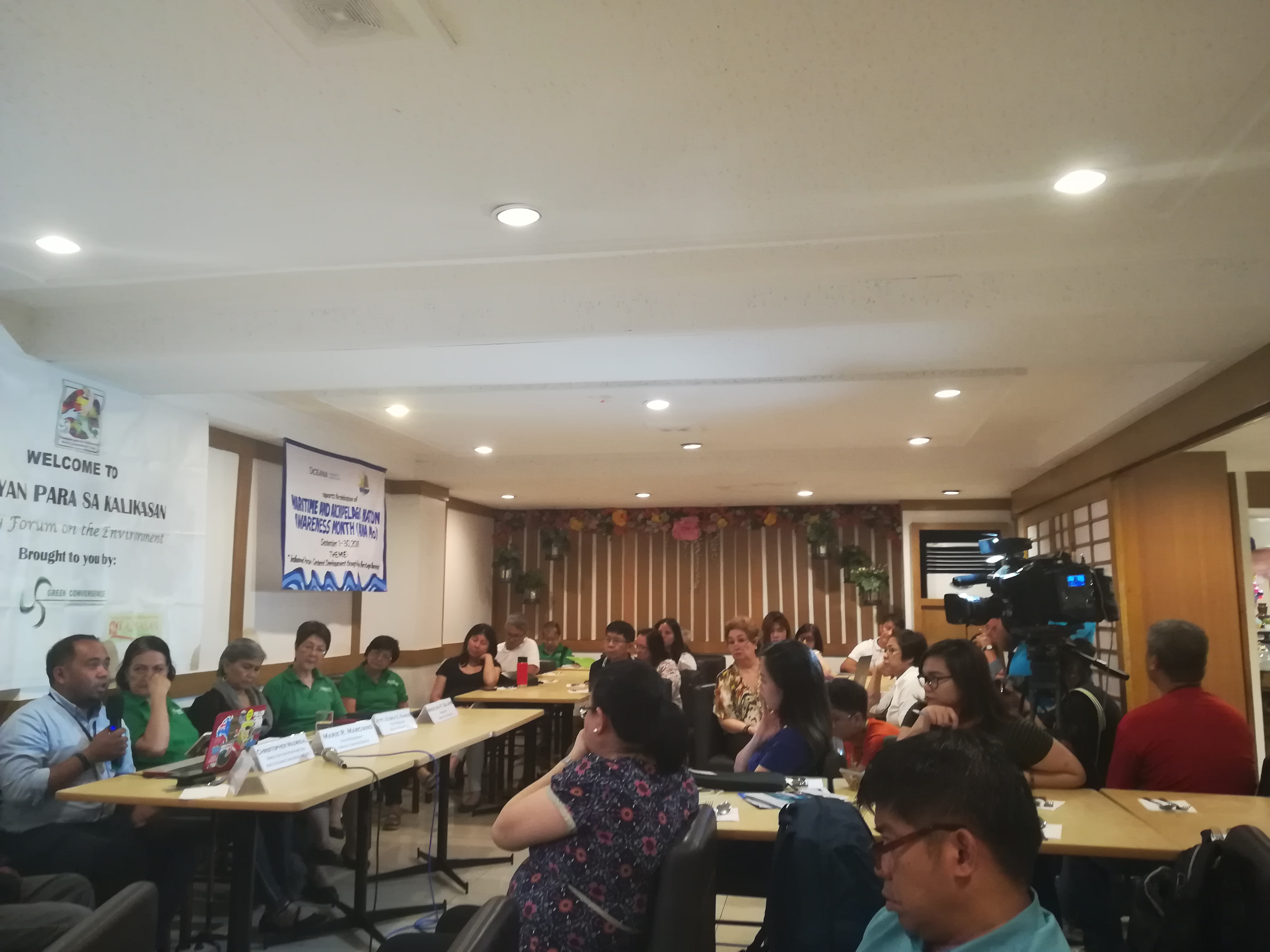
Kamayan Para Sa Kalikasan, the longest running environmental forum in the Philippines, recently held its 342nd session which tackled The State of Philippine Fisheries.

It is hosted by Green Convergence, a non-government organization that addresses social and economic upliftment while preserving natural resources. In partnership with Forest Foundation Philippines and Kamayan, the forum brings in representatives from the government, NGOs, LGUs, and fisherfolk to discuss issues about the country’s waters.

From left: Pablo Rosales of Pangisda Pilipinas, Director for Maritime Development and Oceans Concerns (NCWC) Christopher Madrigal, Vice President of Green Convergence Marie Marciano, Vice President of Oceana Philippines Gloria Ramos, and Green Convergence President Angelina Galang.

Other than dealing with a timely topic, it also coincides with the celebration of the Maritime and Archipelagic Nation Awareness Month (MANA Mo) this September. Maritime Development and Oceans Concerns director Christopher Madrigal, Oceana Philippines vice president Atty. Gloria Ramos, Manila Bay Clean Up Program of Department of Local and Interior Government project head Carlos Tan, and Pangisda Pilipinas representative Pablo Rosales shared their experiences and expertise.

The issue with our fisheries

One of the issues that plague our country’s fishing spots is also one of the oldest reason: dynamite fishing. Despite the legal actions taken to prohibit destructive fishing, the decline in fishery production is still evident due to the damages that are sustained by coral reefs.

Another problem at hand is commercial fishing. This is the process of catching as many fish as possible to be later sold at a marketable price. These prices, according to Rosales, are cheaper than what the fishermen offer.

With technology that exceeds our own hook and line fishermen, commercial fishing poses a threat to their catch as well as profit.

But in totality, the representatives present during the forum concluded that fisheries in the Philippines are overexploited which leads to the growing scarcity of fish and the dramatic rise of its market price due to demand.

Support and discipline

Rosales laments the poor conditions that have befallen fisherfolk as well as the gradual depletion of the country’s fisheries. “Ang kalagayan ng mangingisda ay repleksyon ng kalagayan ng ating karagatan,” he says. 

The Pangisda Pilipinas representative then encouraged his countrymen to support fish products procured from the hard work of local fishermen.

Apart from supporting local, Ramos also calls upon the initiative of the Filipinos to follow and respect maritime laws for a more productive outcome. And, of course, to preserve the marine wonders that the country is blessed with.

Kamayan Para Sa Kalikasan convenes every third Friday of the month with new topics each meeting. The next topic will be confirmed by Green Convergence prior to the forum itself.

The forum is held every third Friday of the month at the Kamayan Restaurant along EDSA and is open for all those who are interested to attend. For more information, visit Green Convergence Philippines on FaceBook at facebook.com/greenconvergencephilippines/.

Calendar of Activities: October 2018


GC CALENDAR OF EVENTS FOR OCTOBER 2018

DATE
ACTIVITY
October 15


Board of Trustees Meeting

Faculty Conference Room (Room 121), Mother Mary Joseph Hall, Miriam College

9:00 AM

October 19


Kamayan Para Sa Kalikasan Forum

Is Euro-2 the Solution to Rising Fuel Prices?

10:30 AM-2:00 PM

Kamayan Restaurant, Greenhills, EDSA, Mandaluyong City