

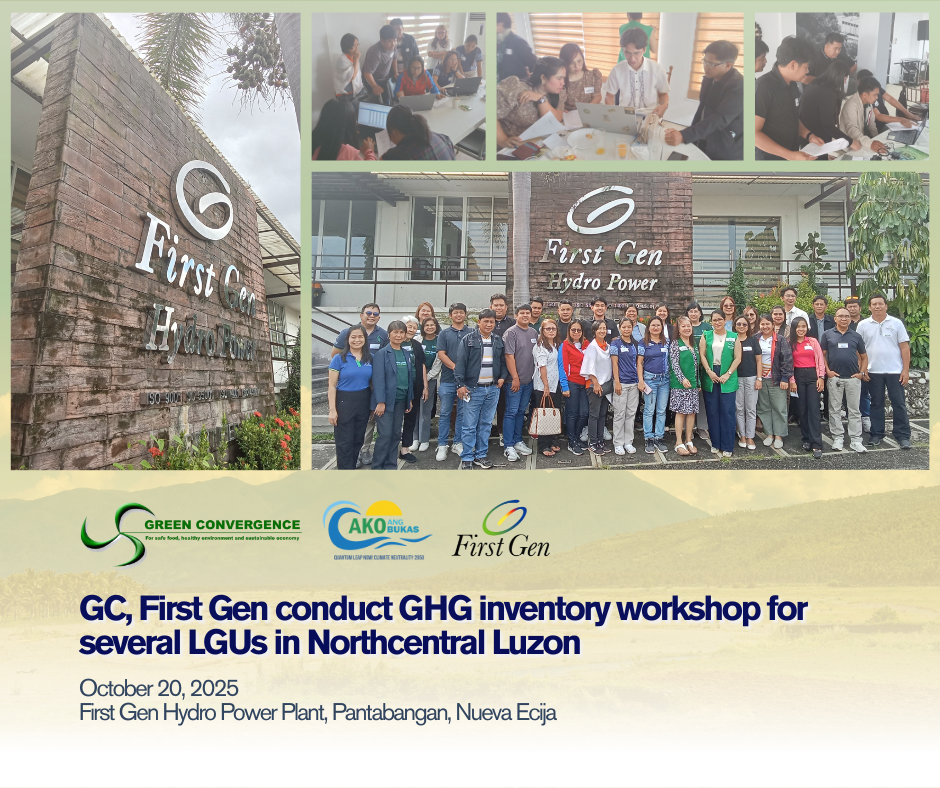
Green Convergence (GC), in partnership with First Gen’s Corporate Social Responsibility Group and through the Ako Ang Bukas (AAB) Advocacy Program, held a greenhouse gas (GHG) inventory workshop on October 20, 2025, at the First Gen Hydro Power Plant in Pantabangan, Nueva Ecija.
The workshop was held for the development of several local government units’ (LGUs) community-level GHG inventory in line with the enhanced Local Climate Change Action Plan (LCCAP) promotions and updating.
Participating LGUs were from Pantabangan and Carranglan of Nueva Ecija, Maria Aurora of Aurora, Alfonso Castaneda and Dupax del Sur of Nueva Vizcaya, and the province of Quirino.
Kickstarting the session, Agnes de Jesus, Chief Sustainability Officer of First Philippine Holdings, provided a situationer on climate change and the Philippines’ commitment to reducing GHG emissions under the Paris Agreement.
She outlined the GHG inventory journey for LGUs—learning the features of a GHG calculator and the practice of identifying GHG sources through the AAB household GHG calculator, applying these onto various entities’ value chains through the AAB entity-level GHG calculator, and using these fundamentals in transitioning to the entity and community-level calculators of the Climate Change Commission (CCC) which has extended parameters.
In line with preparing for the enhanced LCCAP, de Jesus explained that a GHG calculator is beneficial as it will serve as basis for climate action, given that it can identify the GHG hotspots that need intervention, and aid organizations in preparing for the future government requirement on GHG inventory and coming up with accurate data for green fund applications.
She then delved deeper into measuring an entity’s carbon footprint using the AAB calculator—covering scope 1, scope 2, and scope 3 emissions, coined as “buy,” “buy,” and “outside” as key words respectively.
De Jesus also emphasized cutting emissions through the mitigation hierarchy: avoid, minimize, reduce, and remove, with natural or manmade offsetting as the last resort.
As an example on how the AAB entity-level GHG calculator was used by an LGU, she shared the study done by AAB in Barangay Cogon, Ormoc, Leyte.
Also sharing their experience in GHG inventory, Rogelio Abalus Jr., Municipal Planning and Development Coordinator of Nagtipunan, Quirino, gave an overview of their municipality’s 2023 to 2028 enhanced LCCAP.
Nagtipunan’s planning framework consists of modules on stakeholder participation, vulnerability and risk assessment, GHG inventory using the CCC calculator, review of goals and setting of objectives, assessment of options and implementation, and monitoring and evaluation leading to adjustment and modification.
Abalus Jr. detailed the Climate Information and Situation Analysis of Nagtipunan from years 2036 to 2065 and anchored their Climate Change and Vulnerability Assessment on this, alongside efforts on GHG inventory, which involved planning, collecting of data, developing of a GHG inventory management plan, setting GHG emissions reduction targets, and tracking.
Upon implementation, following their 2022 baseline emission totaling 849,785.58 tons of carbon dioxide (from stationary and mobile combustion, purchased electricity, crops and livestock, solid waste, wastewater, and forestry and land use), they have removed 866,914.19 tons of carbon dioxide through carbon sequestration, recording a net emission of 17,128.61 tons of carbon dioxide.
Based on these data, the municipality’s planning team was able to identify technical findings, implications, objectives, potential options, and corresponding Programs, Projects, and Activities (PPAs) for their five priority sectors—social, infrastructure, institution and governance, economic, and environment.
They were also able to identify two decision areas for mitigation and adaptation actions: landslides and flooding.
Abalus Jr. said identifying these is needed for them to address identified local climate risks and enhance resilience and adaptive capacity, and in the future undergo monitoring and evaluation through reporting.
Subsequently, the workshop-proper on the AAB entity-level GHG calculator was then led by Milagros Serrana, AAB Program Leader, with an accompanying dummy data of an LGU for participating LGUs’ practice. After the workshop was a sharing of the LGUs’ ways forward, applying learnings from the session.
Ako Ang Bukas (or “I am the future”) is a movement with a central campaign, “Quantum Leap NOW: Climate Neutrality 2050.” It seeks to involve all sectors and levels of society nationwide in taking urgent, concerted action to address the climate crisis facing the country and the world.
Be part of a bigger change by signing the pledge and joining the AAB program through this link: bit.ly/AKOANGBUKAS. Moreover, calculate your carbon footprint using the AAB household GHG calculator through this link: aab-household-ghg.web.app.