Position paper on Manila Bay Beautification


POSITION PAPER ON MANILA BAY BEAUTIFICATION

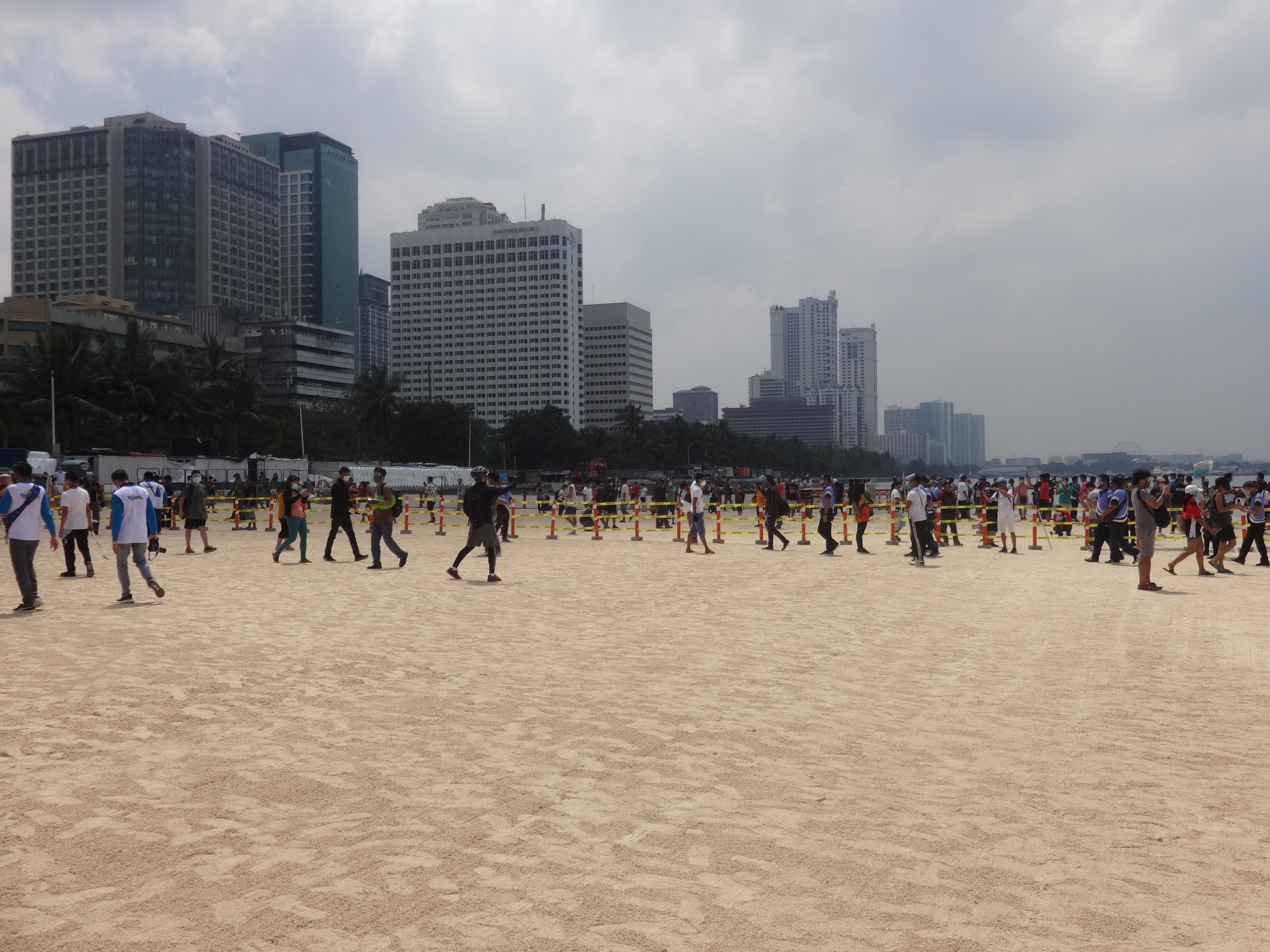
All human activities have an impact on nature to a greater or lesser extent.  Whether an activity should be undertaken depends on the balance between cost and benefit.  This is the rationale for the Environmental Impact Assessment Law (EIA). An EIA is required of any activity that is environmentally critical or in an environmentally critical area.  In the case of the Manila Bay beautification, do the benefits outweigh the environmental and economic cost? The cost includes the destruction of part of a mountain, the emission of large amounts of carbon dioxide from the fuel used to quarry, transport, pulverize and spread the dolomite. There is supposedly also a downside on health, that dolomite is harmful to our lungs.  Economically, the cost is huge; almost P400 million which makes it scandalously expensive especially when the amount could have been used for essential needs of our people.

What is/are the benefits?  Hardly any; a half-kilometer of white sand which, in fact, will be easily eroded away by the next strong typhoon.

The Supreme Court mandamus prescribed the rehabilitation of Manila Bay which meant removal of solid waste, dredging the toxic silt and ensuring that the Bay will henceforth be free of solid and liquid pollution.  The mandamus did not call for the Bay’s artificial beautification, if it can even be called beautification.

Beaches are formed from the interaction of land and water.  Sand is deposited on the coastal area either delivered by rivers or from some sources nearby.  White sand is formed from the fine particles of coral which come from a coral reef nearby and deposited on a particular stretch by the wind and waves.  A beaches formed by the dumping of material from just anywhere is not sustainable.

Had EIA been properly done, the dolomite should have remained in Cebu where it belongs.


Access the Position Paper here:
Postion Paper on Manila Bay Beautification

Honoring God’s Precious Gift: Nature

“A true ecological approach always becomes a social approach; it must integrate questions of justice in debates on the environment, so as to hear both the cry of the earth and the cry of the poor.” -Laudato Si (49)

The pursuit of economic development often results in the neglect of the environment. While there are some who profit from the exploitation of nature, the whole of creation is adversely affected by the consequences of environmental abuse- increased levels of pollution, loss of biodiversity, loss of natural resources, destruction of life-sustaining ecosystems, etc.

Must this so-called ‘development’ be pursued at the expense of the environment? How can we realize economic and social growth without destroying nature? Who is responsible for maintaining the integrity of creation for all life yet to come?


Groups urge for the passage of the Rights of Nature Bill

The Rights of Nature Bill was the main topic for the 363rd session of the Kamayan Para sa Kalikasan Forum held on September 18, 2020 hosted by Green Convergence Philippines.

Atty. Mario Maderaso introduced the bill to the participants as “a legislative proposal anchored on a paradigm shift”.

“There are 2 bills being filled in Congress. Senate Bill 1097 and House Bill 5603 or the Rights of Nature Act. The bill recognizes that nature has legal rights. Being part of nature, we need to recognize its existence. The protection of its rights would also mean the protection of our existence.” he said.

“In inducting this bill, we were supported by an organization based in the US who are also promoting the rights of nature. What is distinct to the principles being followed by other rights of nature advocates in other countries, we have included the coexistence of human rights and the rights of nature.” he added.

“Giving legal personality to the rights of nature, its legal consequence is that it will have a standing in court. Meaning, whenever the rights of nature are violated or damaged, through human agency, a case can be filed in court.” explained Atty. Maderaso.

“Any Philippine resident may file an action” he added.

“There was this case filed by environmental lawyers in Cebu. THey have filed a case on behalf of marine mammals. The petition was dismissed because the marine mammals by itself are not recognized as having a distinct legal personality.

“The court will award certain damages, punitive measures to the violators. These damages will not go personally to those who file the case, but it will go to a trust fund that will be later on managed by a conservation committee.”


Yolly Esguerra, PMPI Coordinator further discussed the campaign on rights of nature.

“The campaign is about the push to recognize the rights of nature.”

“Currently, the models of development paradigm are actually causing the environment to be destroyed continuously.”

“All this environmental destruction is actually largely man-induced and anthropogenic. 

“It is saddening because if you see the statistics, the percentage of humanity in the whole ecosystem and way of life is so small, but our actions are so destructive.” 

(“Nakakalungkot kasi if you see the statistics, the percentage of humanity in the whole ecosystem and way of life, napakaliit lang ang human, but so destructive ang ating mga gawain.”)

“To secure a sustainable future, we must change how we live. This entails major transformations in the ways our global society functions and interacts with natural ecosystems.”

“That is why there is a call for a paradigm shift. We come from the same source, if humans have rights, nature should have rights too.”

(“Kaya ang panawagan is a paradigm shift. Ang pinagmulan natin ay iisa, Kung may karapatan ang tao, may karapatan rin ang kalikasan.”)

Goldman Environmental Prize Recipient Fr. Edwin Gariguez supported this point as he read a quote from Laudato Si, the encyclical of Pope Francis. “When nature is viewed solely as a source of profit, this has serious consequences for a society.” 

“We need to move from a utilitarian, market driven mindset towards an ecological worldview in order to rectify the exploitative development paradigm” he said.

“We need to recover our connectedness with the earth. Without this shift in consciousness, the destruction of ecosystems in exchange for profit will continue” he added.

“Because that is all we see, how much is the profit? What is valuable to the person? But we don’t see what is valuable to nature” he said.

(“Kasi yun lang ang nakikita natin, ano yung kita? Ano yung mahalaga sa tao? Pero hindi natin nakikita yung mahalaga sa kalikasan.”)

In response, Gariguez emphasized the importance of Eco-spirituality and the role of the Indigenous People.

“Many Indigenous Peoples still have respect and love for the earth. We need to learn from them. For them, the land and everything on the earth is permeated with the presence of the spirit” he explained.

As a call for action, he reinforced “the need to affirm the sacredness of mother nature.”

(“Marami pa ring katutubo na mayroong respect and love for the earth. Kinakailangan natin matuto sa kanila.”)

“It is an exciting challenge; we are all one in our paradigm that nature has to be respected” said Dr. Nina Galang, president of Green Convergence.

Since March 1990, Kamayan Para Sa Kalikasan Forum, held every 3rd Friday of each month, has become an institutionalized platform that enables NGO and government representatives, the media, students, teachers, church groups, and concerned citizens to discuss pressing environmental issues in the country. The forum is organized by Green Convergence and is supported by Kamayan Restaurant EDSA with the assistance of the Forest Foundation Philippines.

Watch the full September 2020 Kamayan Forum here:

Green Convergence Celebrates the 2020 Season of Creation

[big_title bigtitle_content=”Reason for the Season”]

The Catholic Church’s liturgical calendar is divided into several meaningful periods: Advent, Christmas, Lent, and Easter. These seasons are meant to celebrate the birth, suffering, death and resurrection of Jesus Christ. They reveal how God so loved the world that He sent His only begotten Son to show us how to live, love, and serve others

Redemption, Jesus dying on the cross for our sins, definitely was an expression of total love of the Father. However, long before Jesus came along, God had been revealing this love through His Creation. From the Big Bang 15-20 billion years ago that formed an infinite number of galaxies, stars, planets, moons and other celestial objects to the formation of our planet 4.7 billion years ago to the origin of life 3.7 billion years ago to the moment He breathed life into the first human.

For the human race, the stage had been set for his use, enjoyment and appreciation. Before him had been the evolution of the Earth from a molten mass of inanimate molecules to the formation of the varied features – mountains, plains, oceans, rivers – to the organisms that were suited to their specific settings of soil, water, and air. The grandiose biodiversity was a reflection of the Almighty’s own glory. God was revealing Himself to us through this creation. And most of all, He gave us the intelligence and consciousness to be able to make use of all these for our growth in knowledge, joy and actualization of our human potential individually and collectively.

The Season of Creation is a time for reflection of God’s omnipotence and love. But it is also a time to reflect on how we have shown our gratitude or ingratitude through our use or misuse of His bounty. Sadly, the state of nature today seems to manifest our indifference and worse, our selfishness, as we see the state of the environment today. From deforestation to air and water pollution to toxic substance, to nuclear contamination and the most urgent global crisis – global warming and its flip side, climate change, it is imperative that we take stock of our systems, actions, and world views and take a wiser course if we are to preserve the Earth’s grandeur, God’s creation.

Lord,

the lofty mountains proclaim Your greatness;
the fields of grain reveal Your goodness;
the teeming seas announce Your benevolence;
the tiny leaf is witness to Your omnipotence;

the mighty forests reflect Your glory;
the brilliant flowers bare Your beauty.

In the song of birds,
in the chirp of crickets,
in the cry of babies, we hear life.

In the warmth of sunshine,
in the kiss of the wind,
in the smile of friends,
we feel Your love.

Lord, You so loved, the world that You gave us this beautiful world that gives nurturance of body and spirit. Give us the commitment to care for Your Earth, to pass on this commitment to our families, friends and neighbors so that our children will inherit a planet that will still yield their sustenance, so that they too will know You through Your creation, so that generation after generation will sing Your praises forever.

[big_title bigtitle_content=”About the Booklet”]

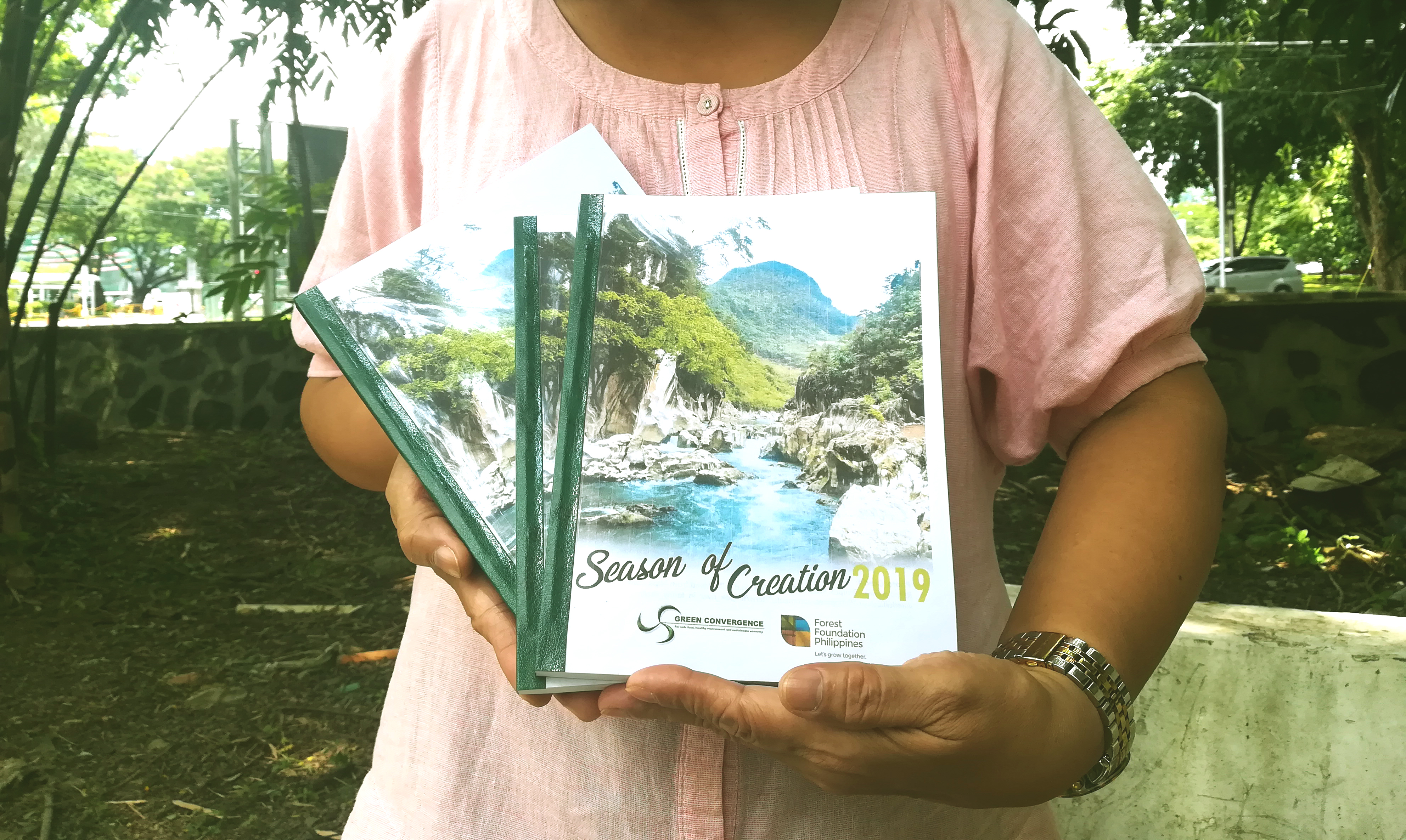
This booklet hopes to help Catholics celebrate the Season of Creation. It is divided into 8 sections:

Section I gives the historical background and context of the celebration of the Season of Creation in the Catholic world and especially in the Philippines today.
Section II offers a guide for Liturgical Celebrations during the Season of Creation. Scripture Readings and Liturgical Resources are presented for all the Sundays that fall within the Season. The Liturgy Resources consist of a brief summary, Points for Reflection, Life Focus Questions, Passages from Laudato Si, and Related Prayers of the Faithful. Votive Mass for Creation is prepared specifically for September 1, which is the World Day of Prayer for Creation, but can be adapted for use at other times. Furthermore, the Season is being extended to Oct. 11 which is Indigenous Peoples’ Day, in recognition of the fact that indigenous peoples have been the best guardians of the earth’s ecosystems.

Section III introduces a guide for examination of conscience and suggested environmental prayers for other occasions.

Section IV features poems related to the environment and pandemics.

Section V highlights several saints of ecology.

Section VI enjoins the faithful to demonstrate environmental conversion in their lifestyle.

Section VII features games that challenge our knowledge on Philippine biodiversity.

Section VIII are Filipino versions of an ecological mass and examination of conscience.