
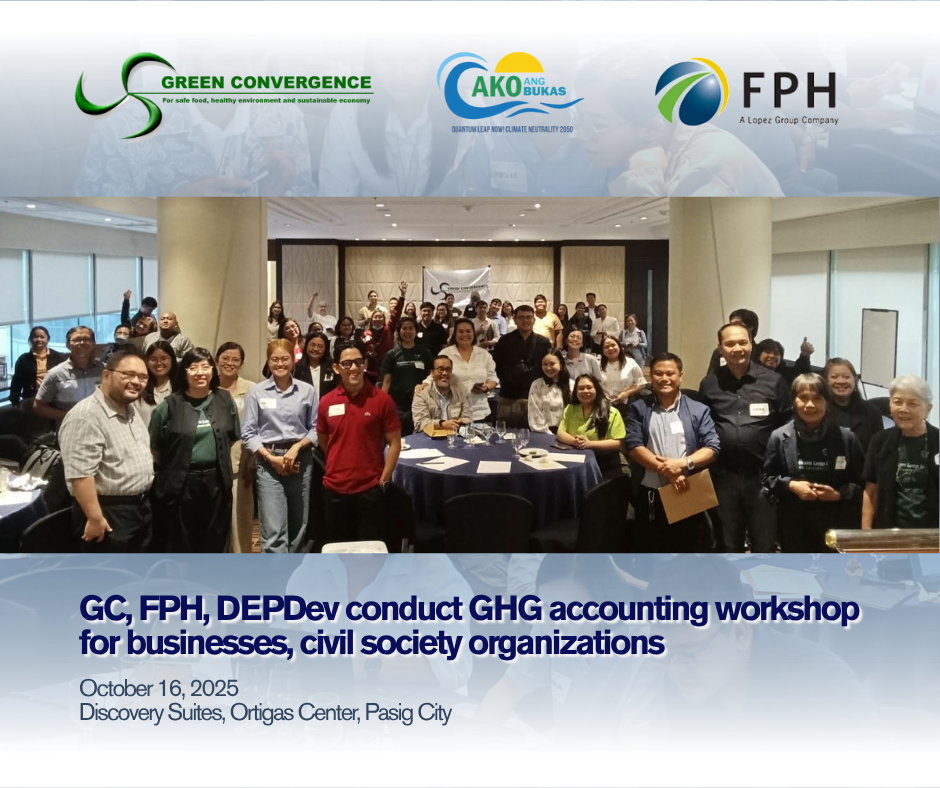
GC, FPH, DEPDev conduct GHG accounting workshop for businesses, civil society organizations

Green Convergence (GC) and First Philippine Holdings (FPH), through its Ako Ang Bukas (AAB) Advocacy Program, held a greenhouse gas (GHG) accounting workshop for businesses and civil society organizations (CSOs) on October 16, 2025, at Discovery Suites in Ortigas Center, Pasig City.

The workshop was co-organized with the environmental technical working group of the Sustainability Development Goals (SDG) Stakeholder Chamber of the Department of Economy, Planning and Development (DEPDev).

Jonas Dumdum of the environmental technical working group of DEPDev’s SDG Stakeholder Chamber echoed the sole purpose of the workshop, “you cannot report what you cannot measure, and you cannot measure if you do not identify,” linking it with how international reports still show that the Philippines is still number one in disaster risk-related issues.

Dr. Angelina Galang, Program Director of AAB and Founding Trustee of GC, kickstarted the workshop with a discussion of the ecological paradigm, anchored on the seven environmental principles: (1) Nature knows best, (2) All forms of life are important, (3) Everything is connected to everything else, (4) Everything changes, (5) Ours is a finite Earth, (6) Everything must go somewhere, and (7) Nature is beautiful and we are the stewards of God’s creation.

“We have disturbed, if not destroyed completely, the natural world. We have strayed further and further from nature to the extent that it imperils its ability to sustain our quality of life,” Dr. Galang emphasized the need to revert to nature through the principles, adding that it is the qualitative framework needed to understand the need for GHG accounting.

Agnes de Jesus, Chief Sustainability Officer of FPH and Business Task Force Head of AAB, then delved deeper into GHG accounting and its significant contribution to addressing climate change impacts.

De Jesus highlighted the Philippines’ commitment to reducing emissions under the Paris Agreement and introduced the AAB household GHG calculator web app as a practical tool to help households understand and track their carbon footprint.

She emphasized that ‘the choices we make will affect the climate,’ altogether suggesting to consume less power, consume less processed food, eat local and organic, minimize packaging, and shorten and plan travel routes through lifestyle change and tree planting.

On entity-level GHG accounting, de Jesus reviewed the boundaries and data needed to calculate for entities’ carbon footprint—scope 1 summed up as “burning fuel in your facility,” scope 2 or “buying power and steam” outside your facility, and scope 3 means “outside Scope 1 and 2”—and introduced the features of the AAB entity-level GHG calculator.

In line with the awareness of their carbon footprint through the calculator, she also introduced the mitigation hierarchy to guide decarbonization efforts—avoidance, minimization, reduction, and removing, and nature-based or man-made offsetting as last resort.

Milagros Serrana, Program Leader of AAB, led the workshop-proper on the use of the AAB household and entity-level GHG calculators. She demonstrated how to input data and how the calculator presents graphically the results which show the users’ hotspots.

Several participants were then able to share their results and reflections from the GHG calculation workshop.

Virgen Milagrosa University Foundation used their own data to try out the AAB entity-level GHG calculator and said that it was helpful for them to formulate action points for their university.

Airspeed International Corporation shared that knowing their emission hotspots through the calculator helped them validate their roadmap to promote and advocate sustainable framework up to year 2030.

DEPDev shared that the calculator was interactive and user-friendly.

Ako Ang Bukas (or “I am the future”) is a movement with a central campaign, “Quantum Leap NOW: Climate Neutrality 2050.” It seeks to involve all sectors and levels of society nationwide in taking urgent, concerted action to address the climate crisis facing the country and the world.

Be part of a bigger change by signing the pledge and joining the AAB program through this link: bit.ly/AKOANGBUKAS. Moreover, calculate your carbon footprint using the AAB household GHG calculator through this link: aab-household-ghg.web.app.
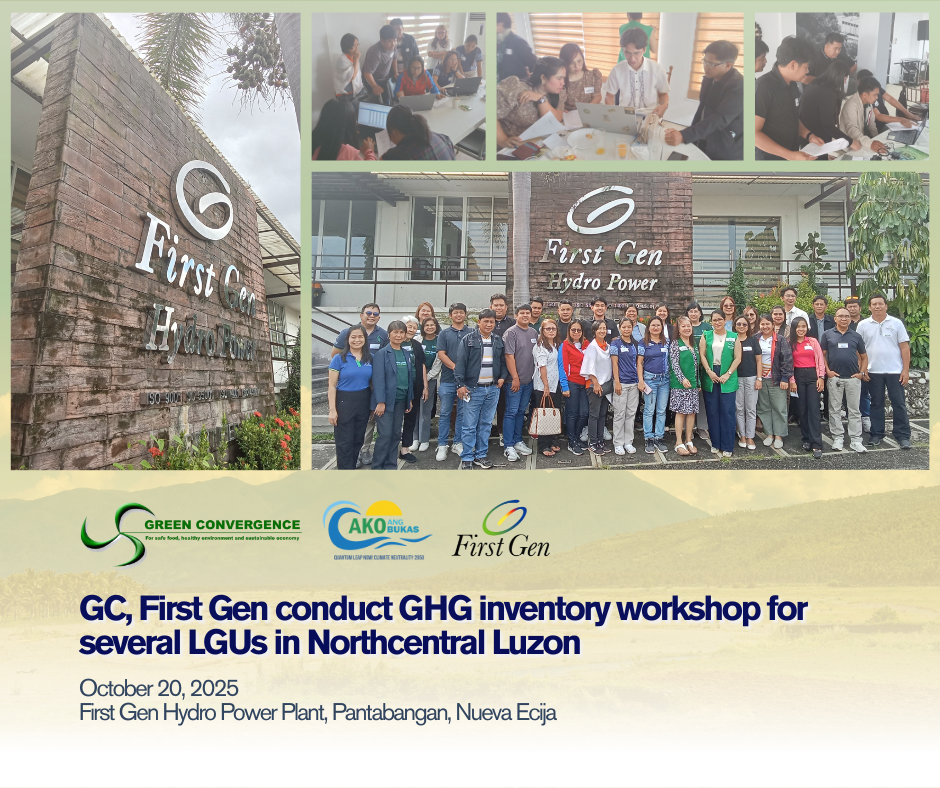
GC, First Gen conduct GHG inventory workshop for several LGUs in Northcentral Luzon

Green Convergence (GC), in partnership with First Gen’s Corporate Social Responsibility Group and through the Ako Ang Bukas (AAB) Advocacy Program, held a greenhouse gas (GHG) inventory workshop on October 20, 2025, at the First Gen Hydro Power Plant in Pantabangan, Nueva Ecija.

The workshop was held for the development of several local government units’ (LGUs) community-level GHG inventory in line with the enhanced Local Climate Change Action Plan (LCCAP) promotions and updating.

Participating LGUs were from Pantabangan and Carranglan of Nueva Ecija, Maria Aurora of Aurora, Alfonso Castaneda and Dupax del Sur of Nueva Vizcaya, and the province of Quirino.

Kickstarting the session, Agnes de Jesus, Chief Sustainability Officer of First Philippine Holdings, provided a situationer on climate change and the Philippines’ commitment to reducing GHG emissions under the Paris Agreement.

She outlined the GHG inventory journey for LGUs—learning the features of a GHG calculator and the practice of identifying GHG sources through the AAB household GHG calculator, applying these onto various entities’ value chains through the AAB entity-level GHG calculator, and using these fundamentals in transitioning to the entity and community-level calculators of the Climate Change Commission (CCC) which has extended parameters.

In line with preparing for the enhanced LCCAP, de Jesus explained that a GHG calculator is beneficial as it will serve as basis for climate action, given that it can identify the GHG hotspots that need intervention, and aid organizations in preparing for the future government requirement on GHG inventory and coming up with accurate data for green fund applications.

She then delved deeper into measuring an entity’s carbon footprint using the AAB calculator—covering scope 1, scope 2, and scope 3 emissions, coined as “buy,” “buy,” and “outside” as key words respectively.

De Jesus also emphasized cutting emissions through the mitigation hierarchy: avoid, minimize, reduce, and remove, with natural or manmade offsetting as the last resort.

As an example on how the AAB entity-level GHG calculator was used by an LGU, she shared the study done by AAB in Barangay Cogon, Ormoc, Leyte.

Also sharing their experience in GHG inventory, Rogelio Abalus Jr., Municipal Planning and Development Coordinator of Nagtipunan, Quirino, gave an overview of their municipality’s 2023 to 2028 enhanced LCCAP.

Nagtipunan’s planning framework consists of modules on stakeholder participation, vulnerability and risk assessment, GHG inventory using the CCC calculator, review of goals and setting of objectives, assessment of options and implementation, and monitoring and evaluation leading to adjustment and modification.

Abalus Jr. detailed the Climate Information and Situation Analysis of Nagtipunan from years 2036 to 2065 and anchored their Climate Change and Vulnerability Assessment on this, alongside efforts on GHG inventory, which involved planning, collecting of data, developing of a GHG inventory management plan, setting GHG emissions reduction targets, and tracking.

Upon implementation, following their 2022 baseline emission totaling 849,785.58 tons of carbon dioxide (from stationary and mobile combustion, purchased electricity, crops and livestock, solid waste, wastewater, and forestry and land use), they have removed 866,914.19 tons of carbon dioxide through carbon sequestration, recording a net emission of 17,128.61 tons of carbon dioxide.

Based on these data, the municipality’s planning team was able to identify technical findings, implications, objectives, potential options, and corresponding Programs, Projects, and Activities (PPAs) for their five priority sectors—social, infrastructure, institution and governance, economic, and environment.

They were also able to identify two decision areas for mitigation and adaptation actions: landslides and flooding.

Abalus Jr. said identifying these is needed for them to address identified local climate risks and enhance resilience and adaptive capacity, and in the future undergo monitoring and evaluation through reporting.

Subsequently, the workshop-proper on the AAB entity-level GHG calculator was then led by Milagros Serrana, AAB Program Leader, with an accompanying dummy data of an LGU for participating LGUs’ practice. After the workshop was a sharing of the LGUs’ ways forward, applying learnings from the session.

Ako Ang Bukas (or “I am the future”) is a movement with a central campaign, “Quantum Leap NOW: Climate Neutrality 2050.” It seeks to involve all sectors and levels of society nationwide in taking urgent, concerted action to address the climate crisis facing the country and the world.

Be part of a bigger change by signing the pledge and joining the AAB program through this link: bit.ly/AKOANGBUKAS. Moreover, calculate your carbon footprint using the AAB household GHG calculator through this link: aab-household-ghg.web.app.


October 2025 Kamayan forum addresses flooding situation, reinforces nature-based mitigation

Green Convergence, with the support of JRS Express, held the 424th session of Kamayan Para Sa Kalikasan forum themed “Baha at Bayanihan: A Holistic Approach to Flood Mitigation” on October 17 via Zoom and Facebook livestream to address worsening flood issues and discuss ecological solutions.

Sr. Marvie Misolas, Executive Director of Miriam College Environmental Studies Institute and a Trustee of Green Convergence, opened the session recognizing climate change, deforestation, watershed degradation, land subsidence, excessive groundwater extraction, and corruption as key causes of flooding.

Noting also that the Philippines is highly vulnerable to disaster due to its geography, at the same time abundant water resources, she calls for actions to ensure resilient communities through more integrated approaches and comprehensive management.

Quezon City’s response to flooding

Following this idea, Leo Martillano, Local Disaster Risk Reduction and Management Officer II of the Quezon City Disaster Risk Reduction and Management Office (QCDRRMO), shared the Drainage Master Plan of the city.

The QCDRRMO, in partnership with the University of the Philippines’ (UP) Resilience Institute, has conducted city profiling, taking into account the geophysical, social, infrastructural, economic, and institutional capacities of the locality.

In line with profiling, they have done area-specific assessments, field evaluation and condition assessments, close community consultations, and further analyses on data gathered to anchor their intervention models.

Though the Quezon City Drainage Master Plan is still at the first few steps of its implementation, the QCDRRMO has rolled-out workshops on flood validation, drainage assessment and inventory, General Information Systems (GIS), as well as on the Internet of Things (IoT)-based decision support system.

Other projects involve both structural and community-based interventions, from youth projects for disaster awareness and preparedness, relocation for those along easements of waterways, participatory monitoring and evaluation mechanisms for barangays, stormwater detention basins wherein basketball courts will be utilized, rainwater harvesting systems for schools and public markets, permeable pavements for sidewalks, to solid waste management for flood risk reduction—and more.

Martillano also emphasized that, when designing and proposing drainage-related projects, they aim to ensure the directly-involved local community has ownership over the projects done in their area, building on the concept of ‘bayanihan’ in the face of flood mitigation.

Trees and science-based solutions

Dr. Fernando Siringan, Research Professor from the UP Marine Science Institute, then delved deeper into dealing with flooding with the help of science and trees, referencing various studies that support effective flood mitigation.

He primarily underscored the importance of applying zoning in floodplains where it is still possible, saying that there is a need to respect the very nature of areas’ landscapes in implementing projects. Floodplains are lands beside rivers and waterways subject to flooding.

Dr. Siringan then reiterated the benefits of reforestation, such as decreasing or delaying run-offs during heavy rains and sediment yield, increasing groundwater recharge, summer stream flow, and biodiversity, lowering air temperature, and prolonging the lifespan of dams and Small Water Impounding Projects (SWIPs).

Considering trees as known natural shields, he presented studies that showed mixed planting of trees with different root distribution characteristics should be popularized to help infiltration of urban trees, as well as “sponge city” projects that may be replicated locally.

Dr. Siringan also linked the benefits of increased forest covers for SWIPS, mentioning observations in the 12 SWIPs of Alcala, Cagayan. Loss of trees can shorten the lifespan of SWIPs due to increased run-offs, soil erosion, sediment-filled rivers, and diminished dry season flow; and, if not desilted, can be costly for municipalities and farmers.

He added that initial trees to be planted in the SWIPs of Alcala should be more tolerant of drier conditions and that propagation of endemic, vulnerable, endangered, and critical trees should be given ‘special attention.’

Dr. Siringan also explained the importance of the river widening and implementation of waterway easement to allow improved transmission of floodwaters downstream, taking notice of the governmental mistake of not wanting to deal with communities in terms of relocation.

“Widening of [water] channels is a more permanent measure of addressing floods. The effect of river dredging is very temporary,” he stated.

Moreover, Dr. Siringan shared that preservation of sand dunes also lessens flooding issues, as they stop seawater from entering the coast and have vegetation that hold the sand in place. Also on coastal preservation, he reinforced the need for wider mangrove belts to reduce wave energy impacts.

Furthermore, on the relation of reclamation projects and the flooding issues, Dr. Siringan said, “Reclamation, if done improperly, kung ito ay nakakabara sa ilog—and I have seen some reclamations na maraming illegal [activities] all over the Philippines na nagpapasikip sa mga ilog—then, definitely, problema ‘yan sa pagbabaha.”

Reflections and ways forward

Reflecting on the discussions of Martillano and Dr. Siringan, Architect and Environmental Planner Dr. Leah dela Rosa, Chairperson of Miriam College’s Department of Sustainability and Environment, built on the idea of ‘looking at where we are’ and understanding local conditions and data in addressing the flood situation.

In understanding these, she also remarked that there should be deeper acknowledgement of shortcomings and acceptance of the consequences of the oversights and mistakes towards nature throughout generations in order to achieve sustainable development.

Dr. dela Rosa then called for sectoral and cross-cultural engagement through formal, informal, and indigenous knowledge-based studies based on past similar experiences, patterns, or actual conditions, highlighting the need for a paradigm shift in behavioral transitions.

Hinting on the current political climate with regard to flood control, she also noted that there is a need for increased levels or degree of governance over proper implementation of mitigation strategies.

Ultimately, Dr. dela Rosa called to ‘return to basics and let nature take its own pace. “We have to be ethical, honest, responsible, and good stewards of our environment and our natural resources—kung mayroon pang natitira,” she expressed.

This sentiment was then echoed by the President of Green Convergence, Victoria Segovia, in her closing remarks, reverting to the ‘nature knows best’ environmental principle and emphasizing that there should be respect for the natural cycles of the environment.

Next Kamayan session was announced to be on November 21, 2025.

Kamayan Para Sa Kalikasan is a monthly initiative organized by Green Convergence that enables non-government organizations (NGOs) and government representatives, the media, students, teachers, church groups, and concerned citizens to discuss, analyze, and create solutions to pressing environmental issues in the country.

For those interested to be a member of Green Convergence, visit these links to register: bit.ly/GCMembershipRegForm

Part 1

Part 2

Part 3