

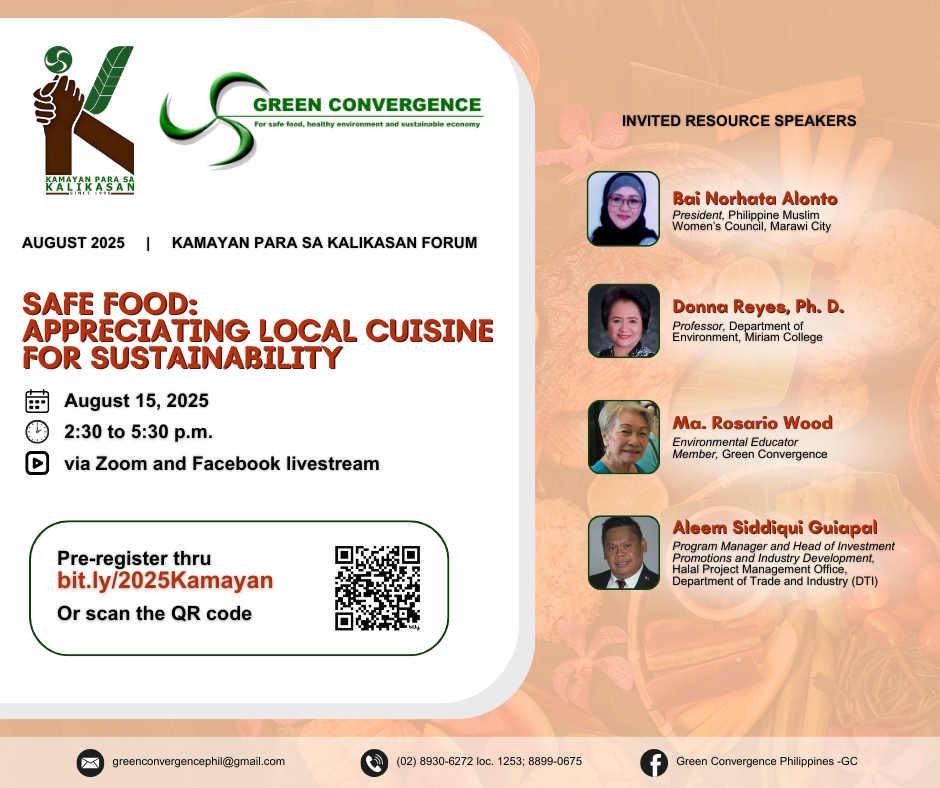
Local cuisines from Luzon, Visayas, and Mindanao, and safe food for sustainability were highlighted in Green Convergence’s 422nd Kamayan Para Sa Kalikasan forum themed “Safe Food: Appreciating Local Cuisine for Sustainability” on August 15, Friday, via Zoom and Facebook livestream.
Green Convergence President Victoria Segovia opened the forum by recognizing healthy, indigenous food as an aid in maintaining agricultural biodiversity, preserving cultural heritage, supporting local farmers and gatherers, and reducing carbon footprint from importing food.
Distinctive features of Halal food
Kickstarting the discussions, the Philippine Muslim Women Council President Bai Norhata Alonto talked about Halal food as more than just adherence to Islamic guidelines but a holistic system and approach to consumption. It is now a growing trillion-dollar Halal industry in which the Philippines has participated in among other Muslim and non-Muslim countries.
Halal food, with “Taib” at the heart of Halal philosophy which is Arabic for “wholesome,” “pure,” or “good,” considers the cleanliness, safety, and health benefits of the food to the human body; hence the ethical ways in which they are prepared and consumed, noting organic farming practices, minimization of food waste, and prioritization of animal welfare.
Alonto emphasized that Halal is not limited to dietary restrictions, such as the known misconception that it is merely the absence of pork, but a comprehensive world view that promotes a responsible relationship with the environment, regardless of religious differences.
“By embracing the principles of ‘Taib,’ rejecting wasteful consumption, and upholding the highest standards of animal welfare, we can see that Halal is and has always been a path to an eco-friendly and sustainable way of life,” Alonto said.
Appreciating Ilocano cuisine and heritage
Also on food sustainability, Miriam College Professor and Kannawidan Foundation, Inc. Board Member Dr. Donna Paz Reyes presented the Ilocano Cuisine and how Ilocanos eat, prepare, and consume food, derived from her authored book, “Salimetmetan To Gameng: Protecting and Preserving the National Heritage of Ilocos Norte.”
Reyes recognized Ilocanos as ‘ultimate ecologists’ and rethought the local term “kuripot,” meaning thrifty, from an environmental perspective, specifically, from a low-carbon lifestyle as climate change mitigation and adaptation.
Mentioning abundance of agriculture in Ilocos Norte, Reyes shared that Ilocano cuisine is essentially vegetable-based, such as the famous pinakbet, dinengdeng or inabraw which is a dish that considers recycled food as its main ingredient is leftover fish, Ilocano salad which is a vegetable salad with KBL (kamatis, fish-based bagoong, lasona) as a dip, and more.
She also shared meat-based Ilocano cuisine, such as those that are from the “kalding” or goat, where all edible parts of the kalding are utilized—bones and meat for kaldereta, skin for kilawen, and innards for papaitan—noting the importance of avoiding food waste.
Other delicacies were also shared, such as tupig, made from glutinous rice, which was related to the rice production in the province wherein their rice supply can sustain their population; bukto or ipon, an indigenous river fish, which was said to be protected by a municipal ordinance for sustainability; bios, eggs of red ants; and abal-abal, May beetles.
At the core of these dishes, Reyes emphasized Ilocanos’ environmental values, as they patronize eating local food in season, avoid waste by cooking viands using leftovers and eating all edible parts of plants and animals, cultivate backyard farms, prioritize good health, forward environmental education through trainings, and conserve natural habitats and food baskets.
Western Visayan gastronomy and sustainability
Onto Western Visayan cuisine, Member of Green Convergence and environmental educator Ma. Rosario Wood glanced across the provinces of Region 6 or Panay island—Aklan, Antique, Capiz, Guimaras, Iloilo, and Negros Occidental—and highlighted the vast ecosystems that supply their food.
Wood detailed that the major industries in the region include agriculture, noting the wide variety of fruit species especially in Iloilo, tourism, milling for sugar cane, and aqua culture, including home locked aqua culture, such as tilapia, hito, and dalag.
She also showcased a variety of cuisines across the region, such as laswa, ginataang labong, kansi, KBL (kadyos, baboy, langka), binakol, native chicken inasal, pancit molo, batchoy, many seafood dishes, and more, which Wood essentially associated with the availability of food under controlled amounts and the locals’ resourcefulness by growing food in their own spaces.
Promotion of Halal Industry
Subsequently, Program Manager and Head of Investment Promotions and Industry Development from the Halal Project Management Office of the Department of Trade and Industry (DTI), Aleem Siddiqui Guiapal, shared his insights on the discussions, saying that the cuisines can be converted into Halal production—it is a matter of compliance and introduction of systems that adhere to Halal food preparation, as Alonto had mentioned earlier.
“As far as the market is concerned, those who are already in the business of food or Halal food preparation, pwede pa i-strengthen ‘yung opportunity na makapagdistribute ng [Halal] market sa mga komunidad,” Guiapal said, noting the huge Muslim community in the Philippines at around ten to 12 percent, which is the third biggest Muslim population in Southeast Asia.
Guiapal also shared that there are ten government agencies, as well as companies and corporations, active in the Halal program. Under DTI, there is non-interest financing attached to the Small Business Corporation, certification programs, Halal testing with the help of the Department of Science and Technology (DOST), trainings with the Philippine Trade and Training Center and TESDA, inclusion of Halal 101 in the curriculum of Mindanao State University, and support for cooperatives by the DK P.O. Fulfillment Company Inc. (DKPO).
Furthermore, Guiapal said that, through this promotion, they are continuing their target of generating around 230 billion in trade and investment revenue for the campaign for a Halal-friendly Philippines.
Closing the forum, Green Convergence Trustee Dr. Angelina Galang summed up the August Kamayan discussion on local cuisine and Halal food production as an emphasis on the important relation of food to the environment.
“Our environment should be sustainable, so that our food can be accessible [and] affordable, giving us the nutrition that we need. […] When we heed to the principles of sustainability, then we also heed the challenge of climate change,” Dr. Galang remarked.
The next Kamayan forum was announced to be on September 19, 2025. Likewise, participants were invited to the forthcoming annual State of Nature Assessment (Green SONA) themed “Ecosystems Integrity: A Must for Philippine Sustainability,” to be held on September 3 to 4, 2025, at the RDE Hall of the Visayas State University, Baybay City, Leyte. Pre-registration details are posted on Green Convergence’s official Facebook page.
Kamayan Para Sa Kalikasan is a monthly initiative organized by Green Convergence that enables non-government organizations (NGOs) and government representatives, the media, students, teachers, church groups, and concerned citizens to discuss, analyze, and create solutions to pressing environmental issues in the country.
For those interested to be a member of Green Convergence, visit these links to register: bit.ly/gcindividual or bit.ly/gcnetorg.
#GreenConvergence #KamayanParaSaKalikasan #SafeFood #AppreciatingLocalCuisine #FilipinoCuisine #Sustainability
