
GC to PH gov’t: ‘Respect rights of IPs; no to false environmental solutions!’

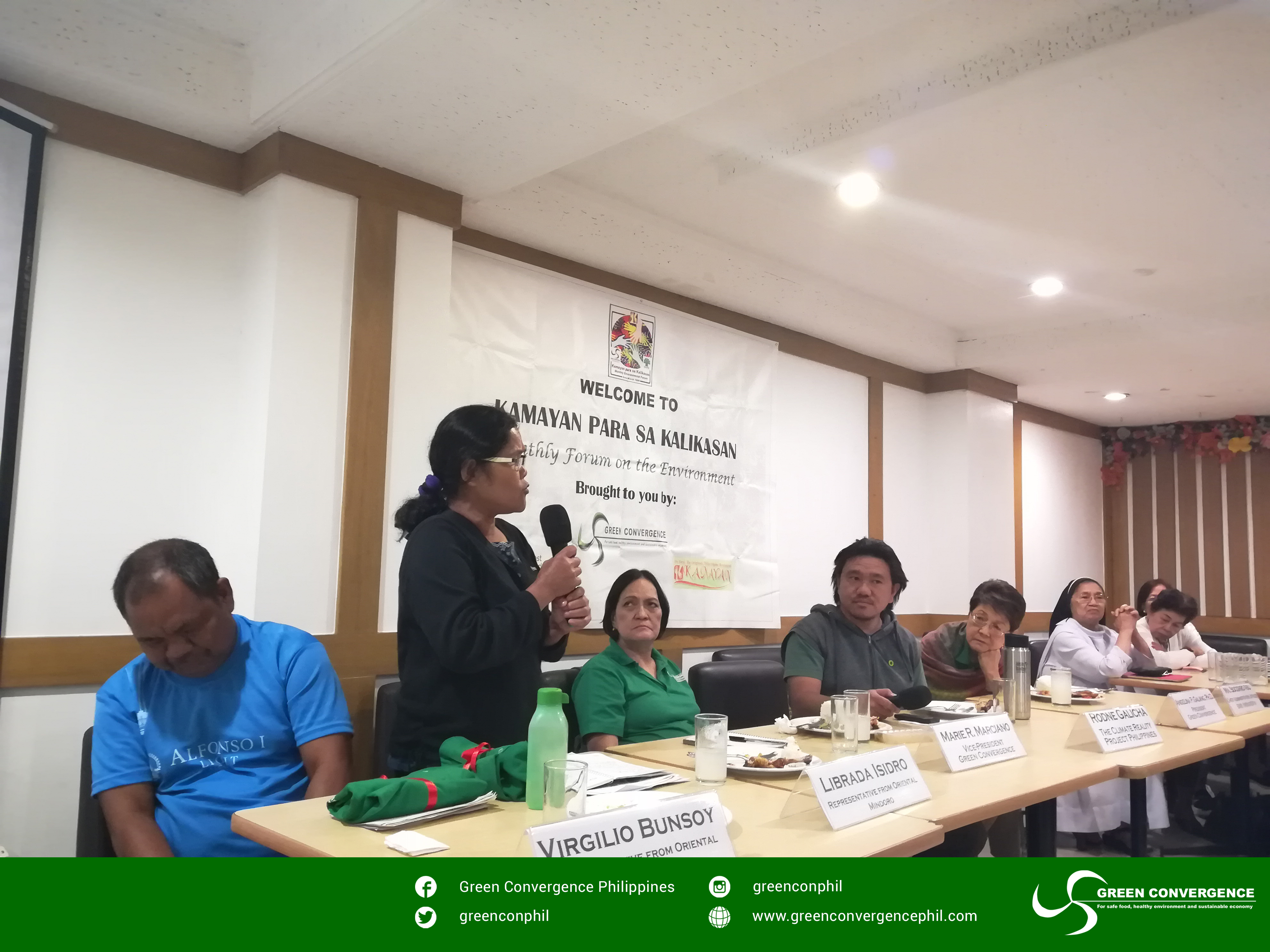
Environmental coalition Green Convergence held “Landslides: Today’s Recurrent Nightmare,” at its monthly Kamayan Para sa Kalikasan Forum. Resource speakers included Rodne Galicha of Climate Reality Philippines and Mangyan representatives from Mindoro Virgilio “Ka Mot” Bunsoy and Alangan tribe leader Librada “Ka Badang” Isidro. They discussed the current environmental situation of Mindoro and the disasters that it regularly experiences related to flooding and landslides caused by mining and mountainside blasting.

Galicha showed the rich biodiversity of Mindoro by presenting a map showing its key biodiversity and important bird areas. Unfortunately, when overlaid with the location of mining areas, it revealed overlaps causing many concerns for its natural landscapes. Citing the cause of recurrent massive landslides in the island, Galicha explained that in mining, drilling is done to know the mineral deposits undernealth; but it is common sense that if mountain blasting is added, landslide will naturally occur since one drilled hole can trigger other existing holes to cause a landslide.

Ka Mot said that mountain blasting in the island is currently being done to give way to the construction of the 8-MW Santa Clara hydro power plant project that will supply the island’s electricity needs; however, he pointed out that there was no mention of any mountain blasting in the Memorandum of Agreement among the Mangyan communities, the local government and the company in-charge of the hydro plant. When he verified this with the engineer in-charge, he was informed that mountain blasting is needed to finish the tunnel on its target deadline.

Aggravated by typhoon Nona in 2015, mountain blasting has caused several landslides forcing Oriental Mindoro Governor Alfonso Umali Jr., to halt the project in 2016.  Mangyan leader, Ka Badang painfully recalls that when typhoon Nona struck, the river overflowed, flooding devastated their community.  Their crops were destroyed and 200 families in one community were left homeless.

“Ang lupa at bundok ay katumbas ng aming buhay. Ang bundok po, ito ay aming pinakabangko dahil dito kami kumukuha ng aming ikinabubuhay,” Ka Badang passionately shared how the IPs see nature during the 346th Kamayan Forum.

Angelina Galang, Green Convergence President, explained that a hydropower plant, though seemingly a better alternative to fossil fuels, may be a false solution when it is not appropriate to the ecology of the place. This is why it is essential to include the indigenous inhabitants in consultations and decisions because they intimately know the area.

Ka Badang recommended to consider solar power as an alternative source of energy for their area because of its relatively less environmental impact.  She also asked for legal support so they can easily voice out and stand for their rights over their ancestral lands.

“Landslides: Today’s Recurrent Nightmare,” was held last January 18, 2019 at Kamayan Restaurant, EDSA, Mandaluyong City. Now on its 29th year, it is the 346th forum of Green Convergence, institutionalized to provide a platform for civil society, government, and media to discuss pressing environmental issues of the country. This month’s forum is supported by Kamayan Restaurant EDSA with the assistance of Forest Foundation Philippines.
You must be logged in to view this content. Free Virtual Library Registration Here

Green Convergence’s Galang: “Update PH communal forest policy!”

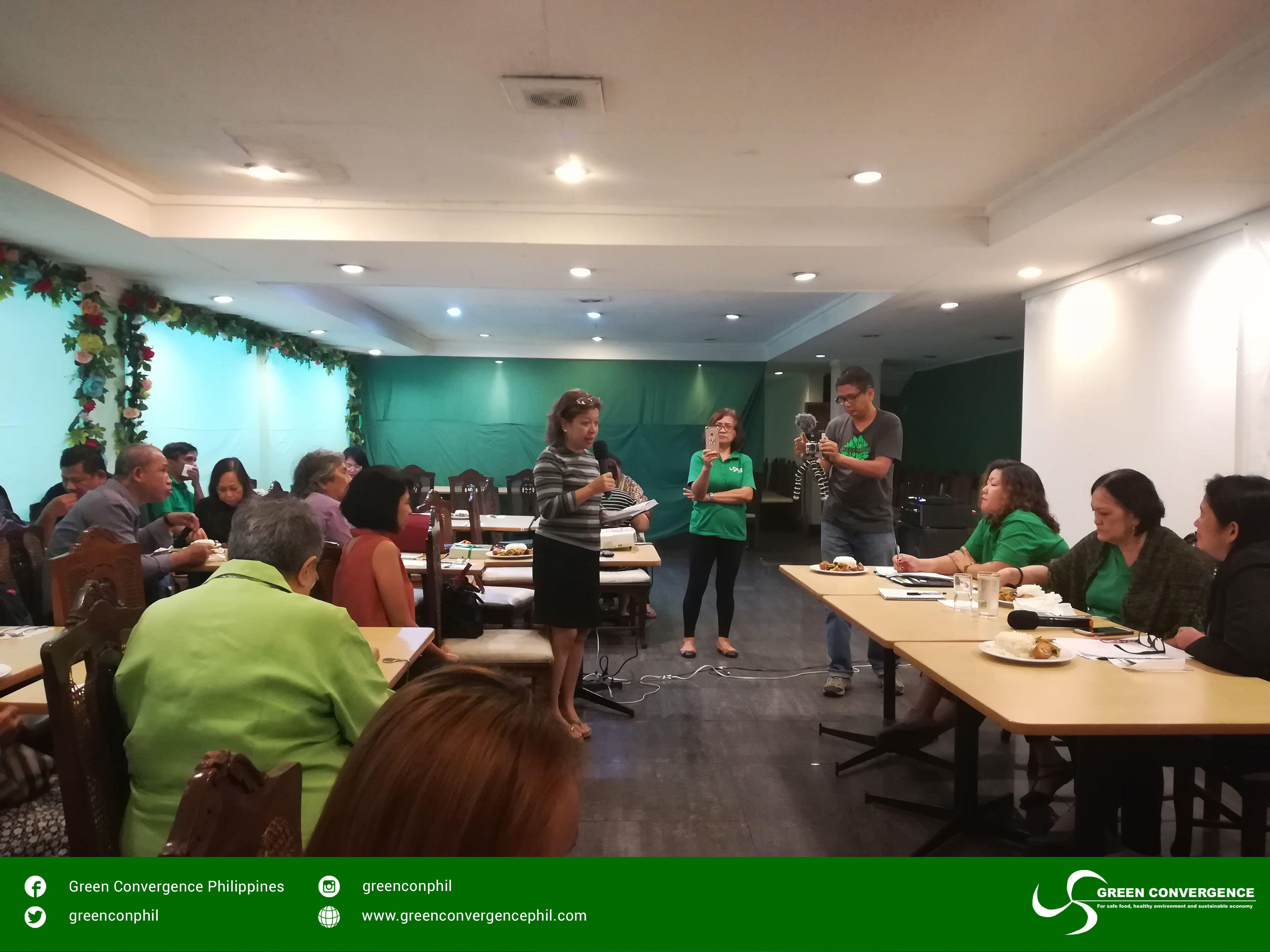
Environmental Coalition Green Convergence held the 345th installment of the monthly Kamayan Para sa Kalikasan Forum last December 21, 2018 at Kamayan Restaurant, EDSA, Mandaluyong City. Resource speakers included forester Amie Rabang of the Forest Management Bureau and Liberty Talastas-Bituin, a member of the indigenous people in the Cordilleras.  They discussed Communal Forest and the status of its implementation.

Rabang stated that “there are 649 assigned communal forests all over the Philippines designated through Memorandum of Agreements between LGUs and the DENR.”

“In our experience in the Cordilleras, several areas not declared as communal forests are sustainably developed that provides livelihood while sustaining the area’s ecological integrity,” asserted Talastas-Bituin.

Rabang declared that “most of the assigned communal forests are disestablished by the DENR because they no longer provide timber.” She further added that “communal forests were conceptualized in 1995 with the main objective of providing timber for the country.”

Talastas-Bituin emphasized that “it is important that LGUs should conduct regular consultative meetings with the communities in the formulation of forest management plans to effectively use and protect these forests.”

Rabang seconded and further explained that communal forests should be included in the land use plans of the local governments.

The Local Government Code grants local government units (LGUs) the right to plan and manage identified communal forests.  We also have the Community-Based Forest Management Program, where a production-sharing agreement between the Department of Environment and Natural Resources and participating people’s organizations (POs).  for 25 years, renewable for another 25 years provide tenurial security and incentives to co-develop, co-utilize and co-manage specific portions of forest lands (DENR Administrative Order No. 96-29).

Realizing that these programs need to be modified to be attuned to the current environmental situation Green Convergence President Angelina Galang concluded that “it is urgent that government updates its policy on communal forests to avoid misuse and overuse of these identified forest lands.” She further highlighted the importance and critical role of forests as mitigation and adaptation instruments to protect us from devastating effects of climate change.

Now on its 29th year, Kamayan Para sa Kalikasan Forum has become an institutionalized platform since March 1990 that enables NGO and government representatives, the media, students, teachers, church groups, and concerned citizens to discuss pressing environmental issues in the country. This month’s forum is supported by Kamayan Restaurant EDSA with the assistance of the Forest Foundation Philippines.

You must be logged in to view this content. Free Virtual Library Registration Here

10M in 10 recognizes partners in Negros Island

PIA, 7th January 2019 via BigNewsNetwork.com

DUMAGUETE CITY, Dec. 15 (PIA) — The 10 Million Trees in 10 Years for Greener Negros Movement (10M in 10) celebrated its 3rd year milestone by recognizing its partners in Negros Island who helped propagate trees over the last three years.

The 10M in 10 is a private-sector led movement that aims to inspire, unite, and encourage community stakeholders and the public to plant, grow, and protect 10 million years in 10 years in Negros Island.

Some 100 individuals from the local government units, national government agencies, academe, academe, business and private sector groups, and non-government organization sector participated in the activity held Dec. 12 at Perpetual Help Community Cooperative Inc., (PHCCI).

Energy Development Corporation (EDC) Senior Manager and Head of Reservior and Project Management Division Engr. Vicente Omandam and Green Convergence for Safe Food, Health Environment and Sustainable Economy President Dr. Angelina Galang, who were the special guests of the event, presented the plaques and certificates of recognition to 10M in 10 partners who were cited during the event.

The first award was given in recognition to the organization’s partners who planted more than 10, 000 trees this year.

The recipients were Department of Environment and Natural Resources – Community Environment and Natural Resources Offices (DENR – CENRO) of Dumaguete City, DENR-CENRO of Cadiz City, City Environment and Natural Resources Office of Tanjay City, Mangrove Sea Grasses Vital Synergy, Cartronix and Logistics Transport Corp., New Bian Yek Commercial Inc., Protected Area Rangers of Tanjay City, Bacolod City Water District, National Irrigation Administration in Negros Occidental, Department of Education (DepEd) – Division of Bago City, Municipal Agriculturist Office of Valencia, Negros Oriental, City Environment Management Office of San Carlos City, and the Local Government of Hinoba-an.

Also recognized were partners who were able to achieve at least 85 percent survival rate of their planted trees.

The recipients were Mr. Rene Vendiola, Mr. Eduardo Baptista, Bacolod City Water District, Barangay Unit of Atipulan and ENRO of Bago City, Negros Oriental State University, St. Paul University Dumaguete, Municipal Agriculturist Office of Sibulan, DENR-CENRO of Cadiz City, Barangay Unit of Pahanocoy, Dumaguete City Water District, ENRO of Sipalay City, ENRO of Tanjay City, Tanjay Protected Area Rangers, and Mosser Environment Corp.

In his message, Omandam congratulated the partners and cited the collaboration of different sectors in promoting a greener Negros and mitigating climate change.

“Through our continuous synergy, may we all be able to witness the improvement in the island’s ecosystems revitalize its biodiversity, and create communities that are resilient to the effects of climate change,” he said.

During the activity, 10 M in 10 Forest Restoration Management Officer Francis Dilig shared an update on the status of the program in Negros Island based on their Monitoring and Evaluation (ME) reports.

Based on the data he presented as of December 2018, there are already 40 sites with ME results.

Twenty-one of these are in Negros Oriental while the remaining 19 are in Negros Occidental.

Said figure translates to around 656 hectares of land covered by the greening program.

Twelve of these lands are privately-owned while the rest are government-owned.

Currently, there are 101 identified species of native, endemic, and exotic forest trees and fruit bearing trees planted in these sites.

The survival rate of these trees are pegged at 0 to 100 percent while the mean or the average survival rate is at 66.97 percent and the median or the middle value of the range of 82.5 percent.

Dr. Angelina Galang, the keynote speaker of the event, encouraged 10M and 10 Movement and their partners to pursue this initiative for sustainable development.

“I think the examples shared will be inspiring and will encourage people to plant trees. The spirit of healthy competition will encourage people to join the planting. If Negros will look into itself that you are doing something good, it will inspire other people,” Galang said. (ra/PIA7-Negros Oriental)