
Environmental groups renew call for sustainable dev’t paradigm in PH

Environmental Coalition Green Convergence held the 353rd installment of the monthly Kamayan Para sa Kalikasan Forum about the pressing environmental concerns that the Philippines is facing on August 16, 2019 (Friday) at Kamayan Restaurant, EDSA, Mandaluyong City.

“There are programs of the government which Filipinos should be deciding on. But in the recent past, we are suddenly confronted with actions of China and with intrusions of the Chinese who are putting up or will be involved in mega projects in our country,” asserts Dr. Angelina Galang, President of Green Convergence.

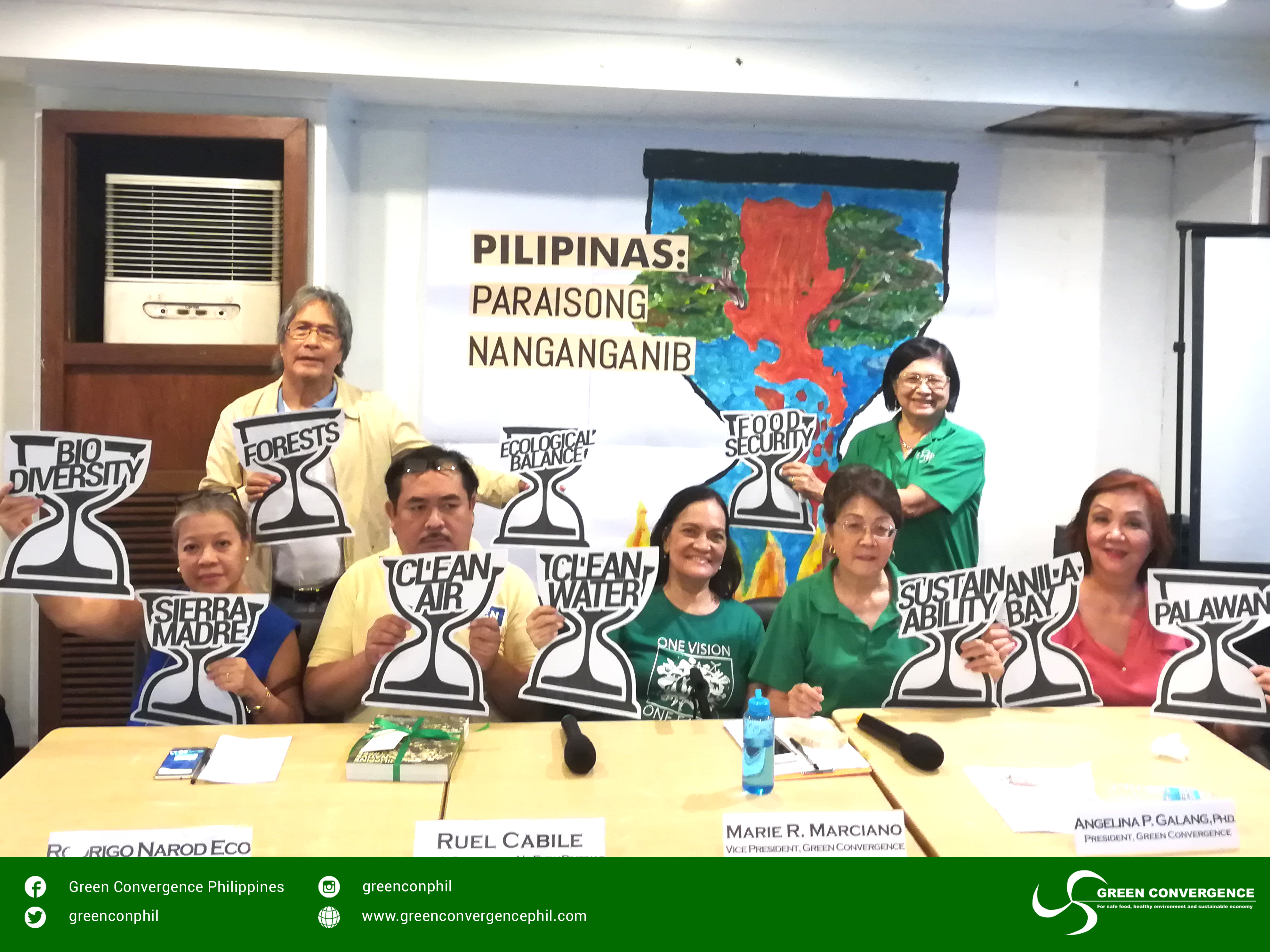
Galang mentioned (1) the absence of a national land use policy, (2) large-scale reclamation activities especially in Manila Bay, (3) the construction of large dams especially the Kaliwa Dam, and (4) the division of Palawan into three separate provinces as actions of the government that are of urgent environmental concern.

These are also topics to be discussed in the upcoming annual State of Nature Assessment (Green SONA) with the theme “Pilipinas, Paraisong Nanganganib” to be held on August 27, 2019 at the Hue Hotel, Puerto Princesa City, Palawan, she explained.

The repercussions of large-scale reclamation to the country’s environment was further discussed by Rodrigo Narod Eco, a researcher from UP Diliman.

“There is no such as a natural disaster,” Eco asserted, “a natural phenomenon only becomes a disaster if it intersects with human activities,” implying that reclamation in Manila Bay will lead to disasters.

If reclamation activities continue in Manila Bay, “Dagdag harang sila sa tubig! ([Reclaimed lands] are added barriers to the flow of water!),” he remarked. This is especially dangerous if a 4-meter high storm surge hits the area.

Biodiversity in Manila Bay will also be negatively affected, considering that fish eggs and larvae of major fish species for food can be found in its shallow waters. Proposed land reclamation projects are exactly in these areas which could endanger the metropolis’ food security.

Eco called for rehabilitation of the Manila Bay, not reclamation for it will not only affect the marginalized communities in the area, such as the fisher folks and the urban poor, but also the entire metropolitan populace.

On the other hand, No Burn Pilipinas Regional Campaigner Ruel Cabile presented the myths of waste-to-energy through incineration and provided suggestions to achieve sustainability by properly managing municipal wastes.

A tribute to environmental champion and founder of Concerned Citizens Against Pollution (COCAP), the late Ester Perez de Tagle was also given. Perez de Tagle advocated against the Japan-Philippines Economic Partnership Agreement (JPEPA) in 2006 and for the promotion of the Euro-4 fuel in the country.

Since March 1990, Kamayan Para Sa Kalikasan Forum has become an institutionalized platform that enables NGO and government representatives, the media, students, teachers, church groups, and concerned citizens to discuss pressing environmental issues in the country. This month’s forum is organized by Green Convergence and is supported by Kamayan Restaurant EDSA with the assistance of the Forest Foundation Philippines.
You must be logged in to view this content. Free Virtual Library Registration Here

Green Convergence to PH gov’t: ‘Invest in native medicinal plants!’

Environmental Coalition Green Convergence held the 352nd installment of the monthly Kamayan Para sa Kalikasan Forum about the future of the Philippine native medicinal plant industry on July 19, 2019 (Friday) at Kamayan Restaurant, EDSA, Mandaluyong City.

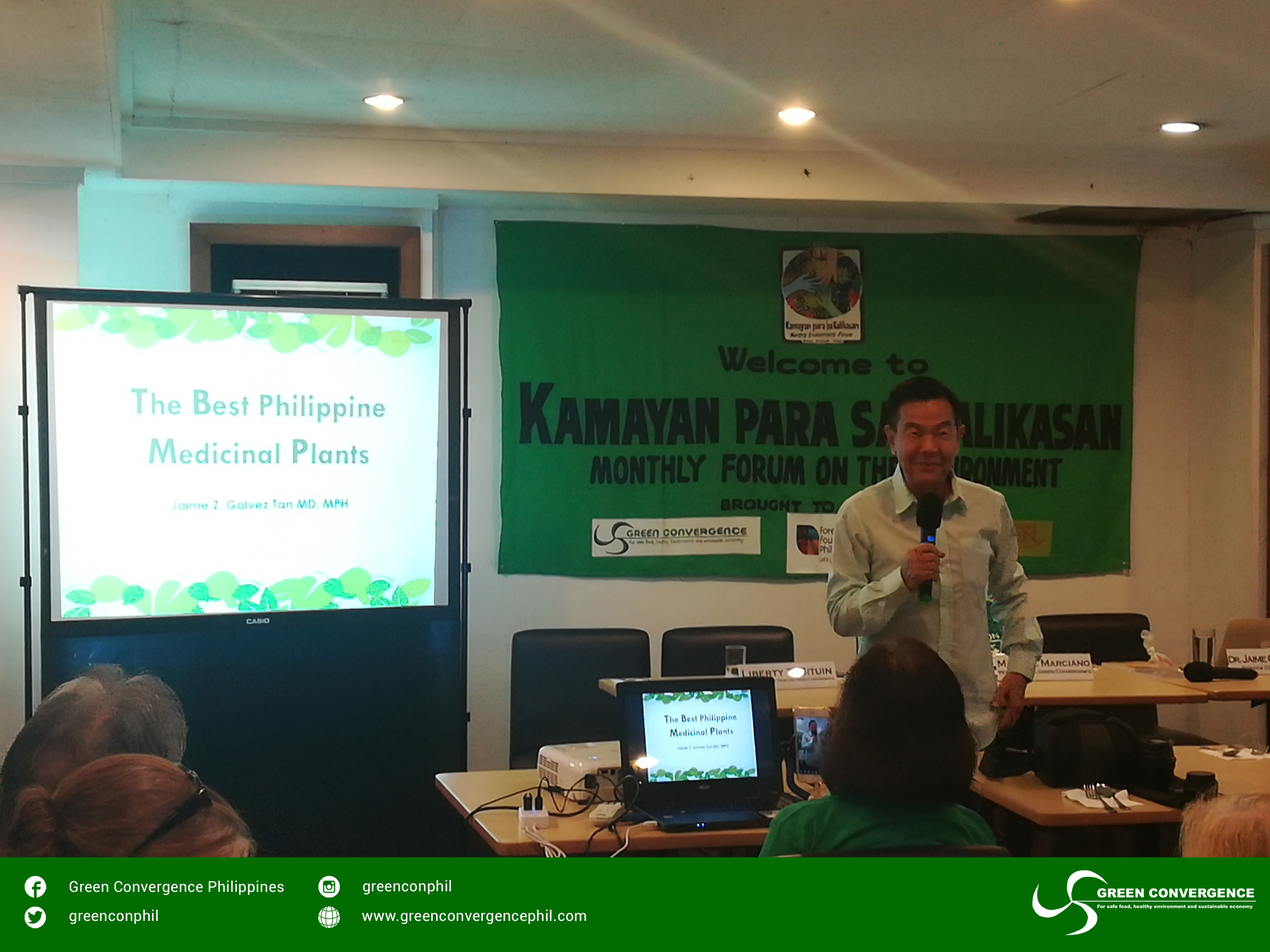
Former Department of Health Secretary Dr. Jaime Galvez Tan discussed that “Around 1500 medicinal plants from more than 13,500 plant species in the Philippines of which more than 3500 are considered indigenous.”

Unfortunately, Galvez Tan stressed, “Only 120 medicinal plants have been scientifically validated for safety and efficacy.”

“Only 10 medicinal plants have been promoted by DOH since 1993 and Philippine Institute for Traditional and Alternative Health Care since 1997,” he added.

Because of this slow promotion of the country’s medicinal plants, an estimated PhP 1.2-billion sales only were attributed to them, compared to PhP 138-billion sales of synthetic drugs. Both records were in 2013.

In fact, Dr. Francis Gomez explained, in mid-1990s to 2000s, medicinal plants had low acceptance from medical doctors due to perceptions that they are associated with ‘Quiapo herbs,’ quack, and backwardness.

“Even Philippine Medical Association stated that herbal medicines are not medicines,” Gomez exclaimed.

Gomez is the CEO and President of New Marketlink Pharmaceutical Corporation, the company behind Lagundex, made of a medicinal plant, whose success was due to persistent education campaign nationwide.

Galvez Tan noted that education campaign on Philippine medicinal plants must continue.

He presented the best medicinal plants that the country possesses: the best vegetable is malunggay (Moringa oleifera), the best spice is luyang dilaw (Curcuma longa), the best grass is takip-kuhol (Centella asiatica), the best palm is coconut (Cocos nucifera), the best stem is makabuhay (Tinospora rumphi), the best flower is ylang-ylang (Cananga adorata Lam), and the best nut is pili (Canarium ovatum Engl.).

All of which have medicinal properties that improve the health conditions of human beings, he stressed.

On the other hand, Igorot and Green Convergence Board Member Liberty Bituin argued that everything in our forests is good for our health. “From fresh air, to the fresh waters, to the stones, to the trees, and all the medicinal plants,” she enumerated, “they are all components of the indigenous ways of improving our health.”

Green Convergence President Dr. Angelina Galang called for the Philippine government to invest in the country’s natural resources and for the civil society to strengthen their campaign for this to be realized.

Since March 1990, Kamayan Para Sa Kalikasan Forum has become an institutionalized platform that enables NGO and government representatives, the media, students, teachers, church groups, and concerned citizens to discuss pressing environmental issues in the country. This month’s forum is organized by Green Convergence and is supported by Kamayan Restaurant EDSA with the assistance of the Forest Foundation Philippines.
You must be logged in to view this content. Free Virtual Library Registration Here

Environmental group echo farmers’ call: ‘Protect PH coconut industry!’

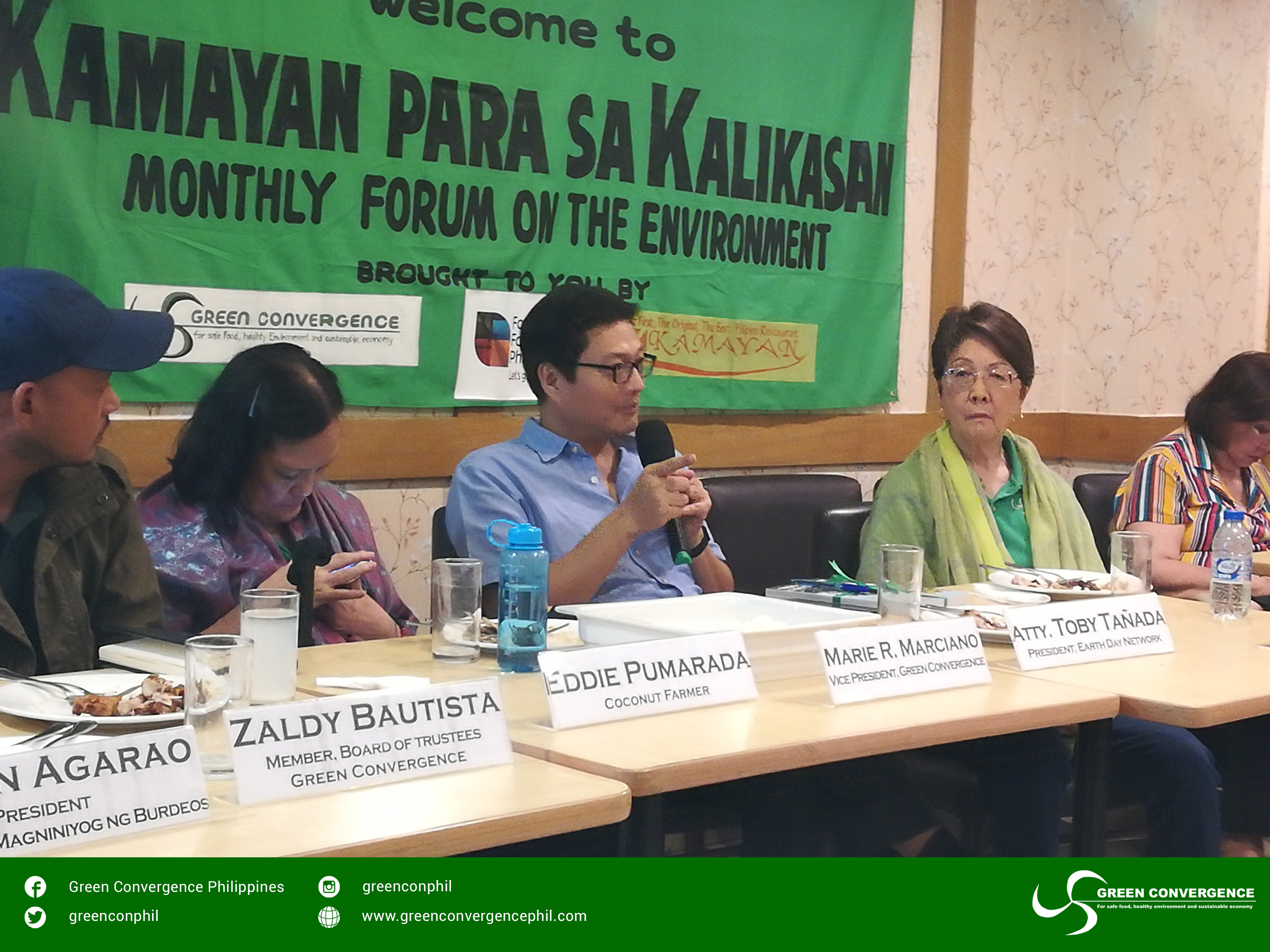
Environmental Coalition Green Convergence held the 351st installment of the monthly Kamayan Para sa Kalikasan Forum about the state of the Philippine coconut industry and alternatives to help the coconut farmers on June 21, 2019 (Friday) at Kamayan Restaurant, EDSA, Mandaluyong City.

Quezon Province’s Samahan ng Magniniyog ng Burdeos President Edison Agarao stressed, “Among the challenges being faced by the coconut farmers are the lowering of coconut product price, market inaccessibility, stiff competition versus other oil products especially palm oil, inaccessibility to technology, and lack of government support.”

The negative state is further aggravated when President Rodrigo Duterte vetoed the Coco Levy Law, one of his campaign promises when he was just running for presidency.

“The campaign for the Coco Levy Bill has gone a long way,” said Atty. Atty. Toby Tañada, President of Earth Day Network, who is one of the major advocates of the policy, “but our farmers were fooled by false promises of this administration.”

Tañada called for a new bill that will immediately address low copra prices. He also encouraged, “Buying from farmers’ cooperatives and [profit] will be used for higher value coco products.”

He also said that the Coco Levy Fund campaign must not stop, and emphasized that “Coconut farmers should not only be the beneficiaries of the coco levy fund, they should likewise be participants in the growth and development of the coconut industry.”

Green Convergence Board Member and coconut farmer himself, Zaldy Bautista introduced intercropping as a way to increase the current income of coconut farmers.

It is a multiple cropping practice that involves growing two or more crops in proximity. Due to profit-oriented agriculture, the method has lost its relevance to farmers.

Madalas na itong ginagawa noong unang panahon ng ating mga ninuno,subalit hindi lang ito masyadong napahalagahan ng ibang mga magsasaka (This has often been done by our ancestors ever since, but this is not given importance by some farmers),” he explained.

Dr. Angelina Galang, Green Convergence President emphasized that the fight for food security is intertwined with the environmental struggle. She mentioned that achieving the ideal future for our common home is achieving the ideal future of the poor.

Since March 1990, Kamayan Para Sa Kalikasan Forum has become an institutionalized platform that enables NGO and government representatives, the media, students, teachers, church groups, and concerned citizens to discuss pressing environmental issues in the country. This month’s forum is organized by Green Convergence and is supported by Kamayan Restaurant EDSA with the assistance of the Forest Foundation Philippines.
You must be logged in to view this content. Free Virtual Library Registration Here

Environmental forum: ‘Go for ecological agriculture practices!’

Environmental Coalition Green Convergence held the 350th installment of the monthly Kamayan Para sa Kalikasan Forum about alternatives to intensive agriculture and achieving food security on May 17, 2019 (Friday) at Kamayan Restaurant, EDSA, Mandaluyong City.

Green Convergence President Dr. Angelina Galang emphasized that “agriculture has almost permanently gone to mass farming methods.”

“While this has arguably contributed to food security,” Galang said, “it resulted in a common perception that plants used in farming and for food are for such purposes only.”

Intensive use of crops solely for mass farming led to “their fading role in maintaining the integrity of our ecology,” she further stressed.

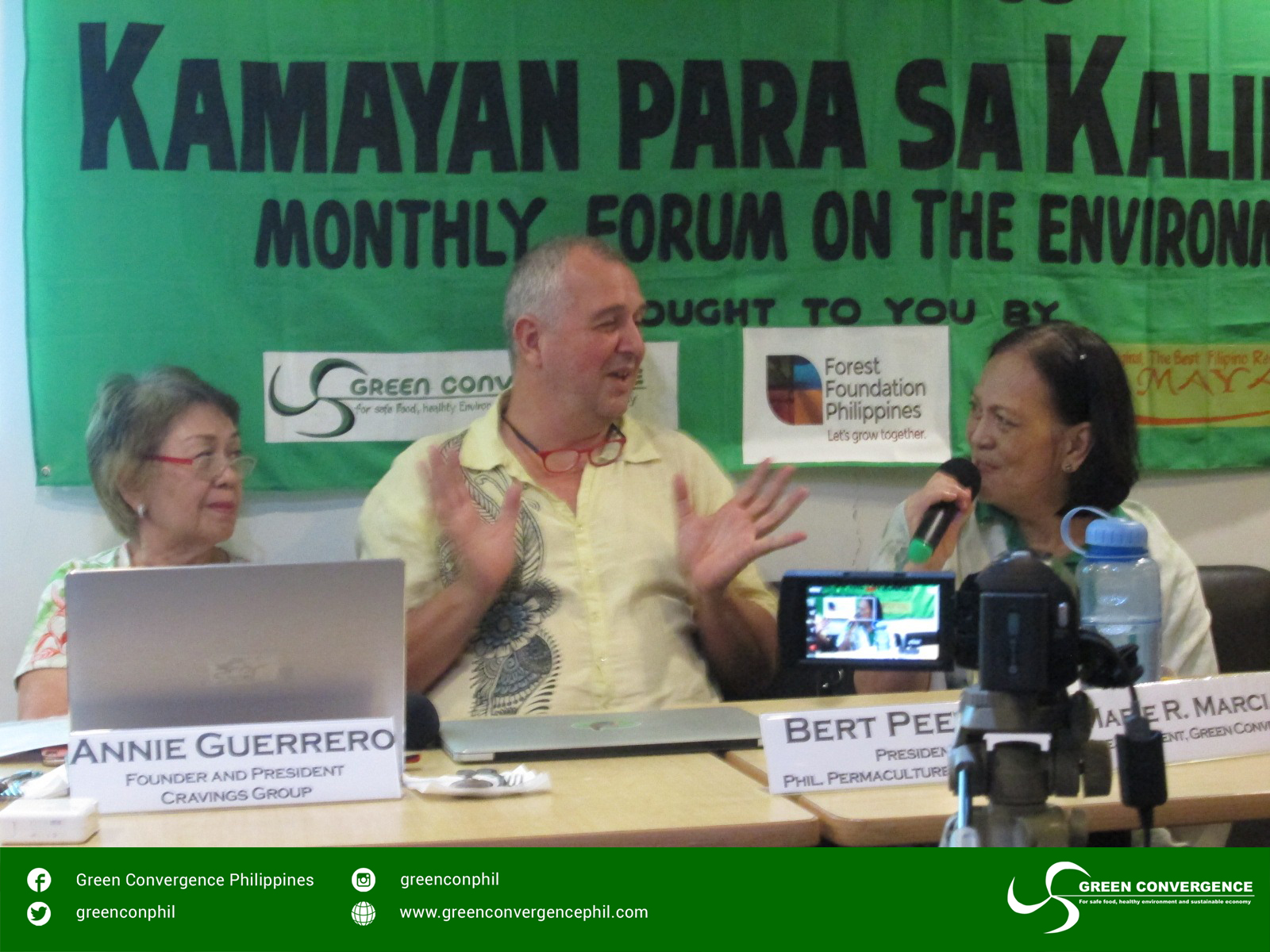
President Bert Peeters of the Philippine Permaculture Association described this phenomenon’s impacts to people, “We are becoming individually more and more separated…our society is a growing ego-system, but a shrinking eco-system.”

To help regain the crops’ ecological role and human connection to the ecosystem, Annie Guerrero, President of Cravings Group introduced the idea of ‘green chefmanship.’ She explained, “Being green means organic, local and sustainable.”

“[It includes the] use of Bokashi technology, an anaerobic composting by fermentation, [and] a process of mixing beneficial microorganisms into kitchen wastes to create powerful yet inexpensive fertilizers,” Guerrero further described the idea.

Green chefmanship coincided with Peeters’ view that “We have to go smooth with biodiversity by connecting to the places where nature thrives…studying the energy flow…and understanding the beautiful shapes of living things.”

Peeters added, “All we need is a little wilderness.”

Since March 1990, Kamayan Para Sa Kalikasan Forum has become an institutionalized platform that enables NGO and government representatives, the media, students, teachers, church groups, and concerned citizens to discuss pressing environmental issues in the country. This month’s forum is organized by Green Convergence and is supported by Kamayan Restaurant EDSA with the assistance of the Forest Foundation Philippines.

You must be logged in to view this content. Free Virtual Library Registration Here

Coalition rejects China-funded Kaliwa Dam project

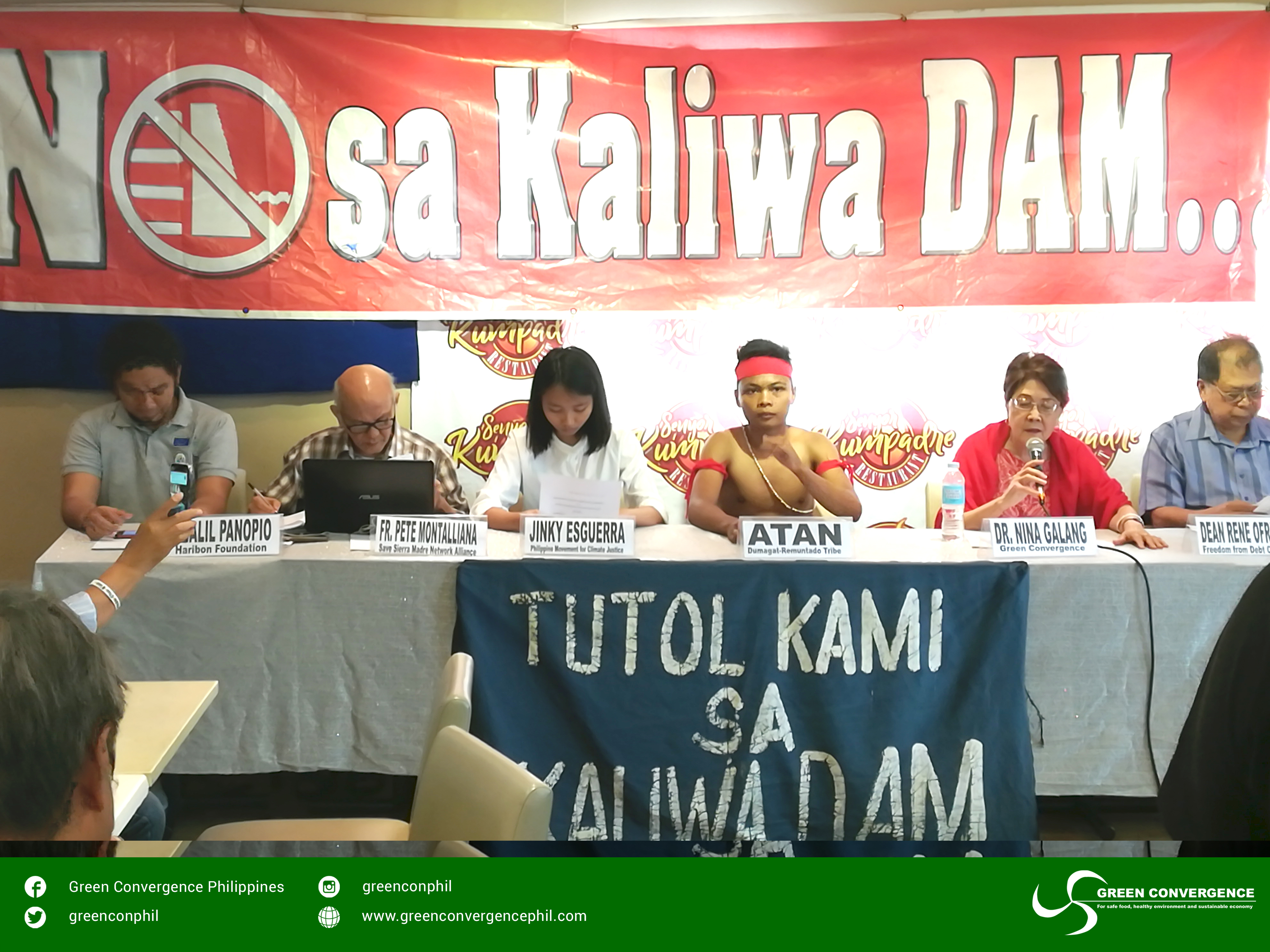
MANILA, Philippines — A coalition of environmental and rights groups has expressed its strong opposition to the proposed construction of Kaliwa Dam, saying the China-funded project would put people’s lives at risk, destroy the biodiversity in the area and tie the country to an ‘onerous’ loan.

The Kaliwa Dam project, a $211.21-million loan from China, is being touted as a solution to Metro Manila’s water requirements. But for Sectors Opposed to the Kaliwa Dam (STOP Kaliwa Dam), the government is just using the shortage in water supply to “aggressively promote” the controversial project.

STOP Kaliwa Dam said there are “more than enough (reasons) to call into serious question the wisdom of pushing through with the construction of the Kaliwa Dam.”

Violation of legal processes

STOP Kaliwa Dam stressed that the project failed to secure consent from the Dumagats and Remontados who own the land as required by the Indigenous Peoples Rights Act.

“In fact, the IP leaders in the area have questioned the Free, Prior and Informed Consent process currently being undertaken by the National Commission on Indigenous Peoples because they were not provided with copies of relevant documents from the Metropolitan Waterworks and Sewerage System as project proponent which are essential for evaluating and making informed decisions,” the groups said.

They also said that the Environmental Management Bureau of the Department of Environment and Natural Resources has not yet issued an Environmental Compliance Certificate, which is needed for any project that poses a potential risk to the environment.

The groups, moreover, said that the construction of the access road to the dam site violates the law since it has no permit from the Protected Area Management Board and the local government unit of Infanta, Quezon.

They also said that the Environmental Management Bureau of the Department of Environment and Natural Resources has not yet issued an Environmental Compliance Certificate, which is needed for any project that poses a potential risk to the environment.

Destruction of biodiversity, contribution to climate change

STOP Kaliwa Dam pointed out that “building a mega dam in the area will cause irreparable damage to the surrounding ecosystem and endanger [and] devastate animal and plant life.

Proclamation 573 declared the Kaliwa Watershed a forest reserve and Proclamation 1636 declared a portion of the area a National Park and Wildlife Sanctuary.

Citing information from the Haribon Foundation, the groups said the Kaliwa Watershed is home to the endangered Northern Philippine Hawk-eagle, Philippine Brown Deer, Philippine Warty Pig, vulnerable Northern Rufous Hornbill, critically-endangered Philippine Eagle and restricted-range birds of the Luzon Endemic Bird Area.

The groups also said that dam reservoirs are “significant” source of greenhouse gas emissions.

“As one of the countries suffering the brunt of climate change impacts, from devastating typhoons to prolonged dry spells, it would be irresponsible and irrational to fund a project that will exacerbate climate change,” they said.

Social cost

The groups noted that the ancestral domains of the Dumagat and Remontados as well as sacred sites and burial grounds will be submerged by the dam.

“Construction of the dam will inundate the Barangay Daraitan in Tanay, Rizal with a population of 1,000 households and 500 households from Pagsangahan, General Nakar, Quezon. This will mean the loss of significant income for the area due to the loss of eco-tourism which has seen a boom in recent years,” they said.

The town of Infanta will lose the benefit of sediment-carrying river flows, which will then affect irrigation to rice paddies, they added.

STOP Kaliwa Dam also said that the project will endanger the lives of people as the mega dam will be constructed within the zone of two active tectonics—the Philippine Fault Zone and the Valley Fault System.

‘Onerous’ loan

The organizations, moreover, stressed that the project “will add to the country’s ballooning debt.

The $211.21-million loan from China carries an interest rate of two percent per annum, payable in 20 years, including a grace period of seven years. It covers 85 percent of the project’s contact amount and carries a management fee of 0.3 percent as well as a commitment of 0.3 percent per annum.

STOP Kaliwa Dam added the project “binds the country to an onerous agreement that encroaches on our sovereignty and opens up assets and natural resources to potential seizure by China.”

Supreme Court Senior Associate Justice Antonio Carpio was quoted as saying that Kaliwa Dam project also offers patrimonial assets as collateral.

But Finance Secretary Carlos Dominguez said the Philippine government does not need to surrender any of its assets to China in case the country fails to settle its obligations on infrastructure projects.

“In conformity with the constitution and laws of the Philippines, none of the pipeline projects allow for appropriation or takeover of domestic assets in the event of failure to pay which hollows out our sovereignty,” Dominguez said.

STOP Kaliwa Dam includes the following organizations:

  • Save Sierra Madre Network Alliance
  • Haribon Foundation
  • Freedom from Debt Coalition
  • Philippine Movement for Climate Justice
  • Alyansa Tigil Mina
  • Green Convergence
  • PAKISAMA
  • Greenresearch
  • Purple Action for Indigenous Women’s Rights (LILAK)
  • Sukatan – LN
  • Ateneo – Office for Social Concern and Involvement
  • NTFP-EP PH
  • Center for Energy, Ecology, and Development
  • Oriang
  • Kongreso ng Pagkakaisa ng Maralitang Lungsod
  • Pambansang Koalisyon ng Kababaihan sa Kanayunan
  • Kalamidad
  • Sanlakas
  • PUP Center for Envrionmental Studies
  • Prelature of Infanta Community Organization of the Philippines Inc.
  • Tribal Center for Development
  • Samahan ng mga Katutubong Agta, Dumagat, Remontado na Binabaka at Pinagtatanggol ang Lupaing Ninuno (SAGIBIN-LN)
  • TFSM-BE
  • Tanggol Kalikasan
  • Bantay Kita
  • Green Thumb Coalition
  • 11.11.11
  • Citizens’ Environment Network.

Source: Philippine STAR


“Cha-Cha” gets heavy beating at forum

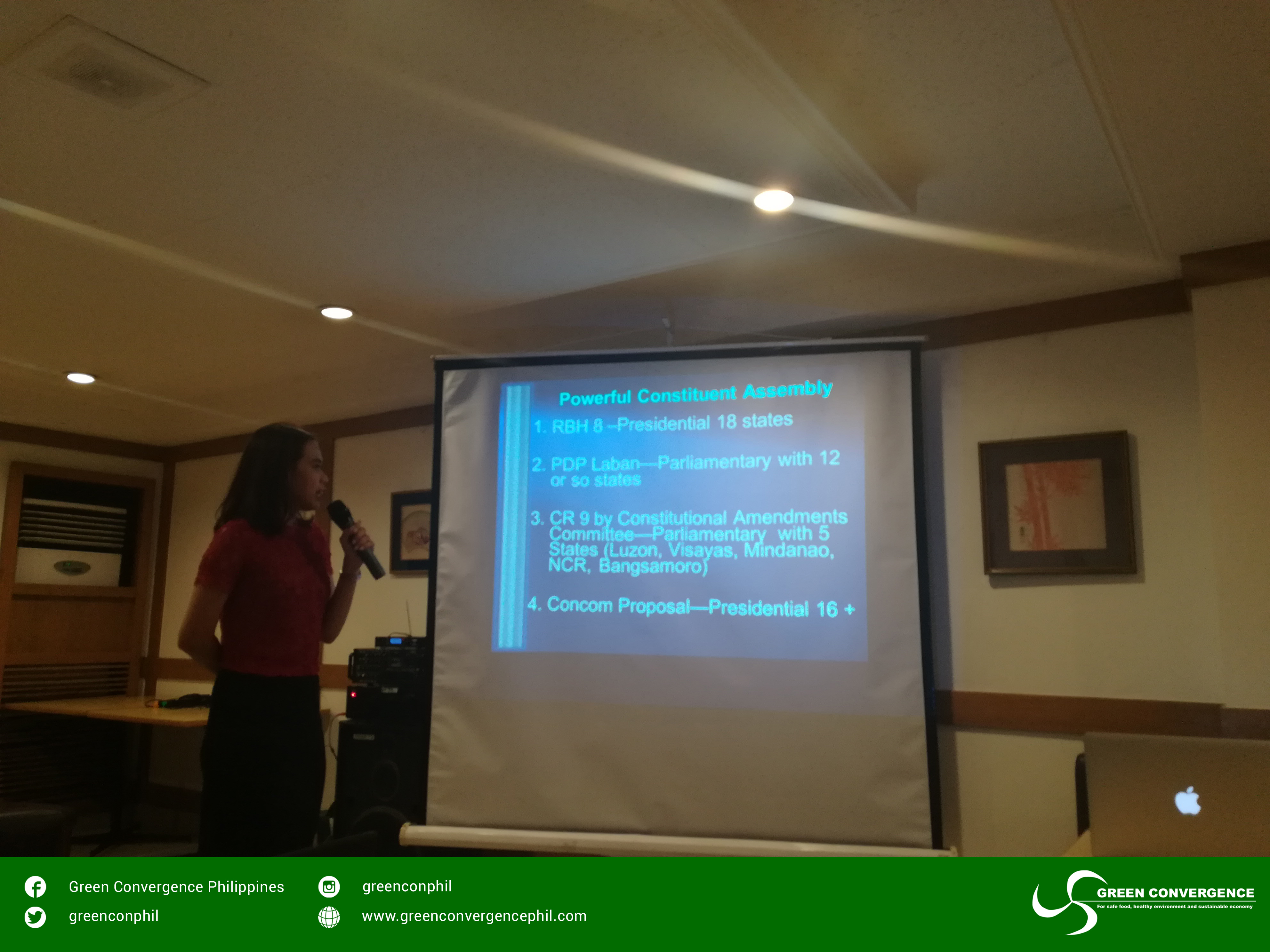
“The proposed Cha-Cha is anti-Filipino in the sense that it is removing protectionist provisions enshrined in the 1987 Constitution that ensure our right to be in control of our resources.” This was the opening salvo of Bayan Muna General Counsel Atty. Cris Yambot at the 348th session of the monthly Kamayan Para sa Kalikasan Forum, which tackled the proposed Charter Change (Cha-Cha) that would shift the Philippines to a federal form of government.

“Furthermore,” Yambot added, “it grants new and formidable powers to the President, giving him executive, legislative, and judicial control over the entire government. It opens the country wider to transnational corporations, and it dilutes or deletes the social justice and human rights provisions enshrined in the 1987 Constitution.”

Atty. Cris Yambut, General Counsel of Bayan Muna discusses the different versions of Charter Change being proposed in the Congress. She noted that Resolution of Both Houses No. 8 or the version submitted by Former President Gloria Arroyo is the one that has been passed at the committee level. It is primarily because “they have the numbers.”

In relation to foreign ownership, Yambot emphasized that in the proposed versions, transnational corporations would in effect be allowed to own and control lands, including already scarce agricultural lands that produce our food supply, and would lift established limits on foreign ownership of mining companies.

She then pointed out specific provisions in the draft Constitution that would abridge the rights of the Filipino people and reduce or remove their protection against unfair competition from big foreign corporations.

For example, she explained, the right to freedom of expression is put in danger by changing it in the proposed charter to “freedom of ‘responsible’ expression.”

“Who is to decide what’s ‘responsible?’” Yambot asked. “Will criticizing government or attending a rally be deemed ‘irresponsible?’”

In an unusual turn of events, Yambot was the sole speaker in this month’s forum, which always strives to present different sides of an issue. Unfortunately, SAGIP Party-list Representative Rodante Marcoleta, one of the authors of the draft Cha-Cha failed to come. Although he had confirmed his attendance up to the day of the forum, he cancelled at the last minute, citing an unforeseen meeting.

Finally, Yambot warned that many of the draft provisions would impact negatively on the environment, and encouraged everyone to carefully study the draft Cha-Cha which is available at the Congress website.

In her closing remarks, Dr. Angelina Galang, President of forum organizer Green Convergence said, “Everything is connected to the environment. We should protect our environment, thus, ownership should be left to the Philippines.”

A bit of politics entered the discussion but Galang enjoined everyone to rise above personal ties, family, alliances and emotional preferences and vote as Filipinos, for the good of the country. She also encouraged citizens and environmental groups to work on influencing lawmakers to reject provisions harmful to the environment and the Filipino people.

Kamayan Para sa Kalikasan Forum has become an institutionalized platform since March 1990 that enables NGO and government representatives, the media, students, teachers, church groups, and concerned citizens to discuss pressing environmental issues in the country. This month’s forum is supported by Kamayan Restaurant EDSA with the assistance of the Forest Foundation Philippines.
You must be logged in to view this content. Free Virtual Library Registration Here

Green Convergence forum tackle effectiveness of ecobricks

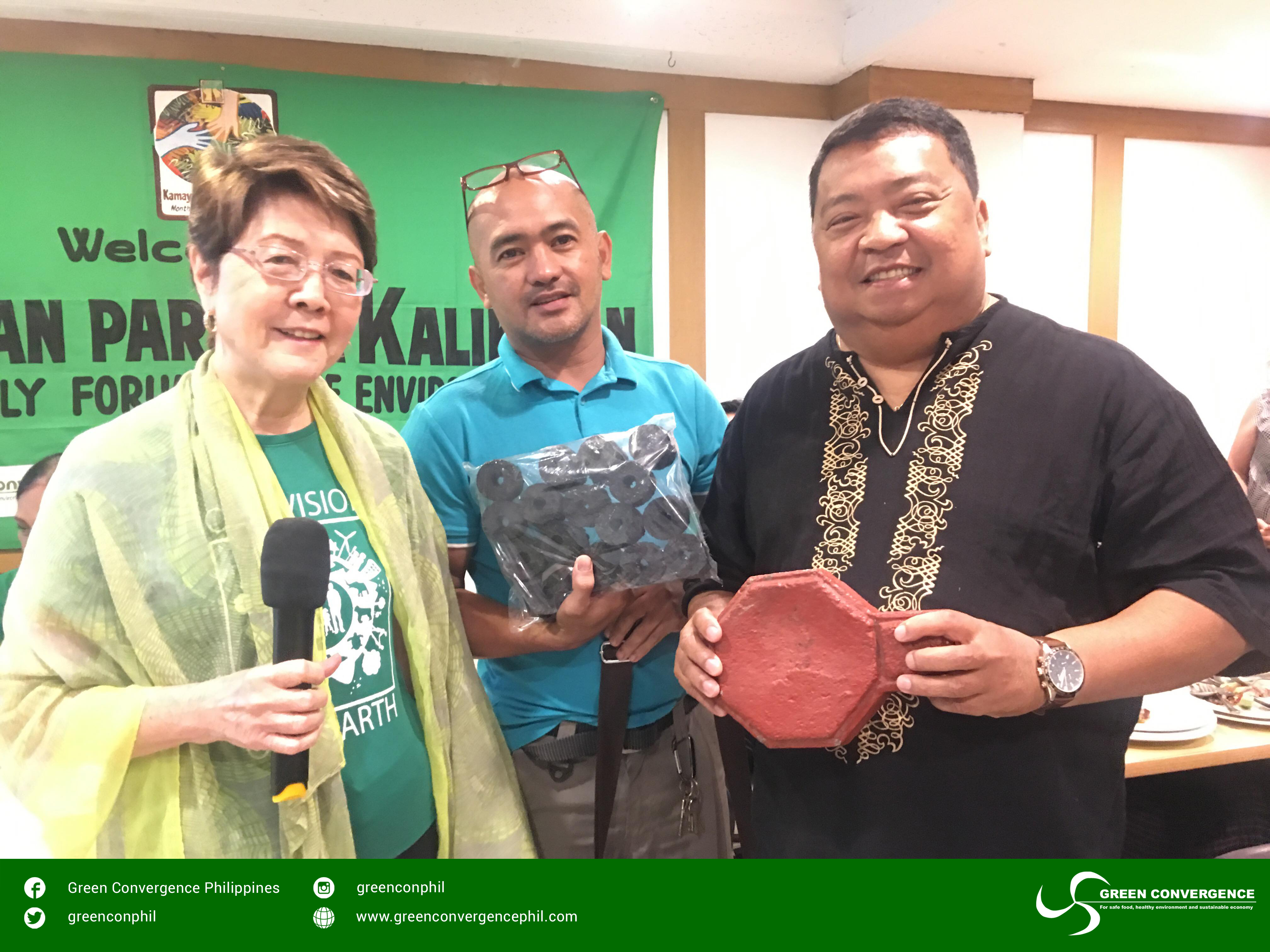
Environmental coalition Green Convergence held the 347th installment of the monthly Kamayan Para sa Kalikasan Forum last February 15, 2019 at Kamayan Restaurant, EDSA, Mandaluyong City. Resource speakers included Lou Arsenio of Ecobricks Philippines, Chairman Rolly Datiles of Barangay Bagumbuhay, Quezon City and Juvy Serafin of the Solid Waste Management Division of the Department of Environment and Natural Resources.

Dr. Angelina Galang (left) with Barangay Bagumbuhay Captain Rolly Datiles (right). Capt. Datiles is successful in implementing the ecological solid waste management law in his barangay with the ecobrick project that he innovated.

The forum scrutinized the two versions of ecobricks – (1) plastic bottle containers stuffed with dry plastic wastes which are used as filler bricks in building systems and (2) actual hollow blocks that are stronger than the former and are made by mixing wet cement and shredded plastic wastes.

Arsenio stressed that the said first version is supposed to be hard as a brick. “Dapat may proper training ang paggawa nito [ecobricks] dahil kung mali ang pagkakagawa, mahirap po itong ayusin (There should be a proper training for making ecobricks because if they are wrongly made, it would be difficult to fix them),” she followed.

On the other hand, Datiles explained that his community’s way of doing the second version is by processing non-biodegradable residual plastic wastes and mixing them with cement to be transformed into tiles and bricks. He presented the 4 E’s that supported his community’s ecobrick initiative and made their ecological solid waste management program successful:

“First you need education for the awareness campaign of the problem and proposed solutions. Second you need engineering so you would have proper equipment for realizing the solution. Third is enforcement. There needs to be a barangay ordinance for the program. Finally, economic sustainability where each household gain economic rewards by participating in the program.”

Serafin lauded the efforts of Chairman Datiles and mentioned, “Kung effective lang talaga ang management ng waste at the barangay level, wala sanang problema sa basura (If waste management is just effective at the barangay level, there could’ve been no problem with wastes).”

She further noted that “Ang dapat atakehin ay ang behavior ng mga tao…lifestyle kasi ng mga tao ngayon is convenience kaya management po ang approach natin (People’s behavior should be tackled…since our lifestyle is now is focused on convenience, that’s why our approach for this is management).”

Datiles said that the problem with wastes is global but the solution must be local. His barangay was also once like Payatas, heavily faced with waste problems. “Inimplement lang po namin ang RA 9003 [Ecological Solid Waste Management Act] na sinuportahan din ng aming [Quezon City] LGU…may City Ordinance No. 1203 po kasi na nagbibigay incentives sa mga barangay na may maayos na solid waste management program (We just implement RA 9003 which is supported by our LGU…there is City Ordinance No. 1203 that gives incentives to the barangays that have good solid waste management programs),” he shared.

However, Arsenio clarified that ecobricks are just a temporary solution. “Ang ecobricks na isinusulong namin ay para lang sa gardening at low walls kaya hindi naman siya kakalaban sa Building Code (The ecobricks that we promote are only for gardening and low walls, that’s why it would not go against the Building Code),” she claimed.

This contrasts with Datiles’ version, “Nagpatest kami sa UP at pumasa naman ang strength ng aming ecobricks…at may mga contractor na bumibili sa amin (We underwent a test at UP and the strength of our ecobricks passed…and we already have contractors that buy from us).”

Serafin discussed that “Kung nagproduce po tayo ng wastes, saan po mapupunta iyon? Ang DENR ay sumusunod sa waste management hierarchy kung saan ang first preferred option po natin ay waste avoidance…nasa efficiency po ‘yan ng LGUs (If we produce wastes, where will they go to? The DENR follows the waste management hierarchy where the first preferred option is waste avoidance…its efficiency lies on the LGUs)” implying that waste-to-energy initiatives like incineration depends on the LGUs’ effectiveness in solid waste management.

Dr. Angelina Galang, Green Convergence President concluded that “We have to look into our individual actions…take it upon ourselves to make them (LGUs) do their job properly. Management is the thing. These options are all open to us but we have to choose what is doable.”

Now on its 29th year, Kamayan Para sa Kalikasan Forum has become an institutionalized platform since March 1990 that enables NGO and government representatives, the media, students, teachers, church groups, and concerned citizens to discuss pressing environmental issues in the country. This month’s forum is supported by Kamayan Restaurant EDSA with the assistance of the Forest Foundation Philippines.
You must be logged in to view this content. Free Virtual Library Registration Here

Letter of Support for the Mangyan Communities

January 22, 2019

HON. ROY A. CIMATU
Secretary
Department of Environment and Natural Resources

Dear Secretary Cimatu,

Isang makakalikasang pagbati!

We, participants of the Kamayan para sa Kalikasan Forum held last January 18, 2019 at Kamayan Restaurant on EDSA, echo the call of the Mangyans in Mindoro that they be involved in decision- making processes affecting their communities.

In 2015, when Typhoon Nona struck Mindoro, the towns of Naujan, Victoria and Baco suffered from massive floods and landslides. This resulted in loss of family members and sources of livelihood. It was later discovered that the negative impacts of the typhoon were worsened by the excessive blasting during the construction of a hydro power plant and its connecting tunnel by the Sta. Clara International Corporation. The blasting heavily deforested the area and weakened the rock substrate causing landslides and flooding.

Members of the communities including the Mangyans, insisted that mountain blasting was not agreed upon by involved stakeholders in the Memorandum of Agreement on the construction of the power plant. Asked by tribe leaders why this aspect of the agreement was invalidated, the corporation responded that it needed to meet certain deadlines; that mountain blasting was the faster method to finish the power plant’s construction.

While the local authorities have decided to halt the construction activities of the plant in 2016, a lot of damage and loss has already occurred. It will be hard for the affected communities to recover from the tragic experience. Therefore, we further support their appeal that community members be included in the monitoring of the rest of this project as well as other projects.

We call on your good office to review Republic Act 8371 or the Indigenous People’s Rights Act of 1997 and to uphold its provisions especially on “ensuring genuine exercise by Indigenous Cultural Communities of their right to Free and Prior Informed Consent (FPIC), whenever applicable” and on “protecting their rights in the introduction and implementation of plans, programs, projects, activities and other undertakings that will affect them and their ancestral domains to ensure their economic, social and cultural well-being.”

Indigenous peoples are crucial in the environmental struggle because they experience firsthand the dangers of the rapid destruction of the environment. We must learn from their perspective, they who live intimately with nature. Projects meant for development may ironically become tools for disasters and further lowering of people’s quality of life should they be implemented without consulting, engaging and involving all the stakeholders. Ensuring the rights of indigenous peoples means ensuring the integrity of the environment.

With DENR in the helm of protecting the environment, let us all work together towards the protection of our only home and the achievement of sustainable development!

Para sa kalikasan,

Green Convergence for Safe Food, Healthy Environment and Sustainable Economy

[distance1]Click the link below for the letter received by the DENR:
Letter of Support for the Mangyan Communities

GC to PH gov’t: ‘Respect rights of IPs; no to false environmental solutions!’

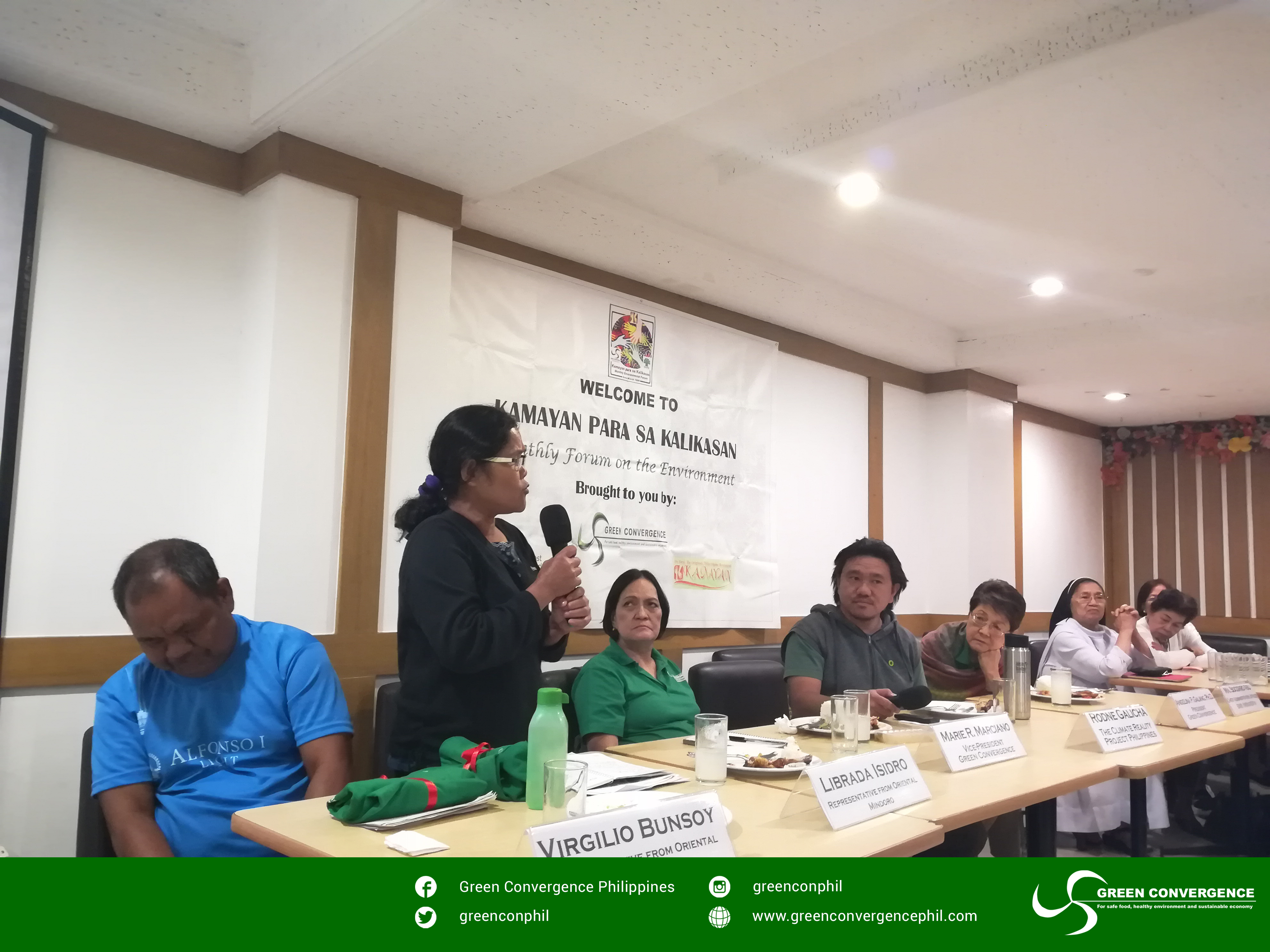
Environmental coalition Green Convergence held “Landslides: Today’s Recurrent Nightmare,” at its monthly Kamayan Para sa Kalikasan Forum. Resource speakers included Rodne Galicha of Climate Reality Philippines and Mangyan representatives from Mindoro Virgilio “Ka Mot” Bunsoy and Alangan tribe leader Librada “Ka Badang” Isidro. They discussed the current environmental situation of Mindoro and the disasters that it regularly experiences related to flooding and landslides caused by mining and mountainside blasting.

Galicha showed the rich biodiversity of Mindoro by presenting a map showing its key biodiversity and important bird areas. Unfortunately, when overlaid with the location of mining areas, it revealed overlaps causing many concerns for its natural landscapes. Citing the cause of recurrent massive landslides in the island, Galicha explained that in mining, drilling is done to know the mineral deposits undernealth; but it is common sense that if mountain blasting is added, landslide will naturally occur since one drilled hole can trigger other existing holes to cause a landslide.

Ka Mot said that mountain blasting in the island is currently being done to give way to the construction of the 8-MW Santa Clara hydro power plant project that will supply the island’s electricity needs; however, he pointed out that there was no mention of any mountain blasting in the Memorandum of Agreement among the Mangyan communities, the local government and the company in-charge of the hydro plant. When he verified this with the engineer in-charge, he was informed that mountain blasting is needed to finish the tunnel on its target deadline.

Aggravated by typhoon Nona in 2015, mountain blasting has caused several landslides forcing Oriental Mindoro Governor Alfonso Umali Jr., to halt the project in 2016.  Mangyan leader, Ka Badang painfully recalls that when typhoon Nona struck, the river overflowed, flooding devastated their community.  Their crops were destroyed and 200 families in one community were left homeless.

“Ang lupa at bundok ay katumbas ng aming buhay. Ang bundok po, ito ay aming pinakabangko dahil dito kami kumukuha ng aming ikinabubuhay,” Ka Badang passionately shared how the IPs see nature during the 346th Kamayan Forum.

Angelina Galang, Green Convergence President, explained that a hydropower plant, though seemingly a better alternative to fossil fuels, may be a false solution when it is not appropriate to the ecology of the place. This is why it is essential to include the indigenous inhabitants in consultations and decisions because they intimately know the area.

Ka Badang recommended to consider solar power as an alternative source of energy for their area because of its relatively less environmental impact.  She also asked for legal support so they can easily voice out and stand for their rights over their ancestral lands.

“Landslides: Today’s Recurrent Nightmare,” was held last January 18, 2019 at Kamayan Restaurant, EDSA, Mandaluyong City. Now on its 29th year, it is the 346th forum of Green Convergence, institutionalized to provide a platform for civil society, government, and media to discuss pressing environmental issues of the country. This month’s forum is supported by Kamayan Restaurant EDSA with the assistance of Forest Foundation Philippines.

You must be logged in to view this content. Free Virtual Library Registration Here

2nd Philippine Environment Summit 2018 (Cebu) Progress Reports

The Environment Summit is a biennial undertaking of Green Convergence to celebrate important breakthroughs and advancements in environmental protection through private and public initiatives. It provides a platform where all sectors can share common challenges, collaborate on creative solutions, and replicate success stories. It is a call to government and the Filipino people to unite in accelerating the drive towards national sustainable development.

Green Convergence is a large coalition of organizations, networks and individuals. With its private partners and DENR, it successfully held the 1st Philippine Environment Summit at the SMX Convention Center, Mall of Asia in February 2016 and the 2nd Philippine Environment Summit at the Waterfront Hotel, Cebu IN February 2018.

Click the links below to know what happened in the summit:
Philippine Environment Summit 2018 Progress Report Day 1

Philippine Environment Summit 2018 Progress Report Day 2

Philippine Environment Summit 2018 Progress Report Day 3