
Thermal waste-to-energy tech, unsafe says environmental scientist

Plastic trash.


BAGUIO CITY – An environmental scientist and former United Nations Development Program (UNDP) consultant said the waste-to-energy (WtE) program promoted by the government is unsafe for the public and environment.

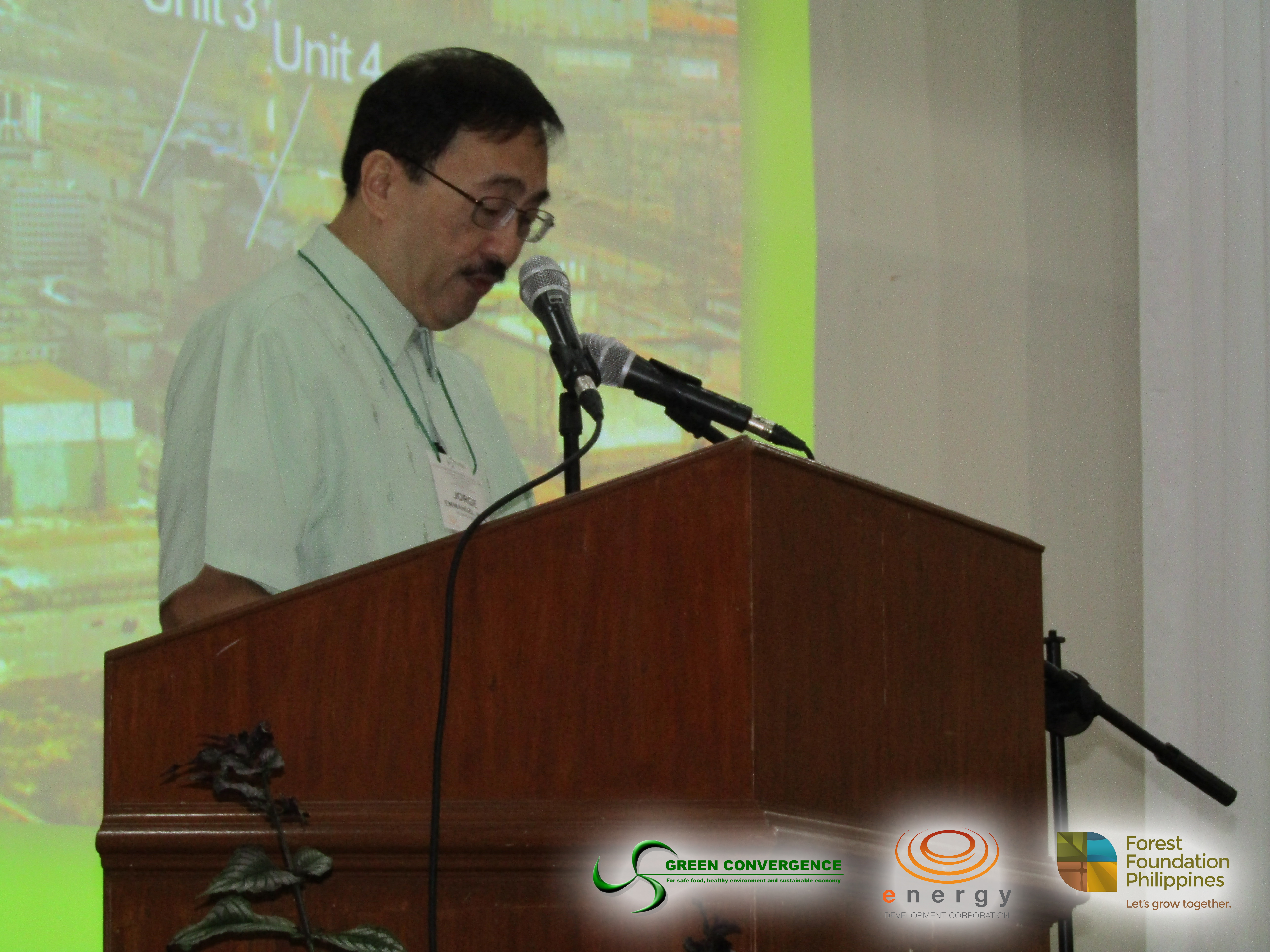
In his talk during the State of the Nature Assessment at Albergo Hotel, Baguio City on August 20, Dr. Jorge Emmanuel, underscored that the people’s health and environment must come first when considering technologies for power generation.

“WtE does not make waste disappear but turns them into toxic ash and pollutants in the air,” he said, adding that, “toxic particulates and gases are concentrated to pollution reduction devices that also require special handling and disposal.”

Emmanuel, who worked as the Chief Technical Advisor of the UNDP on Global Healthcare Waste Projects explained “clean incinerators” are fallacies. He added that the government’s promotion of WtE runs contrary to Clean Air Act (RA 8749) and the law on solid waste disposal (RA 9003g) that prohibits use of incinerators.

He said toxic pollutants are released in varying levels overtime including the deadly dioxin variety — 2,3,7,8-tetrachloro-dibenzo-p-dioxin — and he claims that “[the government] has no capability to continuously monitor dioxins in the environment.”

Environmentalists and many scientists here and abroad have criticized thermal waste treatment and disposal facilities billed as WtE as nothing new, but incinerators attached to boilers and turbines to harness the generated heat to produce power.

There are currently 12 WtE plants in Northern Luzon with a capacity of 87 megawatts according to the Department of Energy December 2017 record. Two are located in Region 1.

The Pepsi Biomass Plant in Rosario, La Union managed by Sure PEP, Inc. is installed but not operational and non-compliant with its reporting obligation based on DoE’s latest report.

A facility set to rise in Brgy. Nagpanaoan, Santa, Ilocos Sur costing P1.16 billion will generate 10MW. Upon operation, the plant will employ 30 individuals and consume 86 tons and 200 tons of municipal solid waste and agricultural waste respectively.

In his first State of the Nation Address, President Duterte said his administration will pursue waste-to-energy technology for power generation and waste management program. The Department of Environment and Natural Resources (DENR) in August 2017 called WtE a “win-win solution” and “smart alternative” to the country’s garbage problem.

Legalizing the use of incinerators is also on the way in the House of Representatives through House Bill 6893 which seeks to amend RAs 8749 and 9003. When passed, the legislation will allow the use of thermal and other treatment technologies to dispose or utilize municipal and hazardous wastes for fuel.  (TNM/Sherwin De Vera)
Green SONA tackles “environmental monsters”

By SHERWIN DE VERA via Northern Dispatch Weekly

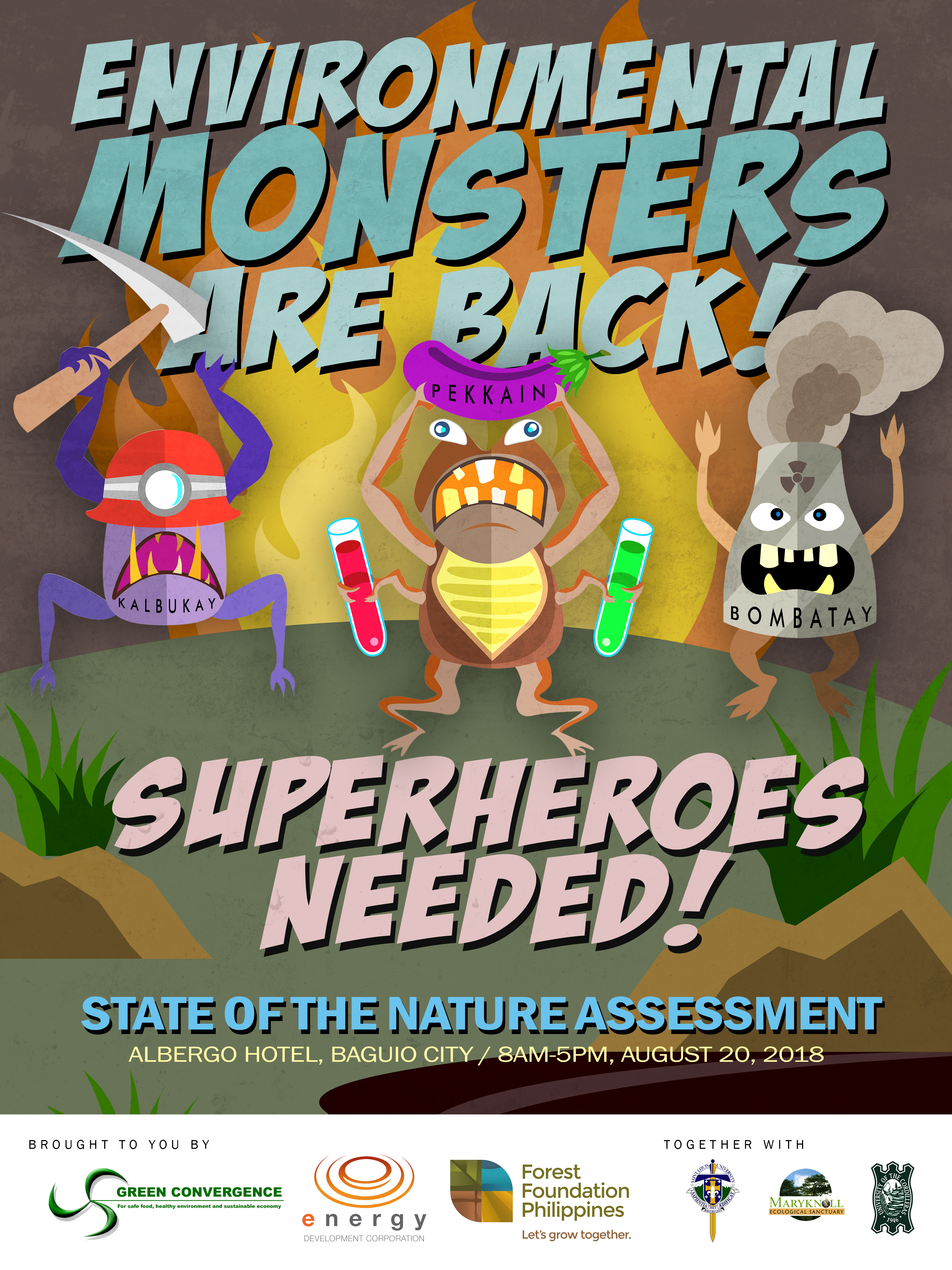
BAGUIO CITY — Environmental advocates across the country gathered at Hotel Albergo in this city on Monday, August 20, for the annual State of the Nature Assessment (Green SONA) organized by Green Convergence (GC). This year’s theme, “Environmental monsters are back; Superheroes needed!” underscored the call for action to protect the environment.

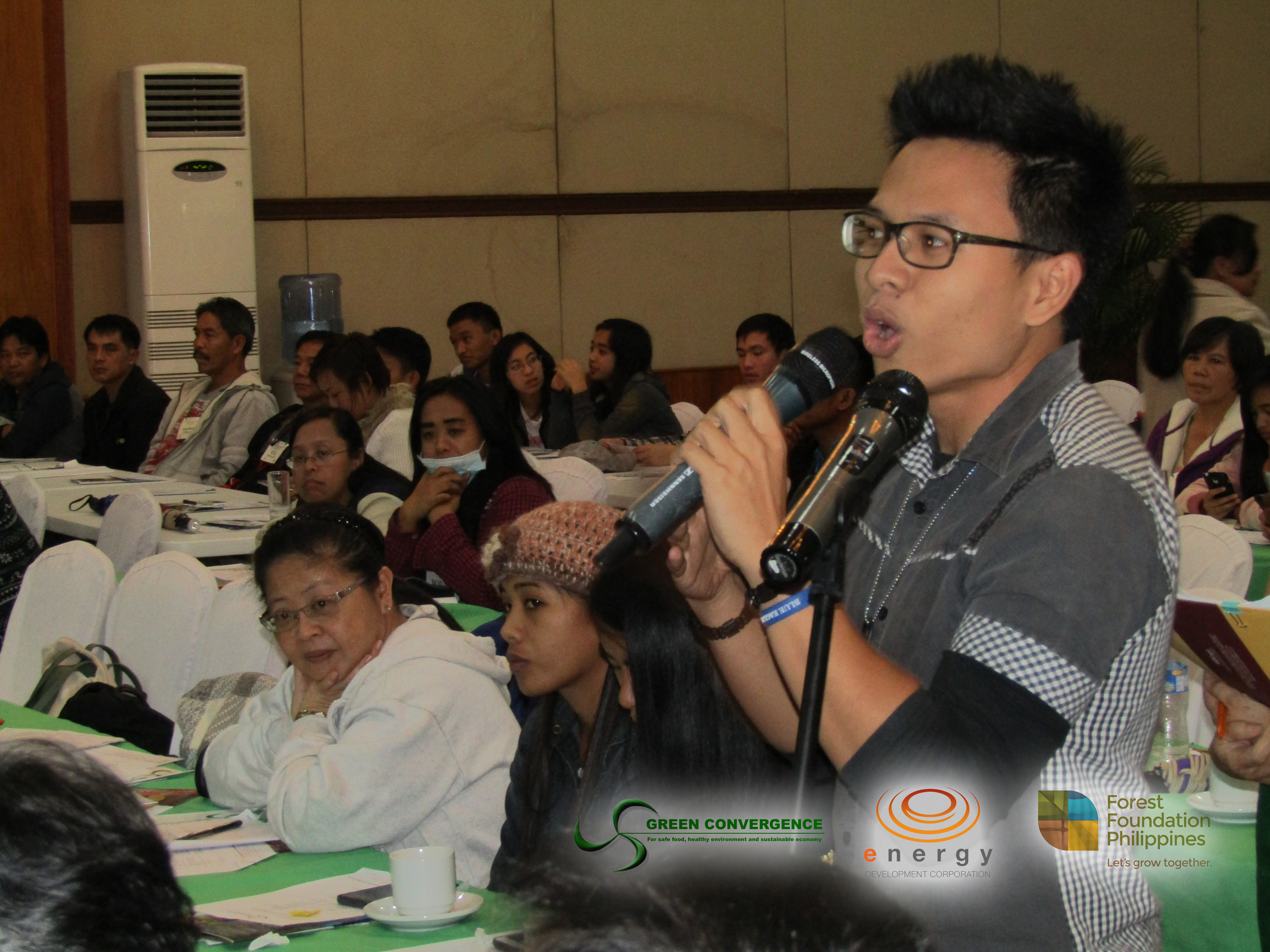
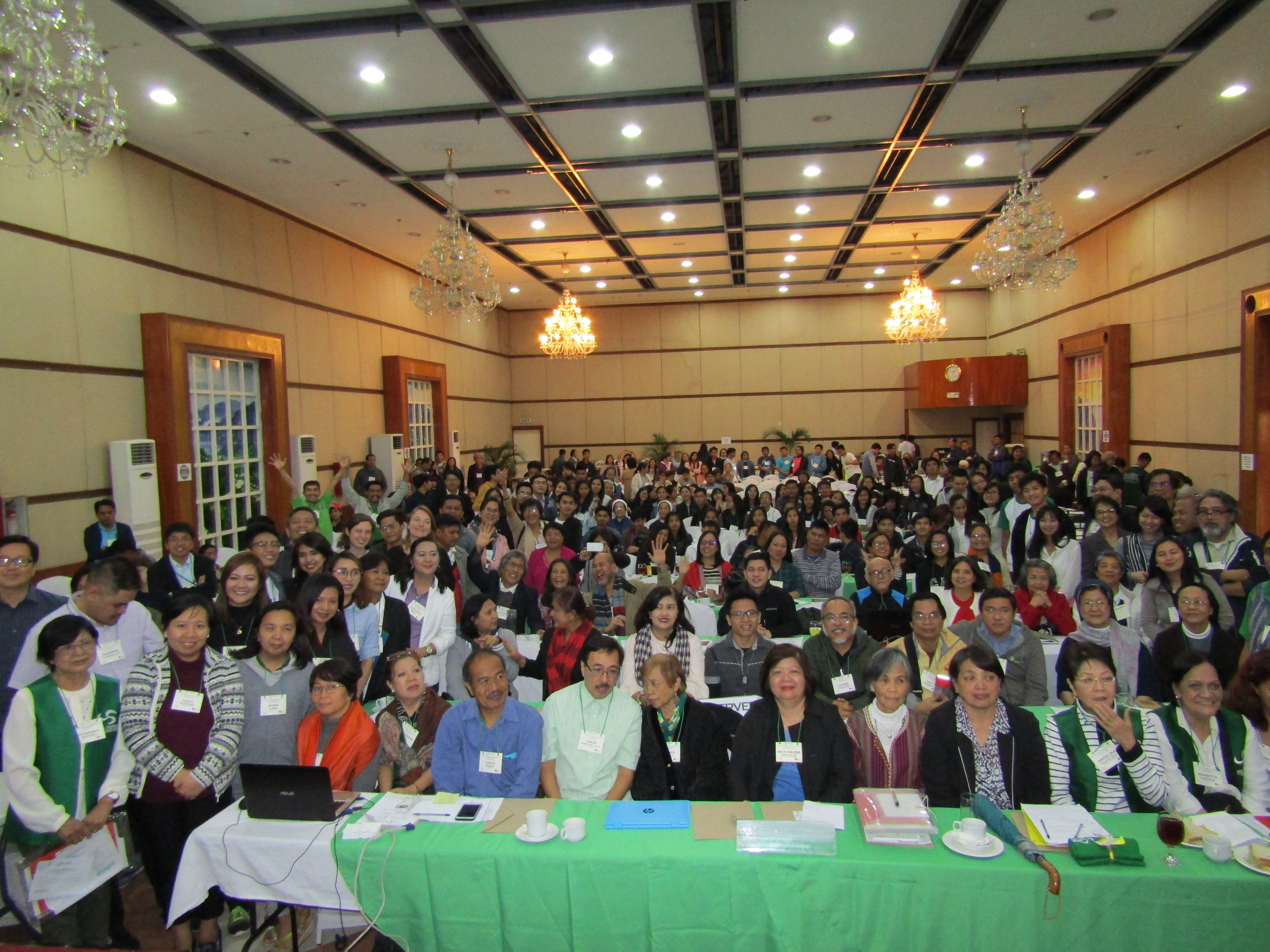
FIGHT THE ‘MONSTERS’. Institutions and environmental advocates converged at Hotel Albergo in Baguio City on August 20 for the State of the Nature Assessment or Green SONA, an annual activity organized by Green Convergence. Delegates cropped a resolution affirming their commitment to fight “environmental monsters” promoted by the government. Photo by Sherwin De Vera

The group’s president, Dr. Angelina Galang, said the activity does not only provide venue to review the state of the environment but also explain why there are technologies that environmental advocates reject.

Speakers discussed the dangers posed by genetically modified organisms (GMO), incineration and nuclear power, and large-scale mining and giant dams to the ecosystem. They also explained the flaws of present environmental laws and government programs related to their topics.

Unsafe power sources

“The environment and people’s health take primacy over the planned revival of the Bataan Nuclear Power Plant, and the use and promotion of waste-to-energy (WtE),” stressed Dr. Jorge Emmanuel.

He shared studies made by international institutions and by the panel of experts commissioned by the Philippine government from 1986 to 1992. The findings said BNPP is unsafe and dangerous for operation, and too costly to repair.

Emmanuel added that management of radioactive waste from nuclear power plants remains to be a top problem and threat worldwide.

He also criticized the government’s promotion of WtE that runs contrary to Clean Air Act (RA 8749) and the law on solid waste disposal (RA 9003) pointing WtE is actually incineration, prohibited under the two legislations.

Emmanuel a former Chief Technical Advisor of the United Nations Development Program on global health-care waste projects underscored that WtE plants produce a variety of pollutants, such as dioxins, that include 2,3,7,8-tetrachloro-dibenzo-p-dioxin, known as the most toxic compound.

He said dioxin levels released in varying levels over time and the government “has no capability to continuously monitor dioxins in the environment.”

Go organic

Instead of encouraging commercialization of genetically modified organisms (GMOs), the government should instead seriously promote organic agriculture. This was the theme discussed by Dr. Chito Medina of Magsasaka at Siyentipiko para sa Pag-unlad ng Agrikultura (MASIPAG).

“Organic farming does not only focus on the being technical of ‘being organic’ but should consider the issue of social justice,” said Medina, adding, “the problem is organic farming is still budding in the country yet the government is already nipping it down by stressing more on regulations.”

He said there are already 62 GMOs approved for commercial use since December 2002 but only two seeds for commercial planting, Bt Corn and RR Corn, were given the go signal so far. Others are contained in imported consumer products and animal feeds use in large farms.

“The problem with GMOs besides health safety is its narrow genetic adaptation instead of targeting it to adapt to broader environmental challenges,” explained Medina in mixed English and Filipino.

Citing studies conducted worldwide, Medina elaborated the detrimental health and environmental effects of Bt and RR Corn. He explained that chemicals found in GM crops cause tumors, cancers, autism, birth defects and other diseases.

His institution is also fighting the approval of golden rice for commercial production. The GM crop designed to produce beta-carotene is set for final field testing in San Mariano, Isabela and Batac, Ilocos Norte.

He said proponent conducted no tests to ascertain the crop’s safety, only field trials for its agronomic traits that also failed to produce favorable results.

Continuing forest lost

The head of Forest Foundation Philippines (FFP), Atty. Jose Canivel, discussed the situation of the country’s forest cover and reforestation efforts.

“We are planting billions worth of seedlings under the National Greening Program (NGP) but we continue to lose our old growth forest, and mature and seed bearing native trees,” the lawyer said.

He lamented that despite having more than 3000 woody plants in the Philippines, the Department of Environment and Natural Resources is mainly planting Mahogany, Gmelina and Falcata, all introduced and exotic species.

Canivel also shared that according to their study, seedlings utilized for the program mainly comes from six large nurseries mostly owned by individuals with connections in the department.

A key problem, according to him, is the absence of a forest management framework. Forest policy that is in effect is Presidential Decree 705 that focuses mainly on the creation and management of forest for industrial purposes.

FFP has lobbied for the Forest Resources Management Bill since the 13th Congress, but it has yet to pass the committee level.

“What we have been lobbying for 20 years is for us to have an appropriate forest policy for our present condition,” he said.# nordis.net

Federalism a major threat to the environment

By KIMBERLIE NGABIT-QUITASOL via Northern Dispatch Weekly

BAGUIO CITY — The Duterte administration’s push for a federal form of government is seen as among the major threats to the environment by green groups who spoke about mines, giant dams and forests at the State of Nature Assessment 2018 on August 20.

“For us charter change and federalism poses the biggest threat to environmental justice,” said Jaybee Garganera of Alyansa Tigil Mina (ATM).

Garganera spoke about how large corporate mines destroyed forests, mountains and rivers; and displaced indigenous communities, and that the present congress cannot be trusted to change the Constitution.

Garganera said this congress rejected the appointment of Gina Lopez as secretary of the Department of Environment and Natural Resources (DENR). He pointed out that many lawmakers have interests in mine corporations or were supported by mining firms during their campaign, including members of the Commission on Appointments.

“Our environmental problem is not a technical problem, not a financial problem even, it is a problem of political will,” Garganera said.

He said that the 10 months of Lopez as DENR secretary proved that environmental law can be strictly implemented if there is political will.

“These people who rejected the appointment of a DENR secretary who had the balls to implement environmental laws, this congress will change the constitution towards federalism,” he said.

Garganera further pointed out that in the draft federal constitution, environmental protection was delegated to the federated regions, which he said is problematic given the existense of political dynasties. “What do we expect when we let political dynasties decide on logging, mining and other extractives?” he said. He added that with the political record of these dynasties, the environment is in big danger.

Garganera also said that in the proposed federal constitution, a phrase ‘as provided by law’ was added to the 60-40 equity rule on foreign ownership provided under the present constitution. He said that with this phrase, congress can later enact a law that would reverse this protectionist provision.

Garganera said that under a federal government, the federated regions will scramble for resources for their states. He said the regions will now invite investors that would include mines, dams, plantations and other extractive industries.

“We join the concern on the new form of political governance being pushed today,” said Atty. Jose Andres Canivel executive director of the Forest Foundation Philippines.

Canivel talked about the state of the country’s forests and he identified the push for federalism as among the major threats to the remaining forests. He said that in the proposed federal constituion, forest management, protected areas and indigenous people concerns are also delegated to the federal regions. “For us it is a difficult situation,” he said.

Canivel cited as example Mount Apo, a protected area because it is a source of energy, home for IPs and habitat of the Philippine eagle. He said Mt. Apo spans three regions. “How will they manage it?” he said. “We asked this question to the members of the constitutional commission and to DILG as well and they told us to offer a suggestion instead,” he added.

Canivel said the proponents of federalism should have thought of this before pushing for a change in the form of government.

Canivel said that their successful forest restoration and protection projects are in IP ancestral lands. “In our experience IPs are doing a better job at forest management,” he said.

Based on the mapping of the Philippine Association for Inter-Cultural Development (PAFID), the remaining forests in the country are within IP ancestral domains, which are also the same areas where mining operations and applications are. PAFID has mapped out the agricultural areas, protected areas, mining operations and applications, remaining forests, IP ancestral domains and important bird areas in the country. Interestingly, the maps showed that mining operations and applications overlap with protected areas, IP ancestral domains and remaining forest areas. # nordis.net

Negros Oriental Bats For Renewable Energy, Vows Against Coal In ‘Green SONA’

By Featuresdesk (ICG) on August 22, 2018 via Page One

The achievements and continuing initiatives of the province of Negros Oriental toward renewable energy (RE) were the major highlights of this year’s State of Nature Assessment (SONA), organized by non-profit environmental group Green Convergence in partnership with the Forest Foundation of the Philippines and leading renewable energy producer Energy Development Corporation (EDC).

Negros Oriental Governor Roel Ragay Degamo, who was among the guest speakers during the day-long event held in Baguio City on August 20, prefaced his message with an unequivocal statement that he is “an advocate of clean, renewable energy” as “a humble representative of the peace-loving and nature-loving people of Negros Oriental.”

The annual conference, also dubbed “Green SONA,” has been held since 2007 and brings together stakeholders from various sectors such as civil society, private business, academe as well as the government to engage in dialogue to address vital environmental issues.

No to coal

During his speech, Degamo reiterated his province’s stance against fossil fuels in power generation, calling to mind Executive Order No. 9 that he signed in March this year mandating the use of clean and renewable energy in all 19 municipalities and six cities of Negros Oriental.

“This means that our local government will no longer issue any permit, authorization or endorsements that support development and operation of coal-fired and fossil-fuel power plants,” he explained. “The province is committed not to use coal as an energy source because of its impact on the environment, on health and global climate.”

Degamo issued his strongest statement yet against coal, saying it is “incredibly dirty.”

Referring to opposition that his move toward RE has received: “Their argument is true and simple: Coal-fired [power] is cheap. My answer is truer and simpler: Environmental destruction is so expensive. It is never negotiable,” stated Degamo.

Nature-rich province

A first-class agricultural province located in the Central Visayas Region with a population of around 1.4 million, Negros Oriental has a total land area of more than 5,000 square kilometers comprised of 19 municipalities and six cities covered by three congressional districts.

“We are bestowed with beautiful tourist destinations that are nature-based,” said Degamo, highlighting further that beneath the fertile soil along the Cuernos de Negros mountain ranges rests one of the province’s most valuable natural resources, which is a vast geothermal field being effectively tapped to produce electricity.

To date, a total of 222.5 MW of electricity is being produced by Negros Oriental’s two geothermal power plants that is owned and operated by geothermal leader Energy Development Corporation in the municipality of Valencia.

Degamo noted that while the generated capacity of the geothermal plants is currently more than enough to supply the power demands of the province, “due to interconnectivity, our power requirement is not stand-alone. It is included and dependent on the power requirements of the whole Visayas grid,” he explained.

Renewable energy expansions

Degamo revealed how he recognizes the need to tap other RE sources despite having relied on geothermal energy for the past 30 years. A 213,292-square-meter solar power plant in Bais City was inaugurated in 2016, generating 24,205 MWh of electricity annually and supplying more than 10,000 households in the region. He reported that the solar plant saves up to 14,838 tons of carbon dioxide emissions every year.

In 2015, Silliman University in Dumaguete City entered into a partnership with a Filipino-American energy group for what was dubbed as “the largest school-based solar power project in Southeast Asia” that powers the 62-hectare campus with 1.2 MW of solar power.

Degamo also bared the Department of Energy’s upcoming hydroelectric power projects in Negros Oriental—three separate facilities in the municipality of Amlan with a total capacity of 5.5 MW, with target testing and commissioning date of the first two in December 2020 and the final one in December 2025.


Green SONA calls for eco-heroes to take action

By climaterealityph | Aug 21, 2018

Environmental advocates convened in the 2018 State of Nature Assessment or the “Green SONA” held last 20 August at the Albergo Hotel, Baguio City.

The gathering is an annual event for assessing the performance of the government in environmental conservation and sustainable development and empowering civil society to take action.

This year’s Green SONA revolved around environmental threats exacerbated by climate change and how they must be addressed, especially those of which had low awareness.

“All environmental issues are directly or indirectly implicated in climate change,” said Dr. Angelina Galang, President of Green Convergence. “Climate change is the most observable result, but it is also the ultimate result of our impacts on the planet.

Among the issues tackled include nuclear energy and incineration, genetically modified organisms, mining and the construction of dams, forest preservation, and sustainable tourism.

While some of these issues have been especially targeted by the Duterte administration such as poor mining and tourism practices, others such as incineration and GMOs have not received as much attention nationally.

Despite the continuing struggles in harmonizing economic growth with environmental protection, Galang praised the efforts of individuals and organizations working together to promote sustainable development.

“Looking back, we see that our efforts have born fruit. I’m talking about the men, women, old and young individuals who are working passionately to save our planet,” she remarked.

Galang also noted the endeavors of the national and local government units to achieve sustainability. However, their campaigns are allegedly unsound and may actually lead to further environmental degradation and adverse socioeconomic impacts.

“There are viable, better alternatives. It is just that the worst alternatives that are now being promoted,” she said.

Ultimately, the Green SONA highlighted the most powerful solution to all environmental issues: the human will, especially in governance.

“The solutions are found not in man-made technology, but in our humanity; a change of heart among us human beings,” said Dr. Gaudelia Reyes, Head of the Center for Environmental Management and Sustainable Development.

The Green SONA was organized by the Green Convergence, a coalition of environment advocacy organizations and individuals campaigning for sustainable development.

Green SONA 2018: Environmental Monsters are Back! Superheroes Needed!

Different environmental groups, representatives from the government, the academe and the church converged in Baguio City on August 20, 2018 for the annual State of Nature Assessment.

Environmental Coalition Green Convergence held the annual State of the Nature Assessment (Green SONA) with the theme “Environmental Monsters are Back; Superheroes Needed!” on August 20, 2018 (Monday) at Albergo Hotel, Baguio City. This year’s SONA focused on the menaces that pose grave danger to the Philippine environment and how these “monsters”—specifically genetically modified organisms (GMOs), incineration and nuclear power, and large-scale mining and giant dams, can be overcome by green heroes such as renewable energy, organic agriculture and reforestation.

“Technologies that Green Convergence totally rejects include (1) genetically modified organisms (GMOs) which intrude on nature in the most basic unit of life — the gene, (2) nuclear power which likewise disturbs the basic unit of matter — the nucleus, and (3) programs like large-scale mining and giant dams which remove and disturb whole ecosystems, forests, rivers and coastal ecosystems, and contribute immensely to climate change,” explained Dr. Angelina Galang, President of Green Convergence.

Speakers included Negros Oriental Governor Hon. Roel Degamo, Dr. Chito Medina of MASIPAG, Jaybee Garganera of Alyansa Tigil Mina, Dr. Jorge Emmanuel of Silliman University and Atty. Jose Andres Canivel of the Forest Foundation Philippines.

Meanwhile, from the government, CAR Chief Tourism Operations Officer Jovy Ganungan, CAR Environment Regional Director’s Representative Atty. Cleo Sabado-Andrada and Climate Change Commission Chief Legal Counsel Atty. Efren MG. Bascos responded to issues raised by the speakers and the participants.

Green SONA 2018 is supported by the Energy Development Corporation and the Forest Foundation Philippines, and is organized in partnership with the Maryknoll Ecological Sanctuary, Saint Louis University, and the University of the Cordilleras. Participants included NGO and government representatives, students, teachers, church groups, and concerned citizens.

You must be logged in to view this content. Free Virtual Library Registration Here

Group to assess state of environment

by Hanna C. Lacsamana via Baguio Midland Courier


Green Convergence Philippines will hold the annual State of the Nature Assessment (Green SONA) with the theme “Environmental monsters are back; Superheroes needed!” on Aug. 20, 8 a.m. at Albergo Hotel, Baguio City.

This year’s forum is expected to tackle how genetically modified organisms (GMOs), nuclear power, and large-scale mining and giant dams are unfolding and destroying the environment.

In a statement, Green Convergence president Angelina Galang said, “Technologies that we totally reject include GMOs, which intrude nature in the most basic unit of life, the gene and nuclear power, which likewise disturbs the basic unit of matter, the nucleus.”

She added that programs like large-scale mining and giant dams remove and disturb whole ecosystems, forests, rivers and coastal ecosystems, and contribute immensely to climate change.

Speakers from different government and non-government groups including Negros Oriental Gov. Roel Degamo, Chito Medina of MASIPAG, Jaybee Garganera of Alyansa Tigil Mina, and Atty. Jose Andres Canivel of the Forest Foundation Philippines are invited to talk about the threats of said “environmental monsters” to the country’s environment, and the best green alternatives for them, specifically renewable energy, organic agriculture and reforestation.

Energy Sec. Alfonso Cusi, Tourism Sec. and agri-tourism advocate Bernadette Puyat, Environment Sec. Roy Cimatu, and Climate Change Commission Sec. Emmanuel de Guzman are expected to react on the issues and alternatives.

Green SONA 2018 is also organized by the Energy Development Corporation and the Forest Foundation Philippines and will be participated in by members of the Maryknoll Ecological Sanctuary, Saint Louis University, University of the Cordilleras, and other environmental groups and advocates.

Environmental groups decry return of “monsters”

Environmental advocates convened for a press conference to call for the stop of the return of environmental monsters in the Philippines.


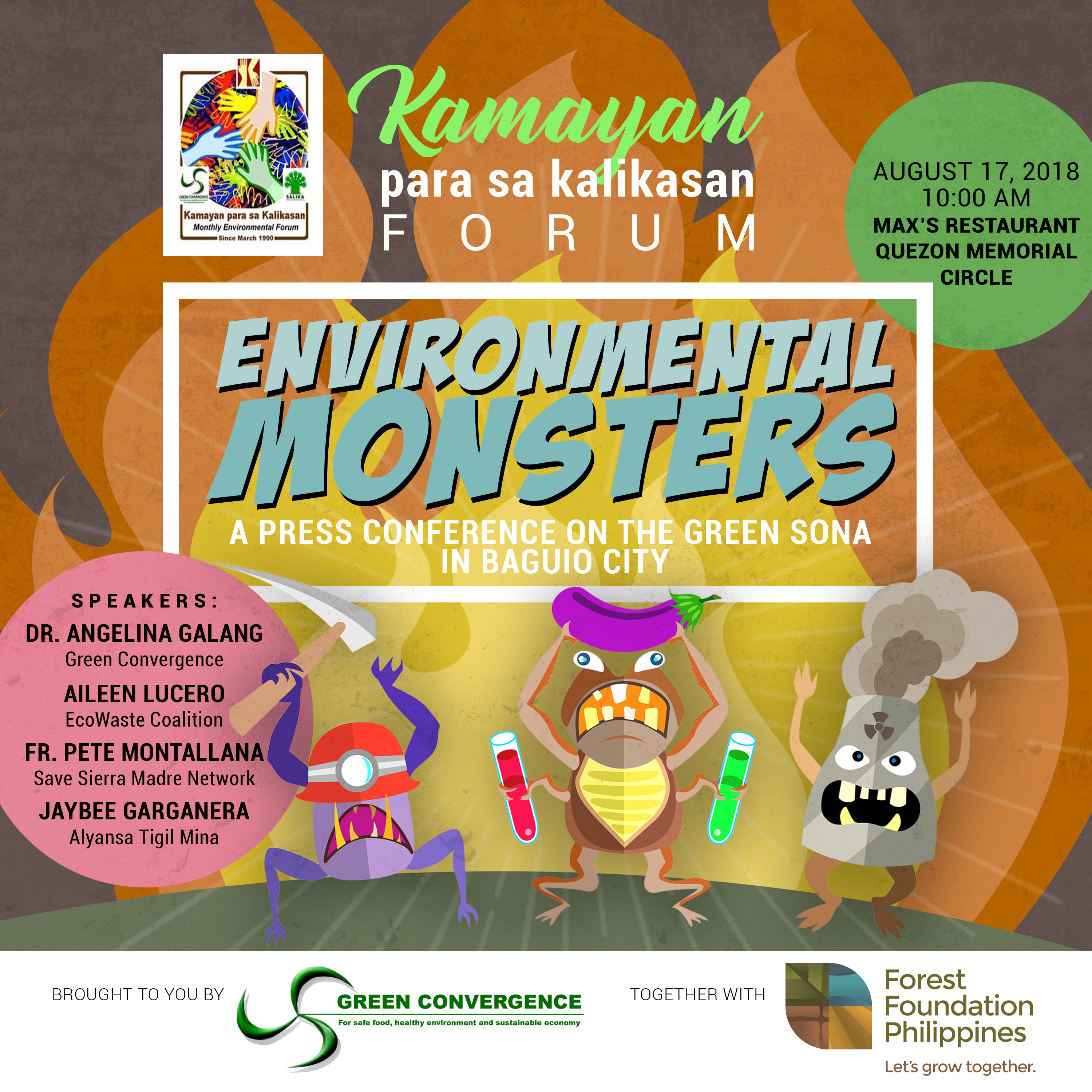
Environmental Coalition Green Convergence held another installment of the monthly Kamayan Para sa Kalikasan Forum on August 17, 2018 (Friday) at Max’s Restaurant, Quezon Memorial Circle, Quezon City.

As a prelude to the upcoming annual Green SONA (State of Nature Assessment) held in Baguio City on August 20 with the theme “Environmental Monsters are Back! Superheroes Needed!” the forum speakers sounded an alarm over the return of “monsters” in the country after they had been effectively neutralized in the past — specifically nuclear power, incineration, genetically modified organisms (GMOs), large-scale mining and giant dams, which pose serious threats to public health and safety, as well as to our environment and ecology.


The official poster for the press conference


“Generations ofenvironmentalists have fought against these dangerous technologies since the 70s,” said Dr. Angelina Galang, President of Green Convergence. She went on to enumerate their hard-earned victories: “Incineration of municipal waste has been legally thwarted, the Bataan nuclear power plant has been mothballed, commercialization of genetically modified eggplant has been stopped, the Chico dam was not continued, the Kaliwa dam did not materialize, and large-scale mining has been effectively pushed back through non-issuance of permits by previous and present administrations.”

Other speakers Aileen Lucero of EcoWaste Coalition, Conrad Vargas of Save Sierra Madre Network and Jaybee Garganera of Alyansa Tigil Mina took turns recalling the long battles green groups waged and won against harmful technologies. However, they expressed grave concern over new calls to lift the ban on incineration as stipulated by RA 9003, the push for approval of genetically modified Golden Rice, the discussions with Russians and Koreans for the construction of a nuclear power plant, and the return of the Kaliwa Dam on the drawing board, signaling new battles that have to be fought against their return.

Now on its 29th year, Kamayan Para sa Kalikasan Forum has become an institutionalized platform since March 1990 that enables NGO and government representatives, the media, students, teachers, church groups, and concerned citizens to discuss pressing environmental issues in the country. The forum is currently also supported by the Forest Foundation Philippines.

You must be logged in to view this content. Free Virtual Library Registration Here

Calendar of Activities: August 2018

GC CALENDAR OF EVENTS FOR AUGUST 2018

DATE
ACTIVITY
August 06


Board of Trustees Meeting

ESI Conference Room

9:00 AM

August 08


State of the Philippine Environment 2018 Forum

Center for Environmental Concerns (CEC)

1:00-4:00 PM

Geronima T. Pecson Auditorium (MB Auditorium), Philippine National University

August 17 Kamayan Para sa Kalikasan Forum

Max’s Restaurant QMC, Quezon City

10:30 AM-1:30 PM

August 20 State of the Nature Assessment (Green SONA) 2018

Theme: “Environmental Monsters are Back; Superheroes Needed!”

8:00 AM-5:00 PM

Albergo Hotel, Baguio City

August 21 Green SONA 2018 Field Trip

8:30 AM-6:00 PM

Baguio City

2nd Philippine Environment Summit 2018 (Cebu) Progress Reports

The Environment Summit is a biennial undertaking of Green Convergence to celebrate important breakthroughs and advancements in environmental protection through private and public initiatives. It provides a platform where all sectors can share common challenges, collaborate on creative solutions, and replicate success stories. It is a call to government and the Filipino people to unite in accelerating the drive towards national sustainable development.

Green Convergence is a large coalition of organizations, networks and individuals. With its private partners and DENR, it successfully held the 1st Philippine Environment Summit at the SMX Convention Center, Mall of Asia in February 2016 and the 2nd Philippine Environment Summit at the Waterfront Hotel, Cebu IN February 2018.

Click the links below to know what happened in the summit:
Philippine Environment Summit 2018 Progress Report Day 1

Philippine Environment Summit 2018 Progress Report Day 2

Philippine Environment Summit 2018 Progress Report Day 3