
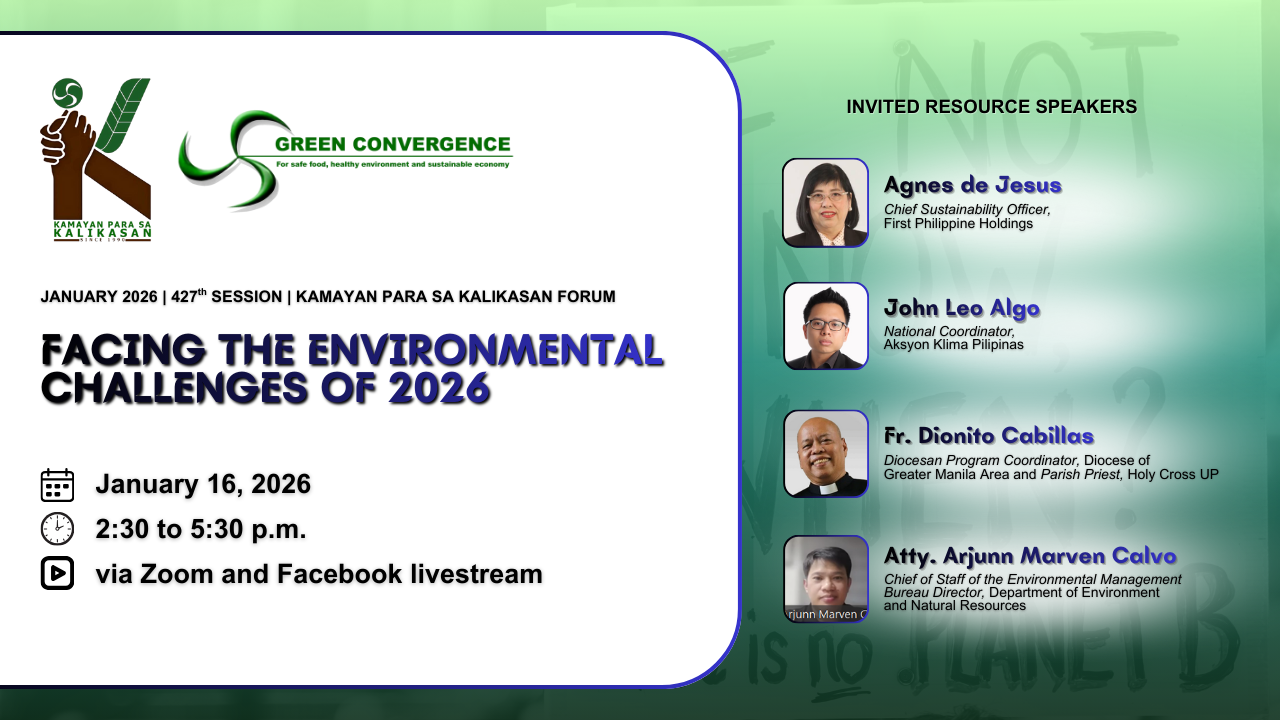
Green Convergence (GC) convened its 427th Kamayan Para sa Kalikasan forum, themed “Facing the Environmental Challenges of 2026,” on January 16, via Zoom and Facebook livestream, bringing together representatives from business, civil society, the Church, and government to discuss the environmental challenges that will shape the country in the coming year.
In her opening remarks, GC President Victoria Segovia said that the forum aims to reflect on what environmental challenges lie ahead for communities, expressing concern on dangerous technologies such as waste-to-energy and nuclear power that are being pushed without proper assessment of their impacts.
Integrating Decarbonization Pathways Into Core Operations
Agnes De Jesus, Chief Sustainability Officer of First Philippine Holdings (FPH) and Business Task Force Head of the Ako Ang Bukas (AAB) Advocacy Program, presented the environmental concerns of the business sector from the perspective of FPH.
She explained that climate-related risks such as flooding, extreme heat, and sea level rise directly affect infrastructure, supply chains, employee welfare, productivity, and asset values, making nature’s stability important to the sustainability of businesses.
De Jesus noted that while many global companies have withdrawn from their decarbonization pledges, FPH continues to pursue a 42% carbon reduction target by 2030 and net zero emissions by 2050, despite financial, technical, and operational constraints.
She also identified other present challenges, including the high cost of environmental measures, limited availability of technologies, and the risk of maladaptation when solutions fail to respond to ecological and social realities.
Echoing the Lopez Group of Companies’ values, she emphasized that protecting nature requires a strategic and integrated approach that recognizes the interdependence of people, ecosystems, and the economy.
“Our contention is that sustainable development requires our collective action, not just for planetary health, but also for the well-being and equity of people,” De Jesus said.
Climate Injustice, Misused Budgets, and Delayed Commitments
John Leo Algo, National Coordinator of Aksyon Klima Pilipinas, outlined the key ecological and governance issues civil society groups are closely monitoring in 2026, following what he described as a year marked by delays and unmet expectations, notably in 2025, which was supposedly the “defining year” for climate action.
Citing a 2025 survey by Asia-Pacific sustainability experts, Algo said climate change, biodiversity loss, plastic waste, deforestation, and waste management remain as priorities, reflecting on systemic failures and not necessarily on lack of awareness.
He raised concerns over corruption in flood control projects, expressing that the lack of accountability has left communities vulnerable to worsening floods, while billions of pesos lost to misappropriation could have been used for more opportunities, such as reforestation and other long-term climate solutions.
He also questioned whether the 2026 national budget genuinely supports climate action, pinpointing continued emphasis on large infrastructure projects instead of nature-based and people-centered solutions.
“There’s never been a better time than right now to start getting more involved than we already are,” Algo said, urging civil society, communities, and institutions to translate awareness into civic engagement.
Algo also discussed upcoming policy developments, including the proposed 75% emissions reduction target, the inclusion of forest protection in the next Nationally Determined Contribution, and the near completion of a National Just Transition Framework—the second in the world after South Africa—to protect vulnerable communities.
Environmental Degradation as a Moral and Social Concern
Through a pre-recorded presentation, Fr. Dionito Cabillas, Diocesan Program Coordinator of the Diocese of Greater Manila Area and Parish Priest of the Holy Cross in UP Diliman, cited theological bases and framed environmental degradation as both a moral and human rights issue.
Inspired by Pope Francis’ encyclical Laudato Si’, Cabillas emphasized that humans are stewards, not owners, of creation and are accountable for its care.
“Environmental destruction like mining, deforestation, ecotourism, building of dams, and corruption in infrastructures directly impact the poor, making ecology a human rights issue,” he said.
Cabillas presented images of mining operations, reclamation, dam construction—particularly the Kaliwa Dam in the Sierra Madre, landfill disasters such as in Binaliw, Cebu, deforestation, and other destructive activities across the country, showing how Indigenous Peoples and marginalized communities experience the harshest impacts of environmental damage.
He outlined the Church’s priority calls for 2026, including repealing the Mining Act of 1995, enforcing the Ecological Solid Waste Management Act, opposing environmentally destructive projects, promoting ecological education among the youth, and sustaining faith-based engagement in sustainable agriculture and pro-people renewable energy.
Stronger Enforcement of Policies, Regulations, and Safeguards
Atty. Arjunn Marven Calvo, Chief of Staff of the Environmental Management Bureau (EMB) Director at the Department of Environment and Natural Resources, tackled the government’s four key environmental priorities for 2026 amid worsening climate risks and development pressures.
Calvo acknowledged that the realities of environmental management are complex and more urgent now, as climate change, rapid infrastructure development, and urbanization increase demand for improved regulatory systems.
“For us in the EMB, these realities translate to a responsibility to make sure that development moves forward without compromising environmental integrity, public health, and long-term sustainability,” Calvo said.
He detailed ongoing efforts to strengthen the Environmental Impact Assessment (EIA) system, including the formulation of specialized Environmental Compliance Certificate guidelines for nuclear facilities following the passage of the Philippine National Nuclear Energy Safety Act, or the PhilAtom Law.
Calvo also cited the conduct of Cumulative Impact Assessments for reclamation projects in Manila Bay, the review of EIA thresholds for infrastructure and mining projects, and intensified enforcement against the observed practice of splitting large projects to evade environmental compliance requirements.
On solid waste management, Calvo reported that, as of 2025, only about 58% of local government units (LGUs) are served by sanitary landfills, needing refocusing on improving compliance, rehabilitation, waste segregation, and monitoring, alongside cautious consideration of waste-to-energy technologies under strict environmental safeguards.
Calvo also said that water quality degradation is still a concern, mentioning pollution of rivers, coastal waters, and groundwater from untreated domestic wastewater, industrial discharge, agricultural runoff, and leachates from poorly managed dumpsites and sanitary landfills, particularly in highly urbanized areas.
With this, he said that the EMB is strengthening enforcement of water quality standards and effluent regulations, intensifying wastewater treatment compliance among LGUs, and enhancing monitoring through field sampling and laboratory analysis to protect public health, food security, and climate resilience.
On air quality, Calvo said vehicle emissions remain the leading source of air pollution, encouraging the push for the transition to Euro V fuel and other vehicle standards, which could significantly reduce particulate emissions and associated health risks.
Overall, recommendations were raised such as strengthening governance by evaluating technologies before they are allowed to enter the country, tightening environmental impact assessments and monitoring, advancing nature-based and biodiversity-inclined approaches, and reinforcing laws that compel companies to move beyond minimum compliance.
Civil society was also encouraged to engage more closely with LGUs by looking into their action plans, budgets, and ensuring that policies in place turn into action at the community level.
Closing the forum, GC Assistant Corporate Secretary Ciela Castillo said that 2026 is no longer something society is preparing for but a reality already being lived, as environmental risks increasingly shape communities and livelihoods.
She added that environmental action is a shared obligation that requires engagement across sectors—not just one sector alone, institutions, as well as everyday choices.
The next Kamayan forum will be on February 20, 2026
Kamayan Para Sa Kalikasan is a monthly initiative organized by Green Convergence that enables non-government organizations (NGOs) and government representatives, the media, students, teachers, church groups, and concerned citizens to discuss, analyze, and create solutions to pressing environmental issues in the country.
For those interested to be a member of Green Convergence, visit this link to register: bit.ly/GCMembershipRegForm.
#GreenConvergence #KamayanParaSaKalikasan #FacingTheEnvironmentalChallengesOf2026 #EnvironmentalIssues #NewYear2026