AAB leads GHG Accounting Workshop in HSBC Philippines’ 2026 Sustainability Forum

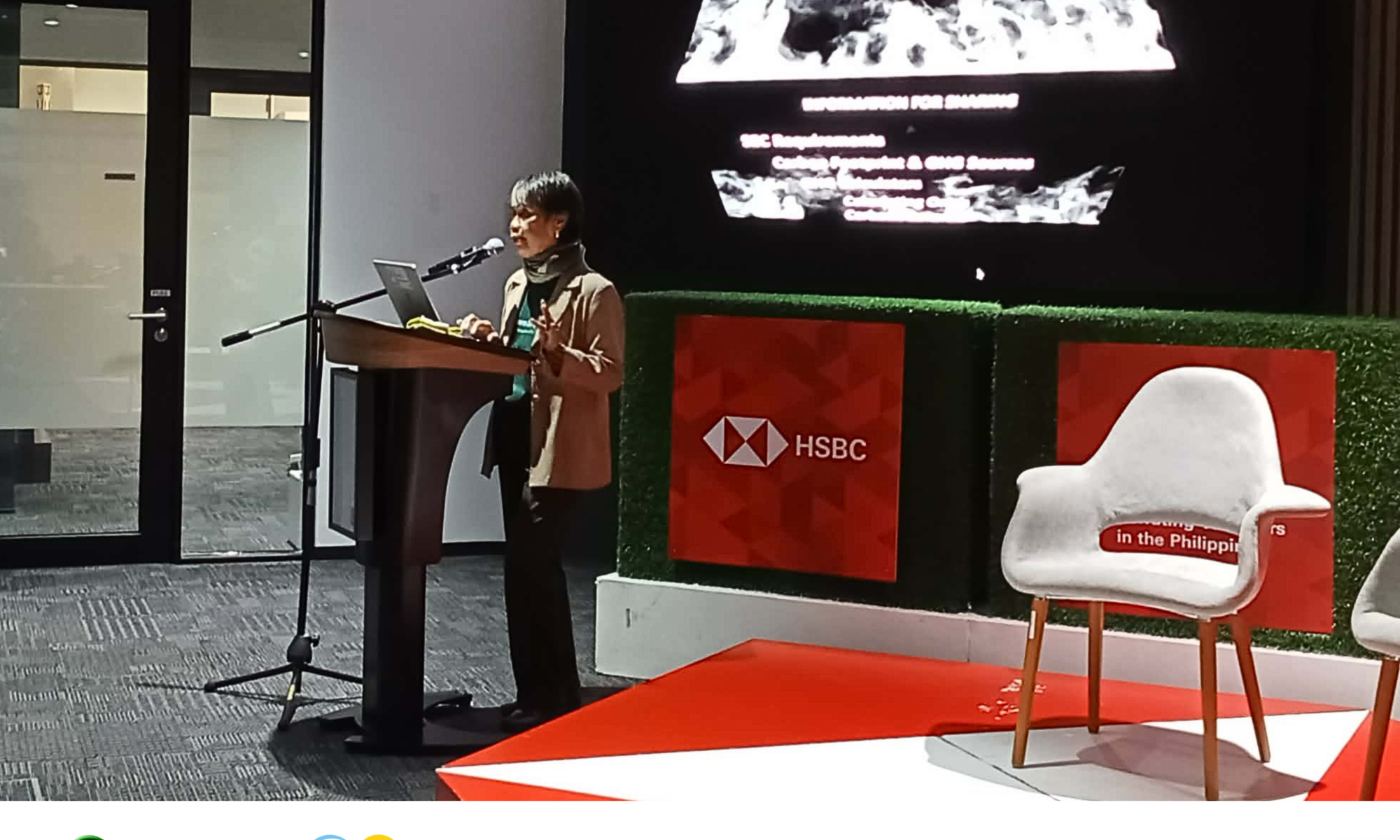
Green Convergence, through the Ako Ang Bukas (AAB) program, led a workshop on greenhouse gas (GHG) accounting at the 2026 Sustainability Forum of HSBC Philippines held on March 26, 2026, at the HSBC Centre, Bonifacio Global City.

The forum gathered HSBC Philippines’ partners and suppliers to discuss building resilient supply chains through emissions measurement and sustainability reporting by equipping them with the practical tools.

Opening the forum, HSBC Philippines Chief Operating Officer Peter Gut emphasized the urgency of balancing short-term and long-term sustainability solutions in line with global climate neutrality goals.

AAB Program Leader Milagros Serrana introduced participants to the fundamentals of GHG accounting—what carbon footprint and emission scopes are, linking it to the new reporting requirements set by the Securities and Exchange Commission (SEC).

Serrana walked participants through the enhanced AAB entity-level GHG calculator, highlighting its updated parameters catering to an expanded coverage across industries while retaining its user-friendly features.

Participants engaged in a hands-on workshop using the updated calculator, followed by a sharing session where companies discussed their sustainability journeys, baselines, and reduction measures.

In the sharing session, several companies shared that they have shifted to electric vehicles, reduced single-use plastics, and included energy management practices as part of their sustainability efforts, with most focusing on minimizing scope 1 and 2 emissions.

Serrana then outlined foreseen national and global decarbonization pathways and introduced the mitigation hierarchy of avoiding, minimizing, and offsetting emissions as mitigation guides.

Complementing the workshop, Nathan Abela of ESG Book emphasized the growing importance of environmental, social, and governance reporting and demonstrated how AAB’s calculator can feed into their digital reporting platform such as the ESB Book website.

Furthermore, a panel discussion with Melissa Vergel de Dios of PLDT and Mark Anthony Cruz Cox of Coca-Cola Europacific Aboitiz Philippines highlighted how sustainability is being integrated into their operations, not as a ‘standalone, extra work’ but as an embedded principle.

Closing the forum, Gut noted the improved common understanding of GHG accounting language, observing that participants easily navigate through the emission scopes, and stressed the importance of collaboration in advancing sustainability efforts across supply chains.

#GreenConvergence #AkoAngBukas #QuantumLeapNOW #ClimateNeutrality2050

GC, ATM March 2026 Kamayan forum raises environmental, social concerns on mining amid green transition

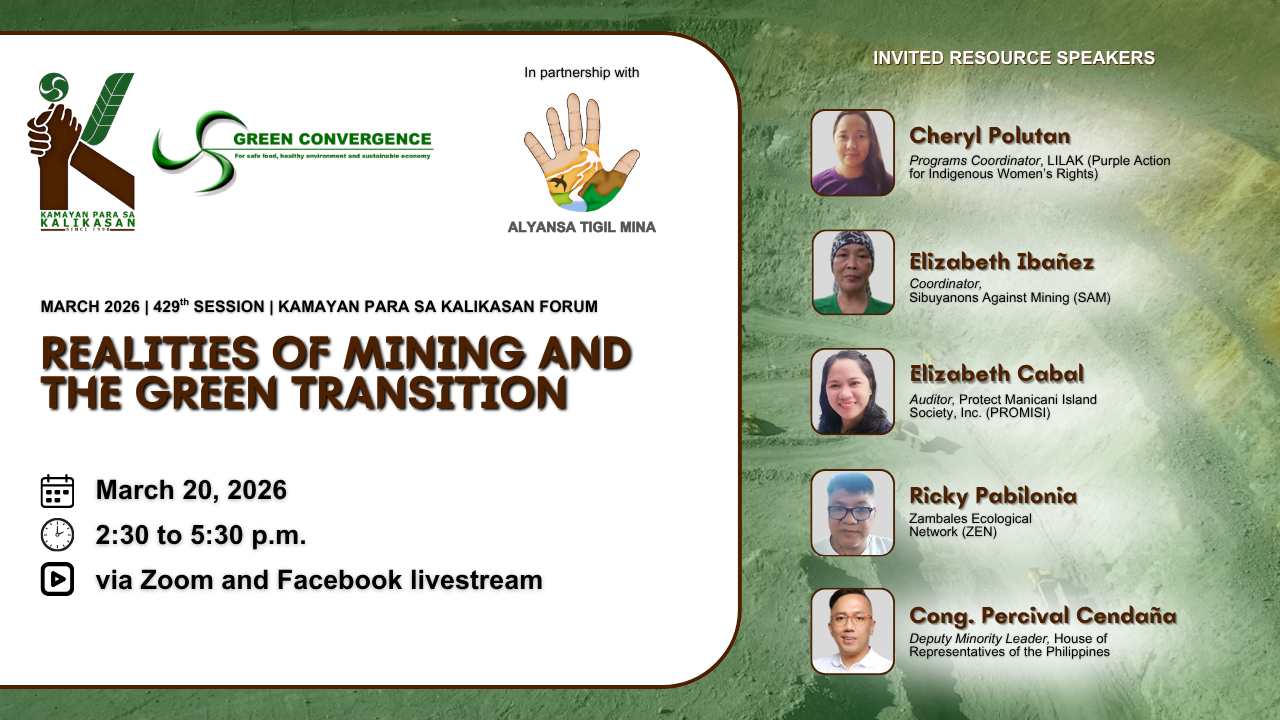
Green Convergence (GC), together with Alyansa Tigil Mina (ATM), convened the 429th Kamayan Para Sa Kalikasan forum themed “Realities of Mining and the Green Transition” on March 20, 2026, via Zoom and Facebook livestream.

The March 2026 forum was part of ATM’s Anti-Mining Solidarity Week 2026, wherein environmental defenders and mining-affected communities echoed the ecological and human rights concerns amid the global push for a “green transition.”

In her opening remarks, GC President Victoria Segovia highlighted prevailing issues on governance surrounding mining in the Philippines.

Segovia questioned the mandate of the Department of Environment and Natural Resources (DENR) to both protect natural resources and issue permits for their extraction and called for institutional reforms that would prioritize environmental protection and genuine sustainable development.

Cheryl Polutan, Programs Coordinator of LILAK (Purple Action for Indigenous Women’s Rights), outlined how the global shift toward renewable energy or the “green transition” increases demand for “critical minerals,” noting the Philippines as a key extraction site.

Polutan said that while the transition to renewable energy is necessary to address the global climate crisis, it also leads to more dependence on extractive practices that can cause further environmental degradation and social inequities.

She highlighted how mining operations have resulted in the loss of water sources, biodiversity, and livelihoods, particularly in agriculture-dependent communities.

Polutan also detailed the gender-based impacts of mining, including cases of harassment, sexual violence, and increased economic vulnerability among women in mining-affected areas.

“We should not just transition, we should do just transition and gender-based climate solutions,” Polutan said, emphasizing the need to ensure that environmental protection and human rights are upheld in the shift to sustainable energy.

Dwelling on the grassroots struggles, Elizabeth Ibañez, Coordinator of Sibuyanons Against Mining (SAM), shared the years-long resistance of communities in Sibuyan Island against mining operations.

Ibañez said residents were driven to establish barricades to protect their island from environmental destruction and disaster risks linked to mining activities.

Ang amin pong panawagan dito ay ipamana ang aming isla para sa aming mga anak at ang mga darating pang mga apo at hindi ipamina, sapagkat ito po ay magwawasak hindi lamang po sa aming kabuhayan kundi papatay din po sa buhay ng lahat ng mamamayan,” Ibañez said.

Kung para sa aming mga mamamayan, bakit kailangan na kami pa rin ‘yung muling ilagay sa mas malaking peligro?” she added, questioning whether the benefits of the green transition truly are for the good of the communities.

Ibañez also raised concerns about social divisions due to the influence of mining companies and threats experienced by environmental defenders, calling for genuine government engagement with affected communities.

On the other hand, Elizabeth Cabal, Auditor of Protect Manicani Island Society, Inc. (PROMISE), echoed similar experiences in Manicani Island, where mining operations have persisted despite environmental risks.

Cabal said the expansion of mining activities continues to threaten ecosystems and livelihoods, particularly for their fisherfolk and farmers.

Para sa amin, hindi ito kaunlaran. Ito ay mas malalang banta sa aming buhay at kinabukasan,” Cabal said.

Napilitan po kaming magbarikada… dahil ito na lamang ang natitirang paraan upang ipaglaban ang aming karapatan at maprotektahan ang aming komunidad,” she stated, emphasizing that community barricades are necessary acts of protection, not of defiance.

Cabal then called on authorities to halt destructive mining practices and reject policies and measures that would further expand extraction in vulnerable areas.

Ricky Pabilonia, representative of the Zambales Ecological Network (ZEN), expanded the discussion and discussed offshore and seabed mining, highlighting their impacts on marine ecosystems and coastal communities.

Pabilonia explained that dredging and seabed extraction contribute to coastal erosion, biodiversity loss, and declining fish catch, which affects the livelihoods of their fisherfolk.

He also pinpointed weak regulatory enforcement and profit-driven practices that prioritize short-term gains over environmental sustainability, placing vulnerable communities on the edge of so-called development.

Through a pre-recorded privilege speech during the Anti-Mining Solidarity Week, Cong. Percival Cendaña, Deputy Minority Leader of the House of Representatives (HoR) representing Akbayan Partylist, drew attention to the current realities faced by barricading communities in the HoR plenary.

Cendaña detailed incidents in Aroroy, Masbate, Sibuyan Island, Homonhon Island, Manicani Island, and MacArthur, Leyte, where displacement, safety risks, and human rights violations linked to mining activities have been reported.

Napakalaking perwisyo para sa napakaliit na ambag. Paldong paldo sa environmental destruction at human rights violations, pero luging-lugi naman sa taxes at royalties,” Cendaña said.

He then called for a review of the Philippine Mining Act of 1995 and urged DENR to act on community petitions and strengthen environmental safeguards and accountability.

In the open forum, participants raised concerns over policy gaps, weak enforcement of environmental safeguards, and the lack of genuine consultation with communities.

Discussions among participants emphasized the need for stronger environmental impact assessments, a national land use plan, and policies that prioritize domestic resource use over raw mineral exports.

Furthermore, discussions also highlighted challenges in reconciling mining operations with community welfare, with participants expressing skepticism over claims of “responsible mining” given the on-ground stories linked to environmental and social impacts.

Participants then called for a unified national movement advocating a just transition, including a moratorium on destructive mining practices, gender-inclusive monitoring mechanisms, and strengthened community participation.

Closing the forum, Teodoro “Teddy” Baguilat Jr., Chairperson of Angat Kalikasan Katutubo Pilipinas, Inc., stressed that mining activities must always respect human rights and follow proper due diligence.

Baguilat also reminded the need for genuine consultation processes, noting proposed changes to policies governing free, prior, and informed consent.

The forum concluded with ATM presenting an original music video representing mining realities nationwide and carrying the message “Ipamana, Huwag Ipamina.”

The next Kamayan forum was announced to be on April 17, 2026.

Kamayan Para Sa Kalikasan is a monthly initiative organized by Green Convergence that enables non-government organizations, government representatives, the media, students, teachers, church groups, and concerned citizens to discuss, analyze, and create solutions to pressing environmental issues in the country.

For those interested to be a member of Green Convergence, visit this link to register:  bit.ly/GCMembershipRegForm

#GreenConvergence #AlyansaTigilMina #KamayanParaSaKalikasan #RealitiesOfMiningAndTheGreenTransition #Mining #GreenTransition

Green Convergence holds ‘Nuclear Energy 101’ forum; Experts underscore science of nuclear energy in local context

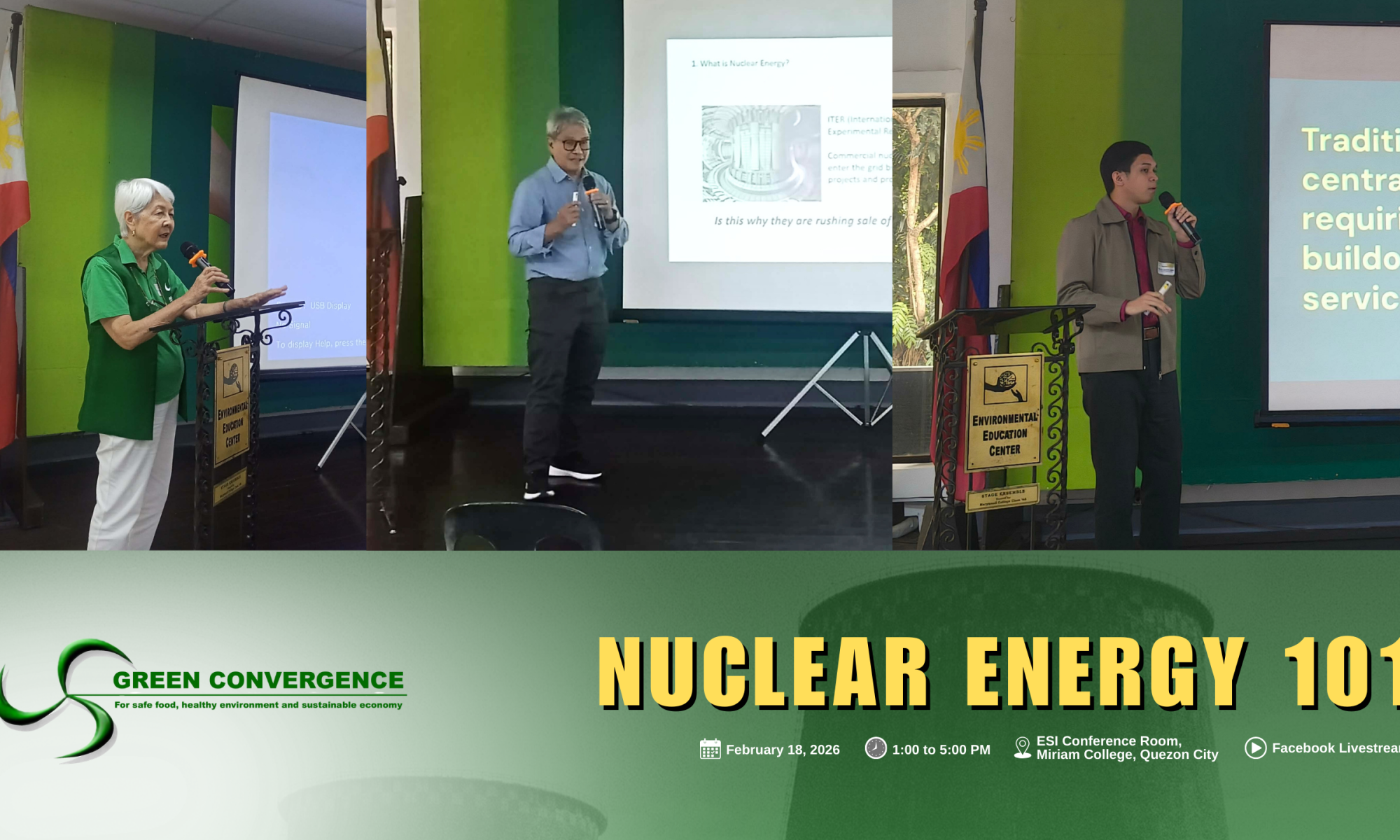
Green Convergence held its “Nuclear Energy 101” forum to increase among its members and allies the scientific knowledge of nuclear energy that would help them evaluate whether it is appropriate for the Philippines.

The forum was held last February 18, 2026, at the Environmental Studies Institute Conference Room of Miriam College in Quezon City, and via Facebook Live.

Invited experts were Dr. Fabian Dayrit, Professor Emeritus of the Ateneo de Manila University College of Science; Charles Jason Diaz, Senior Data Analyst of the Institute for Climate and Sustainable Cities; and Dr. Angelina Galang, Trustee of Green Convergence.

The forum clarified how nuclear energy works, assessed its economic and technical viability, discussed the structural and governance challenges, and placed everything into the local context considering the country’s energy needs, fiscal priorities, and sustainable development goals.

The speakers detailed the fundamentals of nuclear reactions and radioactive materials to ground participants in the science, while emphasizing strict safety standards and the long-term nuclear waste management demands.

Dr. Dayrit urged stakeholders to ask nuclear energy proponents whether the technology they are proposing is based on nuclear fission or nuclear fusion, noting that fission is what is commercially available today, and that it produces highly radioactive waste and carries long-term safety and storage risks.

He explained that while fusion is safer and more capable of supplying large amounts of energy with less ‘long-lived’ waste, it remains newly explored and will require more years of research and development before it can be used commercially.

The discussions also covered the country’s risks and vulnerability to earthquakes, typhoons, and rising sea levels, raising concerns about safety and on the long-term integrity of nuclear facilities and nuclear waste management systems.

Comparisons were made with Finland’s deep geological waste repository and our country’s own geological structure.

Information was shared that Finland’s project took 26 years from research on the proper siting (520 meters underground) to constructing the burial site.

It was also pointed out that the Bataan Nuclear Power Plant was reported to have around 40,000 defects—four times the average number of defects of nuclear power plants—and would require over six years and more than four billion dollars to rehabilitate, without assurance of full operational safety.

It also highlighted great strain in financing in terms of high upfront capital costs, extended construction timelines, added transmission requirements, decommissioning, waste management, and increased reserve margins that nuclear plants would entail.

Diaz stressed that nuclear energy is inflexible and may undermine grid reliability amid rising variable demand, adding that proposed Small Modular Reactors are too risky, still too early in its developmental stage, and economically unviable for the Philippines.

The above significantly rules out nuclear power as an immediate energy source option for the Philippines.

Renewable energy sources such as solar, wind, geothermal, and tidal power, which the Philippines is abundantly blessed with, are more scalable, can be decentralized, and are aligned and compatible with the country’s geography and rapidly evolving power needs.

Dr. Galang elaborated on the various points given by the previous speakers, adding that catastrophes caused by nuclear accidents are ‘in a league quite apart from those caused by other hazards such as typhoons, earthquakes, fires, and others.’

She stressed that after the latter occurs, people can go back to the sites and rebuild their lives; however, in the case of nuclear accidents, they cannot because of the intense radioactivity that the sites suffer.

Dr. Galang also emphasized that civil society organizations’ calls years back against nuclear energy reached decision-makers and were not a waste of effort. She encouraged everyone to persist in engaging the decision-makers and observing vigilance.

“Let’s invest in ecological sustainable development for our children’s future,” Dr. Dayrit said, adding that the Philippines can be a pioneering leader in renewable energy, especially ocean energy, and other safe energy alternatives.

#GreenConvergence #NuclearEnergy101 #NuclearEnergy

Environmental, Social, Legal Concerns on NMIA Construction Examined in February 2026 Kamayan

Green Convergence (GC) held its 428th Kamayan Para sa Kalikasan forum, themed “New Manila International Airport in Bulacan: Is it Necessary?,” on February 20, via Zoom and Facebook livestream, tackling the impacts of the construction of the New Manila International Airport (NMIA) in Bulakan, Bulacan, and the processes taken to reach its approval.

Opening the forum, GC Public Relations Officer David D’Angelo emphasized the need for the continuous conversation despite questions on whether the public’s opinions matter, given that the construction of the NMIA is around 90% complete.

He added that there still is a necessity in further broadening the understanding of both sides of the coin—the pros and the cons—and to figure out how people can altogether ‘make things better for ecological sustainability.’

Atty. Julius Victor Degala, Department Head of the Bulacan Environment and Natural Resources Office, presented the provincial government’s position, explaining that the NMIA is intended to address increasing air traffic demand and complement the Ninoy Aquino International Airport.

He noted that, while some traffic may be diverted to Clark International Airport, its distance of about 90 km from Metro Manila limits its capacity to fully decongest the metro, making Bulacan a strategically viable “Gateway to the North.”

Atty. Degala clarified that the 2,565-hectare project, located in Barangays Taliptip and Bambang in Bulakan, is privately implemented by San Miguel Aerocity Inc. under a 50-year Build-Operate-Transfer concession agreement with the national government through the Department of Transportation.

He added that phase one, which is targeted for completion in 2026, includes two runways and a modern terminal designed to accommodate 35 million passengers annually, with long-term plans to expand to four runways and a capacity of up to 100 million passengers per year.

In line with Republic Act No. 11506 and other environmental and aviation regulations, Atty. Degala said that the project is nationally regulated and must comply with the Philippine Environmental Impact Statement system, civil aviation rules, land acquisition laws, and public participation requirements.

He said the Provincial Development and Physical Framework Plan (PDPFP) views the airport not merely as a transport facility but as growth-inducing infrastructure expected to expand trade and logistics, attract investors, generate employment, and help tourism while integrating disaster risk reduction and climate change adaptation measures.

On the other hand, Architect and Environmental Planner Dr. Nathaniel “Dinky” von Einsiedel questioned the viability of the current site, stressing that the issue is not the need for a new airport but its location within a flood-prone environment at the confluence of major river systems draining into Manila Bay.

He shared hydrological data indicating that the 2,500-hectare reclamation area sits on what he described as the “hydraulic heart of Central Bulacan,” where floodwaters from the Pampanga River basin naturally discharge.

Linked with this hydrologic concern, he warned that burying river mouths and natural flow channels could worsen floods in surrounding municipalities, which currently is already experienced by the residents of Bulacan.

Dr. Von Einsiedel also raised geohazard concerns, referencing warnings about potential strong ground shaking and liquefaction linked to the West Valley Fault System, as well as findings that sea level rise in Manila Bay has exceeded global averages due to subsidence and other factors.

Furthermore, he discussed biodiversity losses, noting that mangrove forests, which were designated as protected zones, have reportedly been cleared, affecting habitats of migratory birds and nursery grounds for fish.

Dr. Von Einsiedel added that around 3,000 residents were reportedly displaced, with allegations from affected families and civil society groups of coercive consultations and insufficient compensation, involving even military personnel in the acts of coercion.

From a geologist’s perspective, Mines and Geosciences Bureau Region 3 Director Noel Lacadin described the site as part of a soft, deltaic location influenced by river runoff from Northern Luzon and compounded by siltation from the 1990 earthquake and the 1991 Mount Pinatubo eruption, requiring extensive engineering and stabilization.

Moreover, Environmental Management Bureau Region 3 Chief Raldy Pagador explained that the project went through the Environmental Impact Assessment (EIA) process under a Category B Environmental Impact Statement (EIS).

The project was issued an Environmental Compliance Certificate (ECC) in 2021 after review and online public hearings conducted during the pandemic, noting also that the EIA study is accessible through the regional office’s website.

In the open forum, participants questioned the effectiveness and transparency of the EIA system, raising concerns that the NMIA’s proponents primarily identify and mitigate their own project risks and that impacts of multiple reclamation projects in Manila Bay were not fully considered.

Residents of Bulacan and civil society representatives also expressed that they are facing worsening floods, declining fisheries income, and gaps in local government review, while government officials responded that hydrologic studies and quarterly monitoring are in place and that the compliance with ECC conditions is being tracked.

Participants also called for genuine public access to EIA documents in respect to their freedom of information and greater accountability in light of alleged violations, while raising questions about alternative airport proposals, such as the then-studied Sangley Point.

The open forum concluded with recommendations: Review and possibly update the EIA and ECC system; require pre-feasibility studies to really determine whether a large-scale project should even proceed to a feasibility study or not; ground decisions on science and ensure development goes with nature, not against nature; guarantee transparent and fair compensation for affected communities; consider simultaneous dredging of all rivers to manage flood pathways; involve multisectoral groups in monitoring; and revisit policies on conversion of alienable and disposable lands in environmentally sensitive areas.

Tying up the discussions, GC President Victoria Segovia delivered her closing remarks, stating that the issue of the NMIA project has more questions and issues than solutions and that it represents a major test of balancing development with environmental protection in the country.

“The real issue now is not just about building the airport—people say that it is also a necessity for national development. What we should do now is to pay attention to ensure that the mitigation measures are in place so that the project is climate resilient, environmentally sustainable, protective of communities, and carefully managed in the long term,” Segovia said, emphasizing that collaboration is crucial.

The next Kamayan forum will be on March 20, 2026.

Kamayan Para Sa Kalikasan is a monthly initiative organized by Green Convergence that enables non-government organizations, government representatives, the media, students, teachers, church groups, and concerned citizens to discuss, analyze, and create solutions to pressing environmental issues in the country.

For those interested to be a member of Green Convergence, visit this link to register:  bit.ly/GCMembershipRegForm

#GreenConvergence #KamayanParaSaKalikasan #NewManilaInternationalAirport


January Kamayan forum maps cross-sector environmental concerns, actions for 2026

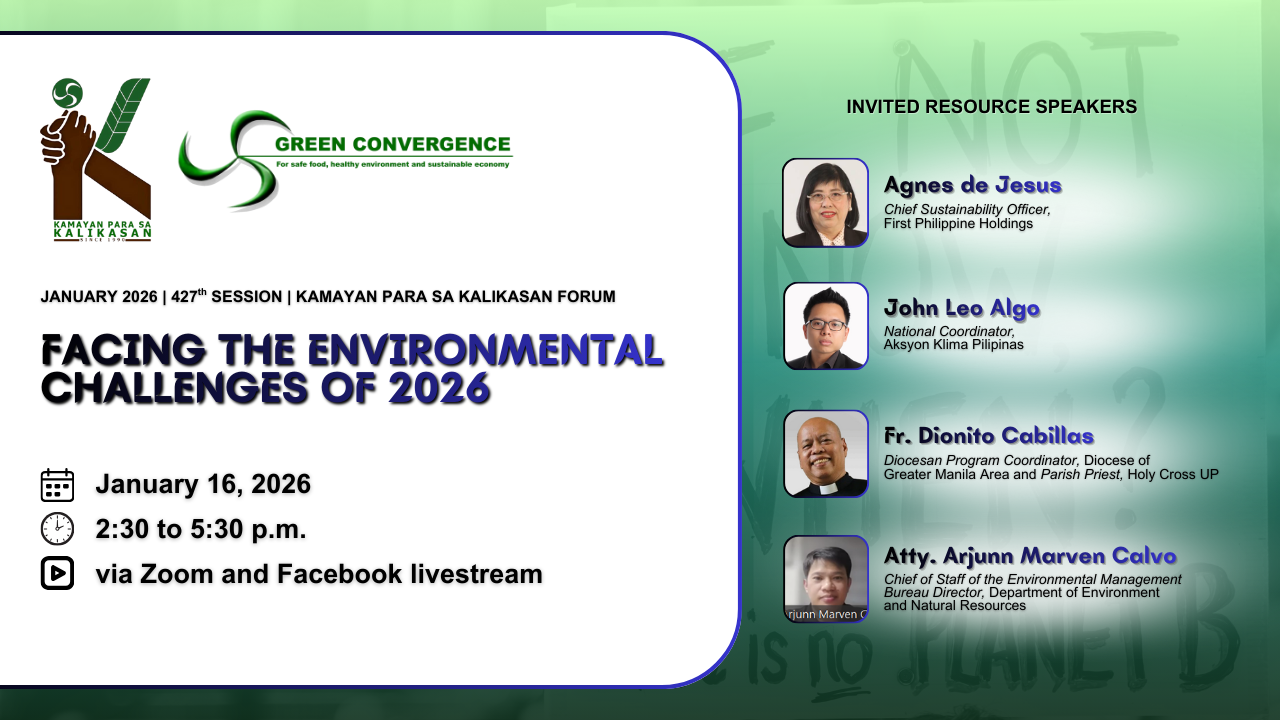
Green Convergence (GC) convened its 427th Kamayan Para sa Kalikasan forum, themed “Facing the Environmental Challenges of 2026,” on January 16, via Zoom and Facebook livestream, bringing together representatives from business, civil society, the Church, and government to discuss the environmental challenges that will shape the country in the coming year.

In her opening remarks, GC President Victoria Segovia said that the forum aims to reflect on what environmental challenges lie ahead for communities, expressing concern on dangerous technologies such as waste-to-energy and nuclear power that are being pushed without proper assessment of their impacts.

Integrating Decarbonization Pathways Into Core Operations

Agnes De Jesus, Chief Sustainability Officer of First Philippine Holdings (FPH) and Business Task Force Head of the Ako Ang Bukas (AAB) Advocacy Program, presented the environmental concerns of the business sector from the perspective of FPH.

She explained that climate-related risks such as flooding, extreme heat, and sea level rise directly affect infrastructure, supply chains, employee welfare, productivity, and asset values, making nature’s stability important to the sustainability of businesses.

De Jesus noted that while many global companies have withdrawn from their decarbonization pledges, FPH continues to pursue a 42% carbon reduction target by 2030 and net zero emissions by 2050, despite financial, technical, and operational constraints.

She also identified other present challenges, including the high cost of environmental measures, limited availability of technologies, and the risk of maladaptation when solutions fail to respond to ecological and social realities.

Echoing the Lopez Group of Companies’ values, she emphasized that protecting nature requires a strategic and integrated approach that recognizes the interdependence of people, ecosystems, and the economy.

“Our contention is that sustainable development requires our collective action, not just for planetary health, but also for the well-being and equity of people,” De Jesus said.

Climate Injustice, Misused Budgets, and Delayed Commitments

John Leo Algo, National Coordinator of Aksyon Klima Pilipinas, outlined the key ecological and governance issues civil society groups are closely monitoring in 2026, following what he described as a year marked by delays and unmet expectations, notably in 2025, which was supposedly the “defining year” for climate action.

Citing a 2025 survey by Asia-Pacific sustainability experts, Algo said climate change, biodiversity loss, plastic waste, deforestation, and waste management remain as priorities, reflecting on systemic failures and not necessarily on lack of awareness.

He raised concerns over corruption in flood control projects, expressing that the lack of accountability has left communities vulnerable to worsening floods, while billions of pesos lost to misappropriation could have been used for more opportunities, such as reforestation and other long-term climate solutions.

He also questioned whether the 2026 national budget genuinely supports climate action, pinpointing continued emphasis on large infrastructure projects instead of nature-based and people-centered solutions.

“There’s never been a better time than right now to start getting more involved than we already are,” Algo said, urging civil society, communities, and institutions to translate awareness into civic engagement.

Algo also discussed upcoming policy developments, including the proposed 75% emissions reduction target, the inclusion of forest protection in the next Nationally Determined Contribution, and the near completion of a National Just Transition Framework—the second in the world after South Africa—to protect vulnerable communities.

Environmental Degradation as a Moral and Social Concern

Through a pre-recorded presentation, Fr. Dionito Cabillas, Diocesan Program Coordinator of the Diocese of Greater Manila Area and Parish Priest of the Holy Cross in UP Diliman, cited theological bases and framed environmental degradation as both a moral and human rights issue.

Inspired by Pope Francis’ encyclical Laudato Si’, Cabillas emphasized that humans are stewards, not owners, of creation and are accountable for its care.

“Environmental destruction like mining, deforestation, ecotourism, building of dams, and corruption in infrastructures directly impact the poor, making ecology a human rights issue,” he said.

Cabillas presented images of mining operations, reclamation, dam construction—particularly the Kaliwa Dam in the Sierra Madre, landfill disasters such as in Binaliw, Cebu, deforestation, and other destructive activities across the country, showing how Indigenous Peoples and marginalized communities experience the harshest impacts of environmental damage.

He outlined the Church’s priority calls for 2026, including repealing the Mining Act of 1995, enforcing the Ecological Solid Waste Management Act, opposing environmentally destructive projects, promoting ecological education among the youth, and sustaining faith-based engagement in sustainable agriculture and pro-people renewable energy.

Stronger Enforcement of Policies, Regulations, and Safeguards

Atty. Arjunn Marven Calvo, Chief of Staff of the Environmental Management Bureau (EMB) Director at the Department of Environment and Natural Resources, tackled the government’s four key environmental priorities for 2026 amid worsening climate risks and development pressures.

Calvo acknowledged that the realities of environmental management are complex and more urgent now, as climate change, rapid infrastructure development, and urbanization increase demand for improved regulatory systems.

“For us in the EMB, these realities translate to a responsibility to make sure that development moves forward without compromising environmental integrity, public health, and long-term sustainability,” Calvo said.

He detailed ongoing efforts to strengthen the Environmental Impact Assessment (EIA) system, including the formulation of specialized Environmental Compliance Certificate guidelines for nuclear facilities following the passage of the Philippine National Nuclear Energy Safety Act, or the PhilAtom Law.

Calvo also cited the conduct of Cumulative Impact Assessments for reclamation projects in Manila Bay, the review of EIA thresholds for infrastructure and mining projects, and intensified enforcement against the observed practice of splitting large projects to evade environmental compliance requirements.

On solid waste management, Calvo reported that, as of 2025, only about 58% of local government units (LGUs) are served by sanitary landfills, needing refocusing on improving compliance, rehabilitation, waste segregation, and monitoring, alongside cautious consideration of waste-to-energy technologies under strict environmental safeguards.

Calvo also said that water quality degradation is still a concern, mentioning pollution of rivers, coastal waters, and groundwater from untreated domestic wastewater, industrial discharge, agricultural runoff, and leachates from poorly managed dumpsites and sanitary landfills, particularly in highly urbanized areas.

With this, he said that the EMB is strengthening enforcement of water quality standards and effluent regulations, intensifying wastewater treatment compliance among LGUs, and enhancing monitoring through field sampling and laboratory analysis to protect public health, food security, and climate resilience.

On air quality, Calvo said vehicle emissions remain the leading source of air pollution, encouraging the push for the transition to Euro V fuel and other vehicle standards, which could significantly reduce particulate emissions and associated health risks.

Overall, recommendations were raised such as strengthening governance by evaluating technologies before they are allowed to enter the country, tightening environmental impact assessments and monitoring, advancing nature-based and biodiversity-inclined approaches, and reinforcing laws that compel companies to move beyond minimum compliance.

Civil society was also encouraged to engage more closely with LGUs by looking into their action plans, budgets, and ensuring that policies in place turn into action at the community level.

Closing the forum, GC Assistant Corporate Secretary Ciela Castillo said that 2026 is no longer something society is preparing for but a reality already being lived, as environmental risks increasingly shape communities and livelihoods.

She added that environmental action is a shared obligation that requires engagement across sectors—not just one sector alone, institutions, as well as everyday choices.

The next Kamayan forum will be on February 20, 2026

Kamayan Para Sa Kalikasan is a monthly initiative organized by Green Convergence that enables non-government organizations (NGOs) and government representatives, the media, students, teachers, church groups, and concerned citizens to discuss, analyze, and create solutions to pressing environmental issues in the country.

For those interested to be a member of Green Convergence, visit this link to register: bit.ly/GCMembershipRegForm

#GreenConvergence #KamayanParaSaKalikasan #FacingTheEnvironmentalChallengesOf2026 #EnvironmentalIssues #NewYear2026

December 2025 Kamayan talks creation, nature in spiritual context

Green Convergence (GC) closed 2025 with the 426th session of Kamayan Para Sa Kalikasan themed “The Birth of Christ and the New Cosmology” last December 19, 2025, via Zoom and Facebook livestream, linking ecological understanding to spiritual meaning in the season of Christmas.

Sr. Marvie Misolas, Miriam College Environmental Studies Institute Executive Director and GC Trustee, opened the forum citing literature by Ilia Delio who acknowledged St. Augustine and St. Bonaventure as ‘observers of the cosmos’.

Quoting Bonaventure, Misolas said that it is important to return to the Book of Creation, as creation is not a backdrop of human drama, but the disclosure of God’s identity.

Laudato Si’ Movement Pilipinas Coordinator Sr. Elizabeth Carranza widened this idea by introducing the “new cosmology,” which she described as a way of understanding the universe that integrates science and spirituality and views creation as conscious, purposeful, and deeply interconnected.

Carranza traced the becoming of the cosmos—from the Big Bang, the birth of stars and galaxies, to the emergence of Earth as home to life, emphasizing that creation is not static but continuously evolving in communion.

She drew this idea from theologian Brian Swimme, who described gravity as a force of “union and communion,” reflecting God’s creative love at work in the universe.

Carranza said Earth became Mother and home to life through billions of years of transformation, giving birth to diverse species and, eventually, to humanity.

“It took billions of years for God to make us,” Carranza noted, underscoring the sacredness of both human life and the natural world.

Carranza then confronted the ecological crisis, pointing to destructive human activities such as mining, deforestation, pollution, and fossil fuel dependence that wound “Mother Earth.”

Quoting Pope Francis’ Laudato Si’, she reminded that creation ‘now cries out to us because of the harm we have inflicted on her.’

Carranza urged a collective response toward the “Ecozoic Era”—a time when humans live in the right relationship with Earth as a living, life-giving home.

Talking about deep incarnation, Carranza said God’s becoming flesh in Christ is inseparable from the whole of creation. “God is always needing to be born on Earth,” she said, calling on people to embody care, compassion, and responsibility in their own lives.

Carranza also led spiritual exercises to help audiences connect with Mother Earth and shared her self-written poem prayer titled ”I am Terra. I am Earth.”, reflecting on her inner connection to Earth, which she said she wrote while walking barefoot.

Understanding the new cosmology in the Philippine context, Bishop Gerardo Alminaza, head of the Catholic Bishops’ Conference of the Philippines’ National Laudato Si’ Program, expanded on the theological concept in his talk titled “Luntian na Pasko.”

Alminaza reframed the story of the birth of Christ as one rooted in vulnerability, displacement, and dependence on nature, which are realities familiar to many Filipinos today.

“Christ is born into a world marked by uncertainty and danger,” he said, noting parallels with communities facing climate disasters, environmental degradation, and development projects imposed without consent.

He cited mining permits, energy projects, and coastal reclamation that displace families and threaten livelihoods, particularly of fisherfolk, farmers, and Indigenous Peoples, which are realities that mirror the vulnerability of Christ’s birth, remarking that ecological issues are also questions of justice and responsibility.

“A luntiang pasko invites us to see the manger not as a decorative symbol but as a reminder that God chooses to enter the world where life is fragile and dependent on the integrity of creation,” Alminaza said.

He emphasized that the injustices faced by Filipinos are not merely technical issues but a moral one, shaped by decisions that determine who bears the cost of development.

Alminaza also added that when affected communities resist, they are often stigmatized or criminalized, prompting the necessary question—’development for whom and at what cost?’

Calling for solidarity, Alminaza urged communities, churches, civil society, and institutions to stand with farmers, fisherfolk, Indigenous Peoples, and urban poor families whose lives are dependent and directly tied to land and water.

“Care for creation and care for people are inseparable,” he said, adding that Christmas calls for both personal conversion and collective action.

Altogether, Carranza and Alminaza invited everyone to rediscover Christmas not only as a celebration, but as a commitment to honor creation, accompany the vulnerable, and allow faith to shape a more just and sustainable future.

Closing the forum, GC President Victoria Segovia reflected on the speakers’ talks through a deeper understanding of “Noel,” meaning joy and celebration, and “Emmanuel,” meaning “God is with us.

She said that “Noel” should remind everyone to choose and share joy amidst difficult times, even including the poor, the lonely, and the forgotten; it should remind hope that resists despair amidst crisis, conflict, and environmental harm.

Moreover, “Emmanuel” should remind that God is with those who suffer poverty, injustice, war, and climate disasters, and with creation that grooms under pollution and abuse.

“Christmas asks us to be God’s presence to stand with the vulnerable, protect life, and care for our common home that the incarnate Christ shared with us in his physical body. The Christmas season then makes us remember that the natural environment is a collective good, the patrimony of all humanity, and the responsibility of everyone,” Segovia expressed.

The next Kamayan session will be on January 16, 2026.

Kamayan Para Sa Kalikasan is a monthly initiative organized by Green Convergence that enables non-government organizations (NGOs) and government representatives, the media, students, teachers, church groups, and concerned citizens to discuss, analyze, and create solutions to pressing environmental issues in the country.

For those interested to be a member of Green Convergence, visit this link to register: bit.ly/GCMembershipRegForm

#GreenConvergence #KamayanParaSaKalikasan #BirthOfChrist #NewCosmology

Part 1

Part 2

November 2025 Kamayan CSO’s Say No to Nuclear Energy, WTE in Just Transition Efforts

Green Convergence (GC) convened the 425th session of the Kamayan Para Sa Kalikasan forum themed “Just Climate Transition: Should it include Nuclear & WTE?” on November 21 via Zoom and Facebook livestream. The November forum was supported by JRS Express.

With stronger calls for the phase out of fossil fuels in the recently concluded Conference of Parties (COP 30) held in Belém, Brazil, GC President Victoria Segovia noted in her opening remarks that national leaders in the Philippines are now promoting the use of waste-to-energy (WTE) and nuclear technologies as alternatives.

Segovia however questioned these steps that the Philippine government is taking. “Is this toward the sustainable development of the Philippines?”

Jumping on this premise, Gerry Arances, Founder and Executive Director of the Center for Energy, Ecology, and Development, challenged the framing of the country’s transition.

“Just transition ?” he asked, stressing that communities already suffering the worst impacts of the climate crisis must be the priority.

Arances noted that, despite 15 years under the Renewable Energy Act, the country’s renewable energy (RE) share increased only from 34% to 35%, while coal now accounts for 62% of the power mix—one of the highest in the world.

Even with this, there are no concrete steps for a fossil fuel phaseout.

However, he said that approved RE capacity is already enough to power the country forward. The Green Energy Auctions awarded 21 to 22 gigawatts of new RE, representing more than 60% of the nation’s existing installed capacity.

If these are implemented as planned, Arances argued that there is no need for new fossil fuel plants, nuclear power, or WTE.

“We already have enough renewable energy in the pipeline for the next decade,” he said. “We do not need WTE. We do not need nuclear.”

Engr. Alberto Dalusung III, Energy Transition Advisor at the Institute for Climate and Sustainable Cities, delved deeper into an evidence-based analysis of nuclear power based on grid limitations, economic realities, and global trends.

He explained that the Philippines has the smallest grid among Southeast Asian countries. In the Philippines, the largest single generating unit in Luzon is under 700 megawatts (MW), and smaller units operate in Visayas and Mindanao.

Given these numbers, Dalusung explained that installing a 1,000-MW nuclear reactor, which is the smallest commercially available size, would overwhelm the Philippine grid and would require massive reserve capacity that the system currently cannot handle.

He also rejected the argument that the country needs more baseload, stressing that the real problem is an oversupply of coal and gas plants that are forced to ramp up and down, damaging equipment and causing outages.

In the open forum, he added that solar is variable and predictable, unlike the argued “stable” baseload plants that frequently trip.

On costs, Dalusung cited international data showing nuclear as one of the most expensive technologies, which entails that it would be even more expensive in the Philippines due to seismic upgrades and absent nuclear infrastructure.

Addressing whether small modular reactors (SMRs) would be the appropriate nuclear technology for the country, he said that SMRs remain experimental, with only two commercially operating worldwide.

On considering WTE technologies in the Philippines, Sonia Mendoza, Chairperson of Mother Earth Foundation, warned that WTE incineration actually worsens both the waste and climate crises despite being marketed as a modern solution.

She said that all thermal WTE processes—from combustion to pyrolysis—emit greenhouse gases (GHGs).

Studies show WTE facilities generate 1.7 times more GHGs per MWh than coal, and even more than oil and natural gas.

Mendoza added that WTE facilities undermine waste reduction, as they depend on a constant waste supply and often involve “put-or-pay” contracts that penalize local governments for failing to meet requirements on the amount of garbage.

Despite claims of reducing landfill use, WTE produces toxic ash requiring engineered landfills, and releases dioxins linked to cancer and reproductive harm.

She also raised legal questions, pointing out that WTE contradicts the Clean Air Act and the Ecological Solid Waste Management Act. In a global context, the European Union has withdrawn funding support for incineration due to its climate impacts.

Reactors from government agencies, Engr. Regina Paula Eugenio from the Environmental Impact Assessment and Management Division of the Department of Environment and Natural Resources Environmental Management Bureau, Shiela Dela Cruz, the Officer-in-Charge and Chief of the Department of Energy’s Nuclear Energy Division, and Engr. Gemmalyn Galang, Science Research Specialist from the Department of Energy Biomass Energy Management Bureau, addressed the issues raised by the plenary speakers.

They acknowledged concerns, but urged “open-mindedness” as government agencies assess nuclear and WTE in the national energy mix.

They also cited ongoing work on nuclear regulatory frameworks, radioactive waste planning, grid studies, public consultations, and coordination with both local and international counterparts.

However, Patria Gwen Borcena, Environmental Sociologist and Executive Director of Greenresearch Environmental Research Group Inc., underscored the longstanding civil society opposition to these technologies—from a recent statement signed by 38 organizations to pastoral letters from church leaders.

She also questioned the government’s claim of inclusivity in the transition process given the aforementioned strong opposition.

Borcena punctuated the forum, “. in the future. , monstrous WTE nuclear?”

As shown in the plenary and panel exchange, while government agencies express openness to nuclear and WTE, civil society organizations (CSOs) maintain that just transition must reject dangerous, costly, and polluting technologies and accelerate the RE transition already within reach.

Wrapping up the forum, Dr. Angelina Galang, Founding Trustee of GC and Program Director of the Movement, firmly stated in her closing remarks that nuclear and WTE are false solutions to the climate change emergency.

“If we go to these technologies when we ever have so much blessings from the Lord, we are shooting ourselves in the foot, in the mouth, and in the head … We’re already vulnerable to natural hazards. We will exacerbate our vulnerability by these technologies,” Dr. Galang expressed.

#GreenConvergence #KamayanParaSaKalikasan #JustTransition #NuclearPower #NuclearEnergy #WasteToEnergy


Part 1

Part 2

Part 3

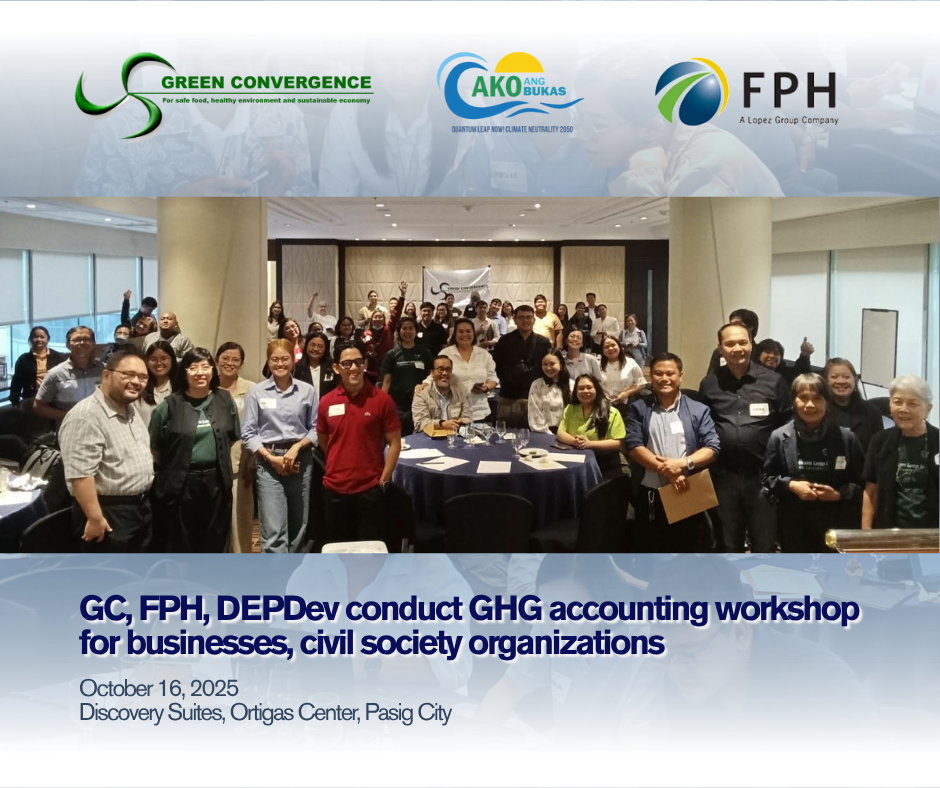
GC, FPH, DEPDev conduct GHG accounting workshop for businesses, civil society organizations

Green Convergence (GC) and First Philippine Holdings (FPH), through its Ako Ang Bukas (AAB) Advocacy Program, held a greenhouse gas (GHG) accounting workshop for businesses and civil society organizations (CSOs) on October 16, 2025, at Discovery Suites in Ortigas Center, Pasig City.

The workshop was co-organized with the environmental technical working group of the Sustainability Development Goals (SDG) Stakeholder Chamber of the Department of Economy, Planning and Development (DEPDev).

Jonas Dumdum of the environmental technical working group of DEPDev’s SDG Stakeholder Chamber echoed the sole purpose of the workshop, “you cannot report what you cannot measure, and you cannot measure if you do not identify,” linking it with how international reports still show that the Philippines is still number one in disaster risk-related issues.

Dr. Angelina Galang, Program Director of AAB and Founding Trustee of GC, kickstarted the workshop with a discussion of the ecological paradigm, anchored on the seven environmental principles: (1) Nature knows best, (2) All forms of life are important, (3) Everything is connected to everything else, (4) Everything changes, (5) Ours is a finite Earth, (6) Everything must go somewhere, and (7) Nature is beautiful and we are the stewards of God’s creation.

“We have disturbed, if not destroyed completely, the natural world. We have strayed further and further from nature to the extent that it imperils its ability to sustain our quality of life,” Dr. Galang emphasized the need to revert to nature through the principles, adding that it is the qualitative framework needed to understand the need for GHG accounting.

Agnes de Jesus, Chief Sustainability Officer of FPH and Business Task Force Head of AAB, then delved deeper into GHG accounting and its significant contribution to addressing climate change impacts.

De Jesus highlighted the Philippines’ commitment to reducing emissions under the Paris Agreement and introduced the AAB household GHG calculator web app as a practical tool to help households understand and track their carbon footprint.

She emphasized that ‘the choices we make will affect the climate,’ altogether suggesting to consume less power, consume less processed food, eat local and organic, minimize packaging, and shorten and plan travel routes through lifestyle change and tree planting.

On entity-level GHG accounting, de Jesus reviewed the boundaries and data needed to calculate for entities’ carbon footprint—scope 1 summed up as “burning fuel in your facility,” scope 2 or “buying power and steam” outside your facility, and scope 3 means “outside Scope 1 and 2”—and introduced the features of the AAB entity-level GHG calculator.

In line with the awareness of their carbon footprint through the calculator, she also introduced the mitigation hierarchy to guide decarbonization efforts—avoidance, minimization, reduction, and removing, and nature-based or man-made offsetting as last resort.

Milagros Serrana, Program Leader of AAB, led the workshop-proper on the use of the AAB household and entity-level GHG calculators. She demonstrated how to input data and how the calculator presents graphically the results which show the users’ hotspots.

Several participants were then able to share their results and reflections from the GHG calculation workshop.

Virgen Milagrosa University Foundation used their own data to try out the AAB entity-level GHG calculator and said that it was helpful for them to formulate action points for their university.

Airspeed International Corporation shared that knowing their emission hotspots through the calculator helped them validate their roadmap to promote and advocate sustainable framework up to year 2030.

DEPDev shared that the calculator was interactive and user-friendly.

Ako Ang Bukas (or “I am the future”) is a movement with a central campaign, “Quantum Leap NOW: Climate Neutrality 2050.” It seeks to involve all sectors and levels of society nationwide in taking urgent, concerted action to address the climate crisis facing the country and the world.

Be part of a bigger change by signing the pledge and joining the AAB program through this link: bit.ly/AKOANGBUKAS. Moreover, calculate your carbon footprint using the AAB household GHG calculator through this link: aab-household-ghg.web.app.

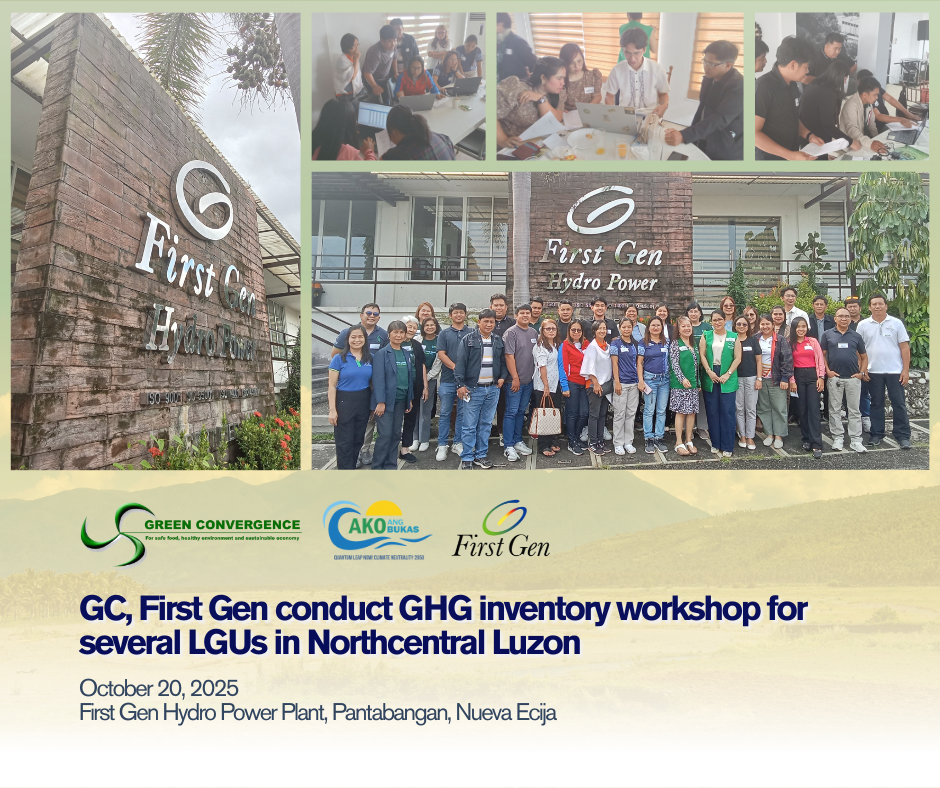
GC, First Gen conduct GHG inventory workshop for several LGUs in Northcentral Luzon

Green Convergence (GC), in partnership with First Gen’s Corporate Social Responsibility Group and through the Ako Ang Bukas (AAB) Advocacy Program, held a greenhouse gas (GHG) inventory workshop on October 20, 2025, at the First Gen Hydro Power Plant in Pantabangan, Nueva Ecija.

The workshop was held for the development of several local government units’ (LGUs) community-level GHG inventory in line with the enhanced Local Climate Change Action Plan (LCCAP) promotions and updating.

Participating LGUs were from Pantabangan and Carranglan of Nueva Ecija, Maria Aurora of Aurora, Alfonso Castaneda and Dupax del Sur of Nueva Vizcaya, and the province of Quirino.

Kickstarting the session, Agnes de Jesus, Chief Sustainability Officer of First Philippine Holdings, provided a situationer on climate change and the Philippines’ commitment to reducing GHG emissions under the Paris Agreement.

She outlined the GHG inventory journey for LGUs—learning the features of a GHG calculator and the practice of identifying GHG sources through the AAB household GHG calculator, applying these onto various entities’ value chains through the AAB entity-level GHG calculator, and using these fundamentals in transitioning to the entity and community-level calculators of the Climate Change Commission (CCC) which has extended parameters.

In line with preparing for the enhanced LCCAP, de Jesus explained that a GHG calculator is beneficial as it will serve as basis for climate action, given that it can identify the GHG hotspots that need intervention, and aid organizations in preparing for the future government requirement on GHG inventory and coming up with accurate data for green fund applications.

She then delved deeper into measuring an entity’s carbon footprint using the AAB calculator—covering scope 1, scope 2, and scope 3 emissions, coined as “buy,” “buy,” and “outside” as key words respectively.

De Jesus also emphasized cutting emissions through the mitigation hierarchy: avoid, minimize, reduce, and remove, with natural or manmade offsetting as the last resort.

As an example on how the AAB entity-level GHG calculator was used by an LGU, she shared the study done by AAB in Barangay Cogon, Ormoc, Leyte.

Also sharing their experience in GHG inventory, Rogelio Abalus Jr., Municipal Planning and Development Coordinator of Nagtipunan, Quirino, gave an overview of their municipality’s 2023 to 2028 enhanced LCCAP.

Nagtipunan’s planning framework consists of modules on stakeholder participation, vulnerability and risk assessment, GHG inventory using the CCC calculator, review of goals and setting of objectives, assessment of options and implementation, and monitoring and evaluation leading to adjustment and modification.

Abalus Jr. detailed the Climate Information and Situation Analysis of Nagtipunan from years 2036 to 2065 and anchored their Climate Change and Vulnerability Assessment on this, alongside efforts on GHG inventory, which involved planning, collecting of data, developing of a GHG inventory management plan, setting GHG emissions reduction targets, and tracking.

Upon implementation, following their 2022 baseline emission totaling 849,785.58 tons of carbon dioxide (from stationary and mobile combustion, purchased electricity, crops and livestock, solid waste, wastewater, and forestry and land use), they have removed 866,914.19 tons of carbon dioxide through carbon sequestration, recording a net emission of 17,128.61 tons of carbon dioxide.

Based on these data, the municipality’s planning team was able to identify technical findings, implications, objectives, potential options, and corresponding Programs, Projects, and Activities (PPAs) for their five priority sectors—social, infrastructure, institution and governance, economic, and environment.

They were also able to identify two decision areas for mitigation and adaptation actions: landslides and flooding.

Abalus Jr. said identifying these is needed for them to address identified local climate risks and enhance resilience and adaptive capacity, and in the future undergo monitoring and evaluation through reporting.

Subsequently, the workshop-proper on the AAB entity-level GHG calculator was then led by Milagros Serrana, AAB Program Leader, with an accompanying dummy data of an LGU for participating LGUs’ practice. After the workshop was a sharing of the LGUs’ ways forward, applying learnings from the session.

Ako Ang Bukas (or “I am the future”) is a movement with a central campaign, “Quantum Leap NOW: Climate Neutrality 2050.” It seeks to involve all sectors and levels of society nationwide in taking urgent, concerted action to address the climate crisis facing the country and the world.

Be part of a bigger change by signing the pledge and joining the AAB program through this link: bit.ly/AKOANGBUKAS. Moreover, calculate your carbon footprint using the AAB household GHG calculator through this link: aab-household-ghg.web.app.


October 2025 Kamayan forum addresses flooding situation, reinforces nature-based mitigation

Green Convergence, with the support of JRS Express, held the 424th session of Kamayan Para Sa Kalikasan forum themed “Baha at Bayanihan: A Holistic Approach to Flood Mitigation” on October 17 via Zoom and Facebook livestream to address worsening flood issues and discuss ecological solutions.

Sr. Marvie Misolas, Executive Director of Miriam College Environmental Studies Institute and a Trustee of Green Convergence, opened the session recognizing climate change, deforestation, watershed degradation, land subsidence, excessive groundwater extraction, and corruption as key causes of flooding.

Noting also that the Philippines is highly vulnerable to disaster due to its geography, at the same time abundant water resources, she calls for actions to ensure resilient communities through more integrated approaches and comprehensive management.

Quezon City’s response to flooding

Following this idea, Leo Martillano, Local Disaster Risk Reduction and Management Officer II of the Quezon City Disaster Risk Reduction and Management Office (QCDRRMO), shared the Drainage Master Plan of the city.

The QCDRRMO, in partnership with the University of the Philippines’ (UP) Resilience Institute, has conducted city profiling, taking into account the geophysical, social, infrastructural, economic, and institutional capacities of the locality.

In line with profiling, they have done area-specific assessments, field evaluation and condition assessments, close community consultations, and further analyses on data gathered to anchor their intervention models.

Though the Quezon City Drainage Master Plan is still at the first few steps of its implementation, the QCDRRMO has rolled-out workshops on flood validation, drainage assessment and inventory, General Information Systems (GIS), as well as on the Internet of Things (IoT)-based decision support system.

Other projects involve both structural and community-based interventions, from youth projects for disaster awareness and preparedness, relocation for those along easements of waterways, participatory monitoring and evaluation mechanisms for barangays, stormwater detention basins wherein basketball courts will be utilized, rainwater harvesting systems for schools and public markets, permeable pavements for sidewalks, to solid waste management for flood risk reduction—and more.

Martillano also emphasized that, when designing and proposing drainage-related projects, they aim to ensure the directly-involved local community has ownership over the projects done in their area, building on the concept of ‘bayanihan’ in the face of flood mitigation.

Trees and science-based solutions

Dr. Fernando Siringan, Research Professor from the UP Marine Science Institute, then delved deeper into dealing with flooding with the help of science and trees, referencing various studies that support effective flood mitigation.

He primarily underscored the importance of applying zoning in floodplains where it is still possible, saying that there is a need to respect the very nature of areas’ landscapes in implementing projects. Floodplains are lands beside rivers and waterways subject to flooding.

Dr. Siringan then reiterated the benefits of reforestation, such as decreasing or delaying run-offs during heavy rains and sediment yield, increasing groundwater recharge, summer stream flow, and biodiversity, lowering air temperature, and prolonging the lifespan of dams and Small Water Impounding Projects (SWIPs).

Considering trees as known natural shields, he presented studies that showed mixed planting of trees with different root distribution characteristics should be popularized to help infiltration of urban trees, as well as “sponge city” projects that may be replicated locally.

Dr. Siringan also linked the benefits of increased forest covers for SWIPS, mentioning observations in the 12 SWIPs of Alcala, Cagayan. Loss of trees can shorten the lifespan of SWIPs due to increased run-offs, soil erosion, sediment-filled rivers, and diminished dry season flow; and, if not desilted, can be costly for municipalities and farmers.

He added that initial trees to be planted in the SWIPs of Alcala should be more tolerant of drier conditions and that propagation of endemic, vulnerable, endangered, and critical trees should be given ‘special attention.’

Dr. Siringan also explained the importance of the river widening and implementation of waterway easement to allow improved transmission of floodwaters downstream, taking notice of the governmental mistake of not wanting to deal with communities in terms of relocation.

“Widening of [water] channels is a more permanent measure of addressing floods. The effect of river dredging is very temporary,” he stated.

Moreover, Dr. Siringan shared that preservation of sand dunes also lessens flooding issues, as they stop seawater from entering the coast and have vegetation that hold the sand in place. Also on coastal preservation, he reinforced the need for wider mangrove belts to reduce wave energy impacts.

Furthermore, on the relation of reclamation projects and the flooding issues, Dr. Siringan said, “Reclamation, if done improperly, kung ito ay nakakabara sa ilog—and I have seen some reclamations na maraming illegal [activities] all over the Philippines na nagpapasikip sa mga ilog—then, definitely, problema ‘yan sa pagbabaha.”

Reflections and ways forward

Reflecting on the discussions of Martillano and Dr. Siringan, Architect and Environmental Planner Dr. Leah dela Rosa, Chairperson of Miriam College’s Department of Sustainability and Environment, built on the idea of ‘looking at where we are’ and understanding local conditions and data in addressing the flood situation.

In understanding these, she also remarked that there should be deeper acknowledgement of shortcomings and acceptance of the consequences of the oversights and mistakes towards nature throughout generations in order to achieve sustainable development.

Dr. dela Rosa then called for sectoral and cross-cultural engagement through formal, informal, and indigenous knowledge-based studies based on past similar experiences, patterns, or actual conditions, highlighting the need for a paradigm shift in behavioral transitions.

Hinting on the current political climate with regard to flood control, she also noted that there is a need for increased levels or degree of governance over proper implementation of mitigation strategies.

Ultimately, Dr. dela Rosa called to ‘return to basics and let nature take its own pace. “We have to be ethical, honest, responsible, and good stewards of our environment and our natural resources—kung mayroon pang natitira,” she expressed.

This sentiment was then echoed by the President of Green Convergence, Victoria Segovia, in her closing remarks, reverting to the ‘nature knows best’ environmental principle and emphasizing that there should be respect for the natural cycles of the environment.

Next Kamayan session was announced to be on November 21, 2025.

Kamayan Para Sa Kalikasan is a monthly initiative organized by Green Convergence that enables non-government organizations (NGOs) and government representatives, the media, students, teachers, church groups, and concerned citizens to discuss, analyze, and create solutions to pressing environmental issues in the country.

For those interested to be a member of Green Convergence, visit these links to register: bit.ly/GCMembershipRegForm

Part 1

Part 2

Part 3