
Environmental group echo farmers’ call: ‘Protect PH coconut industry!’

Environmental Coalition Green Convergence held the 351st installment of the monthly Kamayan Para sa Kalikasan Forum about the state of the Philippine coconut industry and alternatives to help the coconut farmers on June 21, 2019 (Friday) at Kamayan Restaurant, EDSA, Mandaluyong City.

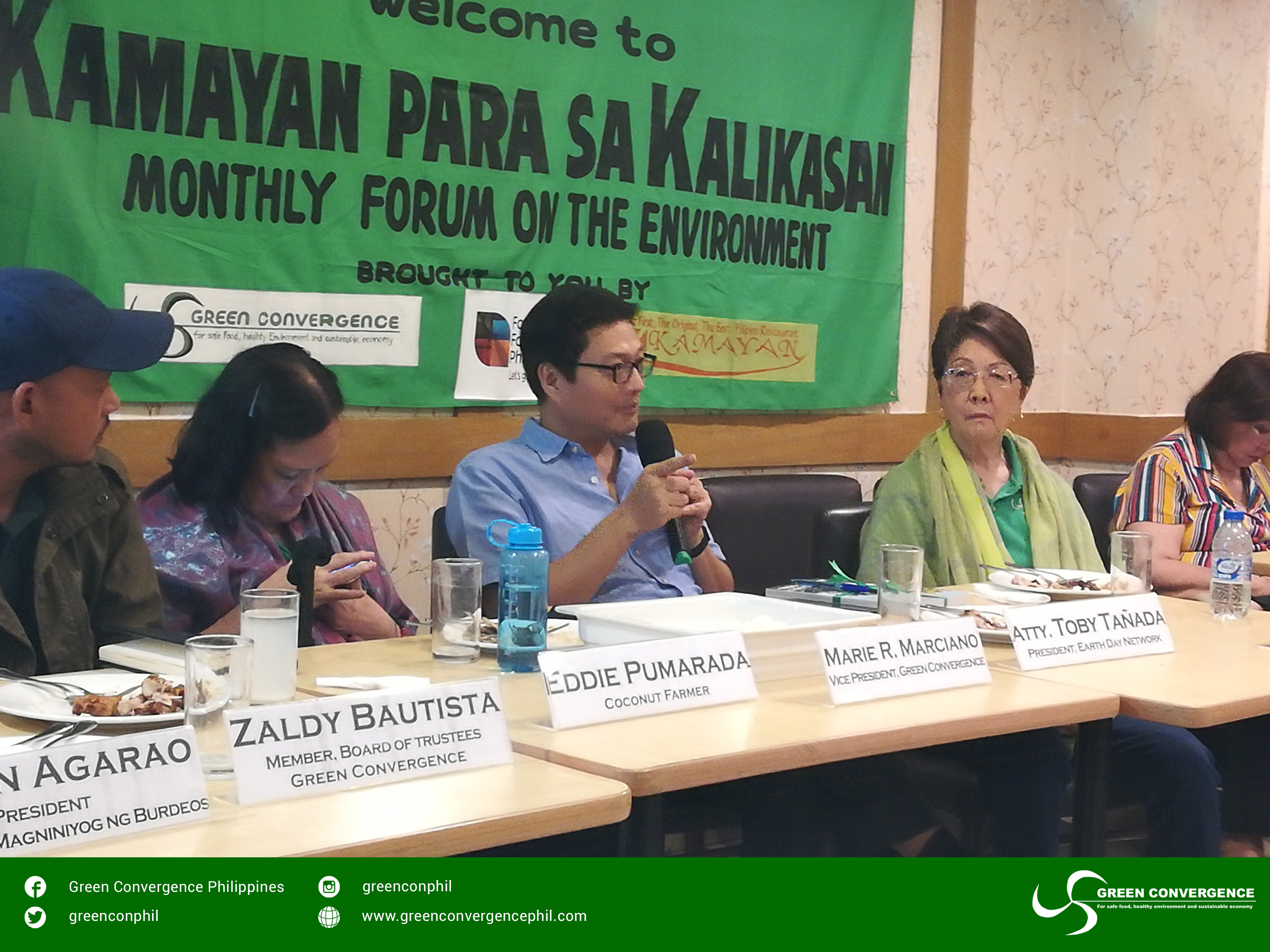
Quezon Province’s Samahan ng Magniniyog ng Burdeos President Edison Agarao stressed, “Among the challenges being faced by the coconut farmers are the lowering of coconut product price, market inaccessibility, stiff competition versus other oil products especially palm oil, inaccessibility to technology, and lack of government support.”

The negative state is further aggravated when President Rodrigo Duterte vetoed the Coco Levy Law, one of his campaign promises when he was just running for presidency.

“The campaign for the Coco Levy Bill has gone a long way,” said Atty. Atty. Toby Tañada, President of Earth Day Network, who is one of the major advocates of the policy, “but our farmers were fooled by false promises of this administration.”

Tañada called for a new bill that will immediately address low copra prices. He also encouraged, “Buying from farmers’ cooperatives and [profit] will be used for higher value coco products.”

He also said that the Coco Levy Fund campaign must not stop, and emphasized that “Coconut farmers should not only be the beneficiaries of the coco levy fund, they should likewise be participants in the growth and development of the coconut industry.”

Green Convergence Board Member and coconut farmer himself, Zaldy Bautista introduced intercropping as a way to increase the current income of coconut farmers.

It is a multiple cropping practice that involves growing two or more crops in proximity. Due to profit-oriented agriculture, the method has lost its relevance to farmers.

Madalas na itong ginagawa noong unang panahon ng ating mga ninuno,subalit hindi lang ito masyadong napahalagahan ng ibang mga magsasaka (This has often been done by our ancestors ever since, but this is not given importance by some farmers),” he explained.

Dr. Angelina Galang, Green Convergence President emphasized that the fight for food security is intertwined with the environmental struggle. She mentioned that achieving the ideal future for our common home is achieving the ideal future of the poor.

Since March 1990, Kamayan Para Sa Kalikasan Forum has become an institutionalized platform that enables NGO and government representatives, the media, students, teachers, church groups, and concerned citizens to discuss pressing environmental issues in the country. This month’s forum is organized by Green Convergence and is supported by Kamayan Restaurant EDSA with the assistance of the Forest Foundation Philippines.
You must be logged in to view this content. Free Virtual Library Registration Here

Environmental forum: ‘Go for ecological agriculture practices!’

Environmental Coalition Green Convergence held the 350th installment of the monthly Kamayan Para sa Kalikasan Forum about alternatives to intensive agriculture and achieving food security on May 17, 2019 (Friday) at Kamayan Restaurant, EDSA, Mandaluyong City.

Green Convergence President Dr. Angelina Galang emphasized that “agriculture has almost permanently gone to mass farming methods.”

“While this has arguably contributed to food security,” Galang said, “it resulted in a common perception that plants used in farming and for food are for such purposes only.”

Intensive use of crops solely for mass farming led to “their fading role in maintaining the integrity of our ecology,” she further stressed.

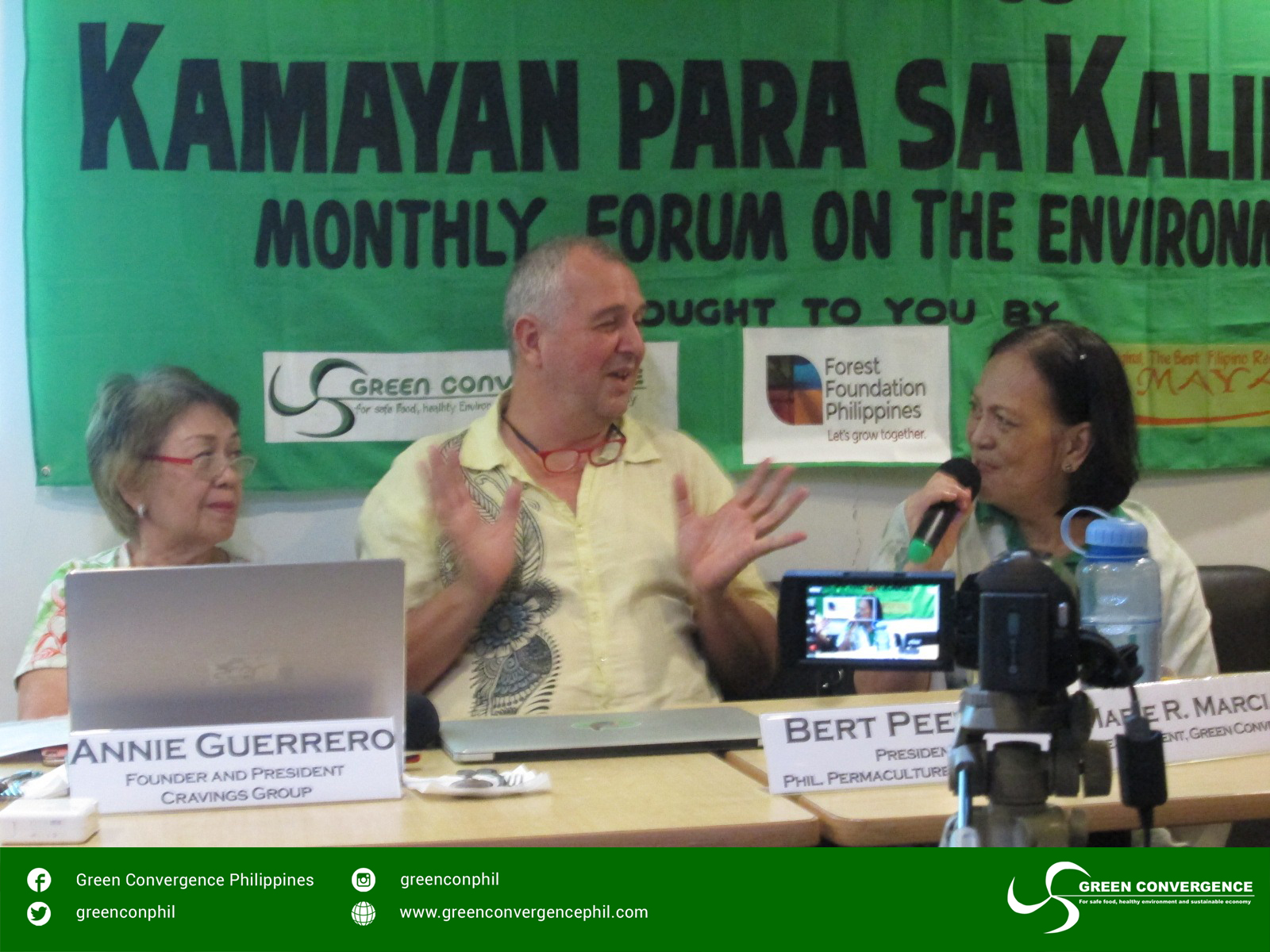
President Bert Peeters of the Philippine Permaculture Association described this phenomenon’s impacts to people, “We are becoming individually more and more separated…our society is a growing ego-system, but a shrinking eco-system.”

To help regain the crops’ ecological role and human connection to the ecosystem, Annie Guerrero, President of Cravings Group introduced the idea of ‘green chefmanship.’ She explained, “Being green means organic, local and sustainable.”

“[It includes the] use of Bokashi technology, an anaerobic composting by fermentation, [and] a process of mixing beneficial microorganisms into kitchen wastes to create powerful yet inexpensive fertilizers,” Guerrero further described the idea.

Green chefmanship coincided with Peeters’ view that “We have to go smooth with biodiversity by connecting to the places where nature thrives…studying the energy flow…and understanding the beautiful shapes of living things.”

Peeters added, “All we need is a little wilderness.”

Since March 1990, Kamayan Para Sa Kalikasan Forum has become an institutionalized platform that enables NGO and government representatives, the media, students, teachers, church groups, and concerned citizens to discuss pressing environmental issues in the country. This month’s forum is organized by Green Convergence and is supported by Kamayan Restaurant EDSA with the assistance of the Forest Foundation Philippines.

You must be logged in to view this content. Free Virtual Library Registration Here

Environmental forum calls to ‘#VoteIndependentSenate in 2019 Election’

Atty. Alex Lacson, Convener of People’s Choice Movement presents the 10 senatorial candidates who have ranked the highest in the organization’s assessment in terms of their (1) character and integrity, (2) competence and abilities, (3) faithfulness to public service and public office and (4) faithfulness to God, Constitution and the rule of law

“After Cory Aquino’s election, nagpabaya tayo, at kasalanan natin kung bakit nandito tayo ngayon (After Cory Aquino’s election, we were neglectful, and it is our fault why we are like this now),” was board member of Green Convergence Sr. Sonia Aldeguer’s assertion at the 349th session of the monthly Kamayan Para sa Kalikasan Forum on April 26, 2019 explaining how President Rodrigo Duterte came to power.

“It’s time to redeem ourselves (this election),” she further stated.

Atty. Alex Lacson, People’s Choice Movement Convenor stressed, “the 2019 Midterm Elections is the most dangerous in our history” and “Duterte may declare Martial Law or a Revolutionary Government” once he gets the validity of a majority vote from the Congress.

“If he declares Martial Law, he is still within the bounds of the Constitution, but if he declares a revolutionary government right after, he is now outside the bounds of the Constitution and nothing, no law can stop him [to do what he wants],” Lacson explained.

The shift to a federal government advocated by President Duterte himself is now being legislated in the Congress. The federalism version principally authored by former President and now House Speaker Gloria Arroyo was favored over the one drafted by Reynato Puno.

Lacson pointed out that Arroyo’s version is “anti-Filipino, anti-poor, anti-democracy, anti-life” given its features that removed provisions on anti-political dynasty and term limits of senators, congressmen and local officials, and also added ones that will allow foreigners to own or exploit the country’s resources.

For these features of the proposed Constitution to not be passed, at least 10 more members must be part of the opposition in the Senate since there are only currently three.

The People’s Choice Movement released a list of ten senatorial candidates that they assessed and have ranked the highest in terms of four categories – (1) character and integrity, (2) competence and abilities, (3) faithfulness to public service and public office and (4) faithfulness to God, Constitution and the rule of law. In order, they are:

  1. Gary Alejano
  2. Bam Aquino
  3. Neri Colmenares
  4. Chel Diokno
  5. Samira Gutoc
  6. Florin Hilbay
  7. Romy Macalintal
  8. Erin Tañada
  9. Mar Roxas
  10. Grace Poe

On the other hand, the Green Thumb Coalition, represented by Norie Garcia of Bantay Kita and Paeng Lopez of Health Care Without Harm, is yet to release their list of senatorial candidates that have been assessed and have ranked the highest in terms of their ‘green’ scores. As of the forum’s date, only nine candidates have completed their survey forms. They are Bam Aquino, Neri Colmenares, Leody de Guzman, Ding Generoso, Florin Hilbay, Grace Poe, Erin Tañada, Samira Gutoc and Chel Diokno.

EcoWaste Coalition, represented by National Coordinator Aileen Lucero, will also release their assessment after the Green Thumb Coalition releases theirs.

The session held at the Kamayan Restaurant, EDSA, Mandaluyong City ended with its participants initiating a campaign called #VoteIndependentSenate.

Green Convergence President Dr. Angelina Galang echoed this and reminded that the Philippines is so rich with natural resources yet they are not fully utilized for the country’s benefits due to the corruption of our politicians. “We can correct this if we elect an independent senate,” she said.

Since March 1990, Kamayan Para Sa Kalikasan Forum has become an institutionalized platform that enables NGO and government representatives, the media, students, teachers, church groups, and concerned citizens to discuss pressing environmental issues in the country. This month’s forum is organized by Green Convergence and is supported by Kamayan Restaurant EDSA with the assistance of the Forest Foundation Philippines.


You must be logged in to view this content. Free Virtual Library Registration Here

“Cha-Cha” gets heavy beating at forum

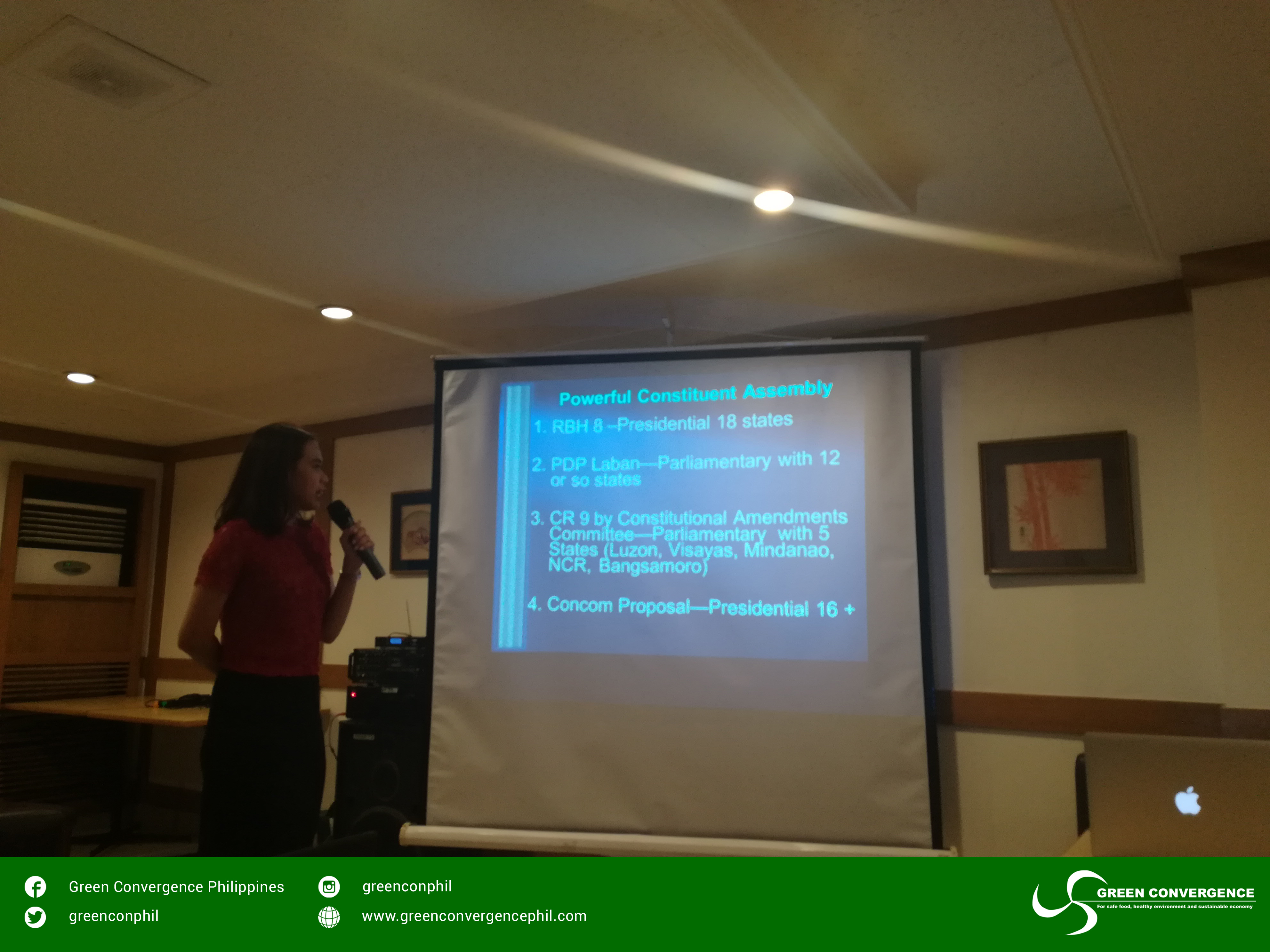
“The proposed Cha-Cha is anti-Filipino in the sense that it is removing protectionist provisions enshrined in the 1987 Constitution that ensure our right to be in control of our resources.” This was the opening salvo of Bayan Muna General Counsel Atty. Cris Yambot at the 348th session of the monthly Kamayan Para sa Kalikasan Forum, which tackled the proposed Charter Change (Cha-Cha) that would shift the Philippines to a federal form of government.

“Furthermore,” Yambot added, “it grants new and formidable powers to the President, giving him executive, legislative, and judicial control over the entire government. It opens the country wider to transnational corporations, and it dilutes or deletes the social justice and human rights provisions enshrined in the 1987 Constitution.”

Atty. Cris Yambut, General Counsel of Bayan Muna discusses the different versions of Charter Change being proposed in the Congress. She noted that Resolution of Both Houses No. 8 or the version submitted by Former President Gloria Arroyo is the one that has been passed at the committee level. It is primarily because “they have the numbers.”

In relation to foreign ownership, Yambot emphasized that in the proposed versions, transnational corporations would in effect be allowed to own and control lands, including already scarce agricultural lands that produce our food supply, and would lift established limits on foreign ownership of mining companies.

She then pointed out specific provisions in the draft Constitution that would abridge the rights of the Filipino people and reduce or remove their protection against unfair competition from big foreign corporations.

For example, she explained, the right to freedom of expression is put in danger by changing it in the proposed charter to “freedom of ‘responsible’ expression.”

“Who is to decide what’s ‘responsible?’” Yambot asked. “Will criticizing government or attending a rally be deemed ‘irresponsible?’”

In an unusual turn of events, Yambot was the sole speaker in this month’s forum, which always strives to present different sides of an issue. Unfortunately, SAGIP Party-list Representative Rodante Marcoleta, one of the authors of the draft Cha-Cha failed to come. Although he had confirmed his attendance up to the day of the forum, he cancelled at the last minute, citing an unforeseen meeting.

Finally, Yambot warned that many of the draft provisions would impact negatively on the environment, and encouraged everyone to carefully study the draft Cha-Cha which is available at the Congress website.

In her closing remarks, Dr. Angelina Galang, President of forum organizer Green Convergence said, “Everything is connected to the environment. We should protect our environment, thus, ownership should be left to the Philippines.”

A bit of politics entered the discussion but Galang enjoined everyone to rise above personal ties, family, alliances and emotional preferences and vote as Filipinos, for the good of the country. She also encouraged citizens and environmental groups to work on influencing lawmakers to reject provisions harmful to the environment and the Filipino people.

Kamayan Para sa Kalikasan Forum has become an institutionalized platform since March 1990 that enables NGO and government representatives, the media, students, teachers, church groups, and concerned citizens to discuss pressing environmental issues in the country. This month’s forum is supported by Kamayan Restaurant EDSA with the assistance of the Forest Foundation Philippines.
You must be logged in to view this content. Free Virtual Library Registration Here

Green Convergence forum tackle effectiveness of ecobricks

Environmental coalition Green Convergence held the 347th installment of the monthly Kamayan Para sa Kalikasan Forum last February 15, 2019 at Kamayan Restaurant, EDSA, Mandaluyong City. Resource speakers included Lou Arsenio of Ecobricks Philippines, Chairman Rolly Datiles of Barangay Bagumbuhay, Quezon City and Juvy Serafin of the Solid Waste Management Division of the Department of Environment and Natural Resources.

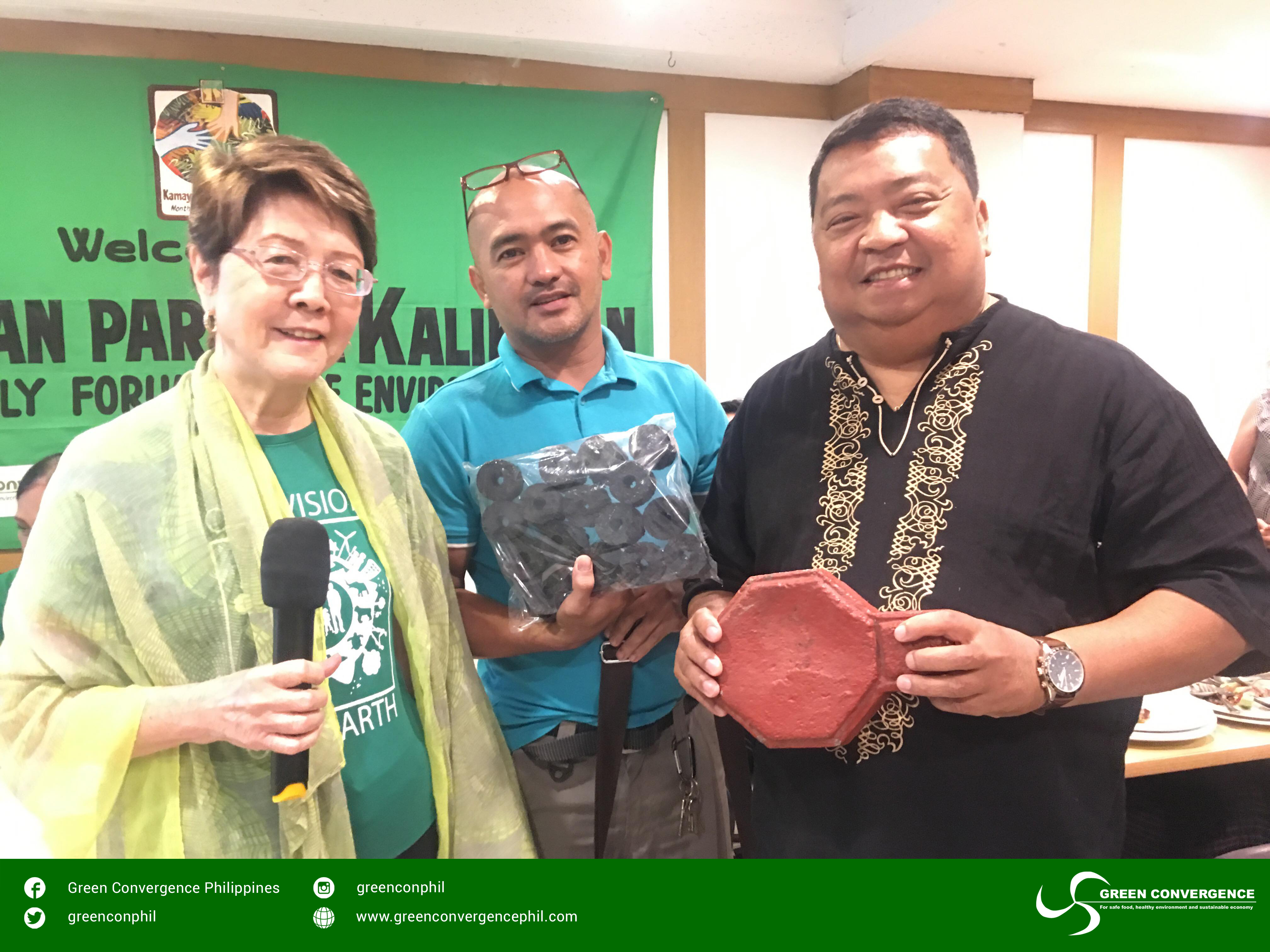
Dr. Angelina Galang (left) with Barangay Bagumbuhay Captain Rolly Datiles (right). Capt. Datiles is successful in implementing the ecological solid waste management law in his barangay with the ecobrick project that he innovated.

The forum scrutinized the two versions of ecobricks – (1) plastic bottle containers stuffed with dry plastic wastes which are used as filler bricks in building systems and (2) actual hollow blocks that are stronger than the former and are made by mixing wet cement and shredded plastic wastes.

Arsenio stressed that the said first version is supposed to be hard as a brick. “Dapat may proper training ang paggawa nito [ecobricks] dahil kung mali ang pagkakagawa, mahirap po itong ayusin (There should be a proper training for making ecobricks because if they are wrongly made, it would be difficult to fix them),” she followed.

On the other hand, Datiles explained that his community’s way of doing the second version is by processing non-biodegradable residual plastic wastes and mixing them with cement to be transformed into tiles and bricks. He presented the 4 E’s that supported his community’s ecobrick initiative and made their ecological solid waste management program successful:

“First you need education for the awareness campaign of the problem and proposed solutions. Second you need engineering so you would have proper equipment for realizing the solution. Third is enforcement. There needs to be a barangay ordinance for the program. Finally, economic sustainability where each household gain economic rewards by participating in the program.”

Serafin lauded the efforts of Chairman Datiles and mentioned, “Kung effective lang talaga ang management ng waste at the barangay level, wala sanang problema sa basura (If waste management is just effective at the barangay level, there could’ve been no problem with wastes).”

She further noted that “Ang dapat atakehin ay ang behavior ng mga tao…lifestyle kasi ng mga tao ngayon is convenience kaya management po ang approach natin (People’s behavior should be tackled…since our lifestyle is now is focused on convenience, that’s why our approach for this is management).”

Datiles said that the problem with wastes is global but the solution must be local. His barangay was also once like Payatas, heavily faced with waste problems. “Inimplement lang po namin ang RA 9003 [Ecological Solid Waste Management Act] na sinuportahan din ng aming [Quezon City] LGU…may City Ordinance No. 1203 po kasi na nagbibigay incentives sa mga barangay na may maayos na solid waste management program (We just implement RA 9003 which is supported by our LGU…there is City Ordinance No. 1203 that gives incentives to the barangays that have good solid waste management programs),” he shared.

However, Arsenio clarified that ecobricks are just a temporary solution. “Ang ecobricks na isinusulong namin ay para lang sa gardening at low walls kaya hindi naman siya kakalaban sa Building Code (The ecobricks that we promote are only for gardening and low walls, that’s why it would not go against the Building Code),” she claimed.

This contrasts with Datiles’ version, “Nagpatest kami sa UP at pumasa naman ang strength ng aming ecobricks…at may mga contractor na bumibili sa amin (We underwent a test at UP and the strength of our ecobricks passed…and we already have contractors that buy from us).”

Serafin discussed that “Kung nagproduce po tayo ng wastes, saan po mapupunta iyon? Ang DENR ay sumusunod sa waste management hierarchy kung saan ang first preferred option po natin ay waste avoidance…nasa efficiency po ‘yan ng LGUs (If we produce wastes, where will they go to? The DENR follows the waste management hierarchy where the first preferred option is waste avoidance…its efficiency lies on the LGUs)” implying that waste-to-energy initiatives like incineration depends on the LGUs’ effectiveness in solid waste management.

Dr. Angelina Galang, Green Convergence President concluded that “We have to look into our individual actions…take it upon ourselves to make them (LGUs) do their job properly. Management is the thing. These options are all open to us but we have to choose what is doable.”

Now on its 29th year, Kamayan Para sa Kalikasan Forum has become an institutionalized platform since March 1990 that enables NGO and government representatives, the media, students, teachers, church groups, and concerned citizens to discuss pressing environmental issues in the country. This month’s forum is supported by Kamayan Restaurant EDSA with the assistance of the Forest Foundation Philippines.
You must be logged in to view this content. Free Virtual Library Registration Here

Letter of Support for the Mangyan Communities

January 22, 2019

HON. ROY A. CIMATU
Secretary
Department of Environment and Natural Resources

Dear Secretary Cimatu,

Isang makakalikasang pagbati!

We, participants of the Kamayan para sa Kalikasan Forum held last January 18, 2019 at Kamayan Restaurant on EDSA, echo the call of the Mangyans in Mindoro that they be involved in decision- making processes affecting their communities.

In 2015, when Typhoon Nona struck Mindoro, the towns of Naujan, Victoria and Baco suffered from massive floods and landslides. This resulted in loss of family members and sources of livelihood. It was later discovered that the negative impacts of the typhoon were worsened by the excessive blasting during the construction of a hydro power plant and its connecting tunnel by the Sta. Clara International Corporation. The blasting heavily deforested the area and weakened the rock substrate causing landslides and flooding.

Members of the communities including the Mangyans, insisted that mountain blasting was not agreed upon by involved stakeholders in the Memorandum of Agreement on the construction of the power plant. Asked by tribe leaders why this aspect of the agreement was invalidated, the corporation responded that it needed to meet certain deadlines; that mountain blasting was the faster method to finish the power plant’s construction.

While the local authorities have decided to halt the construction activities of the plant in 2016, a lot of damage and loss has already occurred. It will be hard for the affected communities to recover from the tragic experience. Therefore, we further support their appeal that community members be included in the monitoring of the rest of this project as well as other projects.

We call on your good office to review Republic Act 8371 or the Indigenous People’s Rights Act of 1997 and to uphold its provisions especially on “ensuring genuine exercise by Indigenous Cultural Communities of their right to Free and Prior Informed Consent (FPIC), whenever applicable” and on “protecting their rights in the introduction and implementation of plans, programs, projects, activities and other undertakings that will affect them and their ancestral domains to ensure their economic, social and cultural well-being.”

Indigenous peoples are crucial in the environmental struggle because they experience firsthand the dangers of the rapid destruction of the environment. We must learn from their perspective, they who live intimately with nature. Projects meant for development may ironically become tools for disasters and further lowering of people’s quality of life should they be implemented without consulting, engaging and involving all the stakeholders. Ensuring the rights of indigenous peoples means ensuring the integrity of the environment.

With DENR in the helm of protecting the environment, let us all work together towards the protection of our only home and the achievement of sustainable development!

Para sa kalikasan,

Green Convergence for Safe Food, Healthy Environment and Sustainable Economy

[distance1]Click the link below for the letter received by the DENR:
Letter of Support for the Mangyan Communities

GC to PH gov’t: ‘Respect rights of IPs; no to false environmental solutions!’

Environmental coalition Green Convergence held “Landslides: Today’s Recurrent Nightmare,” at its monthly Kamayan Para sa Kalikasan Forum. Resource speakers included Rodne Galicha of Climate Reality Philippines and Mangyan representatives from Mindoro Virgilio “Ka Mot” Bunsoy and Alangan tribe leader Librada “Ka Badang” Isidro. They discussed the current environmental situation of Mindoro and the disasters that it regularly experiences related to flooding and landslides caused by mining and mountainside blasting.

Galicha showed the rich biodiversity of Mindoro by presenting a map showing its key biodiversity and important bird areas. Unfortunately, when overlaid with the location of mining areas, it revealed overlaps causing many concerns for its natural landscapes. Citing the cause of recurrent massive landslides in the island, Galicha explained that in mining, drilling is done to know the mineral deposits undernealth; but it is common sense that if mountain blasting is added, landslide will naturally occur since one drilled hole can trigger other existing holes to cause a landslide.

Ka Mot said that mountain blasting in the island is currently being done to give way to the construction of the 8-MW Santa Clara hydro power plant project that will supply the island’s electricity needs; however, he pointed out that there was no mention of any mountain blasting in the Memorandum of Agreement among the Mangyan communities, the local government and the company in-charge of the hydro plant. When he verified this with the engineer in-charge, he was informed that mountain blasting is needed to finish the tunnel on its target deadline.

Aggravated by typhoon Nona in 2015, mountain blasting has caused several landslides forcing Oriental Mindoro Governor Alfonso Umali Jr., to halt the project in 2016.  Mangyan leader, Ka Badang painfully recalls that when typhoon Nona struck, the river overflowed, flooding devastated their community.  Their crops were destroyed and 200 families in one community were left homeless.

“Ang lupa at bundok ay katumbas ng aming buhay. Ang bundok po, ito ay aming pinakabangko dahil dito kami kumukuha ng aming ikinabubuhay,” Ka Badang passionately shared how the IPs see nature during the 346th Kamayan Forum.

Angelina Galang, Green Convergence President, explained that a hydropower plant, though seemingly a better alternative to fossil fuels, may be a false solution when it is not appropriate to the ecology of the place. This is why it is essential to include the indigenous inhabitants in consultations and decisions because they intimately know the area.

Ka Badang recommended to consider solar power as an alternative source of energy for their area because of its relatively less environmental impact.  She also asked for legal support so they can easily voice out and stand for their rights over their ancestral lands.

“Landslides: Today’s Recurrent Nightmare,” was held last January 18, 2019 at Kamayan Restaurant, EDSA, Mandaluyong City. Now on its 29th year, it is the 346th forum of Green Convergence, institutionalized to provide a platform for civil society, government, and media to discuss pressing environmental issues of the country. This month’s forum is supported by Kamayan Restaurant EDSA with the assistance of Forest Foundation Philippines.

You must be logged in to view this content. Free Virtual Library Registration Here

Green Convergence’s Galang: “Update PH communal forest policy!”

Environmental Coalition Green Convergence held the 345th installment of the monthly Kamayan Para sa Kalikasan Forum last December 21, 2018 at Kamayan Restaurant, EDSA, Mandaluyong City. Resource speakers included forester Amie Rabang of the Forest Management Bureau and Liberty Talastas-Bituin, a member of the indigenous people in the Cordilleras.  They discussed Communal Forest and the status of its implementation.

Rabang stated that “there are 649 assigned communal forests all over the Philippines designated through Memorandum of Agreements between LGUs and the DENR.”

“In our experience in the Cordilleras, several areas not declared as communal forests are sustainably developed that provides livelihood while sustaining the area’s ecological integrity,” asserted Talastas-Bituin.

Rabang declared that “most of the assigned communal forests are disestablished by the DENR because they no longer provide timber.” She further added that “communal forests were conceptualized in 1995 with the main objective of providing timber for the country.”

Talastas-Bituin emphasized that “it is important that LGUs should conduct regular consultative meetings with the communities in the formulation of forest management plans to effectively use and protect these forests.”

Rabang seconded and further explained that communal forests should be included in the land use plans of the local governments.

The Local Government Code grants local government units (LGUs) the right to plan and manage identified communal forests.  We also have the Community-Based Forest Management Program, where a production-sharing agreement between the Department of Environment and Natural Resources and participating people’s organizations (POs).  for 25 years, renewable for another 25 years provide tenurial security and incentives to co-develop, co-utilize and co-manage specific portions of forest lands (DENR Administrative Order No. 96-29).

Realizing that these programs need to be modified to be attuned to the current environmental situation Green Convergence President Angelina Galang concluded that “it is urgent that government updates its policy on communal forests to avoid misuse and overuse of these identified forest lands.” She further highlighted the importance and critical role of forests as mitigation and adaptation instruments to protect us from devastating effects of climate change.

Now on its 29th year, Kamayan Para sa Kalikasan Forum has become an institutionalized platform since March 1990 that enables NGO and government representatives, the media, students, teachers, church groups, and concerned citizens to discuss pressing environmental issues in the country. This month’s forum is supported by Kamayan Restaurant EDSA with the assistance of the Forest Foundation Philippines.
You must be logged in to view this content. Free Virtual Library Registration Here

Global warming, ‘urgent concern’ – Green Convergence

Environmental Coalition Green Convergence held the 344th installment of the monthly Kamayan Para sa Kalikasan Forum about the 1.5°C Special Report on climate change of the Intergovernmental Panel on Climate Change (IPCC) on November 16, 2018 (Friday) at Kamayan Restaurant, EDSA, Mandaluyong City.

“The report highlights a number of climate change impacts that could be avoided by limiting global warming to 1.5°C compared to 2°C, or more,” explained Prof. Leoncio Amadore from the UP Institute of Environmental Science and Meteorology.

He explained that even the mere 0.5°C rise in global temperatures in the past 50 years had serious negative impacts to our survival. He said, “[It] has contributed to shifts in the distribution of plant and animal species, decreases in crop yields and more frequent wildfire.”

A 1.5°C or 2°C rise is much worse. Amadore exclaimed, “Coral reefs would decline by 70-90 percent with global warming of 1.5°C, whereas virtually all would be lost with 2°C.”

Rodne Galicha, Living Laudato Si Philippines Convener called for the public to not support corporations that contribute to the worsening of the global climate, including those that produce massive wastes, invests in coal power, and destructive mining.

“We must divest for sustainability and invest in our common home,” stressed Galicha.

On the other hand, Father Pete Montallana, President of Save Sierra Madre Network and now also Convener of the URGENT Initiative shared that Filipino households should be educated to contribute in lessening the impacts of and eventually slowing down global warming.

“A Carbon-Neutral Philippines by the year 2030 through committed Ecological Filipino families,” Montallana mentioned as the Initiative’s main goal.

Green Convergence President Dr. Angelina P. Galang called for everyone to be proactive on the impacts of global warming and to participate in actions to slow it down.

Since March 1990, Kamayan Para Sa Kalikasan Forum has become an institutionalized platform that enables NGO and government representatives, the media, students, teachers, church groups, and concerned citizens to discuss pressing environmental issues in the country. This month’s forum is organized by Green Convergence and is supported by Kamayan Restaurant EDSA with the assistance of the Forest Foundation Philippines.

You must be logged in to view this content. Free Virtual Library Registration Here

‘Cheaper fuels may impact public health’

October 23, 2018 at 09:30 pm by Rex Arcadio R. San Diego II via Manila Standard

Is cheaper fuel the answer?

While there is a clamor for more affordable fuels to address inflation, it might be wise for the government and the public to consider its health impacts.

Speakers and participants to the recent Kamayan para sa Kalikasan Forum in Quezon City were one in this conclusion.

Environment Undersecretary Juan Miguel T. Cuna noted that while the intention to address inflation is noble, there is a need to review, even reconsider the approach due to a number of reasons―both legal and medical.

“We cannot regress and compromise air quality,” Cuna pointed out.

The Land Transportation Franchising and Regulatory Board’s recent approval to increase jeep, and bus fares in November was met with public displeasure.

The Department of Energy’s response is to reintroduce Euro-2 grade fuels―a move that runs contrary to the provisions in the Clean Air Act.

The highest concentration of pollution in Metro Manila is in EDSA, making it a dangerous place for hundreds of thousands who travel, work, study or stay along the thoroughfare.

“We might be killing, penalizing ourselves by regressing in terms of fuel quality. Why regress when we know that lower quality fuels can result in more health problems for the public,” Rene Pineda, president of Partnership for Clean Air, noted.

The group Green Convergence has written the Department of Health to take part in the discussion concerning the health impacts of the transition from Euro-4 to Euro-2.

Records of the Department of Environment and Natural Resources show that despite the presence of many vehicles that are not Euro compliant, air quality in Metro Manila has improved, “though not yet in the targeted levels as set in the parameters by law.”

“The law states that only Euro 4 fuels should be used and sold in the market. And we have actually upgraded our standards. We should do everything we can to sustain that position in view of the health impacts of reintroducing Euro-2 diesel fuels,” Cuna explained.

Since 2016, only Euro-4 fuels are allowed to be marketed in all gasoline stations, and all engines that have been imported, manufactured and installed in vehicles are required to be Euro-4 compliant as mandated by the Clean Air Act.

Euro-2 maybe cheaper, but it is a lower standard fuel that has been proven to be less safe in view of the pollutants it releases into the atmosphere.

Cuna said that while the Energy Department is tasked “to determine fuel mixes,” the DENR is the lead agency when it comes to implementing the Clean Air Act.

“The DOE’s plan may sound good, but it should only be a temporary stop-gap response. A thorough review maybe needed before this issuance is made national,” Cuna added.

The DOE released the order endorsing the return of Euro-2 fuels last August 10, which violates the provisions of the Clean Air Act which requires all fuels to be compliant with Euro 4 standards.

“The DOE in effect usurps the authority of the law, Congress and the DENR, by issuing the order, by technically amending the Clean Air Act thru a department order that goes against the mandates of the law,” Pineda noted.

Pineda added that selling dirty fuel in effect invalidates the Clean Air Act, and thus distorts and disregards the efforts of the DENR to do its job of cleaning the air.

“We cannot adopt a simple ‘business as usual attitude’ and continue improving air quality. There has to be consultation with all stakeholders,” Pineda said.

Cuna lamented that the Energy Department may have overlooked the efforts of the DENR to improve air quality in the DOE’s desire to make fuel prices affordable to the public.

The World Health Organization has declared that diesel exhaust fumes are cancerous and in response, a number of European cities have banned petrol and diesel cars as green initiatives spread across continents.

To date, other countries have transitioned to Euro 5, and no other country produces euro 2 engines.

Cuna attributed this to the hard work of policy makers led by the DENR’s Environmental Management Bureau, who in coordination with different groups, have installed 20 monitoring stations in the National Capital Region and key cities throughout the Philippines to monitor the production of particulate matter (PM5) in the atmosphere, most of which are traced as products of motor vehicles.

Dr. Angelina P. Galang, Green Convergence Convenor said that there is the need to help the poor, but warned that the DOE’s move will bring about environmental problems that will compromise the health of the public.

“We should not go back to the old days when vehicles contribute a lot to air pollution,” said Galang.