

Environmental Forum: ‘Kailangan pa rin ang green spaces sa urban area’

Urban farming was the subject of the 365th session of the monthly Kamayan Para sa Kalikasan Forum held last November 20, 2020 through an online webinar hosted by Green Convergence.

Environmental Lawyer Ipat Luna showed her rooftop garden to the forum participants and shared some of her planting endeavors. “I raised a lot of dapdap for streetside planting. I just bought a kilo of seeds pero sa palagay ko maraming puno’y pakikinabangan natin from that.”

As means of disaster preparedness, Atty. Luna shared that “kahit nabagyuhan at pinabayaan mo [ang garden], it’s still going to give you something. It’s not much pero kung alam mo may value, nakakatuwa rin…I will never run out of camote tops and regular sweet basil.” 

“This is good disaster preparedness.” she added. 

“Policy wise, I think the important thing is for LGUs to support home gardening not just by giving seeds not just by programs that they roll out, but actual technical support and subsidies.” said Atty. Luna.

Carol Galvez of Pitak Project shared the workings of her farm in La Union which promotes regenerative living. “Sa farm ang mantra namin is ‘Build, build, build healthy soil’. That is our wealth. We measure our wealth by how far we’ve regenerated the soil and how much capital we invest back into the land. That is the essence of regenerative living.”

“Rather than increasing the quantity of a certain form of capital, regenerative systems develop the quality of capital. Ang current extractive economy requires ever increasing quantities of capital. That is cancer.”

“Unless the system can be transformed, this will likely lead to overall collapse”, she added.

“Maraming benefits [ang regenerative living]” said Galvez. “It promotes biodiversity, climate change mitigation. We are resilient during disasters. Nung lockdown, may tanim kami.” 

“My point here is we have a choice. We have to choose to regenerate our planet. Let us stop destroying our ecosystems…Let us restore our ecosystems and help build a more equitable world for the future generations to come. I am telling you it is possible.” she concluded.


“It’s really innate for us to get attracted to pretty things or green things. Lalo nang ngayong pandemic, we crave for the outdoors and we want to be outside, and no other color will represent the outdoors like green” shared tourism planner Chen Mencias.

When Mencias started her urban garden, she noted “dumami yung mga ibon and insects. Dumami yung butterflies, bees, beetles.”

“Nung isang araw lang, nakakita ako ng Oriole, which is not very common sa urban area.” she added.

“Kaya kailangan pa rin sa urban area ang green spaces kasi it really provides a place for relaxation and communing with nature” she concluded.

Since March 1990, Kamayan Para Sa Kalikasan Forum has become an institutionalized platform that enables NGO and government representatives, the media, students, teachers, church groups, and concerned citizens to discuss pressing environmental issues in the country. This month’s forum is organized by Green Convergence and is supported by Kamayan Restaurant EDSA with the assistance of the Forest Foundation Philippines.

Watch the full November Kamayan Forum here:
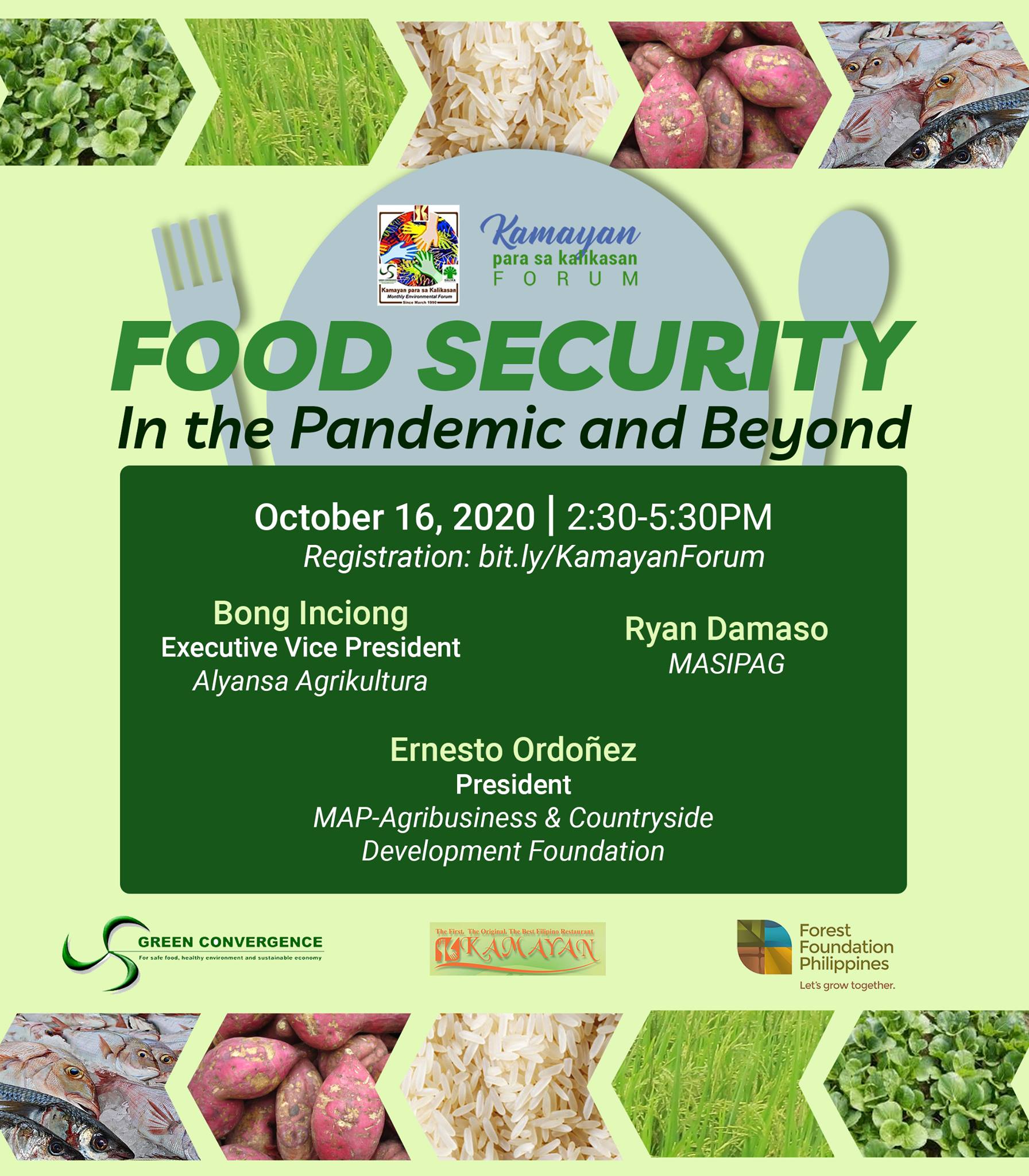
October 2020 Kamayan Forum

According to the UN Food and Agriculture Organization, 59 million Filipinos were reported to suffer from a moderate to severe lack of consistent access to food in 2019. Lack of income, unemployment, and natural disasters are just some of the many causes that lead to the growing number of food-insecure people in the country.

This was all before the impact of the COVID-19 pandemic.

What is the state of the agricultural sector amidst the ongoing pandemic? How has public access to food been affected by the months-long lockdown and quarantine protocols? What can the public and private sectors do to improve people’s access to food?

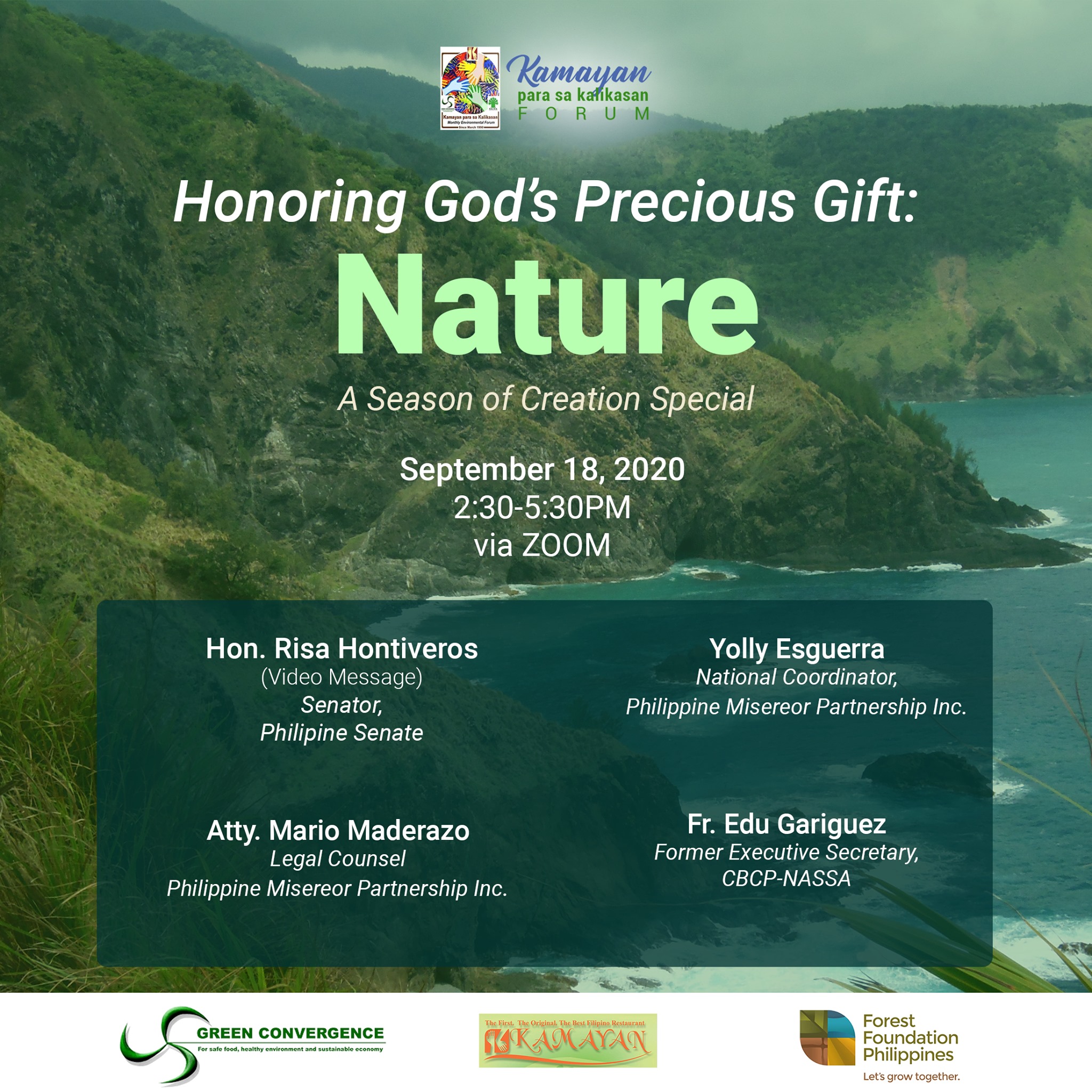
Honoring God’s Precious Gift: Nature

“A true ecological approach always becomes a social approach; it must integrate questions of justice in debates on the environment, so as to hear both the cry of the earth and the cry of the poor.” -Laudato Si (49)

The pursuit of economic development often results in the neglect of the environment. While there are some who profit from the exploitation of nature, the whole of creation is adversely affected by the consequences of environmental abuse- increased levels of pollution, loss of biodiversity, loss of natural resources, destruction of life-sustaining ecosystems, etc.

Must this so-called ‘development’ be pursued at the expense of the environment? How can we realize economic and social growth without destroying nature? Who is responsible for maintaining the integrity of creation for all life yet to come?


Groups urge for the passage of the Rights of Nature Bill

The Rights of Nature Bill was the main topic for the 363rd session of the Kamayan Para sa Kalikasan Forum held on September 18, 2020 hosted by Green Convergence Philippines.

Atty. Mario Maderaso introduced the bill to the participants as “a legislative proposal anchored on a paradigm shift”.

“There are 2 bills being filled in Congress. Senate Bill 1097 and House Bill 5603 or the Rights of Nature Act. The bill recognizes that nature has legal rights. Being part of nature, we need to recognize its existence. The protection of its rights would also mean the protection of our existence.” he said.

“In inducting this bill, we were supported by an organization based in the US who are also promoting the rights of nature. What is distinct to the principles being followed by other rights of nature advocates in other countries, we have included the coexistence of human rights and the rights of nature.” he added.

“Giving legal personality to the rights of nature, its legal consequence is that it will have a standing in court. Meaning, whenever the rights of nature are violated or damaged, through human agency, a case can be filed in court.” explained Atty. Maderaso.

“Any Philippine resident may file an action” he added.

“There was this case filed by environmental lawyers in Cebu. THey have filed a case on behalf of marine mammals. The petition was dismissed because the marine mammals by itself are not recognized as having a distinct legal personality.

“The court will award certain damages, punitive measures to the violators. These damages will not go personally to those who file the case, but it will go to a trust fund that will be later on managed by a conservation committee.”


Yolly Esguerra, PMPI Coordinator further discussed the campaign on rights of nature.

“The campaign is about the push to recognize the rights of nature.”

“Currently, the models of development paradigm are actually causing the environment to be destroyed continuously.”

“All this environmental destruction is actually largely man-induced and anthropogenic. 

“It is saddening because if you see the statistics, the percentage of humanity in the whole ecosystem and way of life is so small, but our actions are so destructive.” 

(“Nakakalungkot kasi if you see the statistics, the percentage of humanity in the whole ecosystem and way of life, napakaliit lang ang human, but so destructive ang ating mga gawain.”)

“To secure a sustainable future, we must change how we live. This entails major transformations in the ways our global society functions and interacts with natural ecosystems.”

“That is why there is a call for a paradigm shift. We come from the same source, if humans have rights, nature should have rights too.”

(“Kaya ang panawagan is a paradigm shift. Ang pinagmulan natin ay iisa, Kung may karapatan ang tao, may karapatan rin ang kalikasan.”)

Goldman Environmental Prize Recipient Fr. Edwin Gariguez supported this point as he read a quote from Laudato Si, the encyclical of Pope Francis. “When nature is viewed solely as a source of profit, this has serious consequences for a society.” 

“We need to move from a utilitarian, market driven mindset towards an ecological worldview in order to rectify the exploitative development paradigm” he said.

“We need to recover our connectedness with the earth. Without this shift in consciousness, the destruction of ecosystems in exchange for profit will continue” he added.

“Because that is all we see, how much is the profit? What is valuable to the person? But we don’t see what is valuable to nature” he said.

(“Kasi yun lang ang nakikita natin, ano yung kita? Ano yung mahalaga sa tao? Pero hindi natin nakikita yung mahalaga sa kalikasan.”)

In response, Gariguez emphasized the importance of Eco-spirituality and the role of the Indigenous People.

“Many Indigenous Peoples still have respect and love for the earth. We need to learn from them. For them, the land and everything on the earth is permeated with the presence of the spirit” he explained.

As a call for action, he reinforced “the need to affirm the sacredness of mother nature.”

(“Marami pa ring katutubo na mayroong respect and love for the earth. Kinakailangan natin matuto sa kanila.”)

“It is an exciting challenge; we are all one in our paradigm that nature has to be respected” said Dr. Nina Galang, president of Green Convergence.

Since March 1990, Kamayan Para Sa Kalikasan Forum, held every 3rd Friday of each month, has become an institutionalized platform that enables NGO and government representatives, the media, students, teachers, church groups, and concerned citizens to discuss pressing environmental issues in the country. The forum is organized by Green Convergence and is supported by Kamayan Restaurant EDSA with the assistance of the Forest Foundation Philippines.

Watch the full September 2020 Kamayan Forum here:

Anti-Terror law met with criticism at environmental forum

The Anti-Terror law and its implications on the environment was the subject of the 361st session of the monthly Kamayan Para sa Kalikasan Forum held on July 17, 2020 through an online webinar hosted by Green Convergence.

The law was criticized by human rights lawyer Neri Colmenares, who described the definition of terrorism as “very overboard”.

“In the first place, that is a very vague law” he said, and added “I am a lawyer, but I wouldn’t understand what act is prohibited [by that law]”.

(Ako, abogado po ako ah. But I wouldn’t understand kung anong act ang pinoprohibit niyan)

Atty. Colmenares gave an example where environmental activists who interfere with destructive mining activities can fall under the definition of terrorism. “In fact, under that definition, EDSA 1, People Power, is nothing more than a terrorist act” he also added.

“[The Anti-Terror law] is an act of state terrorism” asserted Sr. Mary John Mananzan, OSB, one of the oldest activists in the Philippines.

“Since President Duterte assumed office in 2016, at least 113 environmental and land activists were already murdered which is much higher than during the previous administration” cited Sr. Mananzan from Marlon Pareja, Associate Professor of Biology from De La Salle University Dasmarinas.

Under the new law, “this overbroad definition of terrorist acts will only worsen the current abuses environment defenders face in the Philippines…authorities can still find a way to use this law against environment defenders.” She said.

“Our Mother Earth will suffer when those who care for her are terrorized and killed.” She also added.

“The environmental defenders and environmental activists are now an endangered species” said Marie Marciano, Vice-President of Green Convergence.

“With this law, we can expect that the abuses will rise” she noted.

Since March 1990, Kamayan Para Sa Kalikasan Forum, held every 3rd Friday of each month, has become an institutionalized platform that enables NGO and government representatives, the media, students, teachers, church groups, and concerned citizens to discuss pressing environmental issues in the country. The forum is organized by Green Convergence and is supported by Kamayan Restaurant EDSA with the assistance of the Forest Foundation Philippines.

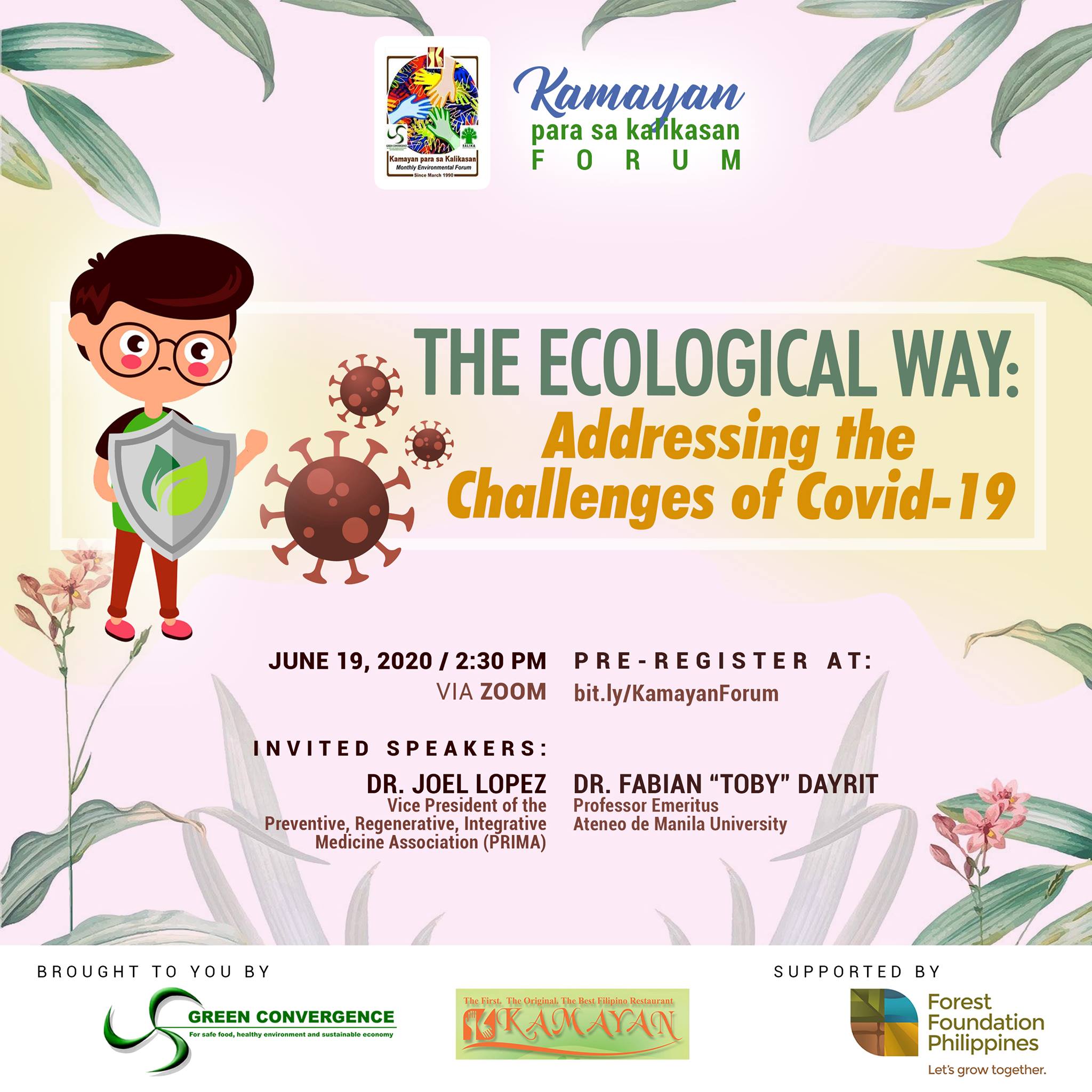
The Ecological Way: Addressing the Challenges of Covid-19

Kamayan Para Sa Kalikasan is back!

This year, the whole world is struck by a pandemic of the coronavirus disease 2019 (COVID-19), a novel infectious disease caused by severe acute respiratory syndrome coronavirus 2 (SARS-CoV-2). First detected in Wuhan, China, the virus spread to the Philippines on January 30, 2020, when the first case of the disease was confirmed in Metro Manila.

On June 4, 2020, the Philippines exceeded the 20,000 mark in a number of cases of the disease, at 20,382. As of the same day, it had the 3rd highest number of cases in Southeast Asia, after Indonesia and Singapore. Due to the spread of the disease, the administration of President Rodrigo Duterte declared the country under a state of public health emergency on March 9, 2020. Several institutions are racing to come up with the best solutions to counter the problems brought about by the crisis.

As the pandemic is not only a health issue but also an environmental one, is there an ecological way to combat its challenges?

Green Convergence to LGUs: ‘Invest in green spaces!’

The state of air quality and the need for expansion of green spaces in Metro Manila was the subject of the 355th monthly Kamayan Para sa Kalikasan Forum held on October 18, 2019 (Friday) at Kamayan Restaurant, EDSA, Mandaluyong City.

In a 2012 report by the World Health Organization, “Every year, around 7 million premature deaths [in the world] are caused by air pollution,” said Lyrio Woldring of Smart Air Philippines, “One in four deaths in the Philippines are attributed to air pollution,” she added.

Woldring emphasized that while the right type of masks are effective in protecting people from the worst impacts of air pollution, she was disappointed that the government was not treating the problem as a health concern. She remarked, “We have a campaign for polio, for dengue, why not for air pollution?”

Meanwhile, Quezon City Mayor Joy Belmonte’s representative, Patrick Alzona of the city’s Environmental Protection and Waste Management Department (EPWMD), spoke about the LGU’s plans to promote green spaces.

Alzona said that as the “lung” of Metro Manila, “Quezon City aims to implement the ‘Green Pedestrian Corridor’ in an attempt to increase the city’s green spaces to 25% of its total land area,” adding further that the City Mayor “wants to create a department solely for climate change and sustainability,” possibly the first of its kind among LGUs.

Asked about the young trees in plant boxes recently destroyed by the government along some streets, Alzona explained that they are treated as “collateral damage” of the national government’s road clearing operations. “They can be replanted,” he said further.

In the discussion, Negros Occidental’s Nordson Forest Park owner Atty. Nordy Diploma passionately declared that government inaction on environmental problems and non-compliance with environmental laws must never be tolerated.

Diploma converted 40 hectares of his land to a forest park for the benefit of his community, instead of using it for business.

“Trees are still the best absorbent of carbon dioxide,” asserted Dr. Angelina Galang, Green Convergence President, as a final reminder to the audience and the LGUs about the importance of trees, particularly the native ones, in combating air pollution.

Since March 1990 Kamayan Para Sa Kalikasan Forum, held every 3rd Friday of each month, has become an institutionalized platform that enables NGO and government representatives, the media, students, teachers, church groups, and concerned citizens to discuss pressing environmental issues in the country. The forum is organized by Green Convergence and is supported by Kamayan Restaurant EDSA, with the assistance of the Forest Foundation Philippines.

You must be logged in to view this content. Free Virtual Library Registration Here

MWSS’ Salamat: ‘I will resign’ if water crisis unsolved

Environmental Coalition Green Convergence held the 354th installment of the monthly Kamayan Para sa Kalikasan Forum about the status of water security in the country on September 20, 2019 (Friday) at Kamayan Restaurant, EDSA, Mandaluyong City.

Energy Development Corporation CEO Federico Lopez explained that the country’s water security problem is part of the ongoing global climate crisis. He said, “Shrinking glaciers will impact freshwater supply…Sea level rise and flooding will intrude aquifers.”

He noted that even without the effects of climate change, Metro Manila is still vulnerable due to very delayed flood control projects. He stressed, “There is a lot of ground subsidence…If water extraction continues.”

On the other hand, retired Lt. Gen. Emmanuel Salamat, Administrator of the Metropolitan Waterworks and Sewerage System (MWSS), in defense of the government’s initiatives said, “Measures have been adopted by MWSS to strengthen Angat Dam which was constructed in 1967 and other water structures to make these earthquake-resilient, for any damage to it will affect water supply, food supply, public safety, and energy resource especially in Metro Manila.”

Salamat promised to resign from his position if his leadership does not solve the water crisis that the metropolis is currently facing.

Alternative solutions were also provided by the forum’s speakers. Lopez recommended that the government must invest in research to develop a technology to utilize the abundant rainwater that the country receives.

Network for Sustainable Water’s Paolo Pagaduan emphasized, “Ang daling sabihin na kailangan nating magpatayo ng bagong ganito, bagong ganyan (It is easy to say that we need to build new this, new that),” when the problem is the people’s excessive consumption of water.

Pagaduan cited Seattle in the United States, where despite the city’s increasing population, water demand stays the same. He exclaimed, “We can reduce consumption to a more manageable level that is acceptable.”

In addition, a tribute to the late environmental champion and former DENR Secretary Gina Lopez was also given. Dr. Angelina Galang of Green Convergence and Dr. Carlo Garcia of the Miriam College Environmental Studies Institute partnered and pledged to plant 65 trees in Barangay Laiban, Tanay, Rizal in honor of the 65 years of life of the champion.

Galang described Lopez, “In the firmament of the environmental movement, she is the supernova, the brightest of all…Probably, a lot of us here became better because of her.”

Siguraduhin natin na ang mga punla, binhi na inilagay niya [Gina Lopez] ay patuloy na magbunga (We must ensure that the seeds she placed must continue to grow),” Jaybee Garganera of Alyansa Tigil Mina said.

“Mining, coal, [and] small island ecosystems; she wanted these issues to be at the forefront of the 2016 elections,” he added.

Since March 1990, Kamayan Para Sa Kalikasan Forum has become an institutionalized platform that enables NGO and government representatives, the media, students, teachers, church groups, and concerned citizens to discuss pressing environmental issues in the country. This month’s forum is organized by Green Convergence and is supported by Kamayan Restaurant EDSA with the assistance of the Forest Foundation Philippines.

You must be logged in to view this content. Free Virtual Library Registration Here

Environmental groups renew call for sustainable dev’t paradigm in PH

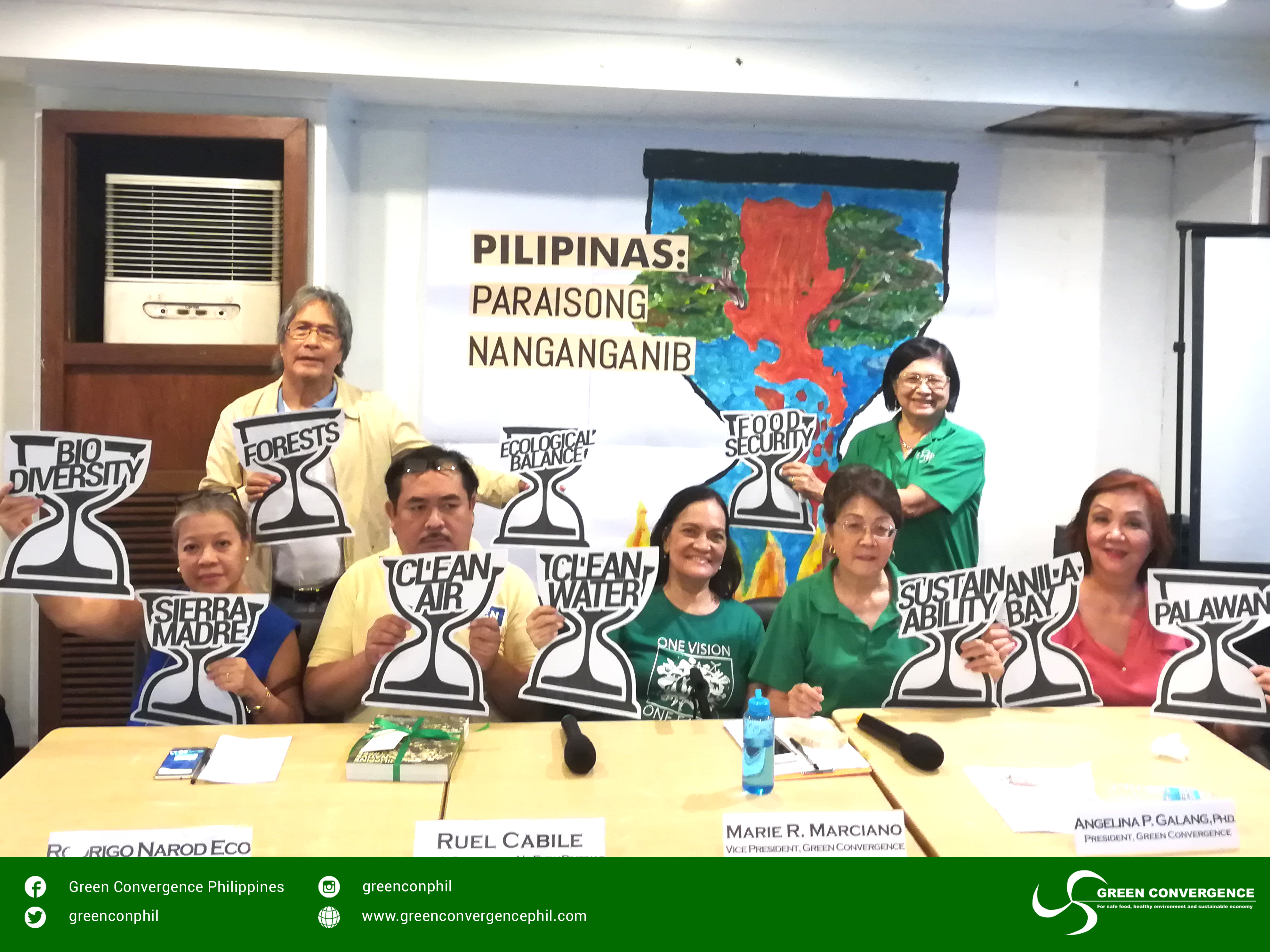
Environmental Coalition Green Convergence held the 353rd installment of the monthly Kamayan Para sa Kalikasan Forum about the pressing environmental concerns that the Philippines is facing on August 16, 2019 (Friday) at Kamayan Restaurant, EDSA, Mandaluyong City.

“There are programs of the government which Filipinos should be deciding on. But in the recent past, we are suddenly confronted with actions of China and with intrusions of the Chinese who are putting up or will be involved in mega projects in our country,” asserts Dr. Angelina Galang, President of Green Convergence.

Galang mentioned (1) the absence of a national land use policy, (2) large-scale reclamation activities especially in Manila Bay, (3) the construction of large dams especially the Kaliwa Dam, and (4) the division of Palawan into three separate provinces as actions of the government that are of urgent environmental concern.

These are also topics to be discussed in the upcoming annual State of Nature Assessment (Green SONA) with the theme “Pilipinas, Paraisong Nanganganib” to be held on August 27, 2019 at the Hue Hotel, Puerto Princesa City, Palawan, she explained.

The repercussions of large-scale reclamation to the country’s environment was further discussed by Rodrigo Narod Eco, a researcher from UP Diliman.

“There is no such as a natural disaster,” Eco asserted, “a natural phenomenon only becomes a disaster if it intersects with human activities,” implying that reclamation in Manila Bay will lead to disasters.

If reclamation activities continue in Manila Bay, “Dagdag harang sila sa tubig! ([Reclaimed lands] are added barriers to the flow of water!),” he remarked. This is especially dangerous if a 4-meter high storm surge hits the area.

Biodiversity in Manila Bay will also be negatively affected, considering that fish eggs and larvae of major fish species for food can be found in its shallow waters. Proposed land reclamation projects are exactly in these areas which could endanger the metropolis’ food security.

Eco called for rehabilitation of the Manila Bay, not reclamation for it will not only affect the marginalized communities in the area, such as the fisher folks and the urban poor, but also the entire metropolitan populace.

On the other hand, No Burn Pilipinas Regional Campaigner Ruel Cabile presented the myths of waste-to-energy through incineration and provided suggestions to achieve sustainability by properly managing municipal wastes.

A tribute to environmental champion and founder of Concerned Citizens Against Pollution (COCAP), the late Ester Perez de Tagle was also given. Perez de Tagle advocated against the Japan-Philippines Economic Partnership Agreement (JPEPA) in 2006 and for the promotion of the Euro-4 fuel in the country.

Since March 1990, Kamayan Para Sa Kalikasan Forum has become an institutionalized platform that enables NGO and government representatives, the media, students, teachers, church groups, and concerned citizens to discuss pressing environmental issues in the country. This month’s forum is organized by Green Convergence and is supported by Kamayan Restaurant EDSA with the assistance of the Forest Foundation Philippines.

You must be logged in to view this content. Free Virtual Library Registration Here

Green Convergence to PH gov’t: ‘Invest in native medicinal plants!’

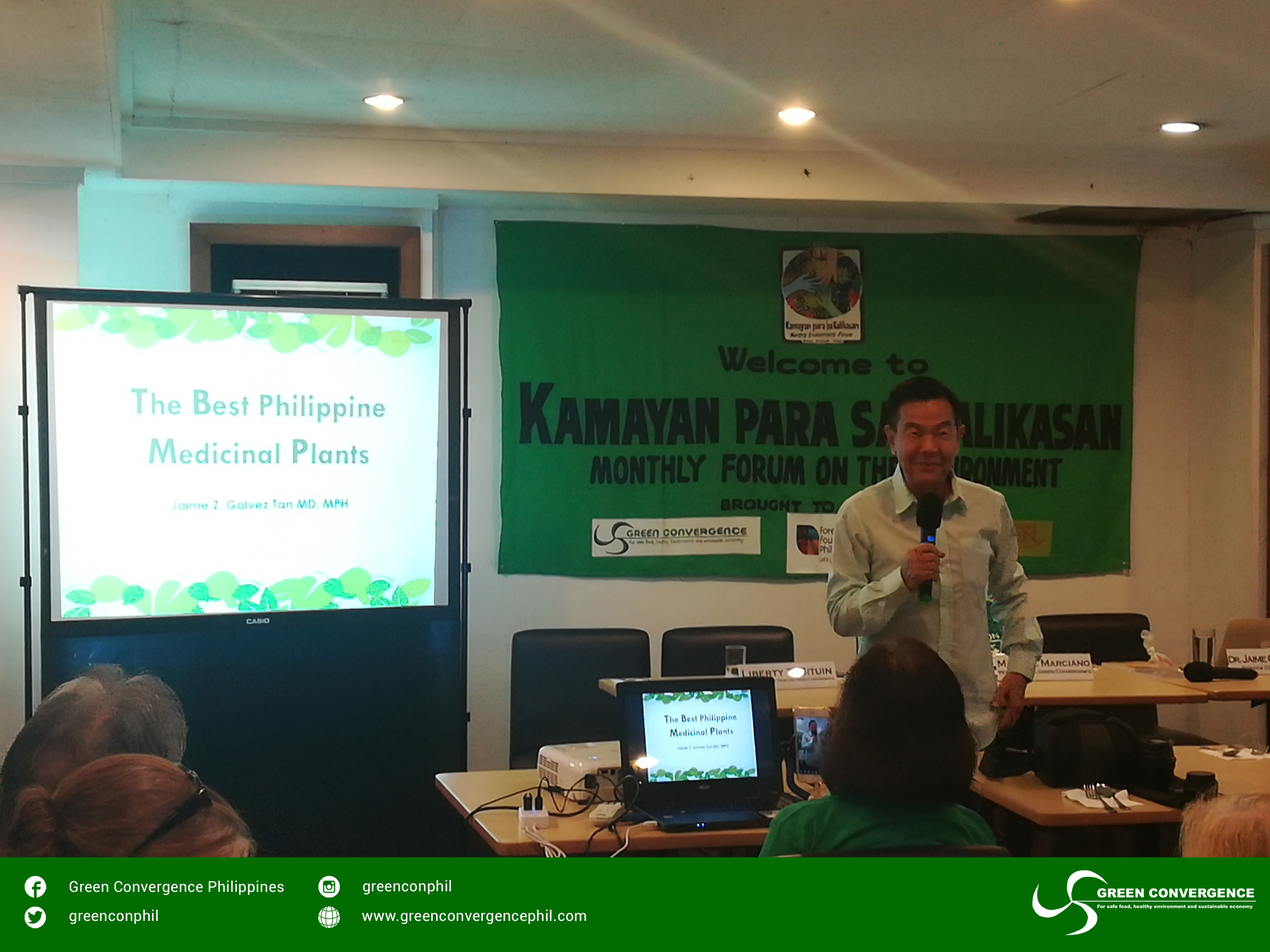
Environmental Coalition Green Convergence held the 352nd installment of the monthly Kamayan Para sa Kalikasan Forum about the future of the Philippine native medicinal plant industry on July 19, 2019 (Friday) at Kamayan Restaurant, EDSA, Mandaluyong City.

Former Department of Health Secretary Dr. Jaime Galvez Tan discussed that “Around 1500 medicinal plants from more than 13,500 plant species in the Philippines of which more than 3500 are considered indigenous.”

Unfortunately, Galvez Tan stressed, “Only 120 medicinal plants have been scientifically validated for safety and efficacy.”

“Only 10 medicinal plants have been promoted by DOH since 1993 and Philippine Institute for Traditional and Alternative Health Care since 1997,” he added.

Because of this slow promotion of the country’s medicinal plants, an estimated PhP 1.2-billion sales only were attributed to them, compared to PhP 138-billion sales of synthetic drugs. Both records were in 2013.

In fact, Dr. Francis Gomez explained, in mid-1990s to 2000s, medicinal plants had low acceptance from medical doctors due to perceptions that they are associated with ‘Quiapo herbs,’ quack, and backwardness.

“Even Philippine Medical Association stated that herbal medicines are not medicines,” Gomez exclaimed.

Gomez is the CEO and President of New Marketlink Pharmaceutical Corporation, the company behind Lagundex, made of a medicinal plant, whose success was due to persistent education campaign nationwide.

Galvez Tan noted that education campaign on Philippine medicinal plants must continue.

He presented the best medicinal plants that the country possesses: the best vegetable is malunggay (Moringa oleifera), the best spice is luyang dilaw (Curcuma longa), the best grass is takip-kuhol (Centella asiatica), the best palm is coconut (Cocos nucifera), the best stem is makabuhay (Tinospora rumphi), the best flower is ylang-ylang (Cananga adorata Lam), and the best nut is pili (Canarium ovatum Engl.).

All of which have medicinal properties that improve the health conditions of human beings, he stressed.

On the other hand, Igorot and Green Convergence Board Member Liberty Bituin argued that everything in our forests is good for our health. “From fresh air, to the fresh waters, to the stones, to the trees, and all the medicinal plants,” she enumerated, “they are all components of the indigenous ways of improving our health.”

Green Convergence President Dr. Angelina Galang called for the Philippine government to invest in the country’s natural resources and for the civil society to strengthen their campaign for this to be realized.

Since March 1990, Kamayan Para Sa Kalikasan Forum has become an institutionalized platform that enables NGO and government representatives, the media, students, teachers, church groups, and concerned citizens to discuss pressing environmental issues in the country. This month’s forum is organized by Green Convergence and is supported by Kamayan Restaurant EDSA with the assistance of the Forest Foundation Philippines.

You must be logged in to view this content. Free Virtual Library Registration Here