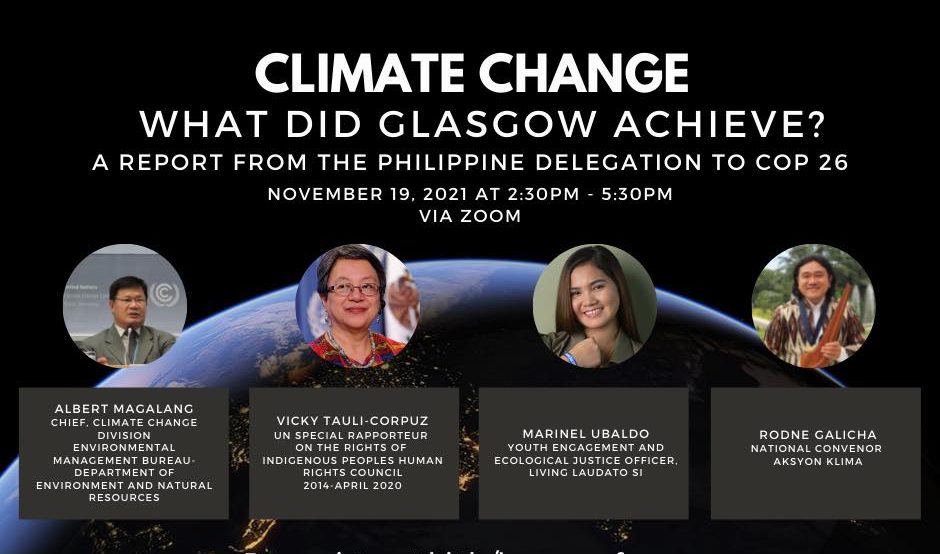
Climate Change: What Did Glasgow Achieve? A Report From the Philippine Delegation to COP 26

The 26th Conference of Parties (or COP 26) of the United Nations Framework Convention on Climate Change (UNFCCC) was recently held in Glasgow, Scotland, United Kingdom, from 31 October to 12 November 2021.

Did the global top-level climate negotiations achieve any significant stride in obtaining country commitments to (1) keep Earth’s temperature within safe limits; (2) address loss and damage from climate impacts, especially in poor and highly vulnerable countries like the Philippines; and (3) implement measures to ensure the sustainability of our planet?

View the full episode via this link:

https://fb.watch/gdWs0qcLrj/

Black Sand Mining

To shed light on the controversies surrounding black sand mining in the Philippines, we have invited stakeholders in this issue to provide us insights and opinions regarding the environmental impacts and possible ultimate outcomes for our country if this type of mining continues.

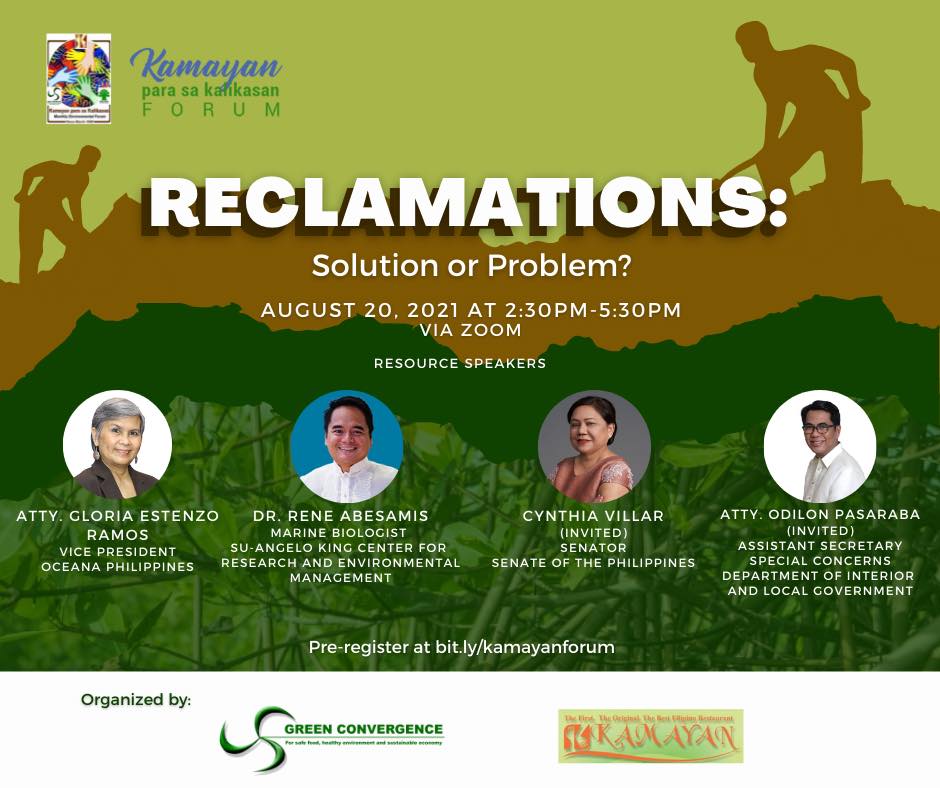
Reclamations: Solution or Problem?

The effects of land reclamation on marine ecology and the coastal environment are gaining attention and being widely studied. It has been found that reclamation may contribute to changes in flooding patterns, cause damage to marine life, and affect the stability of coastal foundations and slopes. With the current proposed and approved reclamation projects in the Philippines, what’s in store for us?

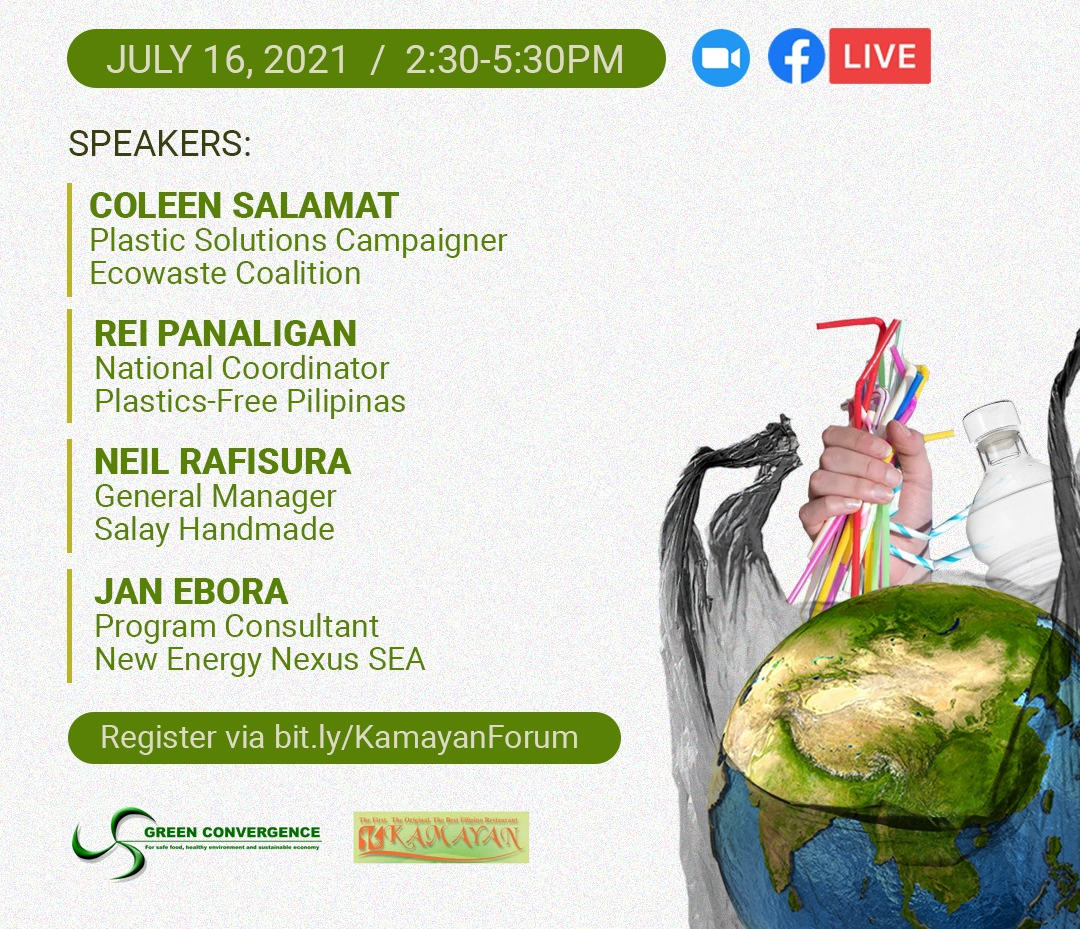
Nature’s Twin Scourges: Plastic and Climate Change

Since the invention of plastic over a hundred years ago, the synthetic material has made its way into every aspect of our life; in food, medicine, clothes, and more, plastic has made our daily tasks more convenient.

Unfortunately, the ease that comes with using plastic has a dark side, and it’s been plaguing our environment slowly but surely. Only less than 10% of all plastics are recycled while the remaining billions of tons of plastic wind up harming wildlife, marine life, and eventually, us humans.

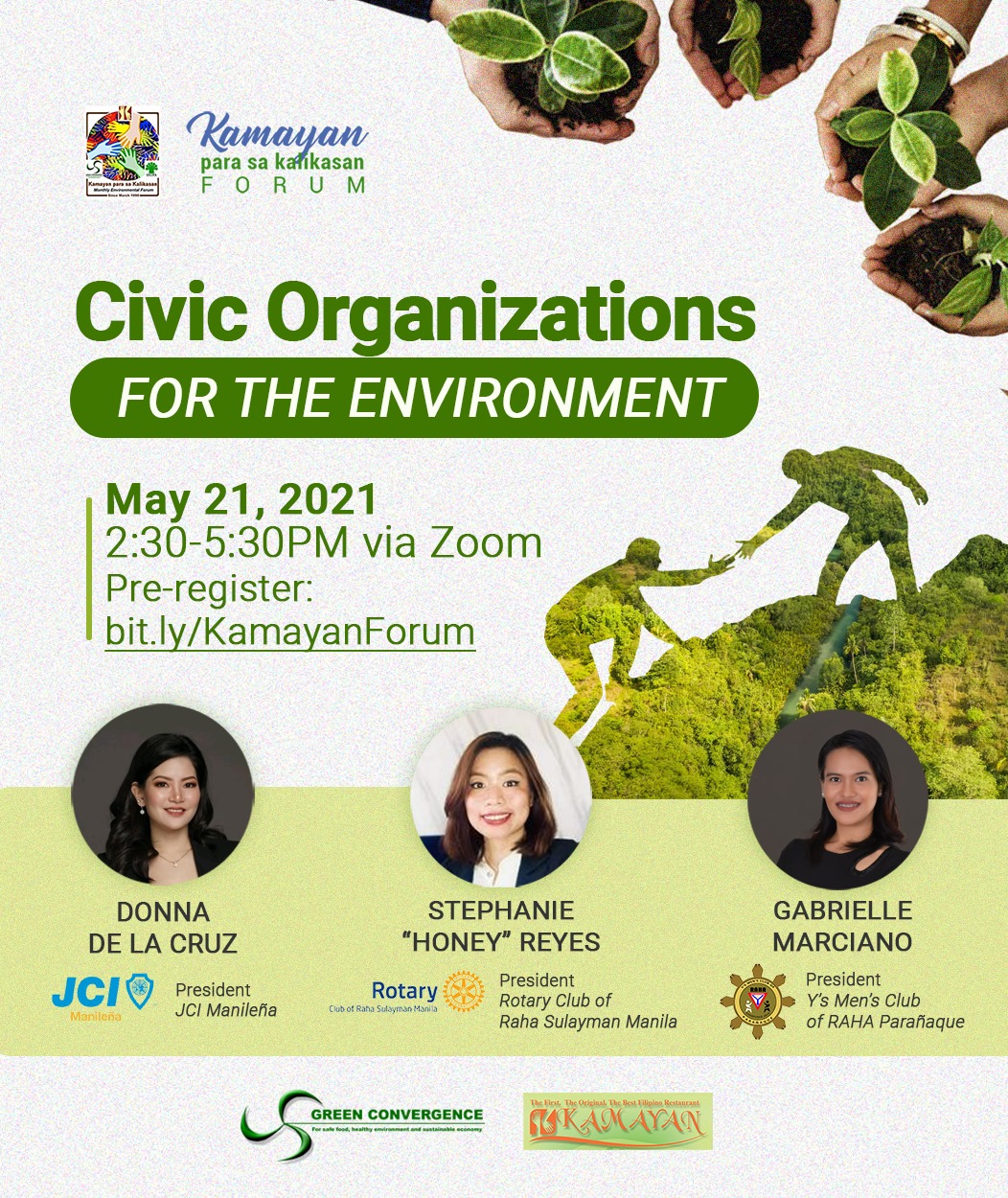
Civic Organizations for the Environment

When the state and business sector fail to secure the needs of the people, it is civil society that plays the lead role in protecting and empowering its own people. In recent years, more and more groups have come together to advocate, not just for the people’s welfare, but also for the environment.

Environmental Forum: ‘We need to re-establish our relationship with nature!’

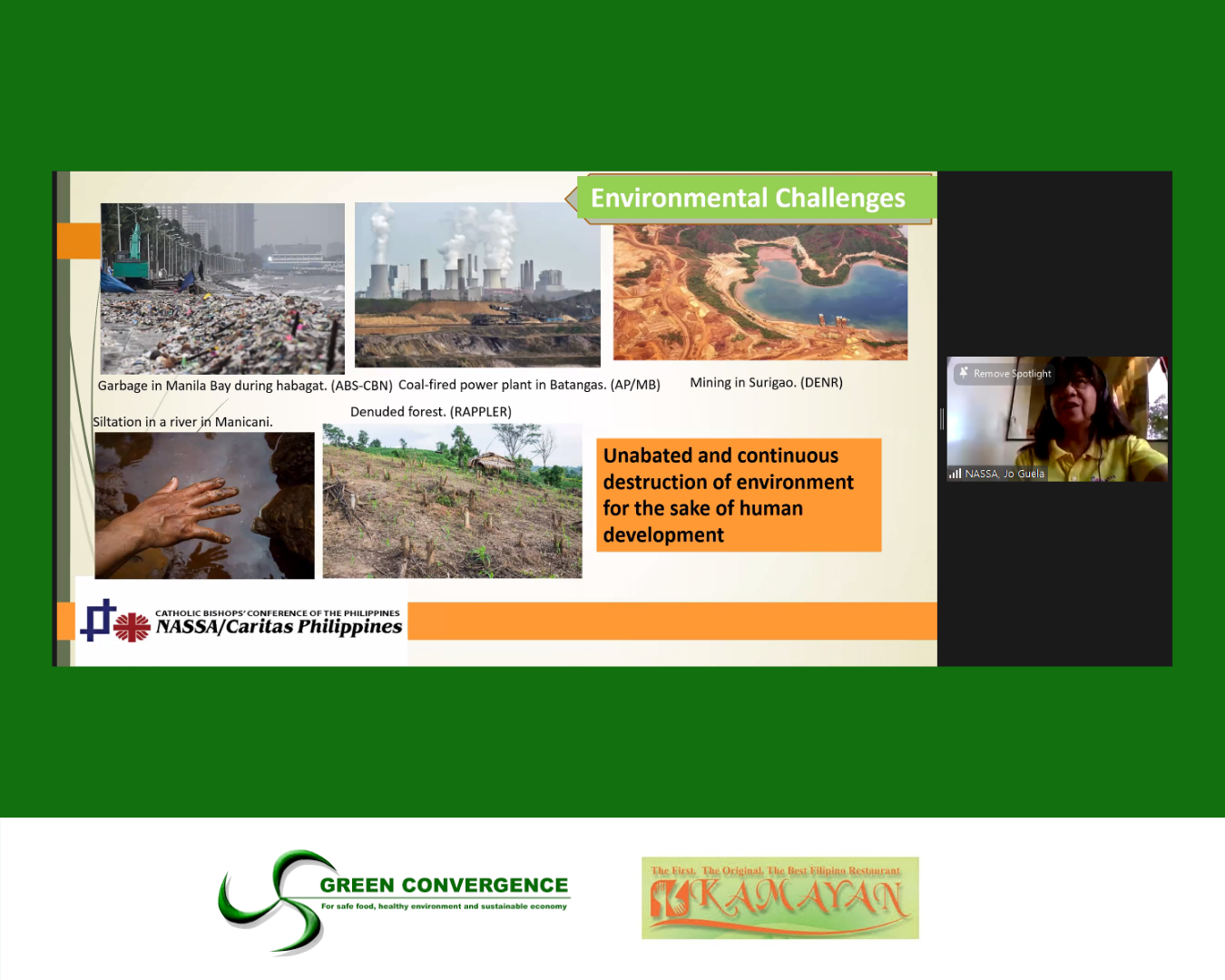
Faith-based organizations gathered to tackle the role of spirituality in caring for the environment in the 370th Kamayan Para sa Kalikasan online forum held by Green Convergence Philippines last April 16, 2021.

“For Buddhists, all things are interconnected,” shared Venerable Zhi Yi, superintendent of the Fo Guang Shan Mabuhay Temple.

“Consciously, Buddhism emphasizes the practice of mindful awareness and a lifestyle of simplicity,” she added.

“As a Buddhist organization, we encourage people to have a vegetarian diet, living with contentment, being kind to oneself and to others. We encourage a plant-based diet because it needs less electricity, gas, time, and water” she explained.

“In just one vegetarian day, you can help reduce carbon emissions by 3kg and 45lbs of food waste,” she said.

Jo Guela of the National Secretariat for Social Action (NASSA/Caritas PH) noted a similarity in the Catholic and Buddhist perspective of interconnectedness. “As [Venerable Zhi Yi] also shared, we as Catholics and Christians define ecology as ‘living in harmony with mother earth’.”

“To secure a sustainable future, we must change how we live. This entails major transformations in the ways our global society functions and interacts with natural ecosystems” she said.

“We need a paradigm shift in order to re-establish our sacred relationship with nature,” said Guela as she cited Pope Francis’ encyclical, Laudato Si.

“Napakahalaga yung how we respect nature and how we connect with nature” she affirmed.

The Vice President of Peacemakers Circle Dr. Shakuntala Vaswani, on the other hand, shared the Hindu perspective on caring for the environment.

“We have a rich heritage of scripture text that has shaped our view of the world and its environment. It has given us awareness of the great forces of nature as well as that all living things are an extension of the divine,” she said.

“Religious ethics have acted as sanctions against environmental destruction for hundreds of years in India,” she added.

“Unfortunately, our stewardship of mother earth has diminished in the last century or so, either due to the loss of understanding, or sheer negligence in the course of population growth, development, and industrialization” said Dr. Vaswani.

“We need to return to the teachings and practices of our religions that infuse sacredness and reverence in our relationship with nature,” she concluded.

On the role of churches, Mervin Toquero of the National Council of Churches in the Philippines, a network of mainline Protestant, Christian, and non-Catholic churches, said “the NCCP sees the role of churches in environmental protection as providing support and encouragement for the whole ecological movement. It does not see itself as separate.”

“Churches are responsive to climate change and disasters which have gotten worse especially in the last few years because of our vulnerability to climate change,” he added.

Citing the NCCP’s policy paper on ecology, Toquero emphasized interconnectedness of life and creation with the Indigenous People’s concept of ‘Land is Life’.

“They do not have the concept of owning the land. They believe that land is here to nurture the present generation and to nurture future generations” he said.

“Caring for the earth has a spiritual basis,” said Leonor Berroya, Treasurer of Green Convergence.

“We had speakers from 4 religions, but everybody is saying the same thing. There is interrelatedness and interconnectivity in creation,” she concluded.


Environmental Coalition Green Convergence held the 369th session of the monthly Kamayan Para sa Kalikasan Forum entitled “Entrepreneurs for the Environment” last March 19, 2021 through Zoom.

“We have entrepreneurs who are either into business reviving nature, regenerating nature, or curing nature,and those who are into businesses who make sure they are sustainable- meaning they are taking care of the environment, otherwise their business will be affected” shared Dr. Angelina Galang, President of Green Convergence.

Among these eco-conscious entrepreneurs is Erwin Po, President of ReconX- a company that converts plastic waste into fuel and other upcycled products. 

Po shared that the company was born out of the need to address the issue of the overwhelming amount of plastics. “Our goal is to effectively minimize  plastic waste, reprocess plastics, and offer a less environmentally damaging product,” he explained.

The ReconX President listed the products they are able to produce from plastics. “Aside from producing fuel, mostly diesel, kerosene, and low octane gasoline, we also upcycle products and convert them into pellets that can be molded into something else” he said.

“There are many good uses of plastics, it’s simply a matter of disposal and management, and this is where we come in as we constantly work on ways on how to renew them, thus completing the entire circular economy cycle.” he concluded.

Pie Cabigas, Manager of Better Than Ice Cream, shared how her family’s company adapted to using  more natural substitutes for their products.

“When we started in 1990, our products were all sugar-based,” said Cabigas.

“In 1995, we came out with our first no-sugar added product, not knowing there is a big market for this in the Philippines that is clamoring for this type of product” said Cabigas. 

The manager shared the difficulties they faced in switching to natural sweeteners. “In 2010, stevia was introduced to the market, but not in the Philippines.” she said. 

“Since we couldn’t get the imported products here, we just decided to work with a local supplier,” she explained.

“It took a while before we were able to switch from sugar to artificial, then from artificial, to the natural-sweetener, stevia” she added.

When asked regarding further developments on their products, Cabigas replied, “We plan to expand this more, not just with using stevia. People have also told us to explore an alternative plant-based frozen dessert.”

The final speaker, Angelo Tan, Green Building Country Lead of the International Finance Corporation, shared his insights on the importance of including infrastructures and buildings in the climate change narrative.

“In the Philippines, the level of urbanization surpassed the 50% mark in 2015” he said.

“What’s very worrying is that with climate change and this rapid urbanization, there is this phenomenon called double exposure where we become more vulnerable to the effects of climate change” he added. 

“We believe that climate change is also climate business, and we recognize the critical role of the private sector in climate change mitigation and adaptation. Entrepreneurs and businessmen and women have a critical role to play” said Tan.

Tan shared that even in the Philippines, green building can be a viable option for climate change mitigation. “Many Filipinos think green buildings are very expensive, but they are not especially when green measures are incorporated in the design of the house”, he explained.

“The first EDGE or Excellence in Design for Greater Efficiencies certified Zero Carbon building in the world is actually in the Philippines, which is the Arthaland Century pacific tower in BGC”, he proudly shared.

“It just shows that developments in the Philippines can be a pioneer in the world in terms of Zero Carbon developments”, he concluded.

The 369th session also marked the 31st Anniversary of Kamayan Para sa Kalikasan. A commemoration was held for its founders- journalists Vic Milan and Ed Aurelio “Ding” Reyes, and restaurateur Vic Vic Villavicencio.

Longtime participant of the Kamayan forum Roy Cabonegro shared about the impact of the forum and its founders. “We started to form a political green party (MAKAKALIKASAN) from the Kamayan Forum. In my experience, [the forum] is really a story of the three founders,” he shared.

“I thank the three of them and the forum. To me, I see no difference between the 3 founders and this forum” he said after lauding the founders.  

Esther Pacheco, President of Concerned Citizens Against Pollution also gave testimony of the influence of the Kamayan forum. “[It] is a landmark in Philippine communication to last so many decades and pioneering ahead of its time an advocacy for nature.”

Poet, publicist, and activist Greg Bituin Jr. also paid homage to the longevity of the forum in his poem as he read, “dahil sa nangasiwa’t bagong pamunuan, tatlong dekada’y nagdaan, forum pa ri’y nariyan”.

Since March 1990, Kamayan Para Sa Kalikasan Forum has become an institutionalized platform that enables NGO and government representatives, the media, students, teachers, church groups, and concerned citizens to discuss pressing environmental issues in the country. This month’s forum is organized by Green Convergence and is supported by Kamayan Restaurant EDSA.


Kabataan Para sa Kalikasan!

Last February 19, 2021, Green Convergence held its 368th Kamayan Para sa Kalikasan Forum entitled “Youth for the Environment”.

Speakers Mitzi Jonelle Tan of Youth Advocates for Climate Action Philippines (YACAP), Natasha & Isabella Tanjutco of Kids for Kids, and Jeff Estela of Youth Strike 4 Climate Philippines shared their experiences as environmental advocates and what drove them to pursue such advocacy at a young age.

Climate action, Nature-based solutions, and intergenerational cooperation was highlighted throughout the forum.

Youth for the Environment

Artists for the Environment

Nature has been the inspiration behind many brilliant works of art. Whether it is through paintings, songs, films, stories, or poems, Mother Nature has been the muse behind these works of creativity.

In this month’s Kamayan Para sa Kalikasan Forum, we take a look at how some artists are giving back to the environment. What role do artists have in the care and protection of the environment? How does their work contribute to the spread of the environmental paradigm?

For its Christmas offering, last Dec. 18, 2020, Kamayan para sa Kalikasan focused on the native Pine Tree and endangered endemic tree species.  The resource speakers were Atty. Allan Barcena, Head of Corporate Social Development of Energy Development Corporation (EDC) and Ronino Gibe, Forester and Social Program Officer of the same company.

Atty. Barcena discussed the Benguet Pine that is dominant in Benguet but also grows in other parts of the Cordillera like Mt. Province, Ifugao, Kalinga, Abra and also in Nueva Vizcaya, Ilocos Norte and Ilocos Sur.  There are actually 2 kinds of native pine trees in the Philippines : The Mindoro Pine and the Benguet Pine.  If people want to see them, some are still located in Timberland, San Mateo;  in Crosswinds, Tagaytay; Benguet Pine Station in La Mesa Nature Reserve, Caloocan; and Benguet Pine Park in Bukidnon.

These pine trees offer the following benefits:

  • Medical experts recommend asthma victims to walk under pine trees in the morning because the trees release terpenes, responsible for the smell of pines that help clean the lungs.
  • The needles can be boiled as tea and drank to cure upper respiratory tract ailments.
  • These trees provide serenity and serve as inspiration to artists. They have enhanced the creativity of visual artists, writers, musicians as seen in the art works that they have produced.

Our native pine trees also offer economic benefits.  They serve as lumber for construction, and are used to make furniture, wood carving and novelty items.  Currently, they are not included in the endangered list of IUCN; but its population is dwindling especially in Baguio.   Congressman Mark Go filed a bill in the House of Representatives seeking a 10-year moratorium on tree-cutting in Baguio City; however, the bill has not passed.

Ronino Gibe, on the other hand, presented other native trees that can be planted and used as Christmas trees.  He also discussed EDC’s BINHI Program.

As background, Mr. Gibe informed the participants that the Philippines is one of the 17 megadiverse countries.  It has high total number of species and high endemic species; however, it is also part of the top 10 most threatened. That’s why the National Greening Program was established and a total log ban was imposed.

Native trees are those indigenous to a given area in geologic time.  This includes trees that have developed and occurred naturally.  They were not introduced by humans. In a Lexicon of Philippine Trees published in 2003, it stated that there are 3,084 native tree species in the Philippines.  800 of these are endemic and around 929 found also in other countries.  But in current studies done by UPLB, our native tree species has gone up to 4,000.

If the Philippines has many native tree species, why are we planting exotic species? Unfortunately, many are not aware of the existence of endemic species.  Through the BINHI project of EDC, they’ve decided to concentrate and prioritize 96 endemic species that are endangered.  These were selected based on the following criteria:  Biodiversity, ecological factors, and demand due to high economic value, superior mechanical strength, and high aesthetic value.  They used a grading system for all 800 endangered species and those with 60-100% average were the 96 species that they have focused on.  They intend to mainstream all these 96 species from Luzon to Mindanao.  They launched the program last 2008 and currently have 186 partners in different regions throughout the Philippines.

He enumerated 3 criteria why they prefer to plant native trees:

1) These species can easily adapt to the environment since they are native;

2) They are typhoon resilient;  and

3) They are the habitat of native fauna.  They contribute to biodiversity.

Exotic species kill the understory because of the acidity of their leaves that are prolific in regenerating.  During typhoon Rolly, most of the fallen trees were exotic.   He presented a list of exotic trees that must be avoided.  These are: Mahogany, Ipil-ipil, Firetree, Mangium, Gmelina, Palo santo, rain tree/acacia, Golden Shower, Teak, Palawan Cherry, Kakauate, and African Tulip.  These are the exotic varieties that have proliferated in our country.  They were brought for commercial purposes and used by landscape artists in their profession.  In contrast, he showed native trees that can compete with the enumerated species:  Siar, Banaba, Malabulak, Narra, Rarang, Salingbobog.

Mr. Gibe also showed photos of native trees that can be alternative to Christmas trees. They flower and bear fruits during the Christmas season. They are resilient, best for urban landscaping, have high economic value and are critically threatened.  These are:

  • Bagauak Morado, also known as fireworks. It bears flowers throughout the year;
  • Malakatmon found in Bataan, Aurora and Palawan. They are relatively small that grows to around 3-5 meters tall, except for the species in Palawan.  Their flower changes color from yellow to gold to red.
  • Molave is typhoon resilient. It flowers from August to January. The flowers turn from purple to yellow.
  • Philippine Teak blooms flowers from September to December. It is usually found in Batangas and Mindoro. The leaves are small compared to the species in Taiwan. Its flowers turn from pink to purple.
  • Igem-Dagat is used as Christmas tree in Batanes. This cannot be cut because it is endangered. People in Taiwan make these into bonsai. They grow in coastal areas.
  • Mapilig is from the Bicol region. It flowers in November. It is one of the hardest wood; unfortunately it is critically endangered.
  • Almaciga is made into Christmas décor because of its cones. It is found in Samar.

Mr. Gibe also listed 5 steps in conserving species:

  • Conduct tree inventory and documentation – take note of mother trees that can be the source for seeds and wildlings.
  • Establish Mother Trees.
  • Protect the selected habitat.
  • Advocate through documentation, publication and conduct orientation seminars

EDC was tapped by the Botanical Conservation International – IUCN, as the first and only Philippine Implementing partner for its Global Tree Assessment Initiative (GTA).  EDC has assessed 800 Philippine endemic species with 489 published.  EDC is propagating 96 species of the most endangered premium trees in the Philippine forest.

They go into partnership using these criteria:

  • Sustainability of the area is ensured.
  • The area is accessible to the public to enhance awareness raising activities.

To those interested in procuring native tree seedlings, they are available in EDC Nurseries located in Ormoc, Leyte; Valencia, Negros Oriental; Albay, Bicol Region; Kidapawan, North Cotobato; Pantabangan, Nueva Ecija; and in Antipolo near Eugenio Lopez Center for Metro Manila.  Varieties depend on what is being propagated. They are open to partnering with organizations. They can help in providing technical expertise in setting up nurseries for big projects.

Some of the common challenges that they’ve encountered in their “tree growing and tree nurturing” programs are:

  • Ensuring that prospective partner organizations are well organized and stable;
  • Choosing the appropriate species for the location. They usually do soil analysis to match it with appropriate species to grow. This ensures good mortality rate.
  • Appropriate timing for growing plants with the planting plan. Growth of seedlings in nurseries must coincide with the planting season, which is during the rainy season.
  • Maintenance & protection of seedlings need time and resources during its 3-5 years growing stage.

Mr. Gibe narrated their experience in propagating Kaladis Narig in Sibugay, Zamboanga.  There was only 1 existing standing tree.  But in partnership with DENR and the local LGU, it is now reported to have 11 standing trees. Last August 2020, the Kaladis Narig species was declared as heritage tree to protect it from being cut and harvested.

As parting words, Mr. Gibe recommended 4 easy steps to participate in saving native trees:

  • Join the discussion with like-minded organizations that advocate Philippine Native Trees;
  • Take photos and inquire from experts before buying or collecting trees;
  • Visit native tree parks and arboretum and read books on native trees
  • Grow, nurture and advocate native trees only.