
December 2025 Kamayan talks creation, nature in spiritual context

Green Convergence (GC) closed 2025 with the 426th session of Kamayan Para Sa Kalikasan themed “The Birth of Christ and the New Cosmology” last December 19, 2025, via Zoom and Facebook livestream, linking ecological understanding to spiritual meaning in the season of Christmas.

Sr. Marvie Misolas, Miriam College Environmental Studies Institute Executive Director and GC Trustee, opened the forum citing literature by Ilia Delio who acknowledged St. Augustine and St. Bonaventure as ‘observers of the cosmos’.

Quoting Bonaventure, Misolas said that it is important to return to the Book of Creation, as creation is not a backdrop of human drama, but the disclosure of God’s identity.

Laudato Si’ Movement Pilipinas Coordinator Sr. Elizabeth Carranza widened this idea by introducing the “new cosmology,” which she described as a way of understanding the universe that integrates science and spirituality and views creation as conscious, purposeful, and deeply interconnected.

Carranza traced the becoming of the cosmos—from the Big Bang, the birth of stars and galaxies, to the emergence of Earth as home to life, emphasizing that creation is not static but continuously evolving in communion.

She drew this idea from theologian Brian Swimme, who described gravity as a force of “union and communion,” reflecting God’s creative love at work in the universe.

Carranza said Earth became Mother and home to life through billions of years of transformation, giving birth to diverse species and, eventually, to humanity.

“It took billions of years for God to make us,” Carranza noted, underscoring the sacredness of both human life and the natural world.

Carranza then confronted the ecological crisis, pointing to destructive human activities such as mining, deforestation, pollution, and fossil fuel dependence that wound “Mother Earth.”

Quoting Pope Francis’ Laudato Si’, she reminded that creation ‘now cries out to us because of the harm we have inflicted on her.’

Carranza urged a collective response toward the “Ecozoic Era”—a time when humans live in the right relationship with Earth as a living, life-giving home.

Talking about deep incarnation, Carranza said God’s becoming flesh in Christ is inseparable from the whole of creation. “God is always needing to be born on Earth,” she said, calling on people to embody care, compassion, and responsibility in their own lives.

Carranza also led spiritual exercises to help audiences connect with Mother Earth and shared her self-written poem prayer titled ”I am Terra. I am Earth.”, reflecting on her inner connection to Earth, which she said she wrote while walking barefoot.

Understanding the new cosmology in the Philippine context, Bishop Gerardo Alminaza, head of the Catholic Bishops’ Conference of the Philippines’ National Laudato Si’ Program, expanded on the theological concept in his talk titled “Luntian na Pasko.”

Alminaza reframed the story of the birth of Christ as one rooted in vulnerability, displacement, and dependence on nature, which are realities familiar to many Filipinos today.

“Christ is born into a world marked by uncertainty and danger,” he said, noting parallels with communities facing climate disasters, environmental degradation, and development projects imposed without consent.

He cited mining permits, energy projects, and coastal reclamation that displace families and threaten livelihoods, particularly of fisherfolk, farmers, and Indigenous Peoples, which are realities that mirror the vulnerability of Christ’s birth, remarking that ecological issues are also questions of justice and responsibility.

“A luntiang pasko invites us to see the manger not as a decorative symbol but as a reminder that God chooses to enter the world where life is fragile and dependent on the integrity of creation,” Alminaza said.

He emphasized that the injustices faced by Filipinos are not merely technical issues but a moral one, shaped by decisions that determine who bears the cost of development.

Alminaza also added that when affected communities resist, they are often stigmatized or criminalized, prompting the necessary question—’development for whom and at what cost?’

Calling for solidarity, Alminaza urged communities, churches, civil society, and institutions to stand with farmers, fisherfolk, Indigenous Peoples, and urban poor families whose lives are dependent and directly tied to land and water.

“Care for creation and care for people are inseparable,” he said, adding that Christmas calls for both personal conversion and collective action.

Altogether, Carranza and Alminaza invited everyone to rediscover Christmas not only as a celebration, but as a commitment to honor creation, accompany the vulnerable, and allow faith to shape a more just and sustainable future.

Closing the forum, GC President Victoria Segovia reflected on the speakers’ talks through a deeper understanding of “Noel,” meaning joy and celebration, and “Emmanuel,” meaning “God is with us.

She said that “Noel” should remind everyone to choose and share joy amidst difficult times, even including the poor, the lonely, and the forgotten; it should remind hope that resists despair amidst crisis, conflict, and environmental harm.

Moreover, “Emmanuel” should remind that God is with those who suffer poverty, injustice, war, and climate disasters, and with creation that grooms under pollution and abuse.

“Christmas asks us to be God’s presence to stand with the vulnerable, protect life, and care for our common home that the incarnate Christ shared with us in his physical body. The Christmas season then makes us remember that the natural environment is a collective good, the patrimony of all humanity, and the responsibility of everyone,” Segovia expressed.

The next Kamayan session will be on January 16, 2026.

Kamayan Para Sa Kalikasan is a monthly initiative organized by Green Convergence that enables non-government organizations (NGOs) and government representatives, the media, students, teachers, church groups, and concerned citizens to discuss, analyze, and create solutions to pressing environmental issues in the country.

For those interested to be a member of Green Convergence, visit this link to register: bit.ly/GCMembershipRegForm

#GreenConvergence #KamayanParaSaKalikasan #BirthOfChrist #NewCosmology
November 2025 Kamayan CSO’s Say No to Nuclear Energy, WTE in Just Transition Efforts

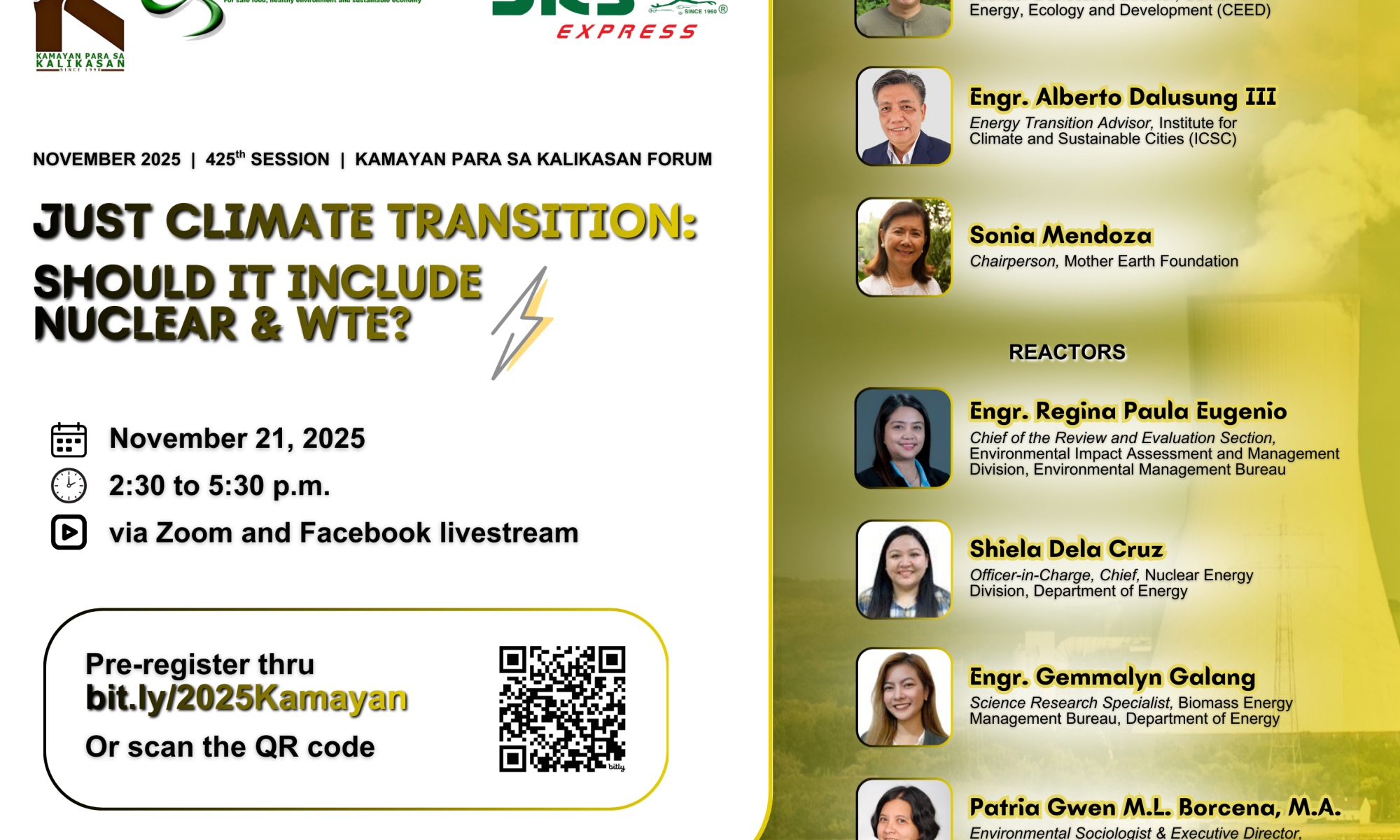
Green Convergence (GC) convened the 425th session of the Kamayan Para Sa Kalikasan forum themed “Just Climate Transition: Should it include Nuclear & WTE?” on November 21 via Zoom and Facebook livestream. The November forum was supported by JRS Express.

With stronger calls for the phase out of fossil fuels in the recently concluded Conference of Parties (COP 30) held in Belém, Brazil, GC President Victoria Segovia noted in her opening remarks that national leaders in the Philippines are now promoting the use of waste-to-energy (WTE) and nuclear technologies as alternatives.

Segovia however questioned these steps that the Philippine government is taking. “Is this toward the sustainable development of the Philippines?”

Jumping on this premise, Gerry Arances, Founder and Executive Director of the Center for Energy, Ecology, and Development, challenged the framing of the country’s transition.

“Just transition ?” he asked, stressing that communities already suffering the worst impacts of the climate crisis must be the priority.

Arances noted that, despite 15 years under the Renewable Energy Act, the country’s renewable energy (RE) share increased only from 34% to 35%, while coal now accounts for 62% of the power mix—one of the highest in the world.

Even with this, there are no concrete steps for a fossil fuel phaseout.

However, he said that approved RE capacity is already enough to power the country forward. The Green Energy Auctions awarded 21 to 22 gigawatts of new RE, representing more than 60% of the nation’s existing installed capacity.

If these are implemented as planned, Arances argued that there is no need for new fossil fuel plants, nuclear power, or WTE.

“We already have enough renewable energy in the pipeline for the next decade,” he said. “We do not need WTE. We do not need nuclear.”

Engr. Alberto Dalusung III, Energy Transition Advisor at the Institute for Climate and Sustainable Cities, delved deeper into an evidence-based analysis of nuclear power based on grid limitations, economic realities, and global trends.

He explained that the Philippines has the smallest grid among Southeast Asian countries. In the Philippines, the largest single generating unit in Luzon is under 700 megawatts (MW), and smaller units operate in Visayas and Mindanao.

Given these numbers, Dalusung explained that installing a 1,000-MW nuclear reactor, which is the smallest commercially available size, would overwhelm the Philippine grid and would require massive reserve capacity that the system currently cannot handle.

He also rejected the argument that the country needs more baseload, stressing that the real problem is an oversupply of coal and gas plants that are forced to ramp up and down, damaging equipment and causing outages.

In the open forum, he added that solar is variable and predictable, unlike the argued “stable” baseload plants that frequently trip.

On costs, Dalusung cited international data showing nuclear as one of the most expensive technologies, which entails that it would be even more expensive in the Philippines due to seismic upgrades and absent nuclear infrastructure.

Addressing whether small modular reactors (SMRs) would be the appropriate nuclear technology for the country, he said that SMRs remain experimental, with only two commercially operating worldwide.

On considering WTE technologies in the Philippines, Sonia Mendoza, Chairperson of Mother Earth Foundation, warned that WTE incineration actually worsens both the waste and climate crises despite being marketed as a modern solution.

She said that all thermal WTE processes—from combustion to pyrolysis—emit greenhouse gases (GHGs).

Studies show WTE facilities generate 1.7 times more GHGs per MWh than coal, and even more than oil and natural gas.

Mendoza added that WTE facilities undermine waste reduction, as they depend on a constant waste supply and often involve “put-or-pay” contracts that penalize local governments for failing to meet requirements on the amount of garbage.

Despite claims of reducing landfill use, WTE produces toxic ash requiring engineered landfills, and releases dioxins linked to cancer and reproductive harm.

She also raised legal questions, pointing out that WTE contradicts the Clean Air Act and the Ecological Solid Waste Management Act. In a global context, the European Union has withdrawn funding support for incineration due to its climate impacts.

Reactors from government agencies, Engr. Regina Paula Eugenio from the Environmental Impact Assessment and Management Division of the Department of Environment and Natural Resources Environmental Management Bureau, Shiela Dela Cruz, the Officer-in-Charge and Chief of the Department of Energy’s Nuclear Energy Division, and Engr. Gemmalyn Galang, Science Research Specialist from the Department of Energy Biomass Energy Management Bureau, addressed the issues raised by the plenary speakers.

They acknowledged concerns, but urged “open-mindedness” as government agencies assess nuclear and WTE in the national energy mix.

They also cited ongoing work on nuclear regulatory frameworks, radioactive waste planning, grid studies, public consultations, and coordination with both local and international counterparts.

However, Patria Gwen Borcena, Environmental Sociologist and Executive Director of Greenresearch Environmental Research Group Inc., underscored the longstanding civil society opposition to these technologies—from a recent statement signed by 38 organizations to pastoral letters from church leaders.

She also questioned the government’s claim of inclusivity in the transition process given the aforementioned strong opposition.

Borcena punctuated the forum, “. in the future. , monstrous WTE nuclear?”

As shown in the plenary and panel exchange, while government agencies express openness to nuclear and WTE, civil society organizations (CSOs) maintain that just transition must reject dangerous, costly, and polluting technologies and accelerate the RE transition already within reach.

Wrapping up the forum, Dr. Angelina Galang, Founding Trustee of GC and Program Director of the Movement, firmly stated in her closing remarks that nuclear and WTE are false solutions to the climate change emergency.

“If we go to these technologies when we ever have so much blessings from the Lord, we are shooting ourselves in the foot, in the mouth, and in the head … We’re already vulnerable to natural hazards. We will exacerbate our vulnerability by these technologies,” Dr. Galang expressed.

#GreenConvergence #KamayanParaSaKalikasan #JustTransition #NuclearPower #NuclearEnergy #WasteToEnergy


Part 1

Part 2

Part 3

October 2025 Kamayan forum addresses flooding situation, reinforces nature-based mitigation

Green Convergence, with the support of JRS Express, held the 424th session of Kamayan Para Sa Kalikasan forum themed “Baha at Bayanihan: A Holistic Approach to Flood Mitigation” on October 17 via Zoom and Facebook livestream to address worsening flood issues and discuss ecological solutions.

Sr. Marvie Misolas, Executive Director of Miriam College Environmental Studies Institute and a Trustee of Green Convergence, opened the session recognizing climate change, deforestation, watershed degradation, land subsidence, excessive groundwater extraction, and corruption as key causes of flooding.

Noting also that the Philippines is highly vulnerable to disaster due to its geography, at the same time abundant water resources, she calls for actions to ensure resilient communities through more integrated approaches and comprehensive management.

Quezon City’s response to flooding

Following this idea, Leo Martillano, Local Disaster Risk Reduction and Management Officer II of the Quezon City Disaster Risk Reduction and Management Office (QCDRRMO), shared the Drainage Master Plan of the city.

The QCDRRMO, in partnership with the University of the Philippines’ (UP) Resilience Institute, has conducted city profiling, taking into account the geophysical, social, infrastructural, economic, and institutional capacities of the locality.

In line with profiling, they have done area-specific assessments, field evaluation and condition assessments, close community consultations, and further analyses on data gathered to anchor their intervention models.

Though the Quezon City Drainage Master Plan is still at the first few steps of its implementation, the QCDRRMO has rolled-out workshops on flood validation, drainage assessment and inventory, General Information Systems (GIS), as well as on the Internet of Things (IoT)-based decision support system.

Other projects involve both structural and community-based interventions, from youth projects for disaster awareness and preparedness, relocation for those along easements of waterways, participatory monitoring and evaluation mechanisms for barangays, stormwater detention basins wherein basketball courts will be utilized, rainwater harvesting systems for schools and public markets, permeable pavements for sidewalks, to solid waste management for flood risk reduction—and more.

Martillano also emphasized that, when designing and proposing drainage-related projects, they aim to ensure the directly-involved local community has ownership over the projects done in their area, building on the concept of ‘bayanihan’ in the face of flood mitigation.

Trees and science-based solutions

Dr. Fernando Siringan, Research Professor from the UP Marine Science Institute, then delved deeper into dealing with flooding with the help of science and trees, referencing various studies that support effective flood mitigation.

He primarily underscored the importance of applying zoning in floodplains where it is still possible, saying that there is a need to respect the very nature of areas’ landscapes in implementing projects. Floodplains are lands beside rivers and waterways subject to flooding.

Dr. Siringan then reiterated the benefits of reforestation, such as decreasing or delaying run-offs during heavy rains and sediment yield, increasing groundwater recharge, summer stream flow, and biodiversity, lowering air temperature, and prolonging the lifespan of dams and Small Water Impounding Projects (SWIPs).

Considering trees as known natural shields, he presented studies that showed mixed planting of trees with different root distribution characteristics should be popularized to help infiltration of urban trees, as well as “sponge city” projects that may be replicated locally.

Dr. Siringan also linked the benefits of increased forest covers for SWIPS, mentioning observations in the 12 SWIPs of Alcala, Cagayan. Loss of trees can shorten the lifespan of SWIPs due to increased run-offs, soil erosion, sediment-filled rivers, and diminished dry season flow; and, if not desilted, can be costly for municipalities and farmers.

He added that initial trees to be planted in the SWIPs of Alcala should be more tolerant of drier conditions and that propagation of endemic, vulnerable, endangered, and critical trees should be given ‘special attention.’

Dr. Siringan also explained the importance of the river widening and implementation of waterway easement to allow improved transmission of floodwaters downstream, taking notice of the governmental mistake of not wanting to deal with communities in terms of relocation.

“Widening of [water] channels is a more permanent measure of addressing floods. The effect of river dredging is very temporary,” he stated.

Moreover, Dr. Siringan shared that preservation of sand dunes also lessens flooding issues, as they stop seawater from entering the coast and have vegetation that hold the sand in place. Also on coastal preservation, he reinforced the need for wider mangrove belts to reduce wave energy impacts.

Furthermore, on the relation of reclamation projects and the flooding issues, Dr. Siringan said, “Reclamation, if done improperly, kung ito ay nakakabara sa ilog—and I have seen some reclamations na maraming illegal [activities] all over the Philippines na nagpapasikip sa mga ilog—then, definitely, problema ‘yan sa pagbabaha.”

Reflections and ways forward

Reflecting on the discussions of Martillano and Dr. Siringan, Architect and Environmental Planner Dr. Leah dela Rosa, Chairperson of Miriam College’s Department of Sustainability and Environment, built on the idea of ‘looking at where we are’ and understanding local conditions and data in addressing the flood situation.

In understanding these, she also remarked that there should be deeper acknowledgement of shortcomings and acceptance of the consequences of the oversights and mistakes towards nature throughout generations in order to achieve sustainable development.

Dr. dela Rosa then called for sectoral and cross-cultural engagement through formal, informal, and indigenous knowledge-based studies based on past similar experiences, patterns, or actual conditions, highlighting the need for a paradigm shift in behavioral transitions.

Hinting on the current political climate with regard to flood control, she also noted that there is a need for increased levels or degree of governance over proper implementation of mitigation strategies.

Ultimately, Dr. dela Rosa called to ‘return to basics and let nature take its own pace. “We have to be ethical, honest, responsible, and good stewards of our environment and our natural resources—kung mayroon pang natitira,” she expressed.

This sentiment was then echoed by the President of Green Convergence, Victoria Segovia, in her closing remarks, reverting to the ‘nature knows best’ environmental principle and emphasizing that there should be respect for the natural cycles of the environment.

Next Kamayan session was announced to be on November 21, 2025.

Kamayan Para Sa Kalikasan is a monthly initiative organized by Green Convergence that enables non-government organizations (NGOs) and government representatives, the media, students, teachers, church groups, and concerned citizens to discuss, analyze, and create solutions to pressing environmental issues in the country.

For those interested to be a member of Green Convergence, visit these links to register: bit.ly/GCMembershipRegForm

Part 1

Part 2

Part 3

Dangers of mining, threats on mangroves, and more: Kamayan’s September forum echoes issues raised in Green SONA 2025

Green Convergence shed light on some issues raised in the recently concluded State of Nature Assessment (Green SONA) 2025 held in Leyte, for the 423rd Kamayan Para Sa Kalikasan forum, “Beyond the Green SONA: Voices, Visions, and Commitments,” held on September 19 via Zoom and Facebook livestream.

In her opening remarks, Green Convergence President Victoria Segovia expressed thanks towards partners and sponsors who made the 20th Green SONA a success, while previewing highlights of the conference, as well as the tree planting initiated annually to offset the carbon footprint produced in conducting the event.

The Green SONA 2025 was co-organized with the Visayas State University (VSU) and sponsored by the First Philippine Holdings, Lasallian Institute for the Environment, Forest Foundation Philippines, Foundation for the Philippine Environment, and Leyte 5th District Rep. Carl Nicolas Cari, with VSU’s official student media organization, Amaranth, as media partner and the University Integrated Media and Public Affairs as the technical organizing partner.

Environmental state of Region 8

Briefing participants of the environmental state of Region 8 where the Green SONA 2025 was held, a recorded discussion of Atty. Dario Suarez, Assistant Regional Director for Management Services of the Department of Environment and Natural Resources Region 8 (DENR 8), was shown in the forum.

Atty. Suarez described Eastern Visayas as one of the most disaster prone regions in the Philippines, facing issues such as landslides, flooding, biodiversity loss, illegal logging, mining, quarrying, and siltation risks, major foreshore and coastal infrastructure, solid waste management, water and air pollution, and climate change impacts.

With this, the DENR 8 formulated seven strategic thrusts, such as (1) adopting climate risk lens in national planning and policy, (2) increasing forest covers, (3) conserving protected areas and biodiversity resources, (4) improving air and water quality and waste management, (5) ensuring water security and resilience in high water-stressed areas, (6) sustainably and responsibly managing mineral resources, and (7) promoting effective land management and governance.

Among the projects detailed by Atty. Suarez was the National Natural Resource Geospatial Database, which monitors forest covers, river basins, mangrove areas, as well as the projects under the region’s jurisdiction.

Region 8 has also adopted the National Greening Program and, upon its implementation, an increase of 15% in forest covers has been observed. Forest protection programs and policies were also mentioned on avoided deforestation, rainforestation, and forest fire protection.

On mining, Atty. Suarez said that the mining industry in the region contributes 1.41 billion pesos in gross domestic product (GDP), with around 2,000 employees. Policies on land ownership to manage land disputes are also enforced.

DENR’s Project TRANSFORM is also set to be replicated in Eastern Samar after its launch in Ormoc City. Project TRANSFORM aims to alleviate poverty through green and blue economy jobs, promote multistakeholder collaboration to address climate change impacts, and more.

Effects of mining in Homonhon Island

Pondering further on mining in the region, Carmi Macapagao, President of the Homonhon Environmental Advocates and Rights Defenders (HEARD), shared the effects of mining operations in Homonhon Island, in Guiuan, Eastern Samar.

Homonhon Island is described to be an agriculture-rich and water-rich island, home to diverse species of flora and several endemic and critically endangered animal species. It also is recognized as a historical site where Ferdinand Magellan first landed.

This island is however threatened by mining, with active operations in five out of eight barangays. With an estimated land area of 10,500 hectares, 6,479 hectares are bound with a Mineral Production Sharing Agreement (MPSA), 2,000 hectares are with the Environmental Protection Agency, and 200 hectares with the Philippine Mining Development Corporation.

MPSA is a contract that allows companies to explore and utilize mineral potential areas, but enclosed with corporate responsibilities such as including shares for the affected communities—which were said to be unobserved.

Suffering mining operations for over 41 years, Macapagao said that there have been no significant changes in the community.

Mine dust has covered the island, water sources are contaminated, there is insufficient power supply, roads are not smooth, there are land use conflicts causing division of community, and classes are disrupted.

Macapagao showed the mining situation surrounding Homonhon National High School. “Paano mo ibibigay ‘yan [safe, healthy, and conducive area for learning] sa mga kabataan kung ‘yun ‘yung nakapaligid sa kanya—maingay na heavy equipment at alikabok—na sobrang nakakaistorbo sa klase nila?” she stressed.

All these impacts continuously impose health risks, inadequate regulatory enforcement displaying a need for stronger legal framework, economic dependency on mining causing residents to choose between economic survival and environmental preservation, and a call for community resilience and advocacy.

Nationwide issues on mining

In line with this, Daniel Arias, Campaign Officer for Visayas of Alyansa Tigil Mina (ATM), provided a nationwide perspective of the effects of mining operations.

Arias briefed the situation of mining under the administration of President Ferdinand Marcos Jr., emphasizing the lack of consultation with directly affected communities due to the fast-tracking and digitalization of the permitting process. Mentioned also were bills like the Enhanced Mining Fiscal Regime wherein only 2% of mining taxes were approved.

On the other hand, a ‘positive’ outcome is the country’s return as a member of the Extractive Industries Transparency Initiative (EITI), which is a multistakeholder initiative revolving around taxing mining companies and reviewing violations.

Furthermore, Arias laid out that the government says there is a ‘huge and urgent’ demand for critical minerals and that the country can supply these as the world transitions to clean energy, however the chambers and the Mines and Geosciences Bureau do not say that mining contributes less than what is exhibited.

He detailed that mining only contributes less than 1% to the country’s economy in GDP, is only less than 0.5% of total employment, and is seen to destroy 18%-20% of the economy, coming from agriculture, forestry, water resources, and fisheries. Arias also said that Bantay Kita reported uncollected taxes from mining amounting to no less than 1 billion pesos.

Violence towards environmentalists, Indigenous Peoples, and women fighting against destructive mining, plantations, and land-grabs was also emphasized as a major issue, making the Philippines one of the most dangerous places in Asia for environmental and human rights defenders.

With these issues on mining at-hand, ATM forwards their calls for a moratorium to stop destructive extractive activities, a reimposition of a ban on open-pit mining, a repeal of the Philippine Mining Act and legislation of Alternative Minerals Management Bill, and the enactment of the Environmental and Human Rights Defenders Bill.

Ang kalikasan ay kailangan nating proteksyunan dahil ito ay magbibigay sa atin ng masaganang bukas. Samantala, ang minahan, sila ang nagpapalala ng krisis sa klima, sa pagkasira ng ating kalikasan, at ang siyang magdudulot sa atin papuntang kadiliman,” Arias expressed.

Blessings of mangrove rehabilitation

On mangrove rehabilitation, Roberto “Ka Dodoy” Ballon, Trustee of the Foundation for the Philippine Environment, shared community initiatives that enabled regeneration of natural resources and mangrove ecosystems health through his recorded discussion.

Ballon said that they have successfully planted 50 hectares of mangroves without a single centavo from government agencies, as a way to address the loss of fish observed for two decades since the 1970s, which affected their livelihoods.

As of date, they have planted a total of 7,000 hectares of mangroves and have established several aquacultures for different marine resources.

Recognizing also the effects of poor solid waste management in fisheries, they have bred initiatives such as raffle draws to proactively engage the communities in addressing issues on waste. These initiatives have been awarded locally and internationally in the past years and have been adopted in other communities.

Ballon also reminded that rehabilitation of mangrove ecosystems are important to ensure food security and build resilience against climate change, given that out of 1,493 municipalities, 832 are coastal, and 60% of the total population are fishermen—yet they are one of the most resource and access-deprived.

Concluding his talk, he then reminded the youth to safeguard the future, especially through continuous mangrove rehabilitation, for the integrity and dignity of the country’s fishermen. “At the end, sinasabi ko, an abundant, clean, healthy, and safe environment for the people and for the next generations,” Ballon added.

Executive Director of Green Convergence, Tessa Oliva, then wrapped up the Kamayan session with a run through of the Green SONA 2025 resolutions, which collated calls and recommendations for the DENR, local government units, academic institutions, civil society organizations and advocacy groups, as well as for the whole Filipino nation to address.

The next Kamayan session will be held on October 17, 2025.

Kamayan Para Sa Kalikasan is a monthly initiative organized by Green Convergence that enables non-government organizations (NGOs) and government representatives, the media, students, teachers, church groups, and concerned citizens to discuss, analyze, and create solutions to pressing environmental issues in the country.

For those interested to be a member of Green Convergence, visit these links to register: bit.ly/gcindividual or bit.ly/gcnetorg.

PART 1

PART 2

PART 3

PART 4

Interconnectedness of health, livelihood, environment highlighted in July 2025 Kamayan forum on indigenous food

Benefits of indigenous food and heirloom rice production were spotlighted during Green Convergence’s 421st Kamayan Para Sa Kalikasan forum themed “Rediscovering Indigenous Food” on July 18, Friday, via Zoom and Facebook livestream.

Opening the discussion, Green Convergence President Victoria Segovia first expressed the contrast of today’s time to the past in terms of food growing activities—how people patronize fast food more and are alienated from organic farming practices, compared to before when people showed deep reverence for the environment to provide food for their nourishment.

“The globalization of the food economy makes food just another commodity to be traded rather than a vehicle for cultural expression and nourishment for the hungry,” Segovia said.

Indigenous foods are foods, plants, and animals that organically live and survive in certain geographic locations according to certain weather conditions.

In line with this, the Chairman of the Social Action Committee of Sta. Teresita Parish in Tupi, South Cotabato, Ernesto Pantua Jr., shared their program on indigenous food for health, livelihood, and environment, where they aim to make healthy and ecologically sustainable food available for Christian communities and Indigenous Peoples (IPs).

The program was initiated upon identifying core problems through their diocese vicariates—concerns regarding conventional farming, unemployment, insufficient income, and insufficient health food for families.

The program started with a three-day seminar with various dioceses, where they were introduced to indigenous food, to which Pantua attested to seeing the benefits of eating indigenous food on their physical and mental health.

Learning through the seminar, he shared some indigenous food choices for liver health, such as togue, labong, and coconut palm; for stomach, spleen, and pancreatic health—eggplant, ampalaya, and sayote; for lung and large intestinal health—monggo, kadiyos, and sitaw; for heart and small intestinal health—malunggay, alugbati, and saluyot; and for kidney and reproductive health—kamote, gabi, and ube.

Program Officer of the Social Action Center of Zambales (SACZ), Loy Arueza, also shared their program on empowering farmers through indigenous rice production and promotion of social enterprise, which started in 2015.

Arueza said that this program was conducted with the environment in mind, given that indigenous rice production is organic farming, as well as an advantage to health, given that a lot of those who attend mass in their diocese have diabetes and hypertension.

In terms of farming production and profitability, they strengthen their systems through prioritizing use of tradition, improving seed varieties through heirloom rice seed exchange, formulating organic fertilizers, and developing climate-resilient production systems using System of Rice Intensification (SRI).

The program also aims to support farmer-led producers and businesses through direct marketing (house-to-house, church-to-church, schools, and online selling), establishing market-based systems with Kadiwa programs and even malls, and increasing consumers’ awareness about the indigenous rice market.

To ensure the sustainability of their indigenous rice production, Arueza shared that they engage with local government units (LGUs) to create local ordinances on promoting and adapting organic agricultural programs, strengthen participation in local development bodies, access Market and Credit at government agencies, and form the Self-help Group (SHEG) approach introduced by Caritas Philippines.

Moreover, they also work closely with stakeholders, such as the LGU, certain government agencies, One Million Lights Philippines, and even academic institutions like President Ramon Magsaysay State University and Ateneo de Manila University, and share their best practices, both locally and internationally.

Discussing the underdeveloped market of indigenous food and rice species due to globalization, greatly affecting the supply and demand, especially for farmers, Pantua emphasized the need for education for awareness of the health benefits from indigenous food, specifically with switching to unpolished rice.

“Makikita natin sa Facebook, sa media, na ang prevalence ng hypertension, diabetes, [and] cancer is the result of our food—’yan ang isang malaking factor kaya diyan tayo magsimula,” Pantua said, in relation to education on indigenous food.

In line with this, Arueza then emphasized the need to support farmer groups for sustainability in their production and even their profit.

Regarding the concern about the accessibility and affordability of heirloom rice in the market, parallel to the health benefits that come with shifting to unpolished rice, Pantua suggested incentivizing farmers and even consumers who switch to organic.

On the other hand, Arueza said that government support is weak with regard to organic programs compared to those who engage in conventional farming.

“Mas mabuti sana kung hindi lang machineries ang nakukuha ng organic farmers mula sa gobyerno kundi binhi, pera, o organic fertilizer din, kasi burden ‘yon sa mga magsasaka ng organic,” Arueza expressed, linking it to the concern on accessibility and affordability of heirloom rice.

Summing up the discussions in the forum, Green Convergence Trustee Dr. Angelina Galang reiterated the “nature knows best” environmental principle and concluded that patronizing local food means keeping the environment healthy and natural. It also brings out good health and livelihood.

“If we all realize that indigenous food is good for the environment and for our health, we will patronize it. If we patronize it, farmers will be encouraged to grow them. Hopefully, prices will go down, more people will buy, more farmers will plant, and more people will be healthy,” Dr. Galang remarked as she closed the forum.

Kamayan Para Sa Kalikasan is a monthly initiative organized by Green Convergence Philippines that enables non-government organizations (NGOs) and government representatives, the media, students, teachers, church groups, and concerned citizens to discuss, analyze, and create solutions to pressing environmental issues in the country.

For those interested to be a member of Green Convergence, visit these links to register: bit.ly/gcindividual or bit.ly/gcnetorg.

#GreenConvergence #KamayanParaSaKalikasan #RediscoveringIndigenousFood #IndigenousFood #Sustainability

PART 1

PART 2

June 2025 Kamayan on organic agriculture as answer to food security

Green Convergence organized its 420th Kamayan Para Sa Kalikasan forum themed “Organic Agriculture: Answer to Food Security?” on June 20, Friday, via Zoom and Facebook livestream, highlighting the need to value organic farming amidst climate disruption.

Kickstarting the forum, Green Convergence President Victoria Segovia acknowledged organic agriculture both as a return back to the basics and a step forward, inviting innovation, scientific expertise, and deep respect for indigenous traditions.

She also recognized the Filipino farmers who have ‘borne the weight of systematic neglect, paid the least while feeding the Filipinos, displaced for the sake of development, and silenced in decisions that affect their lives and lands.’

“If we want a truly sustainable future, we must recognize that food justice is social justice, and this means demanding policies that uplift our farmers,” Segovia emphasized.

Representing Director Bernadette San Juan of the Department of Agriculture-National Organic Agriculture Program (DA-NOAP), Dale Russeth Gabanes, an agricultural journalist and the Development Management Officer of the DA-NOAP, then discussed the brief history of organic agriculture in the Philippines and what programs are in place in line with it.

He explained that from 2011 to 2021, the only system present for recognition of organic farms and/or farmlands is third-party certification, which were supported by group certifications and subsidies.

Then from 2022 onwards, the government support shifted to the Participatory Guarantee System (PGS), which promotes a participatory and localized system for small-scale farmers.

Small-scale farmers are those farmers with lands not more than five hectares.

Moreover, Gabanes introduced the 12 core strategies for DA-NOAP’s proposed reforms, saying that, prior to 2023, DA-NOAP’s responses were only primarily driven by farmers’ requests, therefore the action plans were short-term.

These core strategies include: (1) Policy development with 46 resolutions being monitored, (2) Consumer awareness, advocacy, and promotions, (3) Capacity-building for local government units and farmer groups, (4) Youth internship program, (5) Support to PGS, (6) OA marketplace, (7) Organic agriculture livelihood program, (8) Support for production of certified organic inputs and (9) establishment of local seed centers, (10) Irrigation network services, (11) Animal dispersal, and (12) Continuous research and development.

From the farmers’ perspective, Dr. Charito Medina, founding member and former National Coordinator of Magsasaka at Siyentipiko para sa Pag-unlad ng Agrikultura (MASIPAG), said that nongovernmental organizations (NGOs) and farmer groups have long pushed for and patronized organic agriculture even before government stepped in, integrating economic, socio-cultural, and political dimensions of food production through “agroecology.”

However, there have been challenges in its full adoption, such as its framing in the Organic Agriculture Act as a “profit-centered” practice, not considering soil health, consumer involvement, equity, and others.

In addition, Medina said that the complexity and bureaucracy of certification is a concern, with nine of ten of Filipino farmers being small-scale, causing farmers’ disinterest and revert to status quo, which is perpetuation of conventional chemical farming.

“We should focus on small-scale farmers if you want to go beyond the framing that organic agriculture is not only for profit or business but, more importantly, for inclusive rural development,” Medina said, noting that 32% to 36% of farmers are in rural areas and among the ‘poorest of the poor’ are farmers and fisherfolk.

Medina also pointed out that, referring to the five-hectare scale that DA-NOAP mentioned, Filipino farmers are mostly small-scale with 89% having three hectares or less; 57% having only one hectare or less—hence the repeated emphasis of focusing on small-scale farmer-inclusive programs and policies.

On the other hand, inspired by Pope Francis’ encyclical Laudato Si’ and technological innovation, Fr. Benigno Beltran, Chief Empowerment Optimist of Veritas Social Empowerment, Inc., shared their Laudato Si E-Commerce “Farm to Table” platform, which allows for products to be sold online to organic farming patrons.

Relating to this, Fr. Beltran highlighted the need for small-scale Filipino farmers to learn how to network and collaborate, especially in the era of the global digital economy, and how to integrate it with sustainability initiatives and farming systems towards food security and environmental resilience.

He also shared their educational efforts in helping farmers become “agripreneurs” and empowering women to foster economic growth and sustainability, mentioning a collaboration with the Polytechnic University of the Philippines (PUP) for a program to teach teenage mothers who did not finish college how to market.

Fr. Beltran concluded that, through these initiatives, there is a need to combine ethical values with innovative practices to address poverty, environmental degradation, and social injustice.

Concluding the June forum, the President of the Philippine Network of Educators on Environment (PNEE) and a Trustee of Green Convergence Dr. Cecilia Gascon recognized organic agriculture not only as a method of cultivation, but also a movement for justice and sustainability, in her closing remarks.

“For organic agriculture to be just, it must benefit the marginalized while remaining sustainable,” Dr. Gascon said, taking into account also the importance of collaboration amid the food crisis caused by climate change.

The June Kamayan forum started with a prayer, remembering past Green Convergence trustees and dear friends who passed away: Liberty Talastas Bituin on June 11 and Sylvia Mesina on June 13.

The next forum was announced to be on July 18, 2025.

Kamayan Para Sa Kalikasan is a monthly initiative organized by Green Convergence Philippines that enables non-government organizations (NGOs) and government representatives, the media, students, teachers, church groups, and concerned citizens to discuss, analyze, and create solutions to pressing environmental issues in the country.

For those interested to be a member of Green Convergence, visit these links to register: bit.ly/individual or bit.ly/gcnetorg.

#KamayanParaSaKalikasan #OrganicAgricultureAnswerToFoodSecurity #OrganicAgriculture #GreenConvergence #Sustainability #EnvironmentalProtection


Operation Baklas: Post Election

Upcycling of campaign waste materials, highlighted in May 2025 Kamayan forum

In line with the recently concluded May 2025 midterm elections, government agencies and organizations discussed the disposal of campaign materials in the May 2025 Kamayan Para Sa Kalikasan forum, “Operation Baklas: Post Election,” organized by Green Convergence on May 16, Friday, via Zoom and Facebook livestream.

According to Director Frances Aguindadao Arabe, National Coordinator of the Commission on Elections’ (COMELEC) Task Force Baklas and the Vice Head of the Committee on Environmentally Sustainable Elections, 665,780 tarpaulins have been taken down nationwide as of May 10, 2025.

COMELEC issued 15,398 notices to remove campaign materials nationwide to midterm election candidates, allotting three days to comply, as it may be filed as an election offense. This notice is in line with COMELEC Resolution No. 11111, which ensures environmentally sustainable elections.

A complaint center was also established to give show cause orders to candidates who violate orders to take down campaign materials. As of date, 82 cases have been filed for disqualification due to failure to follow show cause orders.

On disposal, Dir. Aguindadao Arabe said that COMELEC is working closely with the EcoWaste Coalition. They are also in talks with another private entity that recycles plastic waste; however the tarpaulins are still undergoing toxicity tests before recycling and repurposing.

Furthermore, COMELEC is also in talks with the Quezon City and Marikina City governments, noting their efficient disposal systems for the left-behind campaign materials. Other local government units are also said to be involved in the initiatives to collect and repurpose the materials.

As COMELEC’s partner in Operation Baklas, National Coordinator of EcoWaste Coalition Aileen Lucero discussed the steps taken in upcycling the collected campaign materials, along with its advantages and disadvantages.

Upcycling campaign materials can be a “stop gap” for plastics entering the environment, create job or business opportunities, serve as an avenue for creative expression, and aid in cost savings.

On the other hand, disadvantages include the costly demand of materials and equipment needed to upcycle, as well as time and effort; the durability and lifespan of end products; and, most especially, exposure to toxic chemicals.

Lucero said EcoWaste submitted 42 tarpaulin samples to SGS Laboratories for confirmatory analysis, and all samples were found to have exceeded the 100 ppm (parts per million) safety standard.

Cadmium was also discovered in the tarpaulin samples. Cadmium is said to be highly toxic, and exposure to it can cause cancer, renal, gastrointestinal, and neurological problems, and other health concerns to humans—even plants and animals, especially aquatic animals—when ingested.

With this, Lucero said that they make sure upcycled products from campaign materials have no direct link with food: bags, book or notebook covers, bookmarks, envelopes, and others that are mostly used in school.

Lucero then amplified their calls for trash-free elections in the future, emphasizing the responsibility of candidates in using environmentally acceptable materials and conducting post-election clean-up drives and other carbon offsetting activities.

“‘Yung iniiwan na electoral waste, nagiging responsibilidad ng ating mga LGUs na dapat hindi naman sila ‘yun,” Lucero said, adding that this causes a shift in the use of public funds.

The Department of Environment and Natural Resources (DENR) is also actively conducting Operation Baklas, following a directive to the Environmental Management Bureau (EMB) and its regional offices to lead the collection, repurposing, reusing, and recycling of campaign materials together with LGUs.

DENR Litigation and Prosecution Division Chief Atty. Karren Cecile Panopio-Lofranco said that DENR actively shares through social media “EcoTips” that people can do to upcycle left-behind campaign materials.


Atty. Panopio-Lofranco also mentioned that DENR has been closely working with civic, non-governmental groups and organizations like Green Convergence to ensure proper roll-out of Operation Baklas.

Moreover, President of the Philippine Network of Educators for the Environment (PNEE) and Trustee of Green Convergence Dr. Cecilia Gascon shared in the forum that the Southern Luzon State University (SLSU) will be actively involved in Operation Baklas.

In coordination with the Office of the Mayor of Quezon Province, SLSU will mobilize this initiative along with nine of their satellite campuses, ensuring the youth’s active participation in civic and environmental activities.

“Operation Baklas exemplifies how youth-driven civic action can contribute to a cleaner community and a more sustainable electoral culture. With strong partnerships and proactive execution, this initiative can set a model for other towns seeking a post-election environmental recovery,” Dr. Gascon expressed.

On repurposing plastic waste, Executive Vice President of Alpha Distinct Development Solutions, Inc. (Alpha DDSI) Michelle Tañada shared that, as recipients of the Department of Science and Technology Industrial Technology Development Institute’s (DOST-ITDI) agriculture and plastic waste wood composite technology, tarpaulins can be turned into “agriwaste tiles.”

“Whole year-round, may eleksyon o wala, this [repurposed plastic waste] is something that us, the Filipinos, can also use in our daily lifestyle,” Tañada said, expressing pride in Filipino technology.

Director of Zero Waste Philippines and Board Secretary of Green Convergence Clarissa Magsarili closed the forum, reiterating the need for ecological awareness and how it teaches the importance of recycling and upcycling waste.

Furthermore, the next Kamayan forum was announced to be on June 20, 2025.

Kamayan Para Sa Kalikasan is a monthly initiative organized by Green Convergence Philippines that enables non-government organizations (NGOs) and government representatives, the media, students, teachers, church groups, and concerned citizens to discuss, analyze, and create solutions to pressing environmental issues in the country.


#KamayanParaSaKalikasan #OperationBaklasPostElection #OperationBaklas #GreenConvergence #Sustainability #EnvironmentalProtection #Halalan2025 #MidtermElections2025


Vote Green, Not Greed

Green Convergence, along with Alyansa Tigil Mina (ATM), held its April 2025 Kamayan Para Sa Kalikasan forum with the theme “Vote Green, Not Greed” on April 25, via Zoom and Facebook livestream, focusing on the electoral campaign agenda for the upcoming 2025 Midterm Elections produced by a broad coalition of organizations—the “Green Agenda 2025.”

Green Convergence Vice President and Miriam College Environmental Studies Institute Executive Director Sr. Marvie Misolas started the forum with her opening remarks, commemorating the life of Pope Francis and his legacy as a “prophet of the poor” and linking it to the moral obligation of voting for leaders who will uphold environmental protection.

Advocacy Coordinator of Caritas Philippines Jing Rey Henderson kickstarted the forum with an overview of the Green Agenda 2025, which was birthed upon the release of the Catholic Bishops’ Conference of the Philippines (CBCP) pastoral statement in February 2025.

Since its release, the Catholic Church has then made it a point to be at the forefront of the discussions on morality, ecology, economy, and politics—four ideas that were highlighted in the said pastoral statement.

The Green Agenda 2025 was then convened by the Laudato Si’ Convergence, along with ATM, Center for Energy, Ecology, and Development (CEED), Living Laudato Si’ Philippines, Laudato Si’ Movement Pilipinas, Philippine Misereor Philippines Inc. (PMPI), Philippine Movement for Climate Justice, and other environmental groups to make ecology a priority in the election discourse, identify green candidates, and prepare mechanisms to hold elected officials accountable.

National Coordinator of ATM Jaybee Garganera then elaborated the 11-point Green Agenda, which is considered the “executive agenda.”

The 11-point Green Agenda considered preservation of ecological integrity and biodiversity, natural resource and land use management and governance, agricultural sustainability, waste management, climate justice, rejection of mining and other extractive activities, clean energy transition, pro-people and pro-ecology sustainable development, protection of Indigenous Peoples’ (IP) ancestral domains, building of disaster-resilient communities, and integration of sustainable development and Laudato Si’ in education.

Linking these, Garganera also emphasized the interconnectedness of food security, livelihood, and health in addressing climate and environmental issues—protection of the environment means protection of food source, protection of food source means protection of farmers’ and fisherfolks’ livelihood, protection of food source and livelihood means health assurance.

Subsequent to the executive agenda discussion, Deputy Executive Director of CEED Atty. Avril de Torres discussed the legislative agenda, which highlights the call for just transition.

Atty. De Torres specifically mentioned advocating for the No-Go Zone Law, Alternative Minerals Management Bill (AMMB), and the  Extractive Industry Transparency Initiative Law (EITI), among other climate and power-specific policies that would help implement a just transition.

“Mahalaga that we enact a law that would declare unsustainable, extractive, industrial, environmentally or socially harmful activities prohibited in certain areas of the country that are considered key biodiversity areas and habitats,” Atty. De Torres said.

Following the Green Agenda, National Coordinator of PMPI, Yolanda Esguerra then explained the assessment of the “green candidates” through their “Power of Purple” initiative.

They assessed the senatorial candidates according to their performance and involvement in the policies, programs, and advocacies related to the four thematic areas based on the Green Agenda. These are: climate crisis and disasters, environmental protection, agriculture and fisheries, and livelihoods, and vulnerable sectors.

Esguerra said that this initiative is motivated by their aim to inform the people and help them decide on who are those candidates aligned with the Green Agenda. “Ang pagbibigay prayoridad sa kagalingan ng kalikasan at sa mga bulnerableng mamamayan ay kinakailangan dalhin sa eleksyon na ito,” she noted.

Wrapping up the discussions on the Green Agenda 2025, ATM introduced “Gina Gascon,” better known as “Gina G.”

She is an eco-advocate avatar, who encourages everyone to be part of their call to action. Gina G was inspired by eminent environmental advocates Chito Gascon and Gina Lopez.

ATM also presented the actionable points for the Green Agenda 2025. These are: (1) Review and familiarize oneself on the Green Agenda 2025; (2) Popularize it by sharing; (3) Encourage candidates to sign the Green Covenant and to support the Green Agenda; (4) Attend local candidates’ forum and other voters’ activities; (5) Seek more information from local churches or universities; (6) Support green candidates; and (7) continue engagement with participatory governance activities.

In closing, Green Convergence Trustee and Philippine Network For Educators for the Environment (PNEE) President, Dr. Cecilia Gascon, reminded everyone of the parameters in choosing the “right leaders” in the coming 2025 midterm elections.

Dr. Gascon said it is important to publicly support the Green Agenda, advocate for renewables, just energy transition, defense of environmental defenders and indigenous rights. Look into the proven track record of candidates in environmental legislation, community engagement, transparency, and commitment to protecting the ecosystem, food security, and intergenerational equity.

The next Kamayan forum will be on May 16.

Kamayan Para Sa Kalikasan is a monthly initiative organized by Green Convergence Philippines that enables non-government organizations (NGOs) and government representatives, the media, students, teachers, church groups, and concerned citizens to discuss, analyze, and create solutions to pressing environmental issues in the country.

#KamayanParaSaKalikasan #VoteGreenNotGreed #GreenAgenda2025 #GreenConvergence #Sustainability #EnvironmentalProtection #Halalan2025


“Governance and the Environment”

Kamayan’s 35th anniversary session focuses on environmental stances of 2025 midterm election candidates

For the 35th anniversary of Kamayan Para Sa Kalikasan, Green Convergence held its March 2025 forum titled “Governance and the Environment” on Friday, March 21, via Zoom and Facebook livestream, highlighting the relevance of environmental issues in choosing who to vote for in the coming 2025 Philippine midterm elections.

Green Convergence President Victoria Segovia started the forum with her opening remarks, emphasizing the importance of the “green vote” upon observance of ‘involvement of political powers in destructive and extractive industries that enrich themselves and their allies only.’

In commemoration of Kamayan’s 35-year journey, long-time moderator Marie Marciano led the video tribute for the founding fathers—Vic Milan, Ding Reyes, and Vicvic Villavicencio—who started Kamayan out of the need to mainstream environmental issues to the public.

Green Convergence also gave tribute to former environment and natural resources secretary, the late Gina Lopez, as a “woman leader for the environment” during the forum, in observance of March as International Women’s Month.

Panel discussion

The forum’s highlight was the panel discussion amongst three all-women senatorial candidates, namely, former Commission on Audit commissioner Heidi Mendoza, Alliance of Concerned Teachers (ACT) party list Rep. France Castro, and House of Representatives candidate under the Mamamayang Liberal (ML) party list former senator Leila de Lima. 

Mendoza’s representative was lawyer and journalist Joseph Peter Calleja while Castro was represented by Joyce Caubat, the ninth nominee of the ACT party list. De Lima joined the discussion via a pre-recorded video presentation.

On environmental plans

Calleja emphasized that climate justice is social justice: “It’s not too late to reverse the damage but it requires all of us to take the bold and unified action to vote for candidates that are pro-environment.” 

On the other hand, Caubat discussed the impacts of climate change on the education sector and presented ACT party list’s solutions, such as the release of the Maintenance and Other Operating Expenses funds for emergency cooling measures of schools, increase in the 2026 budget for school infrastructure, and implementation of heat emergency protocols in all educational institutions.

Meanwhile, De Lima acknowledged the important role of women with regard to environment and governance and further assured that the ML party list stands in solidarity with the small fishermen in opposing the recent decision of the Supreme Court to allow commercial fishing.

On issues of large-scale mining and use of nuclear power

Over the years, the ML party list candidates have continued to propose bills to solve the issues on large-scale mining and the use of nuclear power such as the Senate Bill 38 instituting a land use policy and the Renewable Energy Act of 2008.

Tackling the same issues, Calleja emphasized the need for a law that protects not just the environment but also the people, while Caubat mentioned the need for environmental impact assessments and funding for environmentally positive projects.

On the controversial anti-terror law

When asked about the killings of women environmental human rights defenders, Calleja stood his ground on due process while Caubat shared their party list’s initiative to sign an anti-redtagging bill along with other organizations. 

De Lima also promised in her pre-recorded video to propose a bill that will address the issue on the protection and safety of the environmental defenders in the country.

On the production of GMOs 

On the “disconnect of the organic agriculture act and fisheries modernization act,” Calleja mentioned that it is one of Mendoza’s plans to augment the budget for research as GMOs’ potential harm to human health, biodiversity, and environment is an important issue that needs to be studied.

Caubat, on the other hand, amplified a pro-people stance given that farmers raise concerns on the impacts of GMOs on crop production: “Yes, it’s technological advancement … but it could also lead to increase in corporate control over agriculture, undermining traditional farming practices and food sovereignty.” 

Initiatives presented in Luntian de Avance

The second part of the forum gathered environmental organizations to tackle the people’s environmental agenda and track record assessments of senatorial candidates.

Panatang Luntian Coordinator Niña Fegi discussed the 11-point people’s environmental agenda, which addressed issues on destructive infrastructure projects, protection of environmental defenders, conservation of biodiversity and natural resources, waste management, equitable local food production, and many more.

In line with this, Center for Environmental Concerns researcher Kevin Cordoviz discussed a fact-based assessment of senatorial candidates titled “Envibe Check” which categorized the “greenest candidates” and the “dirtiest candidates.”

Among the greenest candidates were Ronnel Arambulo, France Castro, Ka Leody de Guzman, Liza Maza, Danilo Ramos, Arlene Brosas, Jerome Adonis, Roberto Ballon, Roy Cabonegro, Teodoro Casiño, Luke Espiritu, and Amirah Lidasan. On the other hand, the dirtiest candidates were Ariel Querubin, Bong Revilla, Allen Capuyan, Rodante Marcoleta, Eric Martinez, Apollo Quiboloy, Bato Dela Rosa, Arnel Escobal, Bong Go, Raul Lambino, Jimmy Bondoc, and Panfilo Lacson.

Among the themes, food, energy, and climate have the highest affirmative engagements, mostly observed from the greenest candidates, while environmental defenders and civic spaces have the highest negative engagements, mostly observed from the dirtiest candidates.

Green Convergence Vice President and Miriam College Environmental Studies Institute Executive Director Sr. Marvie Misolas ended the forum by reminding everyone their most important task: choosing leaders with an ecological lens. 

The next Kamayan forum was announced to be on April 25, contrary to the usual third Friday schedule, in respect to the Good Friday.

Kamayan Para Sa Kalikasan is a monthly initiative organized by Green Convergence Philippines that enables non-government organizations (NGOs) and government representatives, the media, students, teachers, church groups, and concerned citizens to discuss, analyze, and create solutions to pressing environmental issues in the country.

“5th Philippine Environment Summit in a Capsule”

Green Convergence held its Kamayan Para Sa Kalikasan forum for the month of February 2025 titled “5th Philippine Environment Summit in a Capsule” on Friday, February 28, via Zoom and Facebook livestream.

The February forum aimed to debrief and relay ‘in a capsule’ the discussions during the 5th Philippine Environment Summit, which was convened last February 19 to 21, 2025, at the Grand Xing Imperial Hotel in Iloilo City, with the Department of Environment and Natural Resources (DENR).

In recollection of her opening remarks during the Summit, the forum was opened by Green Convergence President Victoria Segovia, amplifying the international, local, and even individual responsibility to ‘quantum leap to climate neutrality.’ This echoes the “Ako Ang Bukas” movement to achieve net zero carbon emissions by the year 2050.

“Together, let us find solutions and inspire each other to take the big leap toward net zero emissions in the immediate future,” Segovia said.

The forum then proceeded to present discussions of the plenary resource speakers in the Summit, covering those that encapsulate the calls to action forwarded in the three-day conference.

Tackling how climate change is an existential threat to human civilization, First Philippine Holdings Corporation Chair and Chief Executive Officer (CEO) Federico Lopez’ talk was presented in the forum.

Lopez detailed climate impacts that have stemmed from the increase of the global temperature above the pre-industrial average, making 2024 the hottest recorded year in the last 125,000 years.

These climate impacts include the alarming spread of wildfires, heat waves causing office and class suspensions, severe droughts affecting agriculture, ocean heat fueling more super typhoons, melting glaciers and ice sheets causing sea level rise, record of the worst coral bleaching, and more that are bringing not only ‘massive destruction’ but also ‘dispossessing millions of families of everything that they have on a brutal and repeated basis.’

“Today, no one is spared from the unprecedented fury that’s unleashed by the more frequent occurrence of extreme weather events that’s supercharged by climate change,” Lopez emphasized.

On the other hand, as presented in the forum, Department of Agriculture (DA) Undersecretary for Policy, Planning, and Regulations Atty. Asis Perez highlighted in his talk during the Summit the effects of climate change on food security.

Perez emphasized that climate change would not be viewed as a concept by farmers, but would rather feel the impacts of it directly, hence the need to focus on more productivity, resiliency, and income from farmers.

He also detailed the mitigation measures that are lined up for the agriculture sector. These include their coconut tree planting initiatives given its high potential in carbon sequestration, composting of biodegradable waste through their facility, alternate wetting and drying (AWD) for rice, manure management, and use of solar energy for irrigation systems in farming.

Following the talks of Lopez on climate change and Perez on food security, First Philippine Holdings Corporation Chief Sustainability Officer Agnes de Jesus provided a talk on what Green Convergence through the “Ako Ang Bukas” (AAB) program is doing to aid greenhouse gas (GHG) reduction measures—the AAB calculator.

De Jesus delved into the technicalities which help calculate the carbon footprint of entities and households who utilize the AAB calculator. She also shared the trainings conducted with Cavite’s Provincial Environment and Natural Resources Office (PENRO), Ormoc City, and First Balfour to encourage the use of the calculator to gauge GHG reduction.

In line with this mission, De Jesus presented the total calculated carbon footprint generated by convening the three-day Summit and what Green Convergence, with the Nature Awareness and Conservation Club, Inc. headed by Social Responsibility Specialist Violeta Imperial, has done to offset the carbon footprint of the Summit—a tree planting activity of 1,500 mangrove seedlings.

Green Convergence Trustee Dr. Angelina Galang then concluded with a presentation of the resolutions and recommendations, as reflected in the Summit outcomes. These covered calls to face the triple planetary crises—climate change, biodiversity loss, and plastic pollution, involve education sectors to raise awareness and popularize climate actions, forward mitigation and adaptation measures inclined with climate justice, and more.

The February forum was closed by Green Convergence Trustee Dr. Cecilia Gascon, wherein she emphasized the need for collective effort to quickly turn knowledge into action, mentioning collaboration as the ‘most powerful tool.’

Moreover, Gascon acknowledged the evident involvement of the youth during the Summit, saying that it is a sign of hope. “Your passion and commitment remind us that climate action is not just about policies and plans, but about empowering a generation that will drive real lasting change,” she expressed.

Kamayan Para Sa Kalikasan is a monthly initiative organized by Green Convergence Philippines that enables non-government organizations (NGOs) and government representatives, the media, students, teachers, church groups, and concerned citizens to discuss, analyze, and create solutions to pressing environmental issues in the country.