
‘Ako Ang Bukas’ movement launches; pushes campaign for climate neutrality by 2050

Ako Ang Bukas, a Philippine multisectoral environmental movement was launched on Friday, unveiling its focal campaign “Quantum Leap NOW to Climate Neutrality 2050!”

“The climate situation requires immediate action and will require stock-taking of greenhouse gas (GHG) emissions and the increase of carbon sinks in the country to achieve net-zero emissions by 2050,” the Ako Ang Bukas movement said.

According to the 2018 Intergovernmental Panel on Climate Change (IPCC) Report, only 10-12 years are left before the 1.5C liveable limit in temperature rise is breached, which will result in untold catastrophes unless immediate action is taken.

“If global warming is to be addressed, we must reduce our emissions and improve the drawdown of our terrestrial ecosystems. That is in the hands of humanity” said Dr. Angelina Galang, one of the prime movers of Ako Ang Bukas and President of Green Convergence.

“The climate neutrality 2050 campaign calls for the quantification of our carbon footprint. All units must be involved. This is a whole-of-nation approach,” Galang added.

In pursuing a nation-wide stock-taking of GHG emissions, the movement will conduct trainings on the use of GHG calculators tailor-made for the different sectors of society.

The use of the personal carbon footprint calculator was demonstrated by GHG Specialist Jan Ralph Ebora during the launch. This calculator will be available for public use in a few days at facebook.com/AkoAngBukas.

Ako Ang Bukas has forged a partnership with Regenerative Revolution to make the calculators accessible to everyone. The specific calculators for businesses, organizations, schools, and the agriculture sector will be available in the coming month.

To ensure the movement’s whole-of-nation approach, an advisory council was formed with representatives from the different sectors of society, namely: Atty. Gloria Estenzo Ramos, Vice President of Oceana Philippines, Federico “Piki” Lopez, Chair & CEO of First Philippine Holdings Corporation, Bishop Gerardo Alminaza of the Diocese of San Carlos, Mayor Richard Gomez of Ormoc City, Vicky-Tauli Corpuz, Former UN Special Rapporteur for Rights of Indigenous Peoples, Fr. John Christian Young, President of Fr. Saturnino Urios University, and Gabrielle Marciano, President of Y’s Men’s Club of RAHA Paranaque.

“We have to do much more to fight the climate crisis by comprehensively changing the way we live and the way we do things”, said Department of Finance Secretary Carlos Dominguez, chairperson of the Climate Change Commission, in a message at the launch.

“This movement will be a shining example of an empowered people’s initiative to build a sustainable and healthier future for our country,” Dominguez said further.

The movement has attracted celebrity champions who also delivered their calls to action during the launch.  Among the AAB Champions are: Atty. Tony Oposa Jr., organizer for environmental legislation, Singer-songwriter Joey Ayala, TV Host and Author Cory Quirino, Actor Bodjie Pascua, House Deputy Speaker and Antique Representative Loren Legarda, Broadcast Journalist Howie Severino, and TV Host Mon Isberto.

Ako Ang Bukas conveys the meaning, “the future depends on me” with an acknowledgement of personal accountability for the climate crisis, and personal responsibility for what is to come. To join the movement, visit bit.ly/AkoAngBukas
Environmental Forum: ‘We need to re-establish our relationship with nature!’

Faith-based organizations gathered to tackle the role of spirituality in caring for the environment in the 370th Kamayan Para sa Kalikasan online forum held by Green Convergence Philippines last April 16, 2021.

“For Buddhists, all things are interconnected,” shared Venerable Zhi Yi, superintendent of the Fo Guang Shan Mabuhay Temple.

“Consciously, Buddhism emphasizes the practice of mindful awareness and a lifestyle of simplicity,” she added.

“As a Buddhist organization, we encourage people to have a vegetarian diet, living with contentment, being kind to oneself and to others. We encourage a plant-based diet because it needs less electricity, gas, time, and water” she explained.

“In just one vegetarian day, you can help reduce carbon emissions by 3kg and 45lbs of food waste,” she said.

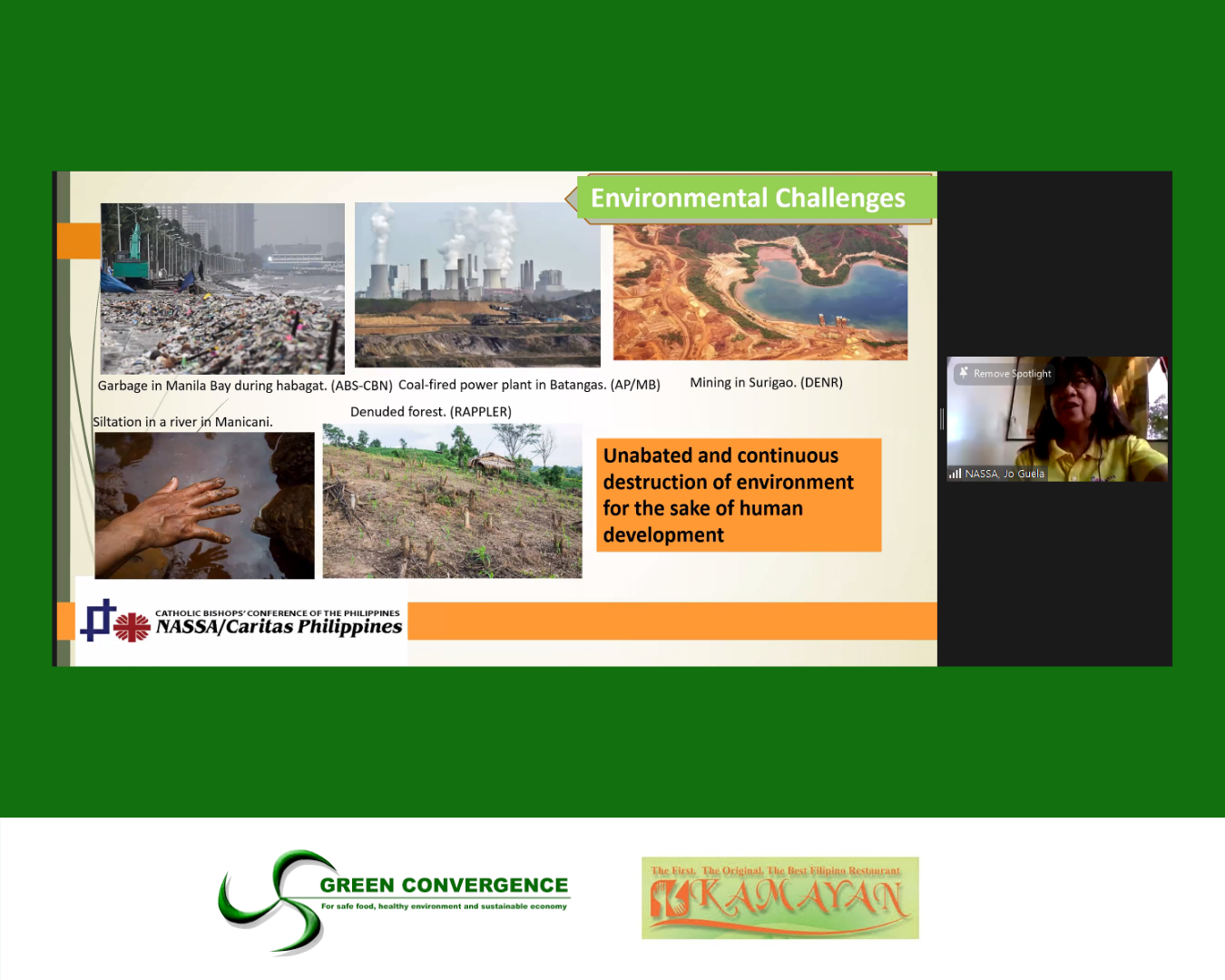
Jo Guela of the National Secretariat for Social Action (NASSA/Caritas PH) noted a similarity in the Catholic and Buddhist perspective of interconnectedness. “As [Venerable Zhi Yi] also shared, we as Catholics and Christians define ecology as ‘living in harmony with mother earth’.”

“To secure a sustainable future, we must change how we live. This entails major transformations in the ways our global society functions and interacts with natural ecosystems” she said.

“We need a paradigm shift in order to re-establish our sacred relationship with nature,” said Guela as she cited Pope Francis’ encyclical, Laudato Si.

“Napakahalaga yung how we respect nature and how we connect with nature” she affirmed.

The Vice President of Peacemakers Circle Dr. Shakuntala Vaswani, on the other hand, shared the Hindu perspective on caring for the environment.

“We have a rich heritage of scripture text that has shaped our view of the world and its environment. It has given us awareness of the great forces of nature as well as that all living things are an extension of the divine,” she said.

“Religious ethics have acted as sanctions against environmental destruction for hundreds of years in India,” she added.

“Unfortunately, our stewardship of mother earth has diminished in the last century or so, either due to the loss of understanding, or sheer negligence in the course of population growth, development, and industrialization” said Dr. Vaswani.

“We need to return to the teachings and practices of our religions that infuse sacredness and reverence in our relationship with nature,” she concluded.

On the role of churches, Mervin Toquero of the National Council of Churches in the Philippines, a network of mainline Protestant, Christian, and non-Catholic churches, said “the NCCP sees the role of churches in environmental protection as providing support and encouragement for the whole ecological movement. It does not see itself as separate.”

“Churches are responsive to climate change and disasters which have gotten worse especially in the last few years because of our vulnerability to climate change,” he added.

Citing the NCCP’s policy paper on ecology, Toquero emphasized interconnectedness of life and creation with the Indigenous People’s concept of ‘Land is Life’.

“They do not have the concept of owning the land. They believe that land is here to nurture the present generation and to nurture future generations” he said.

“Caring for the earth has a spiritual basis,” said Leonor Berroya, Treasurer of Green Convergence.

“We had speakers from 4 religions, but everybody is saying the same thing. There is interrelatedness and interconnectivity in creation,” she concluded.


Environmental Coalition Green Convergence held the 369th session of the monthly Kamayan Para sa Kalikasan Forum entitled “Entrepreneurs for the Environment” last March 19, 2021 through Zoom.

“We have entrepreneurs who are either into business reviving nature, regenerating nature, or curing nature,and those who are into businesses who make sure they are sustainable- meaning they are taking care of the environment, otherwise their business will be affected” shared Dr. Angelina Galang, President of Green Convergence.

Among these eco-conscious entrepreneurs is Erwin Po, President of ReconX- a company that converts plastic waste into fuel and other upcycled products. 

Po shared that the company was born out of the need to address the issue of the overwhelming amount of plastics. “Our goal is to effectively minimize  plastic waste, reprocess plastics, and offer a less environmentally damaging product,” he explained.

The ReconX President listed the products they are able to produce from plastics. “Aside from producing fuel, mostly diesel, kerosene, and low octane gasoline, we also upcycle products and convert them into pellets that can be molded into something else” he said.

“There are many good uses of plastics, it’s simply a matter of disposal and management, and this is where we come in as we constantly work on ways on how to renew them, thus completing the entire circular economy cycle.” he concluded.

Pie Cabigas, Manager of Better Than Ice Cream, shared how her family’s company adapted to using  more natural substitutes for their products.

“When we started in 1990, our products were all sugar-based,” said Cabigas.

“In 1995, we came out with our first no-sugar added product, not knowing there is a big market for this in the Philippines that is clamoring for this type of product” said Cabigas. 

The manager shared the difficulties they faced in switching to natural sweeteners. “In 2010, stevia was introduced to the market, but not in the Philippines.” she said. 

“Since we couldn’t get the imported products here, we just decided to work with a local supplier,” she explained.

“It took a while before we were able to switch from sugar to artificial, then from artificial, to the natural-sweetener, stevia” she added.

When asked regarding further developments on their products, Cabigas replied, “We plan to expand this more, not just with using stevia. People have also told us to explore an alternative plant-based frozen dessert.”

The final speaker, Angelo Tan, Green Building Country Lead of the International Finance Corporation, shared his insights on the importance of including infrastructures and buildings in the climate change narrative.

“In the Philippines, the level of urbanization surpassed the 50% mark in 2015” he said.

“What’s very worrying is that with climate change and this rapid urbanization, there is this phenomenon called double exposure where we become more vulnerable to the effects of climate change” he added. 

“We believe that climate change is also climate business, and we recognize the critical role of the private sector in climate change mitigation and adaptation. Entrepreneurs and businessmen and women have a critical role to play” said Tan.

Tan shared that even in the Philippines, green building can be a viable option for climate change mitigation. “Many Filipinos think green buildings are very expensive, but they are not especially when green measures are incorporated in the design of the house”, he explained.

“The first EDGE or Excellence in Design for Greater Efficiencies certified Zero Carbon building in the world is actually in the Philippines, which is the Arthaland Century pacific tower in BGC”, he proudly shared.

“It just shows that developments in the Philippines can be a pioneer in the world in terms of Zero Carbon developments”, he concluded.

The 369th session also marked the 31st Anniversary of Kamayan Para sa Kalikasan. A commemoration was held for its founders- journalists Vic Milan and Ed Aurelio “Ding” Reyes, and restaurateur Vic Vic Villavicencio.

Longtime participant of the Kamayan forum Roy Cabonegro shared about the impact of the forum and its founders. “We started to form a political green party (MAKAKALIKASAN) from the Kamayan Forum. In my experience, [the forum] is really a story of the three founders,” he shared.

“I thank the three of them and the forum. To me, I see no difference between the 3 founders and this forum” he said after lauding the founders.  

Esther Pacheco, President of Concerned Citizens Against Pollution also gave testimony of the influence of the Kamayan forum. “[It] is a landmark in Philippine communication to last so many decades and pioneering ahead of its time an advocacy for nature.”

Poet, publicist, and activist Greg Bituin Jr. also paid homage to the longevity of the forum in his poem as he read, “dahil sa nangasiwa’t bagong pamunuan, tatlong dekada’y nagdaan, forum pa ri’y nariyan”.

Since March 1990, Kamayan Para Sa Kalikasan Forum has become an institutionalized platform that enables NGO and government representatives, the media, students, teachers, church groups, and concerned citizens to discuss pressing environmental issues in the country. This month’s forum is organized by Green Convergence and is supported by Kamayan Restaurant EDSA.

State of Nature Assessment 2020 Resolutions

STATE OF NATURE ASSESSMENT
Krisis: COVID at Kalikasan
August 21, 2020

RESOLUTIONS

Whereas the Philippines is a country gifted with rich natural resources considered as among the most remarkable in the world and has unique topographies teeming with biodiversity;

Whereas the rich geographical ecosystems of the Philippines provide ecological services to the people and protect them and other life forms from the impact of climate change;

Whereas our country’s characteristic of being mountainous mitigates impacts of stronger typhoons brought about by climate change;

Whereas the world, the Philippines not exempted, is now challenged with COVID-19 pandemic that has claimed lives and drastically affected economy due to the imposition of needed lockdowns and community quarantine to prevent community transmission of the disease;

Whereas the use of disposable protective gadgets such as face masks, face shields, personal protective equipment (PPE) have been mandated as precautionary measures to manage community transmission of COVID-19;

Whereas municipal and medical wastes are increasing due to the disposal of protective gadgets against COVID-19;

Whereas the increasing volume of waste generated, consequently increased disposal fees, thereby diverting hospital budget to address COVID-19;

Whereas healthcare facilities have existing protocols that have been proven effective in the management and disposal of infectious waste way before COVID-19;

Whereas waste collectors, as frontliners, need provision for hazard pay and guaranteed availment of regular employee benefits, considering their work exposure in the disposal of infectious waste;

Whereas talks in Congress have been ongoing to use incineration to address the mounting volume of infectious waste;

Whereas RA 8749 or The Philippine Clean Air Act of 1999 bans incineration due to the emission of dioxin and other toxic substances that pose hazards to health and ecosystems;

Whereas RA 8749 mandates instead the use of non-burn technologies to address infectious waste;

Whereas mining projects that were suspended or cancelled by then Secretary Gina Lopez due to environmental violations or non-compliance with contractual obligations, are now recommended to be re-opened as part of the economic recovery/stimulus program in response to COVID19;

Whereas the impact of mining on the environment and human lives has been proven to be devastating and threatens our geographic ecosystems, biodiversity and watersheds that protect us from the impact of climate change and provide good quality of life for all;

Whereas a better normal must be conceptualized to ensure the health of people, other creatures, and that of our ecosystems, to bring about an ecological sustainable environment for present and future generations to enjoy;


We, the participants of the 2020 State of Nature Assessment with the theme, “Krisis: COVID at Kalikasan” held this August 21, 2020 via Zoom, call on the government to:

CRITICALLY evaluate and RE-THINK the re-activation of mining sites all over the country;

REJECT the idea that mining and river-dredging are stimulus activities for economic recovery amid COVID-19;

BAN open-pit mining as promised by President Duterte since 2016;

ENACT the Green Bills pending in Congress including new laws on Minerals Management, Sustainable Forest, National Land Use, Indigenous Conservation Areas, Freedom of Information and Defending Human Rights Defenders;

STOP any plan to legalize the use of incineration;

PROMOTE instead zero waste lifestyle;

BAN single-use plastics and OPT for reusable and washable PPEs;

ENFORCE the ban on incineration found in Section 20 of RA 8749 or Philippine Clean Air Act of 1999 and instead MANDATE the use of non-burn technologies to address and manage infectious waste;

CREATE a comprehensive database on best practices in treating special wastes with the use of non-burn technologies;

EMPOWER and ASSIST the health care industry and people to practice and promote ecological solid waste management through strict compliance of segregation at source, and environmentally-friendly management of infectious waste;

MANDATE hazard pay and regular employee benefits (SSS, Philhealth, Pag-ibig) to waste collectors of infectious waste;

PROVIDE people-centered, environment-friendly and country-based programs and solutions to address COVID-19;

For our part as members of civil society, we resolve to:

ENSURE that natural environment is not compromised and human lives not endangered;

SUPPORT local government units that oppose mining;

OPPOSE the implementation of environmentally destructive projects such as the use of incineration and continued operations of large-scale mining, and other environmentally destructive projects;

LOBBY for the government to adopt an ecological paradigm in conceptualizing a  “Better  Normal” plan to ensure that similar occurrences of this pandemic are avoided or managed properly ensuring no additional health hazards to people and the environment;

PROMOTE Laudato Si as blue print for moving forward to a better normal;

RAISE AWARENESS among the people especially the youth, for them to become champions of ecological sustainable development;

PROMOTE behavioral change and create a culture that promotes care for the environment;

UNITE to protect the environment and SYNERGIZE our actions that are socially inclusive, economically sustainable, and environmentally beneficial; and lastly,

AFFIRM God’s gift of life and UPHOLD the integrity of creation.

Kabataan Para sa Kalikasan!

Last February 19, 2021, Green Convergence held its 368th Kamayan Para sa Kalikasan Forum entitled “Youth for the Environment”.

Speakers Mitzi Jonelle Tan of Youth Advocates for Climate Action Philippines (YACAP), Natasha & Isabella Tanjutco of Kids for Kids, and Jeff Estela of Youth Strike 4 Climate Philippines shared their experiences as environmental advocates and what drove them to pursue such advocacy at a young age.

Climate action, Nature-based solutions, and intergenerational cooperation was highlighted throughout the forum.

Youth for the Environment

For its Christmas offering, last Dec. 18, 2020, Kamayan para sa Kalikasan focused on the native Pine Tree and endangered endemic tree species.  The resource speakers were Atty. Allan Barcena, Head of Corporate Social Development of Energy Development Corporation (EDC) and Ronino Gibe, Forester and Social Program Officer of the same company.

Atty. Barcena discussed the Benguet Pine that is dominant in Benguet but also grows in other parts of the Cordillera like Mt. Province, Ifugao, Kalinga, Abra and also in Nueva Vizcaya, Ilocos Norte and Ilocos Sur.  There are actually 2 kinds of native pine trees in the Philippines : The Mindoro Pine and the Benguet Pine.  If people want to see them, some are still located in Timberland, San Mateo;  in Crosswinds, Tagaytay; Benguet Pine Station in La Mesa Nature Reserve, Caloocan; and Benguet Pine Park in Bukidnon.

These pine trees offer the following benefits:

  • Medical experts recommend asthma victims to walk under pine trees in the morning because the trees release terpenes, responsible for the smell of pines that help clean the lungs.
  • The needles can be boiled as tea and drank to cure upper respiratory tract ailments.
  • These trees provide serenity and serve as inspiration to artists. They have enhanced the creativity of visual artists, writers, musicians as seen in the art works that they have produced.

Our native pine trees also offer economic benefits.  They serve as lumber for construction, and are used to make furniture, wood carving and novelty items.  Currently, they are not included in the endangered list of IUCN; but its population is dwindling especially in Baguio.   Congressman Mark Go filed a bill in the House of Representatives seeking a 10-year moratorium on tree-cutting in Baguio City; however, the bill has not passed.

Ronino Gibe, on the other hand, presented other native trees that can be planted and used as Christmas trees.  He also discussed EDC’s BINHI Program.

As background, Mr. Gibe informed the participants that the Philippines is one of the 17 megadiverse countries.  It has high total number of species and high endemic species; however, it is also part of the top 10 most threatened. That’s why the National Greening Program was established and a total log ban was imposed.

Native trees are those indigenous to a given area in geologic time.  This includes trees that have developed and occurred naturally.  They were not introduced by humans. In a Lexicon of Philippine Trees published in 2003, it stated that there are 3,084 native tree species in the Philippines.  800 of these are endemic and around 929 found also in other countries.  But in current studies done by UPLB, our native tree species has gone up to 4,000.

If the Philippines has many native tree species, why are we planting exotic species? Unfortunately, many are not aware of the existence of endemic species.  Through the BINHI project of EDC, they’ve decided to concentrate and prioritize 96 endemic species that are endangered.  These were selected based on the following criteria:  Biodiversity, ecological factors, and demand due to high economic value, superior mechanical strength, and high aesthetic value.  They used a grading system for all 800 endangered species and those with 60-100% average were the 96 species that they have focused on.  They intend to mainstream all these 96 species from Luzon to Mindanao.  They launched the program last 2008 and currently have 186 partners in different regions throughout the Philippines.

He enumerated 3 criteria why they prefer to plant native trees:

1) These species can easily adapt to the environment since they are native;

2) They are typhoon resilient;  and

3) They are the habitat of native fauna.  They contribute to biodiversity.

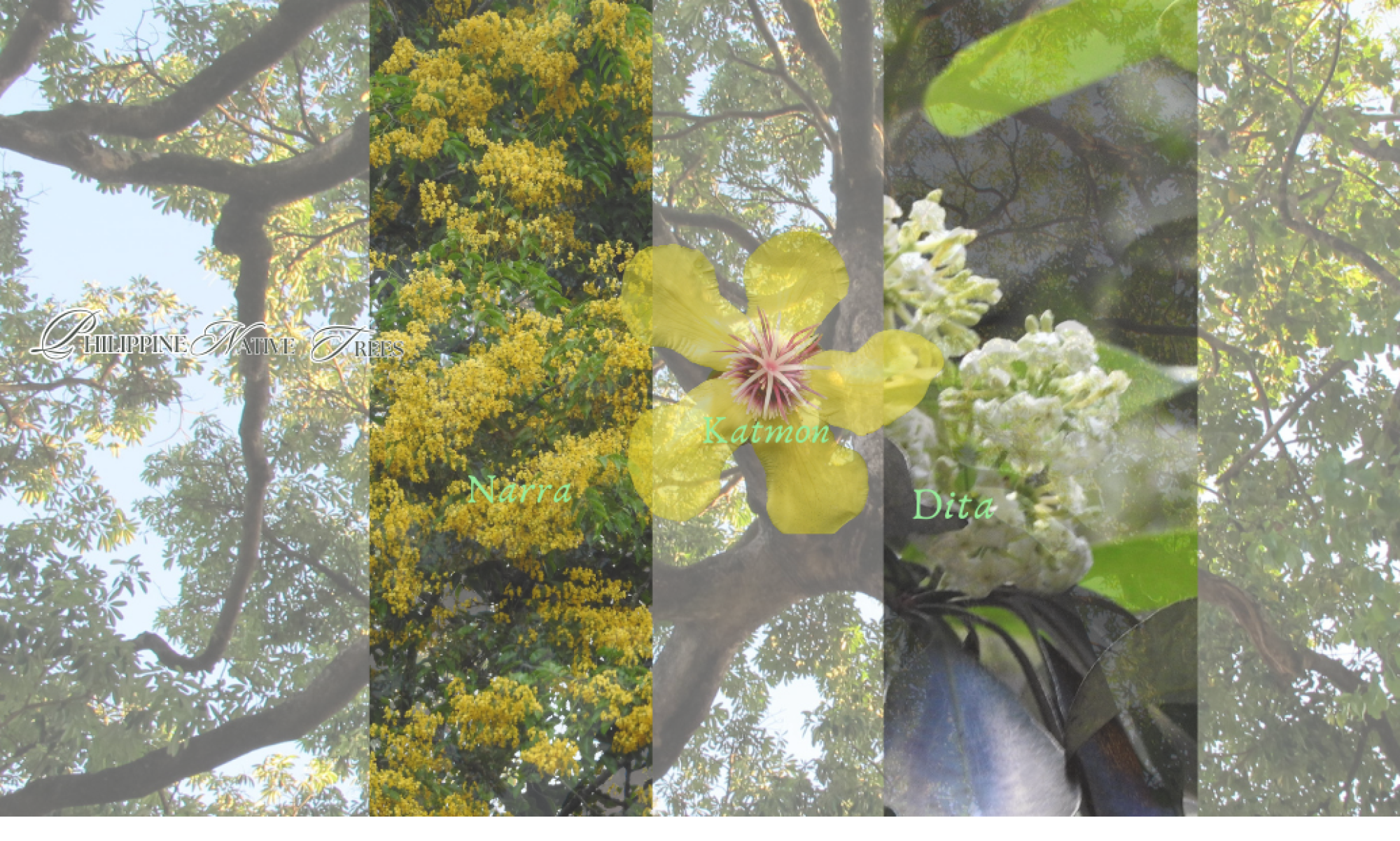
Exotic species kill the understory because of the acidity of their leaves that are prolific in regenerating.  During typhoon Rolly, most of the fallen trees were exotic.   He presented a list of exotic trees that must be avoided.  These are: Mahogany, Ipil-ipil, Firetree, Mangium, Gmelina, Palo santo, rain tree/acacia, Golden Shower, Teak, Palawan Cherry, Kakauate, and African Tulip.  These are the exotic varieties that have proliferated in our country.  They were brought for commercial purposes and used by landscape artists in their profession.  In contrast, he showed native trees that can compete with the enumerated species:  Siar, Banaba, Malabulak, Narra, Rarang, Salingbobog.

Mr. Gibe also showed photos of native trees that can be alternative to Christmas trees. They flower and bear fruits during the Christmas season. They are resilient, best for urban landscaping, have high economic value and are critically threatened.  These are:

  • Bagauak Morado, also known as fireworks. It bears flowers throughout the year;
  • Malakatmon found in Bataan, Aurora and Palawan. They are relatively small that grows to around 3-5 meters tall, except for the species in Palawan.  Their flower changes color from yellow to gold to red.
  • Molave is typhoon resilient. It flowers from August to January. The flowers turn from purple to yellow.
  • Philippine Teak blooms flowers from September to December. It is usually found in Batangas and Mindoro. The leaves are small compared to the species in Taiwan. Its flowers turn from pink to purple.
  • Igem-Dagat is used as Christmas tree in Batanes. This cannot be cut because it is endangered. People in Taiwan make these into bonsai. They grow in coastal areas.
  • Mapilig is from the Bicol region. It flowers in November. It is one of the hardest wood; unfortunately it is critically endangered.
  • Almaciga is made into Christmas décor because of its cones. It is found in Samar.

Mr. Gibe also listed 5 steps in conserving species:

  • Conduct tree inventory and documentation – take note of mother trees that can be the source for seeds and wildlings.
  • Establish Mother Trees.
  • Protect the selected habitat.
  • Advocate through documentation, publication and conduct orientation seminars

EDC was tapped by the Botanical Conservation International – IUCN, as the first and only Philippine Implementing partner for its Global Tree Assessment Initiative (GTA).  EDC has assessed 800 Philippine endemic species with 489 published.  EDC is propagating 96 species of the most endangered premium trees in the Philippine forest.

They go into partnership using these criteria:

  • Sustainability of the area is ensured.
  • The area is accessible to the public to enhance awareness raising activities.

To those interested in procuring native tree seedlings, they are available in EDC Nurseries located in Ormoc, Leyte; Valencia, Negros Oriental; Albay, Bicol Region; Kidapawan, North Cotobato; Pantabangan, Nueva Ecija; and in Antipolo near Eugenio Lopez Center for Metro Manila.  Varieties depend on what is being propagated. They are open to partnering with organizations. They can help in providing technical expertise in setting up nurseries for big projects.

Some of the common challenges that they’ve encountered in their “tree growing and tree nurturing” programs are:

  • Ensuring that prospective partner organizations are well organized and stable;
  • Choosing the appropriate species for the location. They usually do soil analysis to match it with appropriate species to grow. This ensures good mortality rate.
  • Appropriate timing for growing plants with the planting plan. Growth of seedlings in nurseries must coincide with the planting season, which is during the rainy season.
  • Maintenance & protection of seedlings need time and resources during its 3-5 years growing stage.

Mr. Gibe narrated their experience in propagating Kaladis Narig in Sibugay, Zamboanga.  There was only 1 existing standing tree.  But in partnership with DENR and the local LGU, it is now reported to have 11 standing trees. Last August 2020, the Kaladis Narig species was declared as heritage tree to protect it from being cut and harvested.

As parting words, Mr. Gibe recommended 4 easy steps to participate in saving native trees:

  • Join the discussion with like-minded organizations that advocate Philippine Native Trees;
  • Take photos and inquire from experts before buying or collecting trees;
  • Visit native tree parks and arboretum and read books on native trees
  • Grow, nurture and advocate native trees only.

Environmental Forum: ‘Kailangan pa rin ang green spaces sa urban area’

Urban farming was the subject of the 365th session of the monthly Kamayan Para sa Kalikasan Forum held last November 20, 2020 through an online webinar hosted by Green Convergence.

Environmental Lawyer Ipat Luna showed her rooftop garden to the forum participants and shared some of her planting endeavors. “I raised a lot of dapdap for streetside planting. I just bought a kilo of seeds pero sa palagay ko maraming puno’y pakikinabangan natin from that.”

As means of disaster preparedness, Atty. Luna shared that “kahit nabagyuhan at pinabayaan mo [ang garden], it’s still going to give you something. It’s not much pero kung alam mo may value, nakakatuwa rin…I will never run out of camote tops and regular sweet basil.” 

“This is good disaster preparedness.” she added. 

“Policy wise, I think the important thing is for LGUs to support home gardening not just by giving seeds not just by programs that they roll out, but actual technical support and subsidies.” said Atty. Luna.

Carol Galvez of Pitak Project shared the workings of her farm in La Union which promotes regenerative living. “Sa farm ang mantra namin is ‘Build, build, build healthy soil’. That is our wealth. We measure our wealth by how far we’ve regenerated the soil and how much capital we invest back into the land. That is the essence of regenerative living.”

“Rather than increasing the quantity of a certain form of capital, regenerative systems develop the quality of capital. Ang current extractive economy requires ever increasing quantities of capital. That is cancer.”

“Unless the system can be transformed, this will likely lead to overall collapse”, she added.

“Maraming benefits [ang regenerative living]” said Galvez. “It promotes biodiversity, climate change mitigation. We are resilient during disasters. Nung lockdown, may tanim kami.” 

“My point here is we have a choice. We have to choose to regenerate our planet. Let us stop destroying our ecosystems…Let us restore our ecosystems and help build a more equitable world for the future generations to come. I am telling you it is possible.” she concluded.


“It’s really innate for us to get attracted to pretty things or green things. Lalo nang ngayong pandemic, we crave for the outdoors and we want to be outside, and no other color will represent the outdoors like green” shared tourism planner Chen Mencias.

When Mencias started her urban garden, she noted “dumami yung mga ibon and insects. Dumami yung butterflies, bees, beetles.”

“Nung isang araw lang, nakakita ako ng Oriole, which is not very common sa urban area.” she added.

“Kaya kailangan pa rin sa urban area ang green spaces kasi it really provides a place for relaxation and communing with nature” she concluded.

Since March 1990, Kamayan Para Sa Kalikasan Forum has become an institutionalized platform that enables NGO and government representatives, the media, students, teachers, church groups, and concerned citizens to discuss pressing environmental issues in the country. This month’s forum is organized by Green Convergence and is supported by Kamayan Restaurant EDSA with the assistance of the Forest Foundation Philippines.

Watch the full November Kamayan Forum here:

October 2020 Kamayan Forum

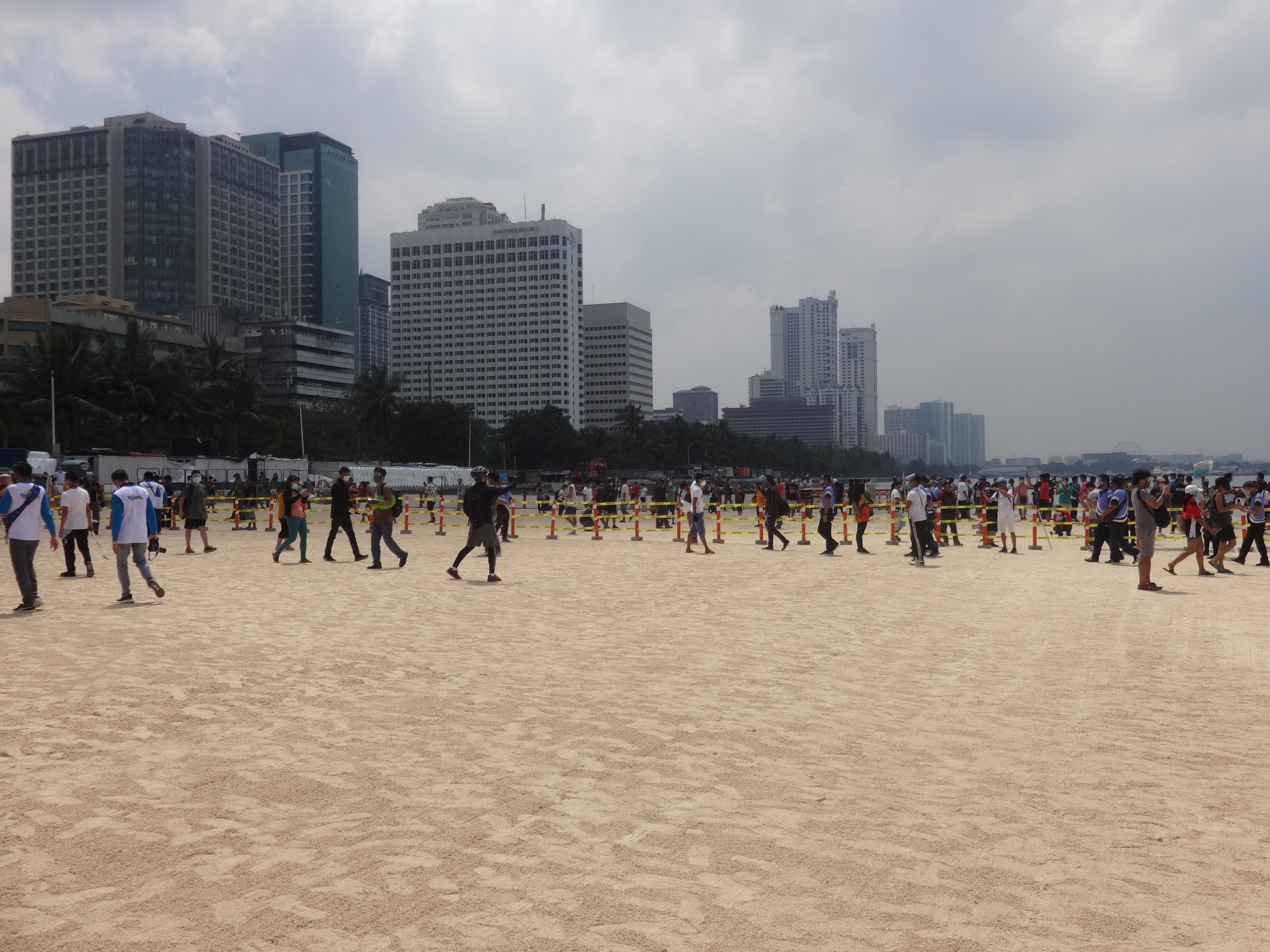
Position paper on Manila Bay Beautification


POSITION PAPER ON MANILA BAY BEAUTIFICATION

All human activities have an impact on nature to a greater or lesser extent.  Whether an activity should be undertaken depends on the balance between cost and benefit.  This is the rationale for the Environmental Impact Assessment Law (EIA). An EIA is required of any activity that is environmentally critical or in an environmentally critical area.  In the case of the Manila Bay beautification, do the benefits outweigh the environmental and economic cost? The cost includes the destruction of part of a mountain, the emission of large amounts of carbon dioxide from the fuel used to quarry, transport, pulverize and spread the dolomite. There is supposedly also a downside on health, that dolomite is harmful to our lungs.  Economically, the cost is huge; almost P400 million which makes it scandalously expensive especially when the amount could have been used for essential needs of our people.

What is/are the benefits?  Hardly any; a half-kilometer of white sand which, in fact, will be easily eroded away by the next strong typhoon.

The Supreme Court mandamus prescribed the rehabilitation of Manila Bay which meant removal of solid waste, dredging the toxic silt and ensuring that the Bay will henceforth be free of solid and liquid pollution.  The mandamus did not call for the Bay’s artificial beautification, if it can even be called beautification.

Beaches are formed from the interaction of land and water.  Sand is deposited on the coastal area either delivered by rivers or from some sources nearby.  White sand is formed from the fine particles of coral which come from a coral reef nearby and deposited on a particular stretch by the wind and waves.  A beaches formed by the dumping of material from just anywhere is not sustainable.

Had EIA been properly done, the dolomite should have remained in Cebu where it belongs.


Access the Position Paper here:
Postion Paper on Manila Bay Beautification

Groups urge for the passage of the Rights of Nature Bill

The Rights of Nature Bill was the main topic for the 363rd session of the Kamayan Para sa Kalikasan Forum held on September 18, 2020 hosted by Green Convergence Philippines.

Atty. Mario Maderaso introduced the bill to the participants as “a legislative proposal anchored on a paradigm shift”.

“There are 2 bills being filled in Congress. Senate Bill 1097 and House Bill 5603 or the Rights of Nature Act. The bill recognizes that nature has legal rights. Being part of nature, we need to recognize its existence. The protection of its rights would also mean the protection of our existence.” he said.

“In inducting this bill, we were supported by an organization based in the US who are also promoting the rights of nature. What is distinct to the principles being followed by other rights of nature advocates in other countries, we have included the coexistence of human rights and the rights of nature.” he added.

“Giving legal personality to the rights of nature, its legal consequence is that it will have a standing in court. Meaning, whenever the rights of nature are violated or damaged, through human agency, a case can be filed in court.” explained Atty. Maderaso.

“Any Philippine resident may file an action” he added.

“There was this case filed by environmental lawyers in Cebu. THey have filed a case on behalf of marine mammals. The petition was dismissed because the marine mammals by itself are not recognized as having a distinct legal personality.

“The court will award certain damages, punitive measures to the violators. These damages will not go personally to those who file the case, but it will go to a trust fund that will be later on managed by a conservation committee.”


Yolly Esguerra, PMPI Coordinator further discussed the campaign on rights of nature.

“The campaign is about the push to recognize the rights of nature.”

“Currently, the models of development paradigm are actually causing the environment to be destroyed continuously.”

“All this environmental destruction is actually largely man-induced and anthropogenic. 

“It is saddening because if you see the statistics, the percentage of humanity in the whole ecosystem and way of life is so small, but our actions are so destructive.” 

(“Nakakalungkot kasi if you see the statistics, the percentage of humanity in the whole ecosystem and way of life, napakaliit lang ang human, but so destructive ang ating mga gawain.”)

“To secure a sustainable future, we must change how we live. This entails major transformations in the ways our global society functions and interacts with natural ecosystems.”

“That is why there is a call for a paradigm shift. We come from the same source, if humans have rights, nature should have rights too.”

(“Kaya ang panawagan is a paradigm shift. Ang pinagmulan natin ay iisa, Kung may karapatan ang tao, may karapatan rin ang kalikasan.”)

Goldman Environmental Prize Recipient Fr. Edwin Gariguez supported this point as he read a quote from Laudato Si, the encyclical of Pope Francis. “When nature is viewed solely as a source of profit, this has serious consequences for a society.” 

“We need to move from a utilitarian, market driven mindset towards an ecological worldview in order to rectify the exploitative development paradigm” he said.

“We need to recover our connectedness with the earth. Without this shift in consciousness, the destruction of ecosystems in exchange for profit will continue” he added.

“Because that is all we see, how much is the profit? What is valuable to the person? But we don’t see what is valuable to nature” he said.

(“Kasi yun lang ang nakikita natin, ano yung kita? Ano yung mahalaga sa tao? Pero hindi natin nakikita yung mahalaga sa kalikasan.”)

In response, Gariguez emphasized the importance of Eco-spirituality and the role of the Indigenous People.

“Many Indigenous Peoples still have respect and love for the earth. We need to learn from them. For them, the land and everything on the earth is permeated with the presence of the spirit” he explained.

As a call for action, he reinforced “the need to affirm the sacredness of mother nature.”

(“Marami pa ring katutubo na mayroong respect and love for the earth. Kinakailangan natin matuto sa kanila.”)

“It is an exciting challenge; we are all one in our paradigm that nature has to be respected” said Dr. Nina Galang, president of Green Convergence.

Since March 1990, Kamayan Para Sa Kalikasan Forum, held every 3rd Friday of each month, has become an institutionalized platform that enables NGO and government representatives, the media, students, teachers, church groups, and concerned citizens to discuss pressing environmental issues in the country. The forum is organized by Green Convergence and is supported by Kamayan Restaurant EDSA with the assistance of the Forest Foundation Philippines.

Watch the full September 2020 Kamayan Forum here:

Green Convergence Celebrates the 2020 Season of Creation

[big_title bigtitle_content=”Reason for the Season”]

The Catholic Church’s liturgical calendar is divided into several meaningful periods: Advent, Christmas, Lent, and Easter. These seasons are meant to celebrate the birth, suffering, death and resurrection of Jesus Christ. They reveal how God so loved the world that He sent His only begotten Son to show us how to live, love, and serve others

Redemption, Jesus dying on the cross for our sins, definitely was an expression of total love of the Father. However, long before Jesus came along, God had been revealing this love through His Creation. From the Big Bang 15-20 billion years ago that formed an infinite number of galaxies, stars, planets, moons and other celestial objects to the formation of our planet 4.7 billion years ago to the origin of life 3.7 billion years ago to the moment He breathed life into the first human.

For the human race, the stage had been set for his use, enjoyment and appreciation. Before him had been the evolution of the Earth from a molten mass of inanimate molecules to the formation of the varied features – mountains, plains, oceans, rivers – to the organisms that were suited to their specific settings of soil, water, and air. The grandiose biodiversity was a reflection of the Almighty’s own glory. God was revealing Himself to us through this creation. And most of all, He gave us the intelligence and consciousness to be able to make use of all these for our growth in knowledge, joy and actualization of our human potential individually and collectively.

The Season of Creation is a time for reflection of God’s omnipotence and love. But it is also a time to reflect on how we have shown our gratitude or ingratitude through our use or misuse of His bounty. Sadly, the state of nature today seems to manifest our indifference and worse, our selfishness, as we see the state of the environment today. From deforestation to air and water pollution to toxic substance, to nuclear contamination and the most urgent global crisis – global warming and its flip side, climate change, it is imperative that we take stock of our systems, actions, and world views and take a wiser course if we are to preserve the Earth’s grandeur, God’s creation.

Lord,

the lofty mountains proclaim Your greatness;
the fields of grain reveal Your goodness;
the teeming seas announce Your benevolence;
the tiny leaf is witness to Your omnipotence;

the mighty forests reflect Your glory;
the brilliant flowers bare Your beauty.

In the song of birds,
in the chirp of crickets,
in the cry of babies, we hear life.

In the warmth of sunshine,
in the kiss of the wind,
in the smile of friends,
we feel Your love.

Lord, You so loved, the world that You gave us this beautiful world that gives nurturance of body and spirit. Give us the commitment to care for Your Earth, to pass on this commitment to our families, friends and neighbors so that our children will inherit a planet that will still yield their sustenance, so that they too will know You through Your creation, so that generation after generation will sing Your praises forever.

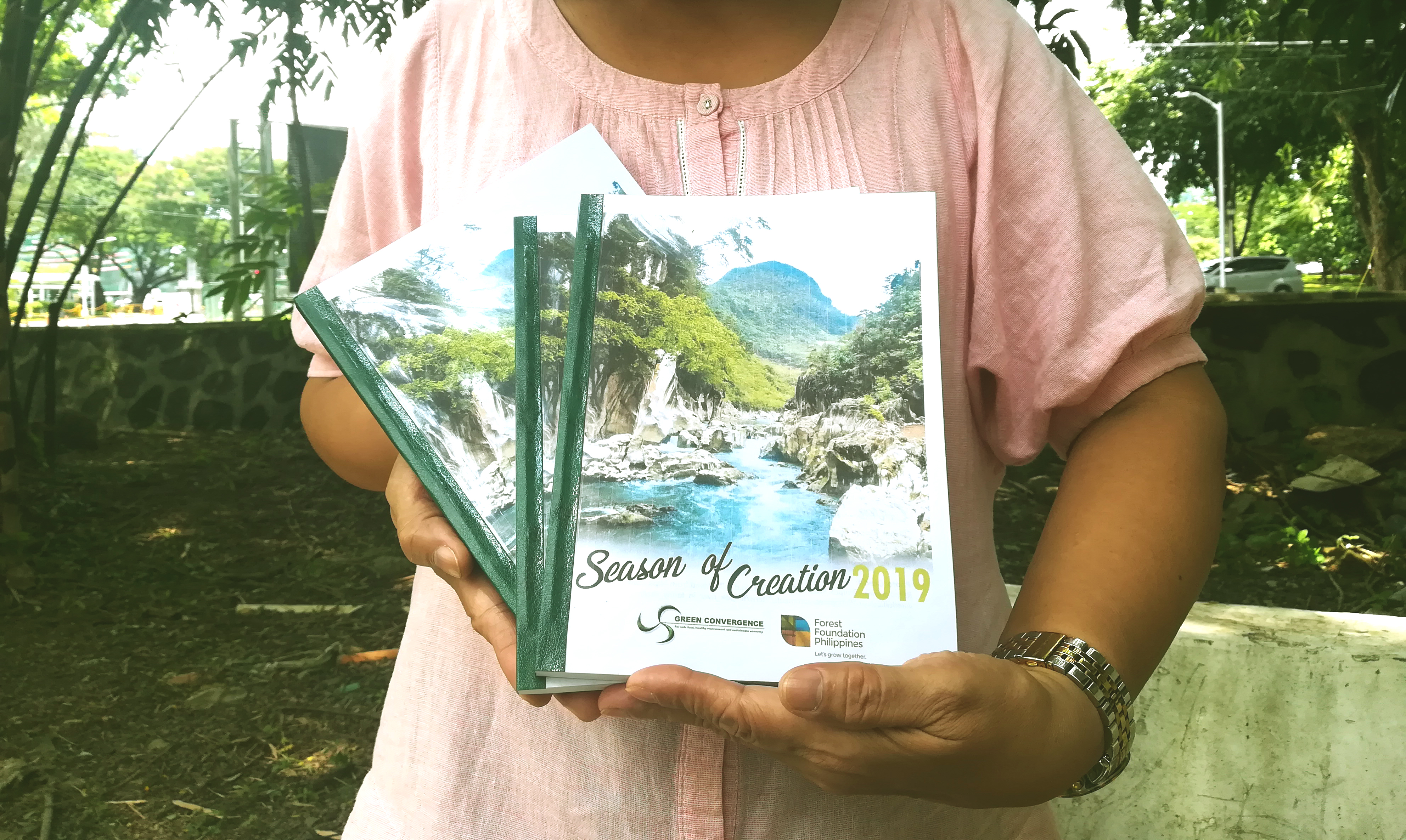
[big_title bigtitle_content=”About the Booklet”]

This booklet hopes to help Catholics celebrate the Season of Creation. It is divided into 8 sections:

Section I gives the historical background and context of the celebration of the Season of Creation in the Catholic world and especially in the Philippines today.
Section II offers a guide for Liturgical Celebrations during the Season of Creation. Scripture Readings and Liturgical Resources are presented for all the Sundays that fall within the Season. The Liturgy Resources consist of a brief summary, Points for Reflection, Life Focus Questions, Passages from Laudato Si, and Related Prayers of the Faithful. Votive Mass for Creation is prepared specifically for September 1, which is the World Day of Prayer for Creation, but can be adapted for use at other times. Furthermore, the Season is being extended to Oct. 11 which is Indigenous Peoples’ Day, in recognition of the fact that indigenous peoples have been the best guardians of the earth’s ecosystems.

Section III introduces a guide for examination of conscience and suggested environmental prayers for other occasions.

Section IV features poems related to the environment and pandemics.

Section V highlights several saints of ecology.

Section VI enjoins the faithful to demonstrate environmental conversion in their lifestyle.

Section VII features games that challenge our knowledge on Philippine biodiversity.

Section VIII are Filipino versions of an ecological mass and examination of conscience.