The Anti-Terror law and its implications on the environment was the subject of the 361st session of the monthly Kamayan Para sa Kalikasan Forum held on July 17, 2020 through an online webinar hosted by Green Convergence.
The law was criticized by human rights lawyer Neri Colmenares, who described the definition of terrorism as “very overboard”.
“In the first place, that is a very vague law” he said, and added “I am a lawyer, but I wouldn’t understand what act is prohibited [by that law]”.
(Ako, abogado po ako ah. But I wouldn’t understand kung anong act ang pinoprohibit niyan)
Atty. Colmenares gave an example where environmental activists who interfere with destructive mining activities can fall under the definition of terrorism. “In fact, under that definition, EDSA 1, People Power, is nothing more than a terrorist act” he also added.
“[The Anti-Terror law] is an act of state terrorism” asserted Sr. Mary John Mananzan, OSB, one of the oldest activists in the Philippines.
“Since President Duterte assumed office in 2016, at least 113 environmental and land activists were already murdered which is much higher than during the previous administration” cited Sr. Mananzan from Marlon Pareja, Associate Professor of Biology from De La Salle University Dasmarinas.
Under the new law, “this overbroad definition of terrorist acts will only worsen the current abuses environment defenders face in the Philippines…authorities can still find a way to use this law against environment defenders.” She said.
“Our Mother Earth will suffer when those who care for her are terrorized and killed.” She also added.
“The environmental defenders and environmental activists are now an endangered species” said Marie Marciano, Vice-President of Green Convergence.
“With this law, we can expect that the abuses will rise” she noted.
Since March 1990, Kamayan Para Sa Kalikasan Forum, held every 3rd Friday of each month, has become an institutionalized platform that enables NGO and government representatives, the media, students, teachers, church groups, and concerned citizens to discuss pressing environmental issues in the country. The forum is organized by Green Convergence and is supported by Kamayan Restaurant EDSA with the assistance of the Forest Foundation Philippines.
The state of air quality and the need for expansion of green spaces in Metro Manila was the subject of the 355th monthly Kamayan Para sa Kalikasan Forum held on October 18, 2019 (Friday) at Kamayan Restaurant, EDSA, Mandaluyong City.
In a 2012 report by the World Health Organization, “Every year, around 7 million premature deaths [in the world] are caused by air pollution,” said Lyrio Woldring of Smart Air Philippines, “One in four deaths in the Philippines are attributed to air pollution,” she added.
Woldring emphasized that while the right type of masks are effective in protecting people from the worst impacts of air pollution, she was disappointed that the government was not treating the problem as a health concern. She remarked, “We have a campaign for polio, for dengue, why not for air pollution?”
Meanwhile, Quezon City Mayor Joy Belmonte’s representative, Patrick Alzona of the city’s Environmental Protection and Waste Management Department (EPWMD), spoke about the LGU’s plans to promote green spaces.
Alzona said that as the “lung” of Metro Manila, “Quezon City aims to implement the ‘Green Pedestrian Corridor’ in an attempt to increase the city’s green spaces to 25% of its total land area,” adding further that the City Mayor “wants to create a department solely for climate change and sustainability,” possibly the first of its kind among LGUs.
Asked about the young trees in plant boxes recently destroyed by the government along some streets, Alzona explained that they are treated as “collateral damage” of the national government’s road clearing operations. “They can be replanted,” he said further.
In the discussion, Negros Occidental’s Nordson Forest Park owner Atty. Nordy Diploma passionately declared that government inaction on environmental problems and non-compliance with environmental laws must never be tolerated.
Diploma converted 40 hectares of his land to a forest park for the benefit of his community, instead of using it for business.
“Trees are still the best absorbent of carbon dioxide,” asserted Dr. Angelina Galang, Green Convergence President, as a final reminder to the audience and the LGUs about the importance of trees, particularly the native ones, in combating air pollution.
Since March 1990 Kamayan Para Sa Kalikasan Forum, held every 3rd Friday of each month, has become an institutionalized platform that enables NGO and government representatives, the media, students, teachers, church groups, and concerned citizens to discuss pressing environmental issues in the country. The forum is organized by Green Convergence and is supported by Kamayan Restaurant EDSA, with the assistance of the Forest Foundation Philippines.
Environmental Coalition Green Convergence held the 354th installment of the monthly Kamayan Para sa Kalikasan Forum about the status of water security in the country on September 20, 2019 (Friday) at Kamayan Restaurant, EDSA, Mandaluyong City.
Energy Development Corporation CEO Federico Lopez explained that the country’s water security problem is part of the ongoing global climate crisis. He said, “Shrinking glaciers will impact freshwater supply…Sea level rise and flooding will intrude aquifers.”
He noted that even without the effects of climate change, Metro Manila is still vulnerable due to very delayed flood control projects. He stressed, “There is a lot of ground subsidence…If water extraction continues.”
On the other hand, retired Lt. Gen. Emmanuel Salamat, Administrator of the Metropolitan Waterworks and Sewerage System (MWSS), in defense of the government’s initiatives said, “Measures have been adopted by MWSS to strengthen Angat Dam which was constructed in 1967 and other water structures to make these earthquake-resilient, for any damage to it will affect water supply, food supply, public safety, and energy resource especially in Metro Manila.”
Salamat promised to resign from his position if his leadership does not solve the water crisis that the metropolis is currently facing.
Alternative solutions were also provided by the forum’s speakers. Lopez recommended that the government must invest in research to develop a technology to utilize the abundant rainwater that the country receives.
Network for Sustainable Water’s Paolo Pagaduan emphasized, “Ang daling sabihin na kailangan nating magpatayo ng bagong ganito, bagong ganyan (It is easy to say that we need to build new this, new that),” when the problem is the people’s excessive consumption of water.
Pagaduan cited Seattle in the United States, where despite the city’s increasing population, water demand stays the same. He exclaimed, “We can reduce consumption to a more manageable level that is acceptable.”
In addition, a tribute to the late environmental champion and former DENR Secretary Gina Lopez was also given. Dr. Angelina Galang of Green Convergence and Dr. Carlo Garcia of the Miriam College Environmental Studies Institute partnered and pledged to plant 65 trees in Barangay Laiban, Tanay, Rizal in honor of the 65 years of life of the champion.
Galang described Lopez, “In the firmament of the environmental movement, she is the supernova, the brightest of all…Probably, a lot of us here became better because of her.”
“Siguraduhin natin na ang mga punla, binhi na inilagay niya [Gina Lopez] ay patuloy na magbunga (We must ensure that the seeds she placed must continue to grow),” Jaybee Garganera of Alyansa Tigil Mina said.
“Mining, coal, [and] small island ecosystems; she wanted these issues to be at the forefront of the 2016 elections,” he added.
Since March 1990, Kamayan Para Sa Kalikasan Forum has become an institutionalized platform that enables NGO and government representatives, the media, students, teachers, church groups, and concerned citizens to discuss pressing environmental issues in the country. This month’s forum is organized by Green Convergence and is supported by Kamayan Restaurant EDSA with the assistance of the Forest Foundation Philippines.
[big_title heading=”1″ bigtitle_content=”Reason for the Season”]
The Catholic Church’s liturgical calendar is divided into several meaningful periods: Advent, Christmas, Lent, and Easter. These seasons are meant to celebrate the birth, suffering, death and resurrection of Jesus Christ. They reveal how God so loved the world that He sent His only begotten Son to show us how to live, love, and serve others
Redemption, Jesus dying on the cross for our sins, definitely was an expression of total love of the Father. However, long before Jesus came along, God had been revealing this love through His Creation. From the Big Bang 15-20 billion years ago that formed an infinite number of galaxies, stars, planets, moons and other celestial objects to the formation of our planet 4.7 billion years ago to the origin of life 3.7 billion years ago to the moment He breathed life into the first human.
For the human race, the stage had been set for his use, enjoyment and appreciation. Before him had been the evolution of the Earth from a molten mass of inanimate molecules to the formation of the varied features – mountains, plains, oceans, rivers – to the organisms that were suited to their specific settings of soil, water, and air. The grandiose biodiversity was a reflection of the Almighty’s own glory. God was revealing Himself to us through this creation. And most of all, He gave us the intelligence and consciousness to be able to make use of all these for our growth in knowledge, joy and actualization of our human potential individually and collectively.
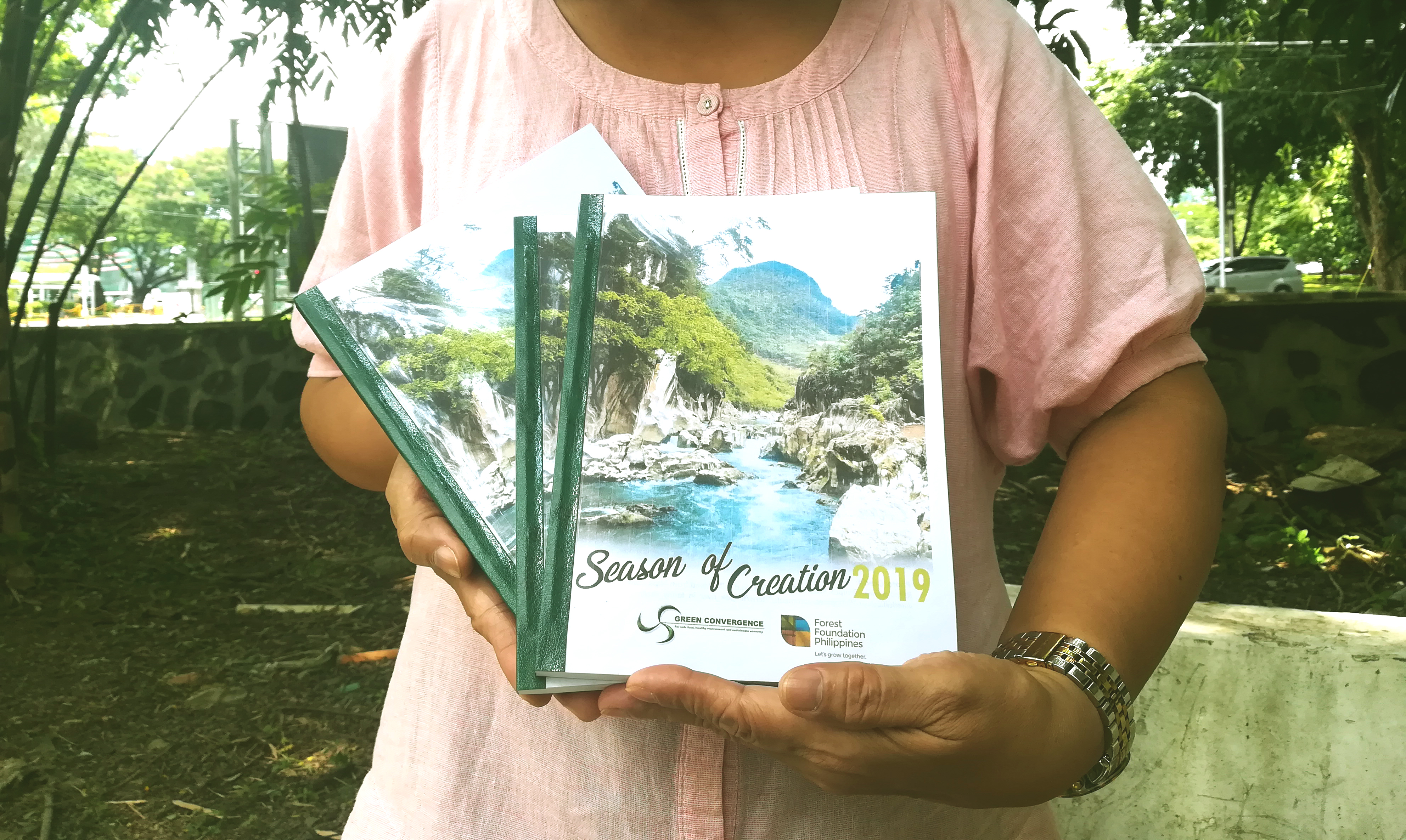
Green Convergence participates in this year’s Season of Creation celebration by offering this booklet to the parishes to help them be engaged in the environmental movement.
The Season of Creation is a time for reflection of God’s omnipotence and love. But it is also a time to reflect on how we have shown our gratitude or ingratitude through our use or misuse of His bounty. Sadly, the state of nature today seems to manifest our indifference and worse, our selfishness, as we see the state of the environment today. From deforestation to air and water pollution to toxic substance, to nuclear contamination and the most urgent global crisis – global warming and its flip side, climate change, it is imperative that we take stock of our systems, actions, and world views and take a wiser course if we are to preserve the Earth’s grandeur, God’s creation.
Lord,
the lofty mountains proclaim Your greatness;
the fields of grain reveal Your goodness;
the teeming seas announce Your benevolence;
the tiny leaf is witness to Your omnipotence;
the mighty forests reflect Your glory;
the brilliant flowers bare Your beauty.
In the song of birds,
in the chirp of crickets,
in the cry of babies, we hear life.
In the warmth of sunshine,
in the kiss of the wind,
in the smile of friends, we feel Your love.
Lord, You so loved, the world that You gave us this beautiful world that gives nurturance of body and spirit. Give us the commitment to care for Your Earth, to pass on this commitment to our families, friends and neighbors so that our children will inherit a planet that will still yield their sustenance, so that they too will know You through Your creation, so that generation after generation will sing Your praises forever.
[big_title heading=”1″ bigtitle_content=”About the Season of Creation 2019 Booklet”]
This booklet hopes to help Catholics celebrate the Season of Creation. It is divided into 5 sections.
In Section 1, the first article gives the over-all perspective that situates the Season among the significant seasons that the Church observes; it points to the plan of God from the beginning of time. The second article adds that creation is continully unfolding and that we are called to cooperate with God in this as co-creators.
Section 2 offers a guide for the liturgical celebration of the Season. It weaves into the standard parts of Holy Mass appreciation and gratitutde for God’s bounty. The liturgy is further enriched by reflections, life focus questions and passages from Laudato Si.
This is followed by suggested prayers for other occasions.
Section 3 introduces several saints of ecology.
Section 4 enjoins the faithful to be environmentalists themselves through behaviors that conserve the earth’s resources and respect its ecology, one of them the creation and nurturance of gardens of native trees.
Section 5 features games that challenge our knowledge of Philippine biodiversity.
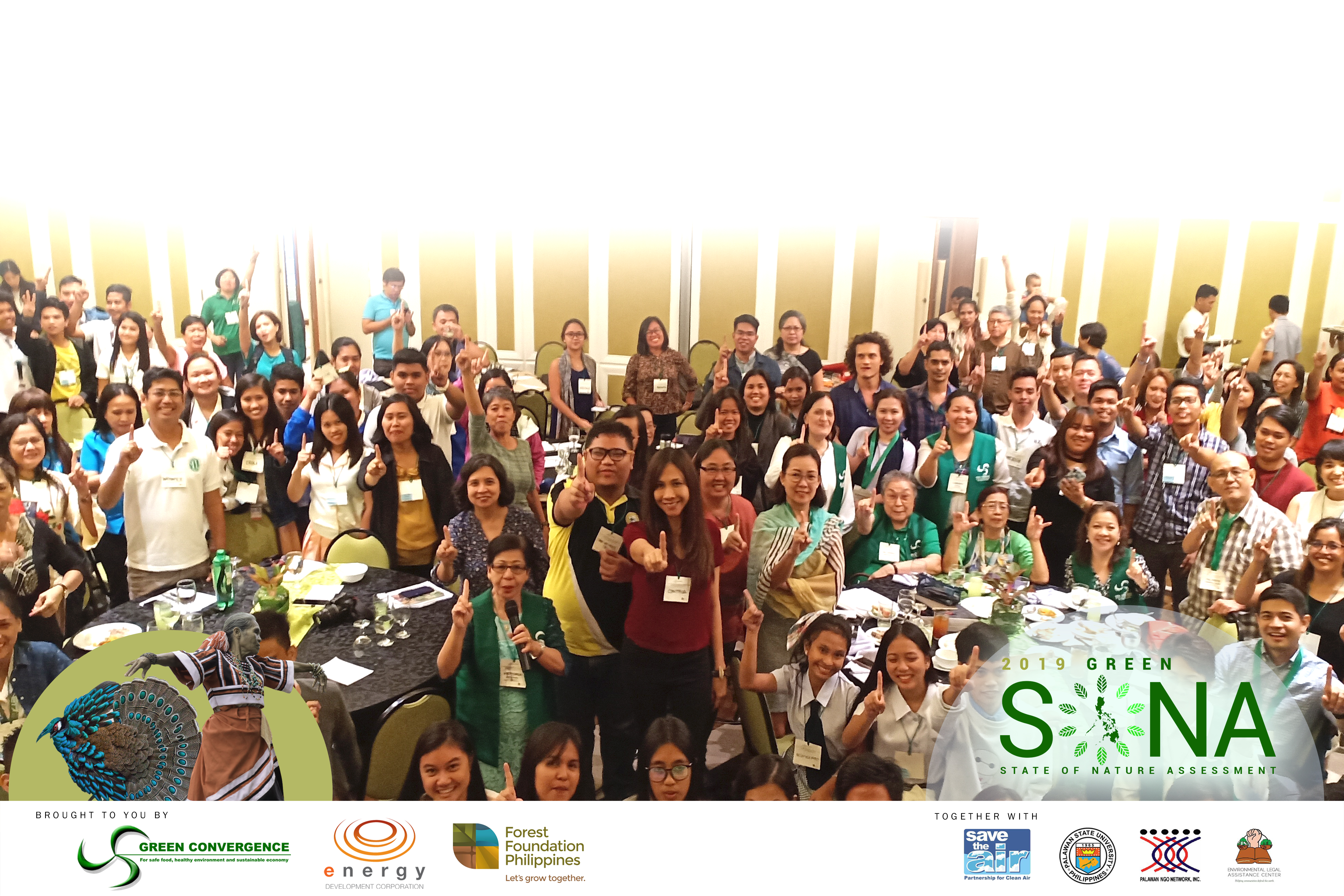
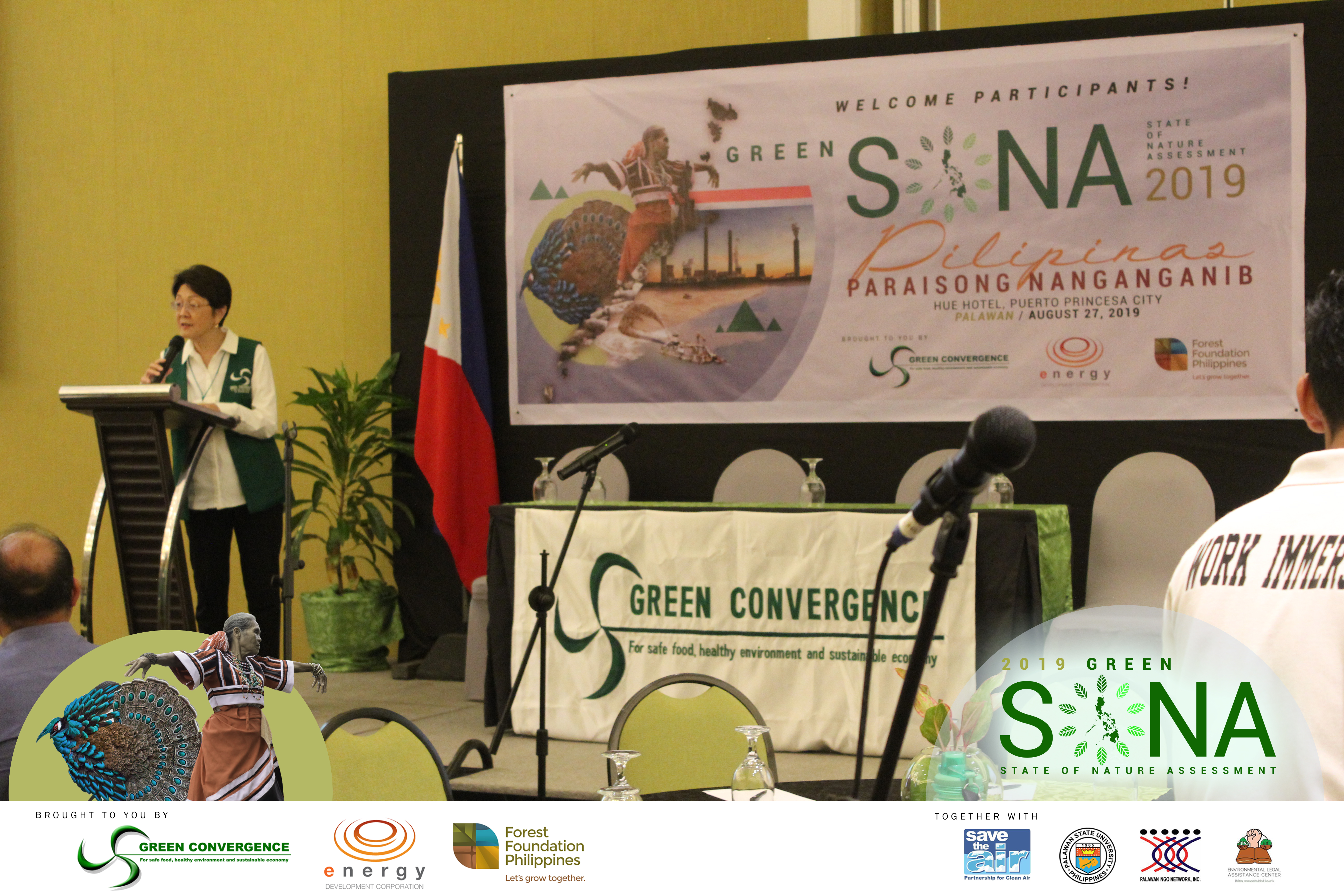
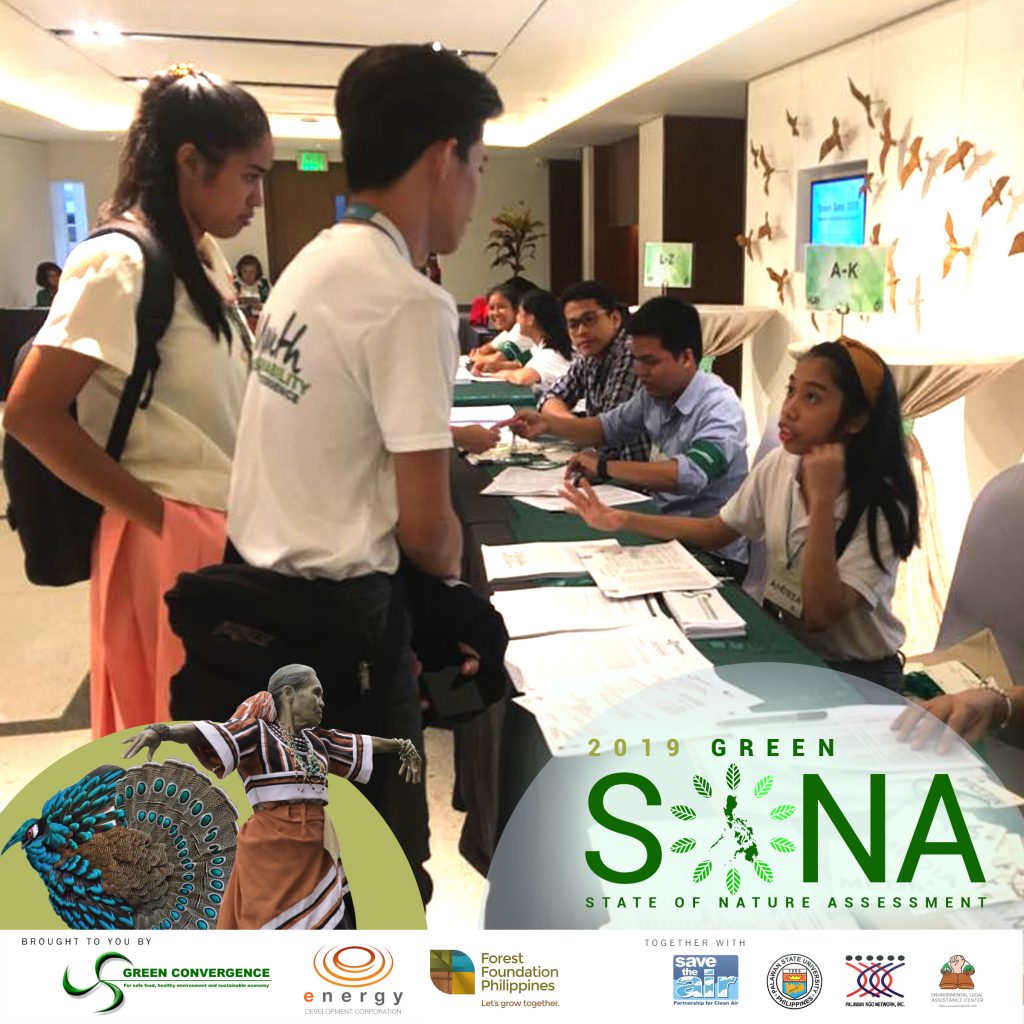
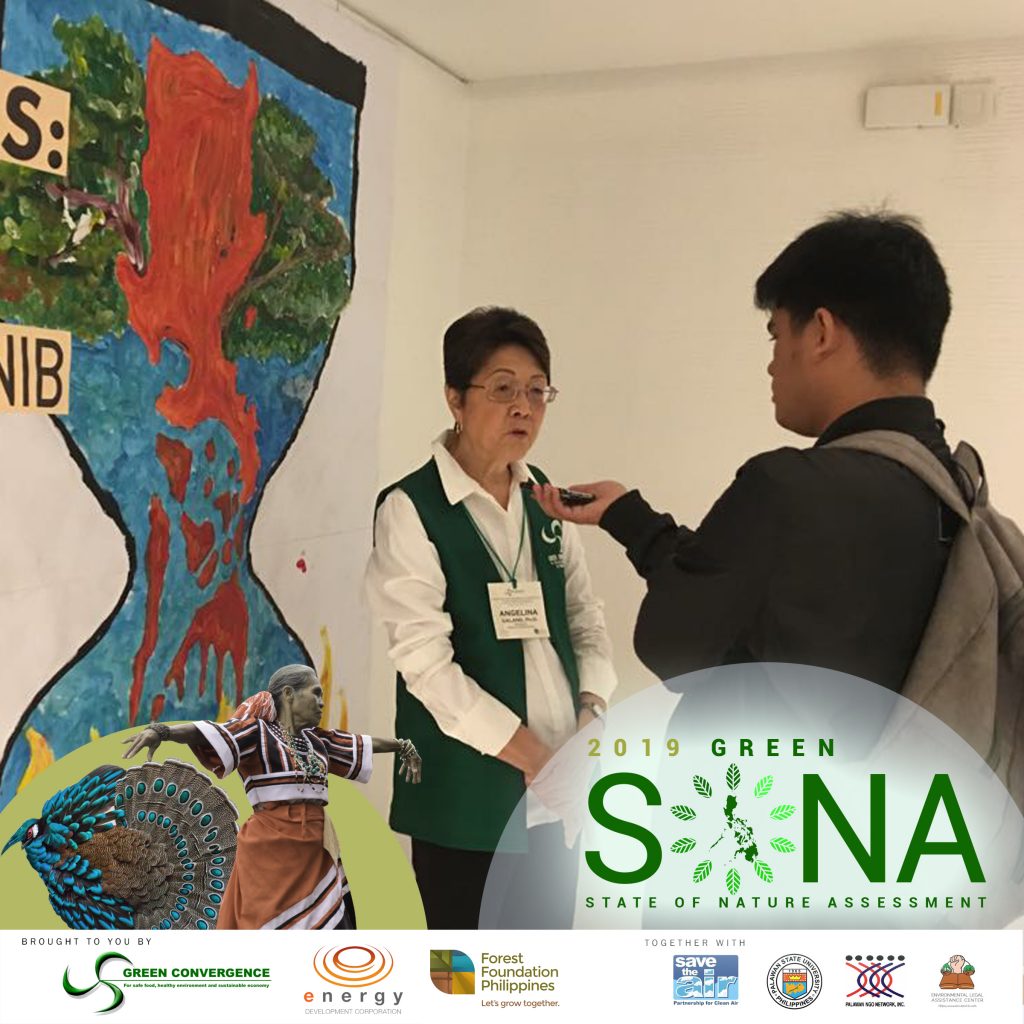
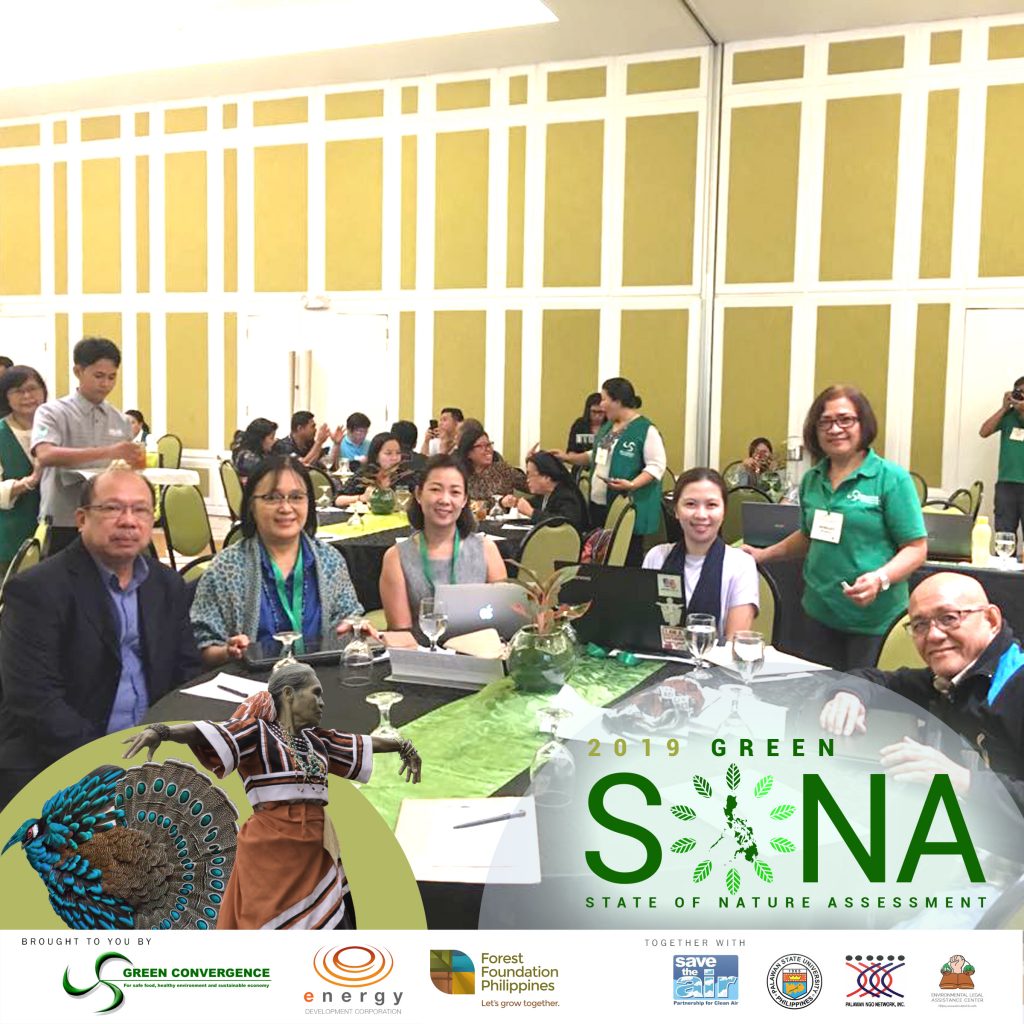
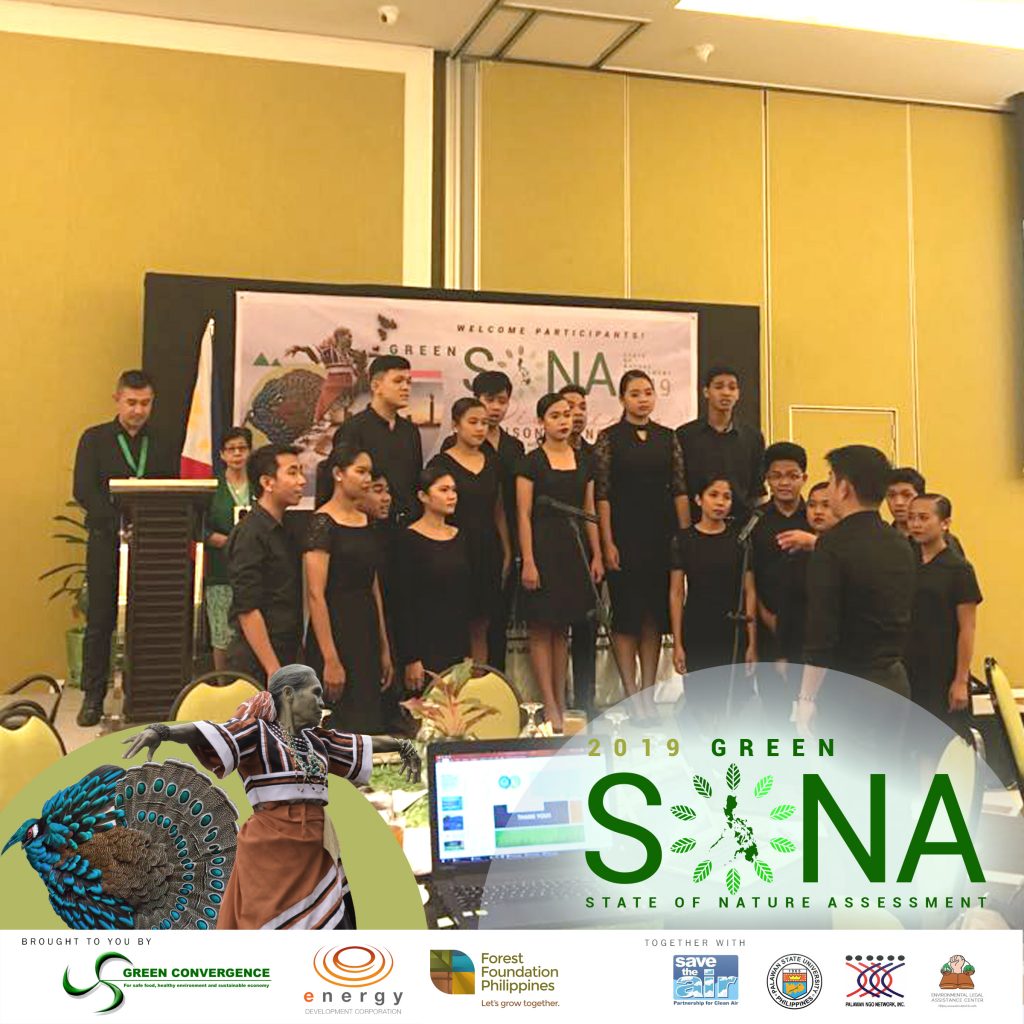
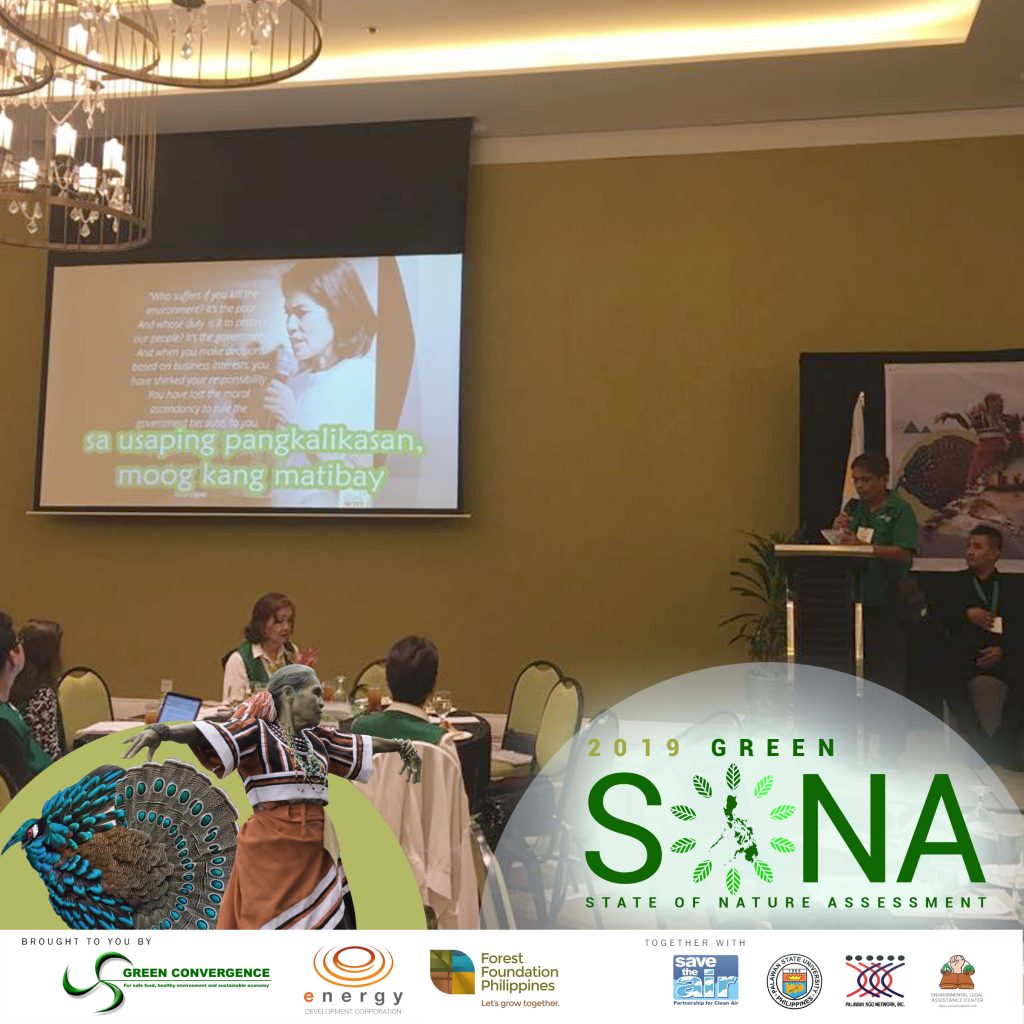
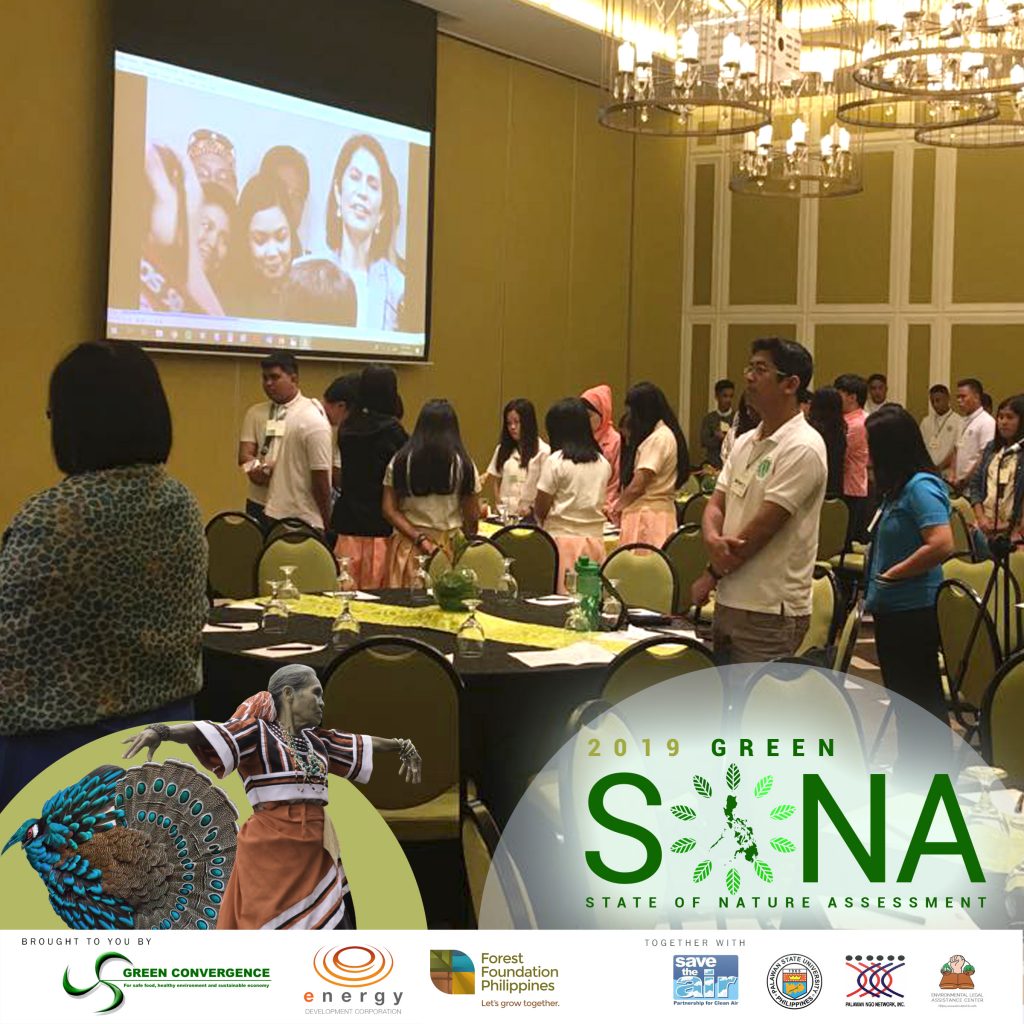
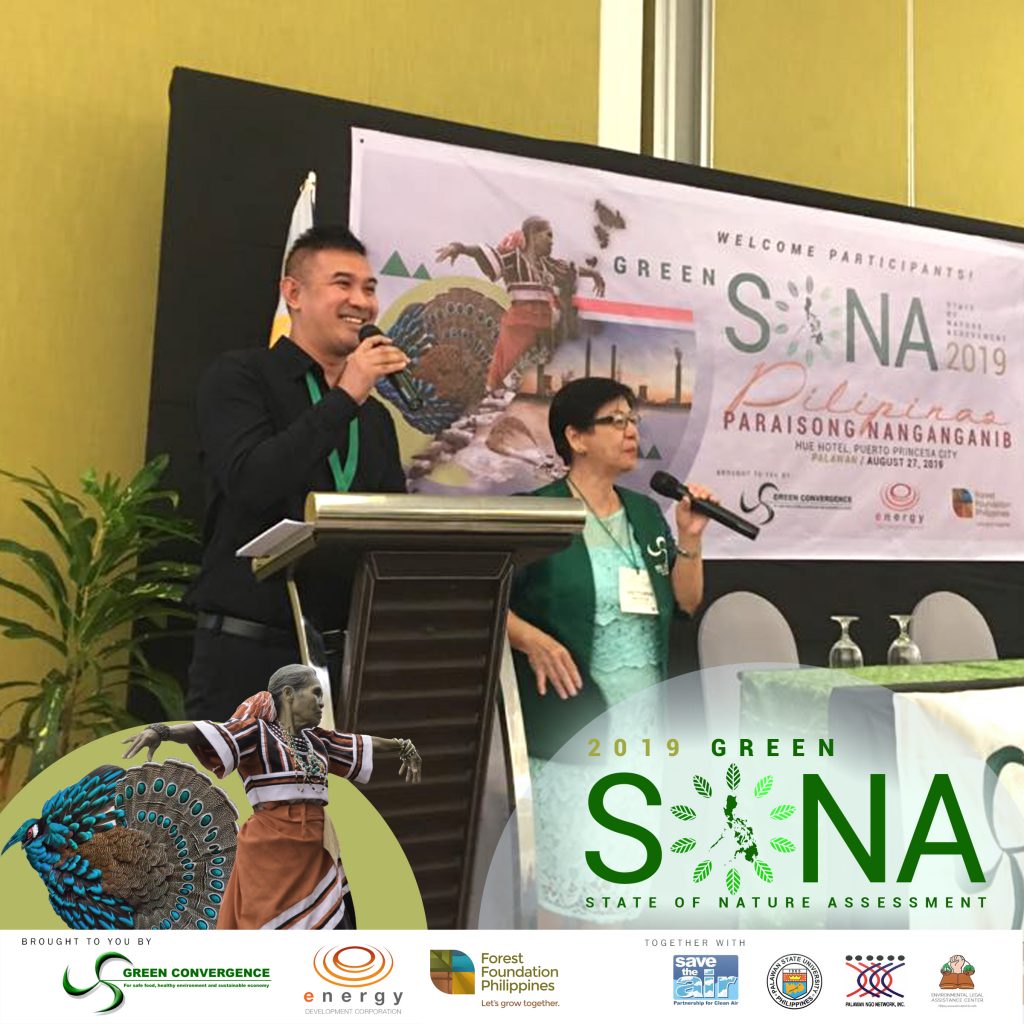
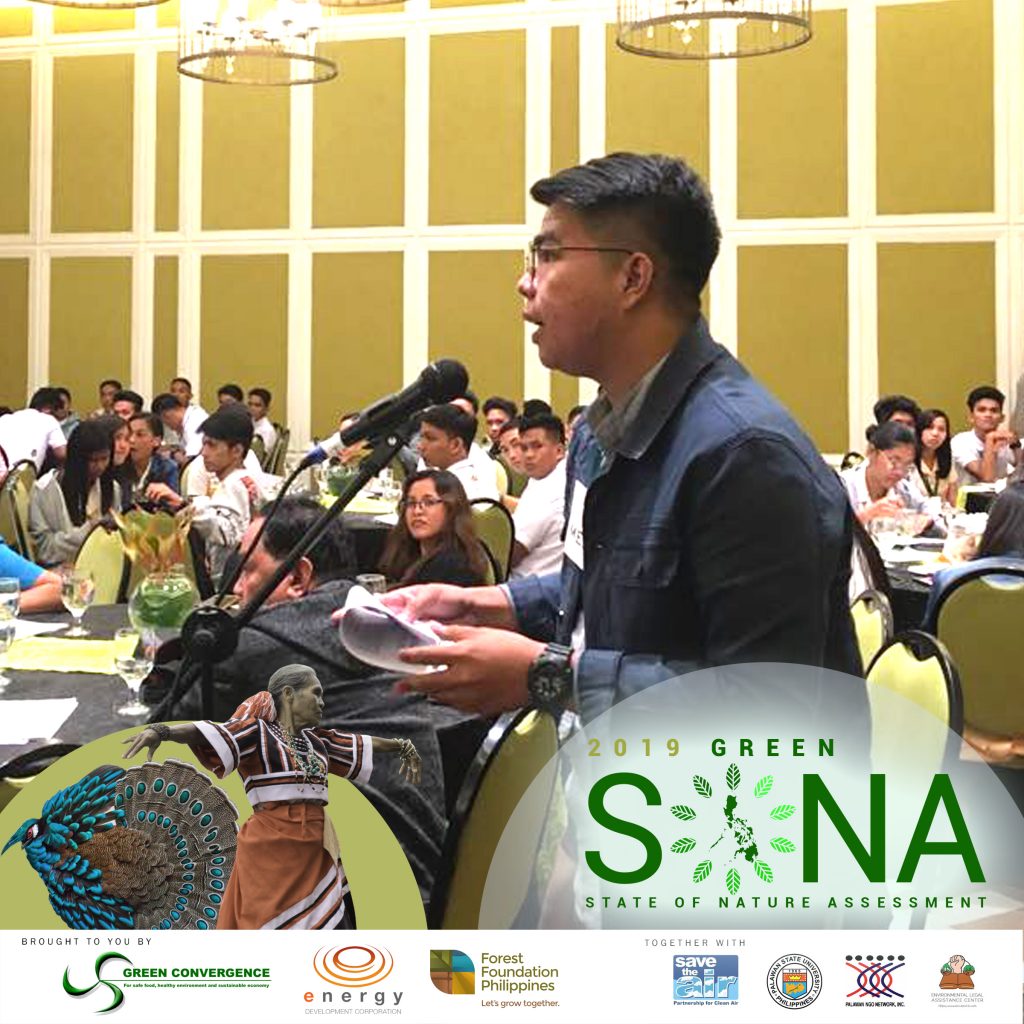
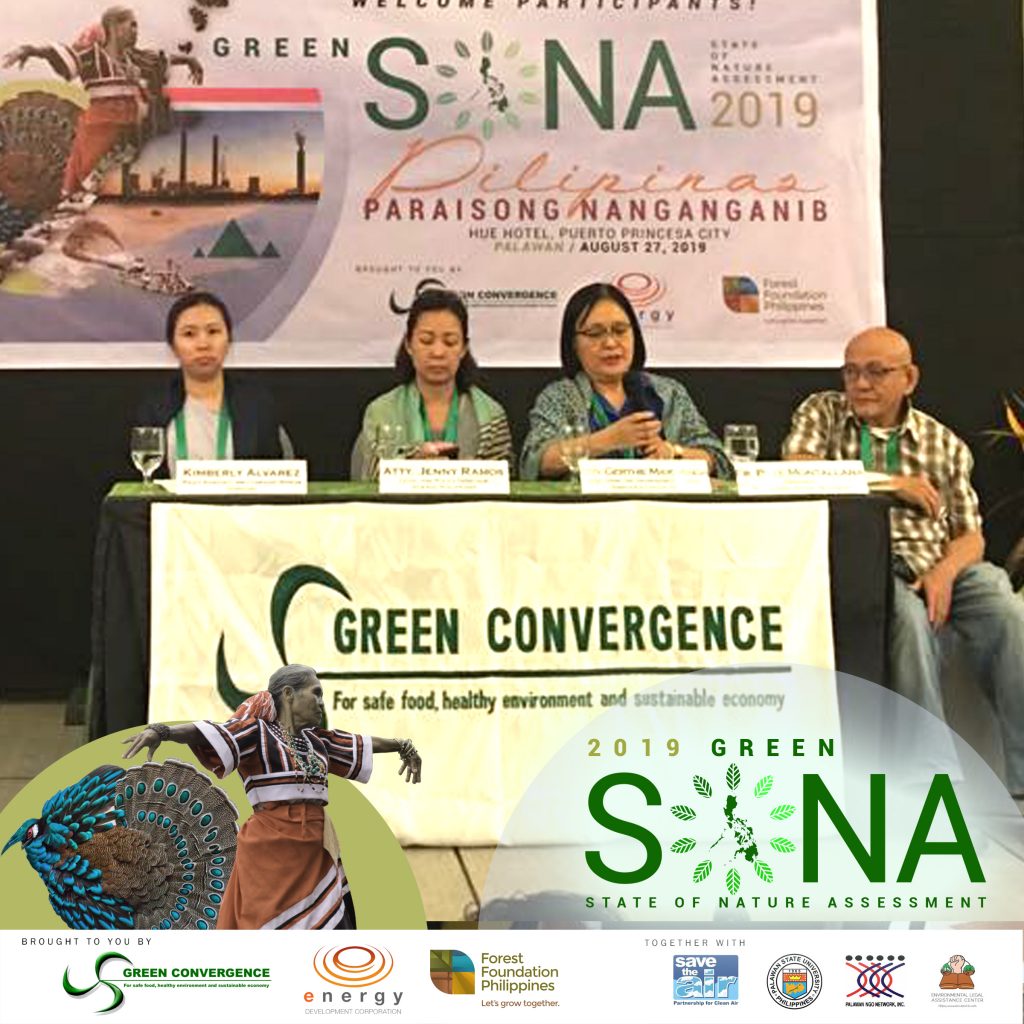
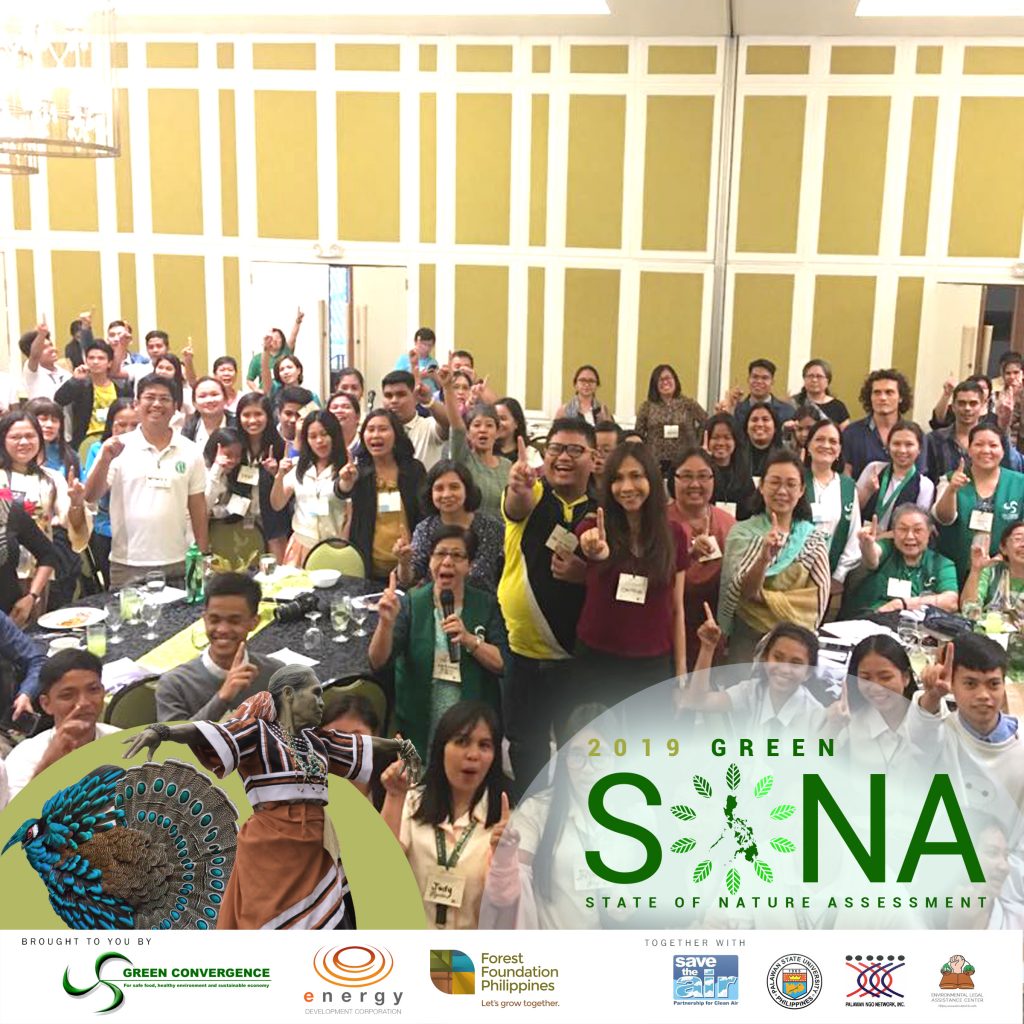
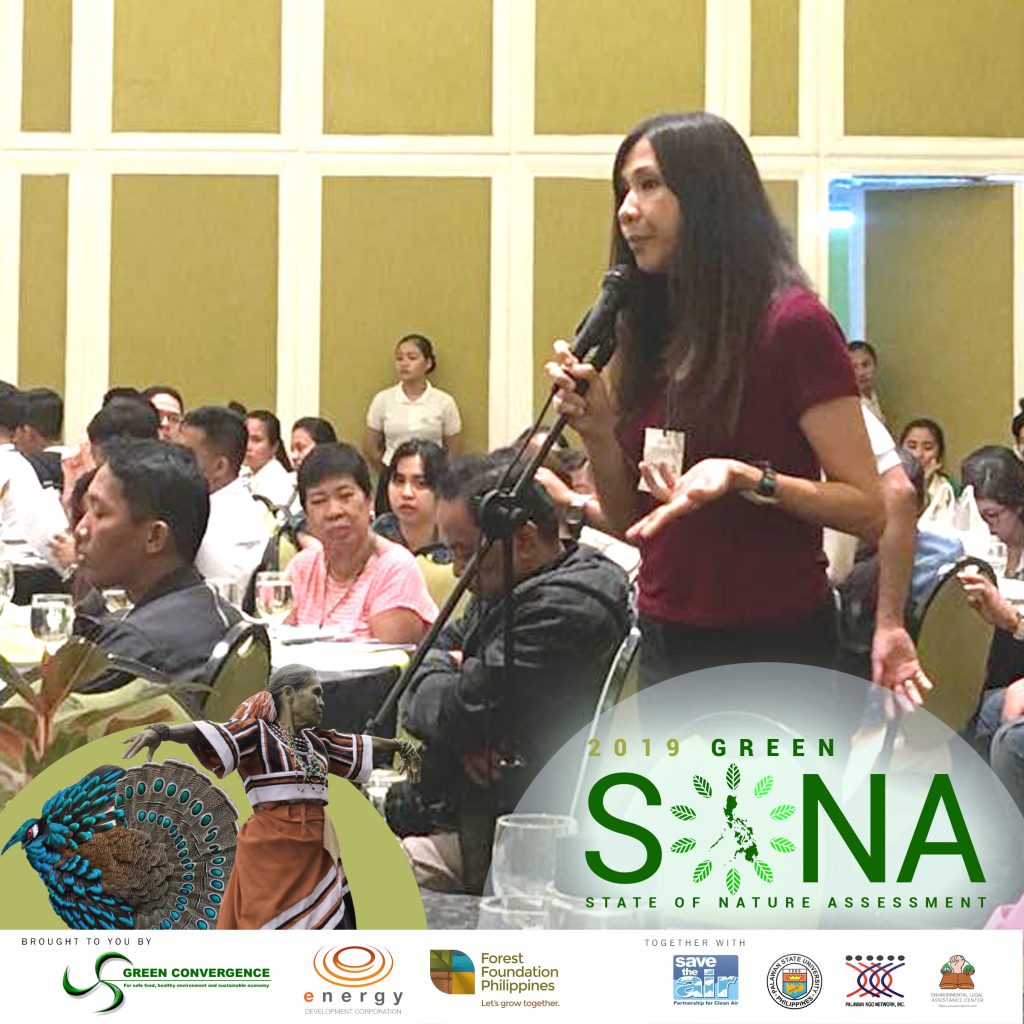
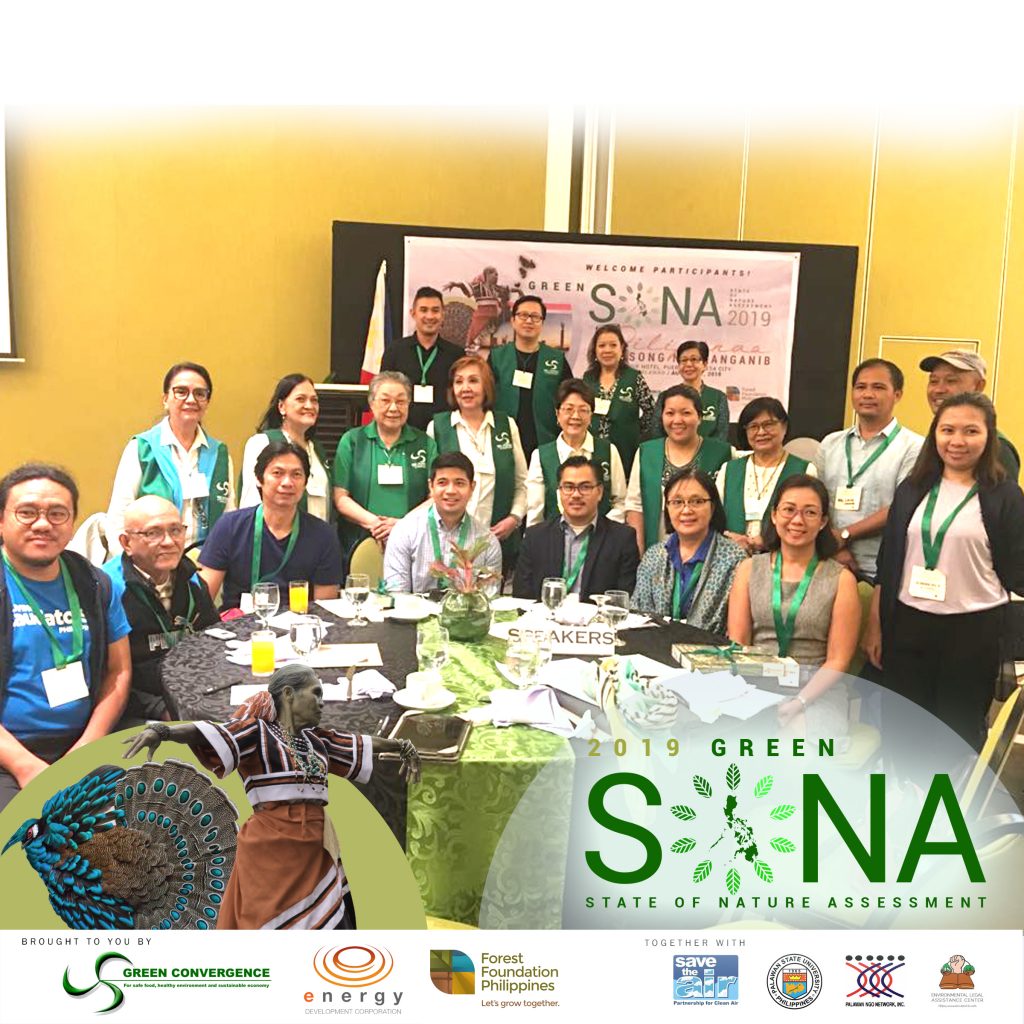
Green Convergence together with the Energy Development Corporation (EDC) and the Forest Foundation Philippines, and with the support of Partnership for Clean Air, Palawan State University, Palawan NGO Network, Inc. (PNNI), and the Environmental Legal Assistance Center (ELAC) held the 2019 State of Nature Assessment (#GreenSONA): Pilipinas, #ParaisongNanganganib at the Hue Hotel, Puerto Princesa City on August 27, 2019. An environmental tour in three learning sites in Puerto Princesa City, namely, Bacungan Mangrove River, Puerto Princesa City Landfill, and PNNI Office was conducted after the event on August 28, 2019.
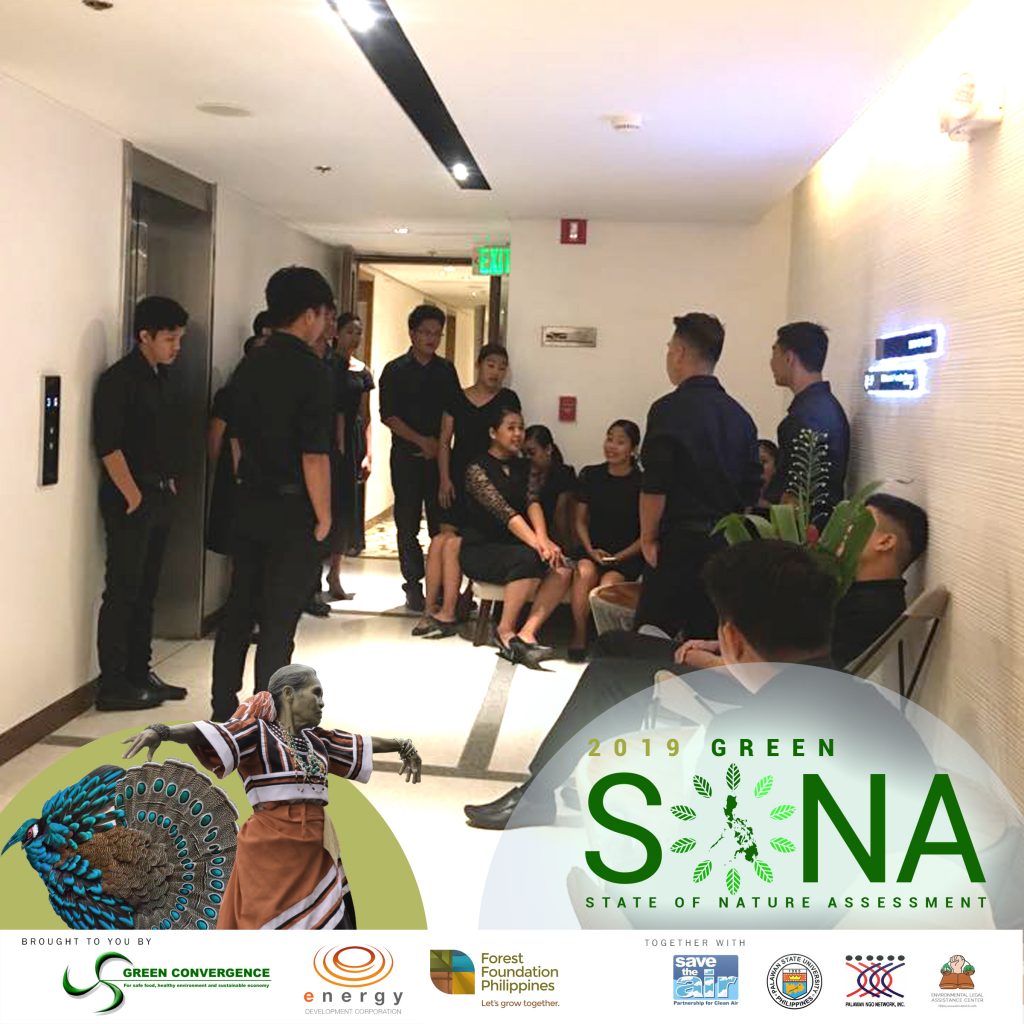
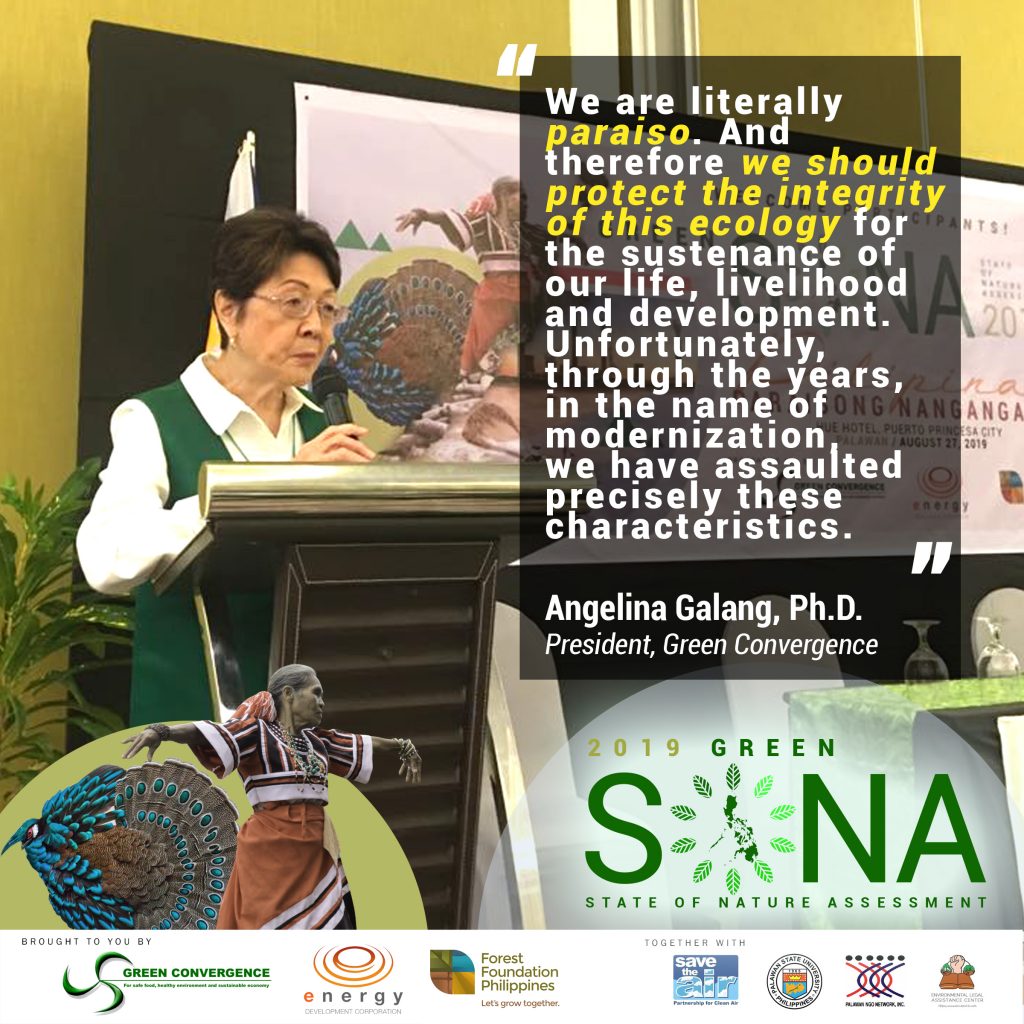
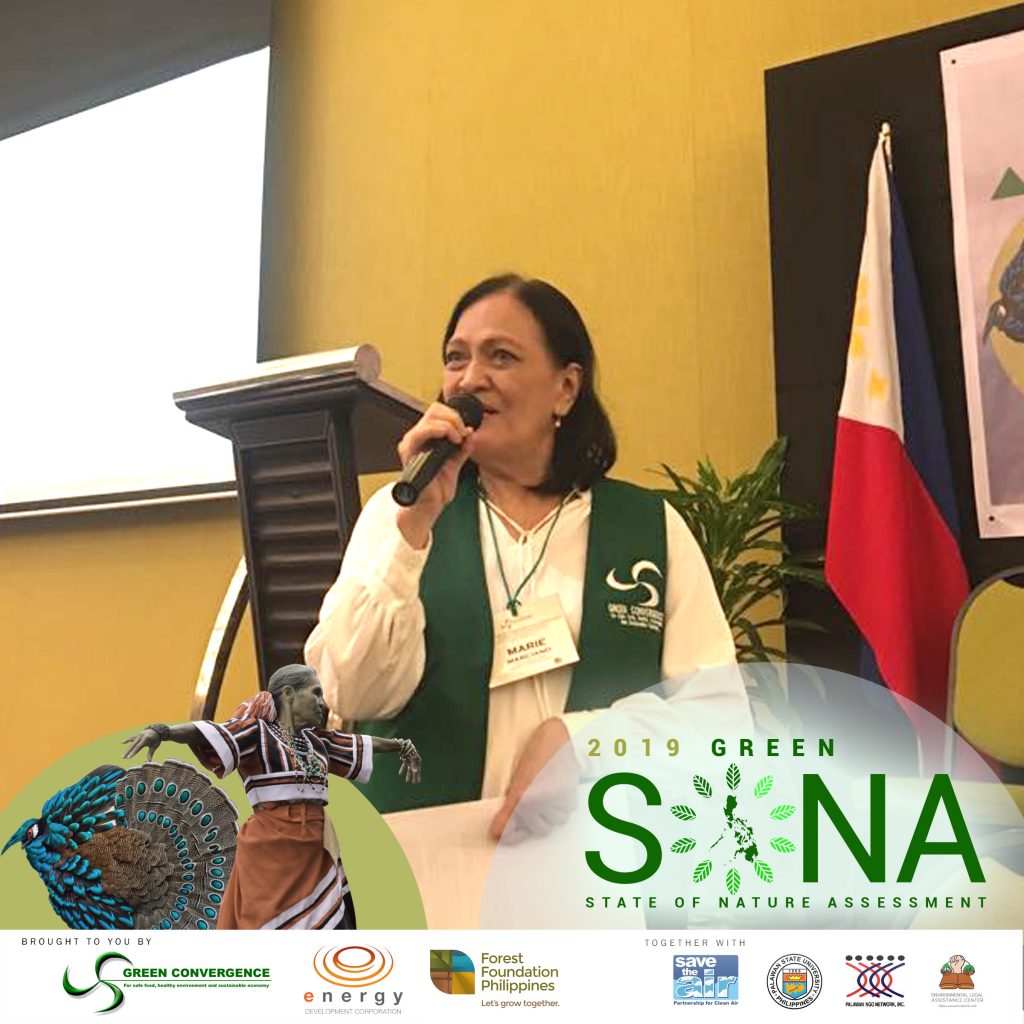
The Green SONA commenced with the National Anthem and Invocation led by singers from the Palawan State University. An opening number featuring songs in Cuyonon and Filipino languages were also performed by the group. Their performances were shortly followed by an orientation to the Green SONA by Green Convergence President Angelina P. Galang, Ph.D. In her message, she emphasized that “We are literally paraiso. And therefore we should protect the integrity of this ecology for the sustenance of our life, livelihood and development. Unfortunately, through the years, in the name of modernization, we have assaulted precisely these characteristics.”
Green Convergence President Angelina P. Galang, Ph.D. orients everyone about what the annual State of Nature Assessment or Green SONA is all about.
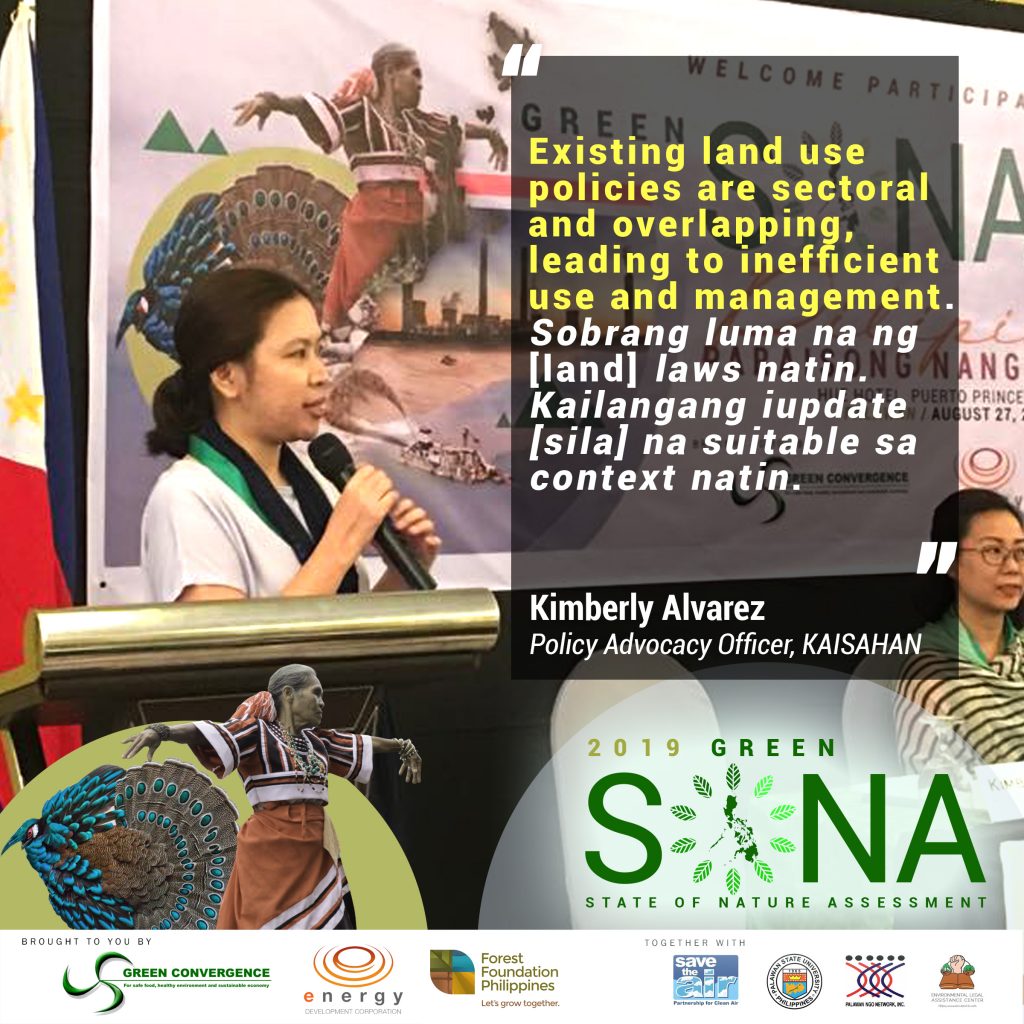
The first part of the annual assessment of the national environment dealt with its threats. Kimberly Alvarez, Policy Advocacy Officer of Kaisahan tungo sa Kaunlaran ng Kanayunan at Repormang Pansakahan or Solidarity Towards Countryside Development and Agrarian Reform (also known as Kaisahan) discussed the negative implications brought about by the lack of land use policy in the country. She mentioned, “Existing land use policies are sectoral and overlapping, leading to inefficient use and management. Sobrang luma na ng [land] laws natin. Kailangang iupdate [sila] na suitable sa context natin.”
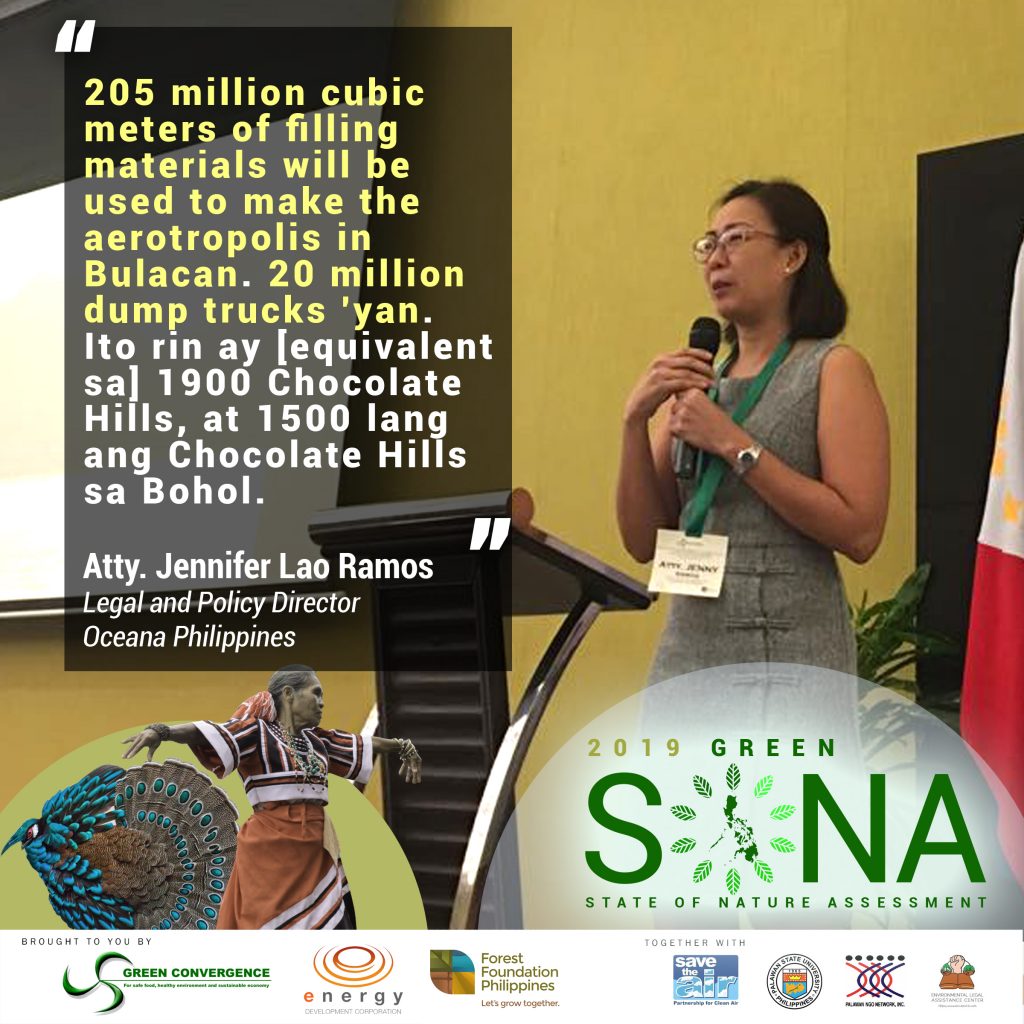
Alavarez’ report was followed by Atty. Jennifer Lao Ramos’ presentation on the impacts of reclamation activities to marine biodiversity. She stressed that reclamation should not be the operative word used for the activity, and it must be “dump and fill.” She cited the planned aerotropolis in Bulacan as an example, “205 million cubic meters of filling materials will be used to make the aerotropolis in Bulacan. 20 million dump trucks ‘yan. Ito rin ay [equivalent sa] 1900 Chocolate Hills, at 1500 lang ang Chocolate Hills sa Bohol.”
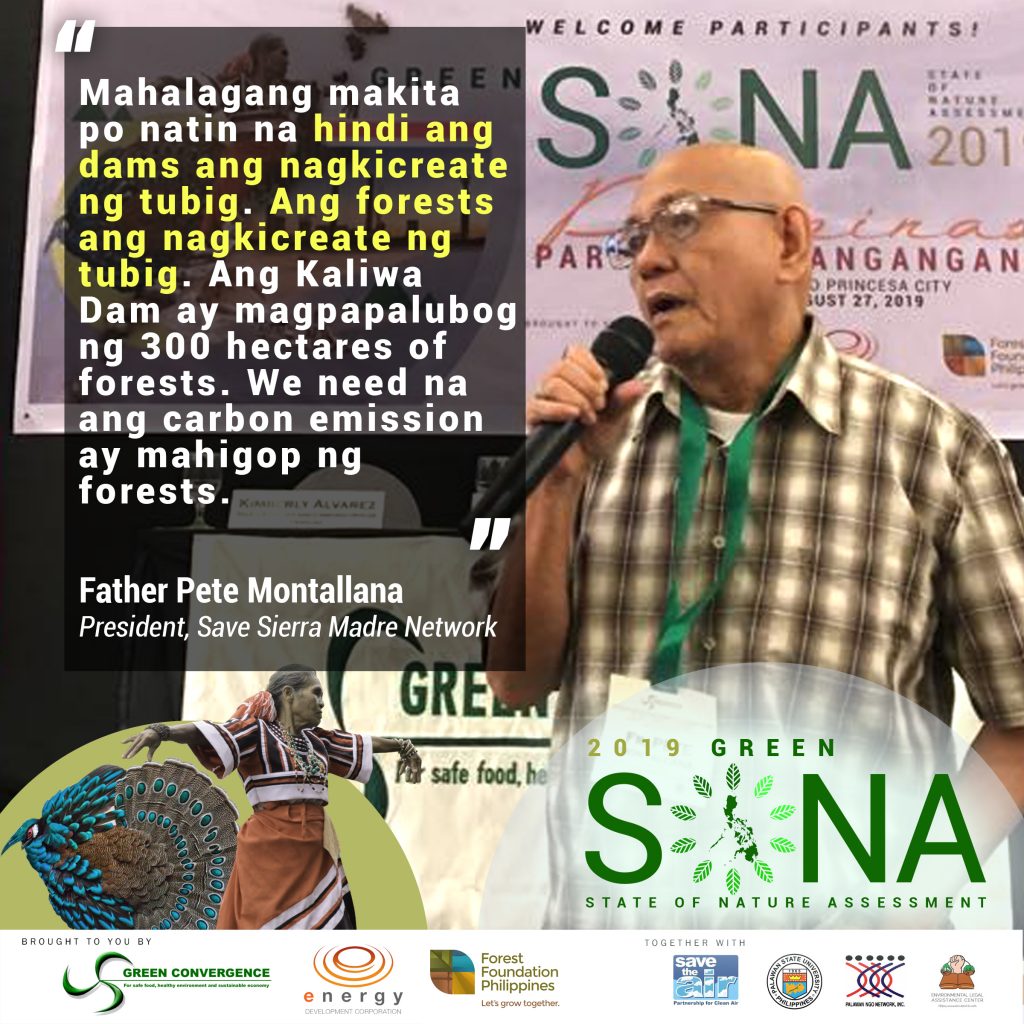
Father Pete Montallana, Executive Director of Save Sierra Madre Network, on the other hand, was the one to talk about the dangers with large dams, with focus on the controversial Kaliwa Dam to be built in the Sierra Madre Mountain Range region. He reminded the audience that, “Mahalagang makita po natin na hindi ang dams ang nagkicreate ng tubig. Ang forests ang nagkicreate ng tubig.Ang Kaliwa Dam ay magpapalubog ng 300 hectares of forests. We need na ang carbon emission ay mahigop ng forests.”
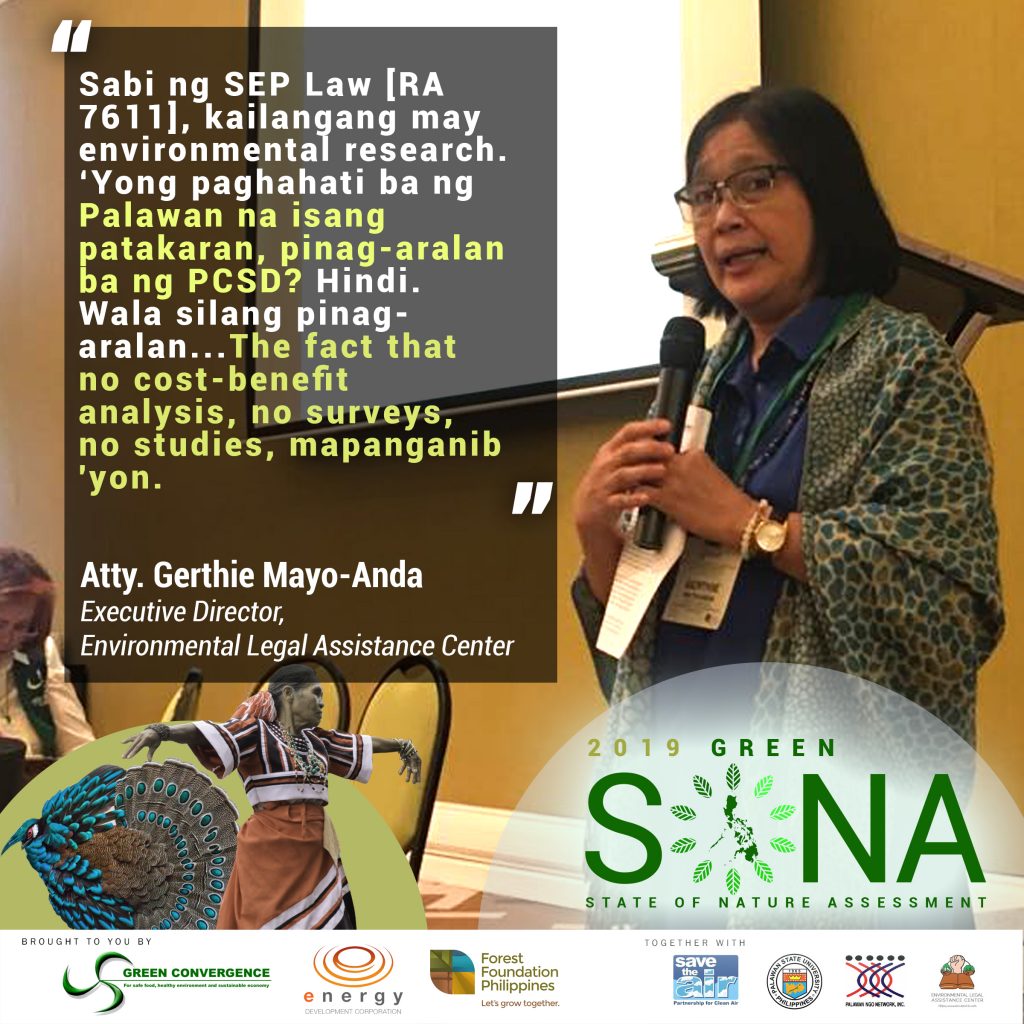
The session then moved to talk about an important local issue in Palawan that can affect the environment in a national scale. Atty. Gerthie Mayo-Anda, Executive Director of the Environmental Legal Assistance Center on the division of Palawan into three separate provinces emphasized, “Sabi ng SEP Law [Strategic Environment Plan for Palawan o RA 7611], kailangang may environmental research. ‘Yong paghahati ba ng Palawan na isang patakaran, pinag-aralan ba ng PCSD [o Palawan Council for Sustainable Development]? Hindi. Wala silang pinag-aralan…The fact that no cost-benefit analysis, no surveys, no studies, mapanganib ‘yon.” She further exclaimed that the division will turn Palawan into a lost ecological frontier.
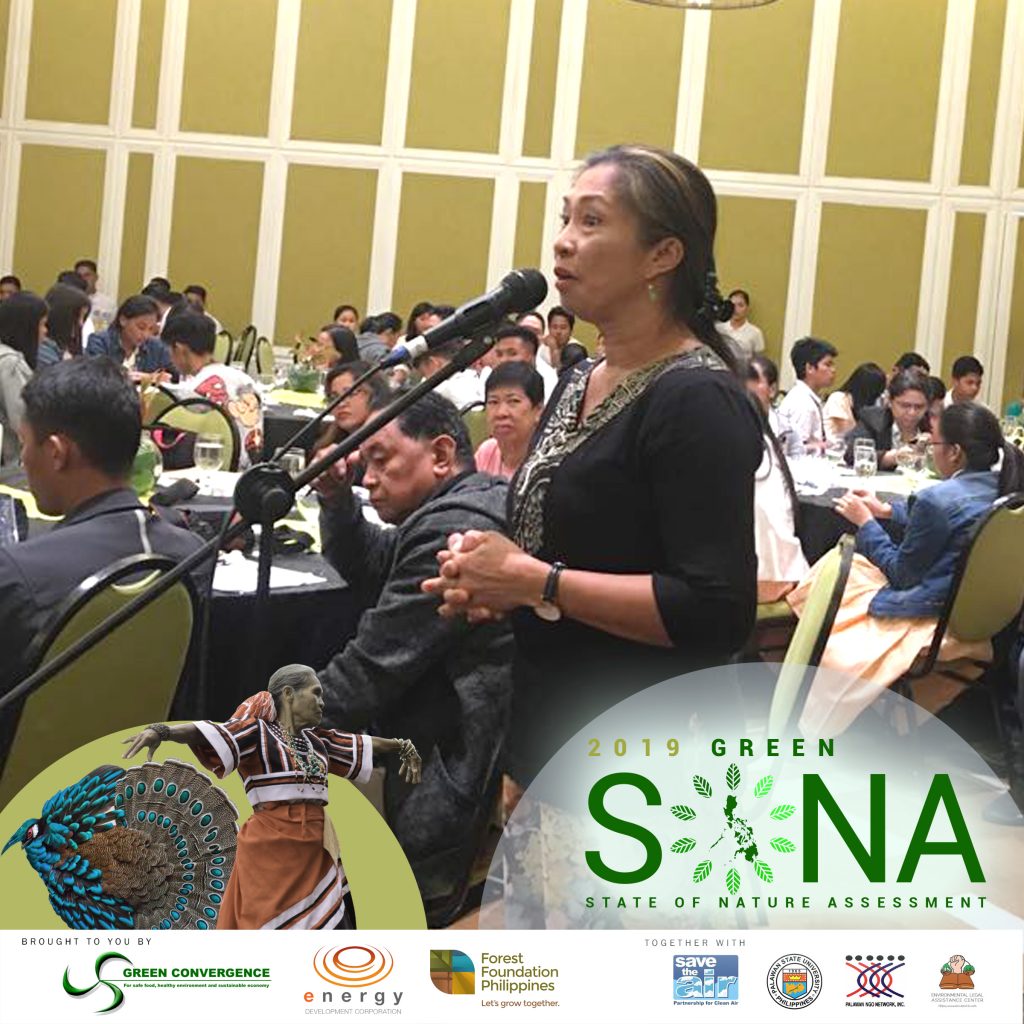
An open forum was held after the first four speakers delivered their talks.
Participants of Green SONA 2019 shout, “One Palawan!” in support of the ongoing campaign of the province’s environmental defenders to protect the nationally significant ecosystem of Palawan from greedy political ambitions of some.
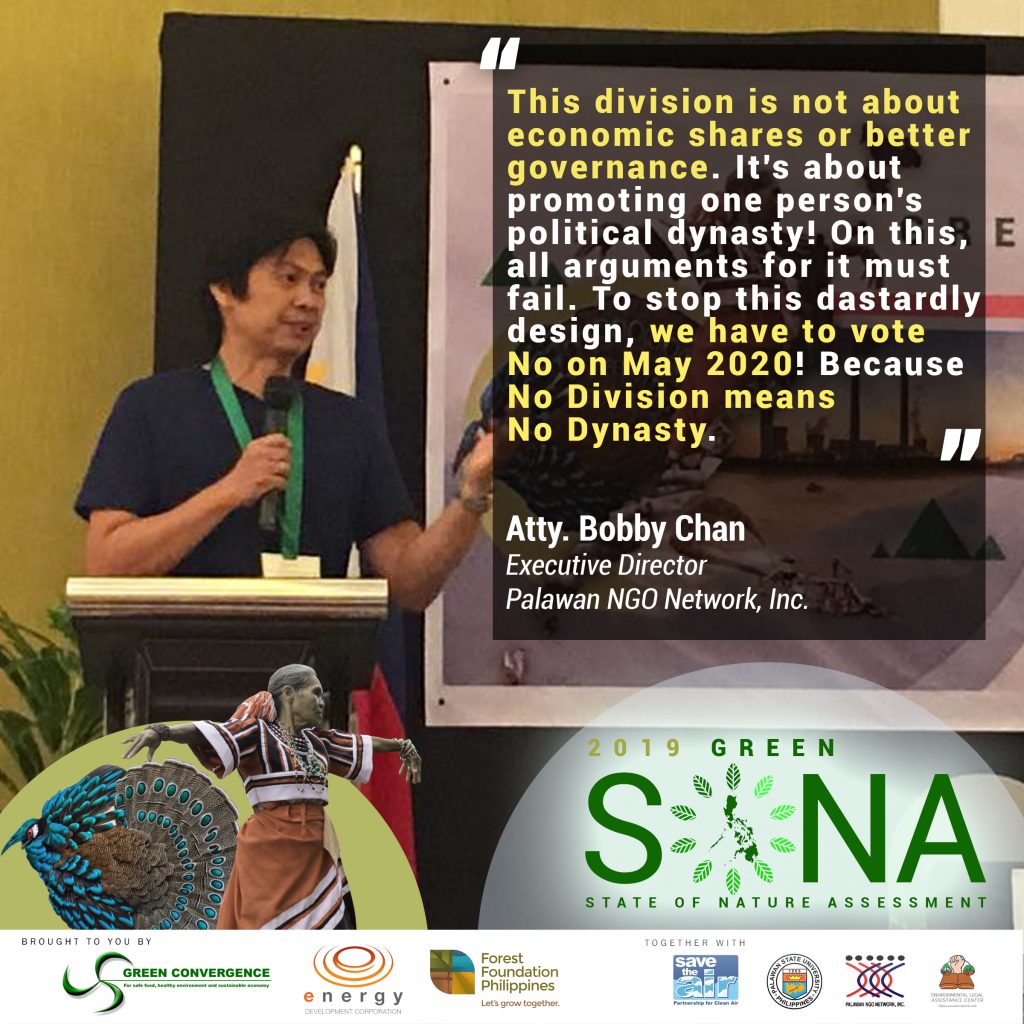
For the second part of the assessment, the environmentalists then evaluated the status of government programs related to the environment. Prominent Executive Director of PNNI, Atty. Bobby Chan was tasked to talk on the status of the enforcement of the Expanded National Green Program and Forest Laws in the Philippines. He reminded the participants that any policy will not be successful if the personal interests of a few overwhelm the interests of the public. He connected his presentation with the division of Palawan and said, “This division is not about economic shares or better governance. It’s about promoting one person’s political dynasty! On this, all arguments for it must fail. To stop this dastardly design, we have to vote no on May 2020! Because no division means no dynasty.”
Energy Development Corporation’s Assistant Vice President Miko de Vera shared the advocacy of his company to promote renewable sources for the country’s energy needs. Unfortunately, many barriers have to be overcome. He pointed out that, “The good news is, in many parts of the world, coal plants are being shut down. The bad news is, in the Philippines, we’re going for the opposite direction.”
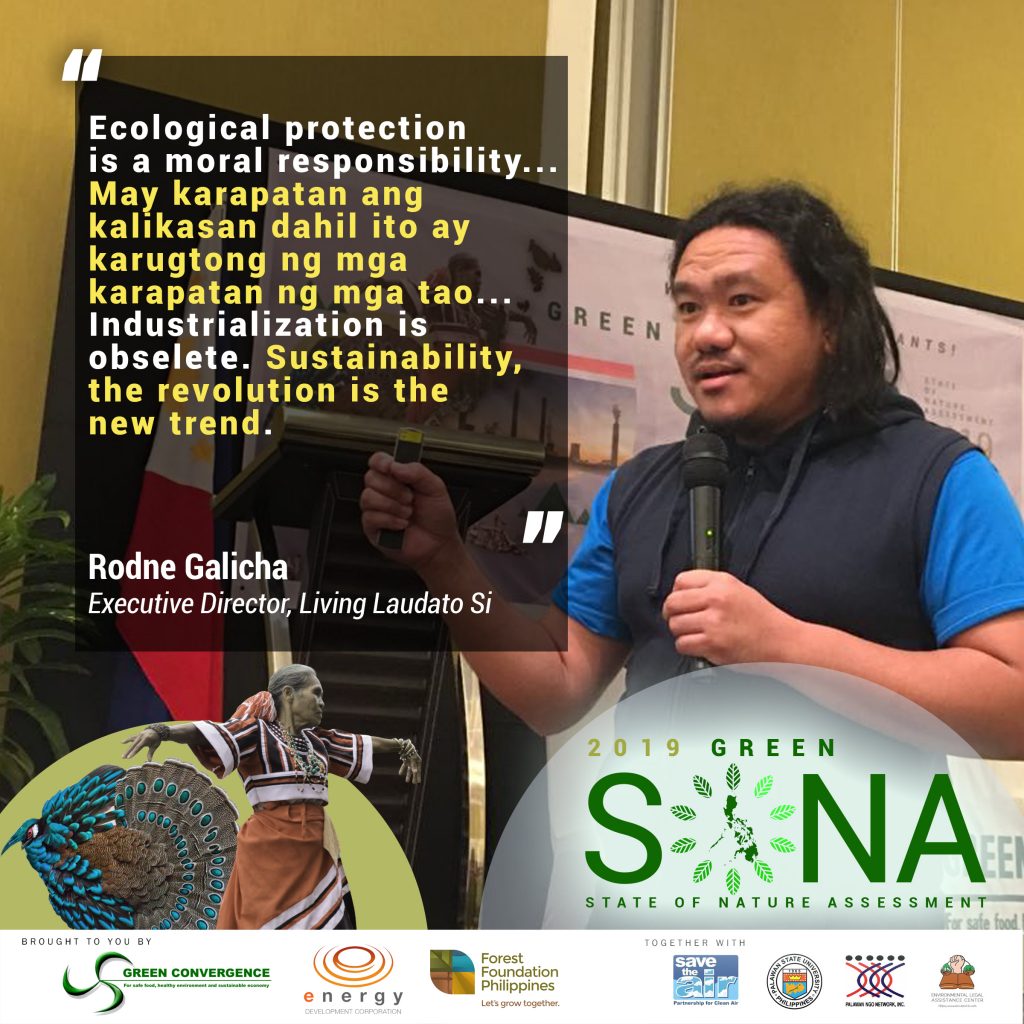
Finally, for the last report on the state of the Philippine environment, Living Laudato Si Executive Director Rodne Galicha encouraged the audience that should divest from companies and institutions that contribute to the further destruction of the environment. He noted that, “Ecological protection is a moral responsibility…May karapatan ang kalikasan dahil ito ay karugtong ng mga karapatan ng mga tao…Industrialization is obselete. Sustainability, the revolution is the new trend.”
Similar to the first part of the assessment, an open forum followed the speeches of the speakers. After this, Department of Environment and Natural Resources (DENR) MIMAROPA Regional Executive Director Henry Adornado, Ph.D. was asked to react to the reports and assessments delivered by the speakers, as well as the questions raised by the members of the audience. He assured everyone that, “In every management plan that we do, we [will] ensure that NGOs are invited.”
Upon the presentation of Imelda Sarmiento, Green Convergence Philippine Native Trees Program Head, of the Children’s Book Project featuring the Philippine native trees, Green Convergence Vice President delivered the resolutions of the annual Green SONA. It was immediately followed by a closing message by Atty. Louie Cascara, Legal Counsel of Palawan State University who spoke in behalf of the University President Ramon Docto, Ph.D
Green SONA 2019 was hosted by Victoria Segovia, a member of the Board of Trustees of Green Convergence, and Cris Ecaldre, a Faculty member at the Palawan State University. Green SONA is an annual gathering of the members of civil society organizations, the academe, the Church, the media, the indigenous communities, and other sectors to assess the state of the Philippine environment.
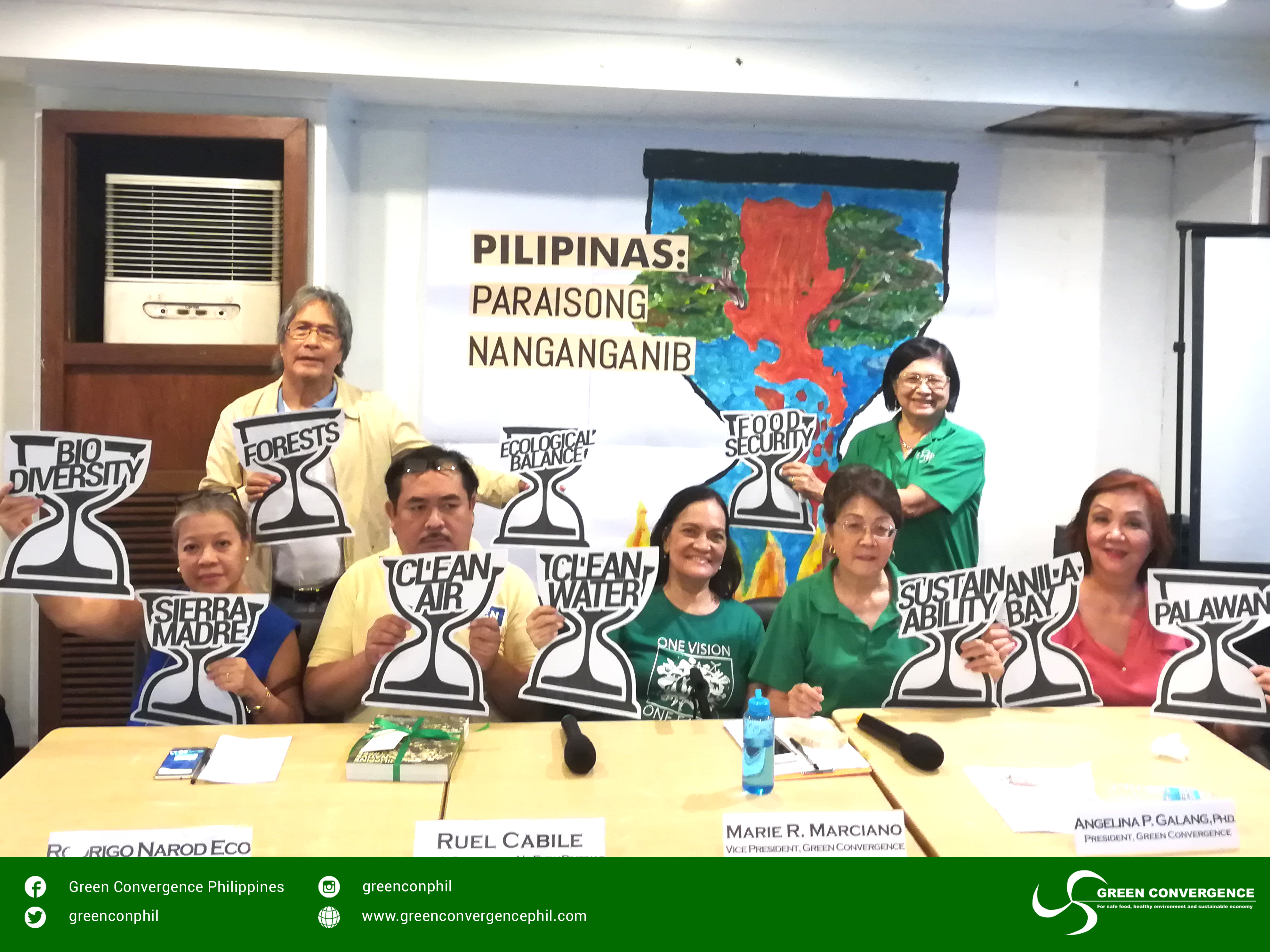
Environmental Coalition Green Convergence held the 353rd installment of the monthly Kamayan Para sa Kalikasan Forum about the pressing environmental concerns that the Philippines is facing on August 16, 2019 (Friday) at Kamayan Restaurant, EDSA, Mandaluyong City.
“There are programs of the government which Filipinos should be deciding on. But in the recent past, we are suddenly confronted with actions of China and with intrusions of the Chinese who are putting up or will be involved in mega projects in our country,” asserts Dr. Angelina Galang, President of Green Convergence.
Galang mentioned (1) the absence of a national land use policy, (2) large-scale reclamation activities especially in Manila Bay, (3) the construction of large dams especially the Kaliwa Dam, and (4) the division of Palawan into three separate provinces as actions of the government that are of urgent environmental concern.
These are also topics to be discussed in the upcoming annual State of Nature Assessment (Green SONA) with the theme “Pilipinas, Paraisong Nanganganib” to be held on August 27, 2019 at the Hue Hotel, Puerto Princesa City, Palawan, she explained.
The repercussions of large-scale reclamation to the country’s environment was further discussed by Rodrigo Narod Eco, a researcher from UP Diliman.
“There is no such as a natural disaster,” Eco asserted, “a natural phenomenon only becomes a disaster if it intersects with human activities,” implying that reclamation in Manila Bay will lead to disasters.
If reclamation activities continue in Manila Bay, “Dagdag harang sila sa tubig! ([Reclaimed lands] are added barriers to the flow of water!),” he remarked. This is especially dangerous if a 4-meter high storm surge hits the area.
Biodiversity in Manila Bay will also be negatively affected, considering that fish eggs and larvae of major fish species for food can be found in its shallow waters. Proposed land reclamation projects are exactly in these areas which could endanger the metropolis’ food security.
Eco called for rehabilitation of the Manila Bay, not reclamation for it will not only affect the marginalized communities in the area, such as the fisher folks and the urban poor, but also the entire metropolitan populace.
On the other hand, No Burn Pilipinas Regional Campaigner Ruel Cabile presented the myths of waste-to-energy through incineration and provided suggestions to achieve sustainability by properly managing municipal wastes.
A tribute to environmental champion and founder of Concerned Citizens Against Pollution (COCAP), the late Ester Perez de Tagle was also given. Perez de Tagle advocated against the Japan-Philippines Economic Partnership Agreement (JPEPA) in 2006 and for the promotion of the Euro-4 fuel in the country.
Since March 1990, Kamayan Para Sa Kalikasan Forum has become an institutionalized platform that enables NGO and government representatives, the media, students, teachers, church groups, and concerned citizens to discuss pressing environmental issues in the country. This month’s forum is organized by Green Convergence and is supported by Kamayan Restaurant EDSA with the assistance of the Forest Foundation Philippines.
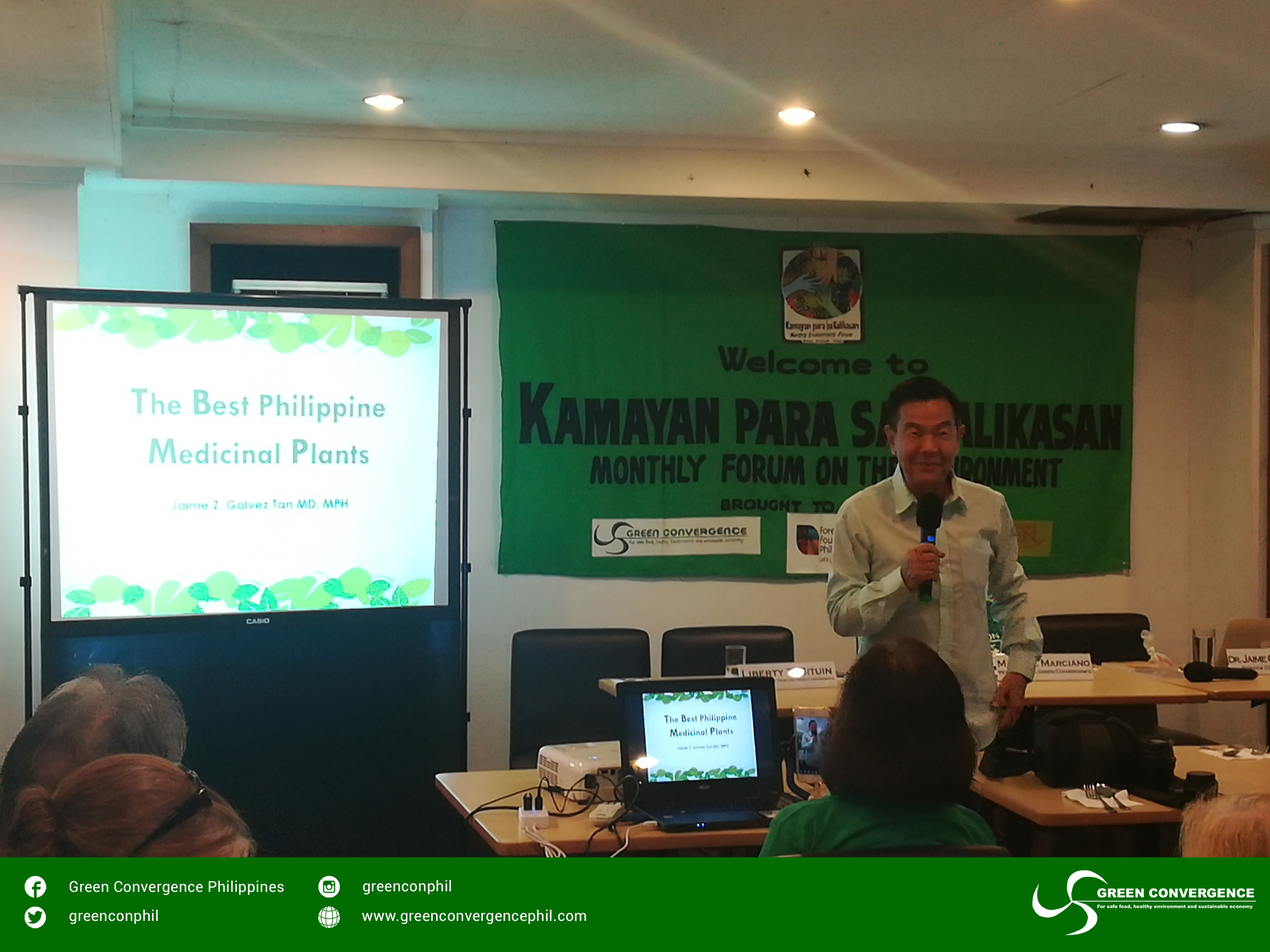
Environmental Coalition Green Convergence held the 352nd installment of the monthly Kamayan Para sa Kalikasan Forum about the future of the Philippine native medicinal plant industry on July 19, 2019 (Friday) at Kamayan Restaurant, EDSA, Mandaluyong City.
Former Department of Health Secretary Dr. Jaime Galvez Tan discussed that “Around 1500 medicinal plants from more than 13,500 plant species in the Philippines of which more than 3500 are considered indigenous.”
Unfortunately, Galvez Tan stressed, “Only 120 medicinal plants have been scientifically validated for safety and efficacy.”
“Only 10 medicinal plants have been promoted by DOH since 1993 and Philippine Institute for Traditional and Alternative Health Care since 1997,” he added.
Because of this slow promotion of the country’s medicinal plants, an estimated PhP 1.2-billion sales only were attributed to them, compared to PhP 138-billion sales of synthetic drugs. Both records were in 2013.
In fact, Dr. Francis Gomez explained, in mid-1990s to 2000s, medicinal plants had low acceptance from medical doctors due to perceptions that they are associated with ‘Quiapo herbs,’ quack, and backwardness.
“Even Philippine Medical Association stated that herbal medicines are not medicines,” Gomez exclaimed.
Gomez is the CEO and President of New Marketlink Pharmaceutical Corporation, the company behind Lagundex, made of a medicinal plant, whose success was due to persistent education campaign nationwide.
Galvez Tan noted that education campaign on Philippine medicinal plants must continue.
He presented the best medicinal plants that the country possesses: the best vegetable is malunggay (Moringa oleifera), the best spice is luyang dilaw (Curcuma longa), the best grass is takip-kuhol (Centella asiatica), the best palm is coconut (Cocos nucifera), the best stem is makabuhay (Tinospora rumphi), the best flower is ylang-ylang (Cananga adorata Lam), and the best nut is pili (Canarium ovatum Engl.).
All of which have medicinal properties that improve the health conditions of human beings, he stressed.
On the other hand, Igorot and Green Convergence Board Member Liberty Bituin argued that everything in our forests is good for our health. “From fresh air, to the fresh waters, to the stones, to the trees, and all the medicinal plants,” she enumerated, “they are all components of the indigenous ways of improving our health.”
Green Convergence President Dr. Angelina Galang called for the Philippine government to invest in the country’s natural resources and for the civil society to strengthen their campaign for this to be realized.
Since March 1990, Kamayan Para Sa Kalikasan Forum has become an institutionalized platform that enables NGO and government representatives, the media, students, teachers, church groups, and concerned citizens to discuss pressing environmental issues in the country. This month’s forum is organized by Green Convergence and is supported by Kamayan Restaurant EDSA with the assistance of the Forest Foundation Philippines.
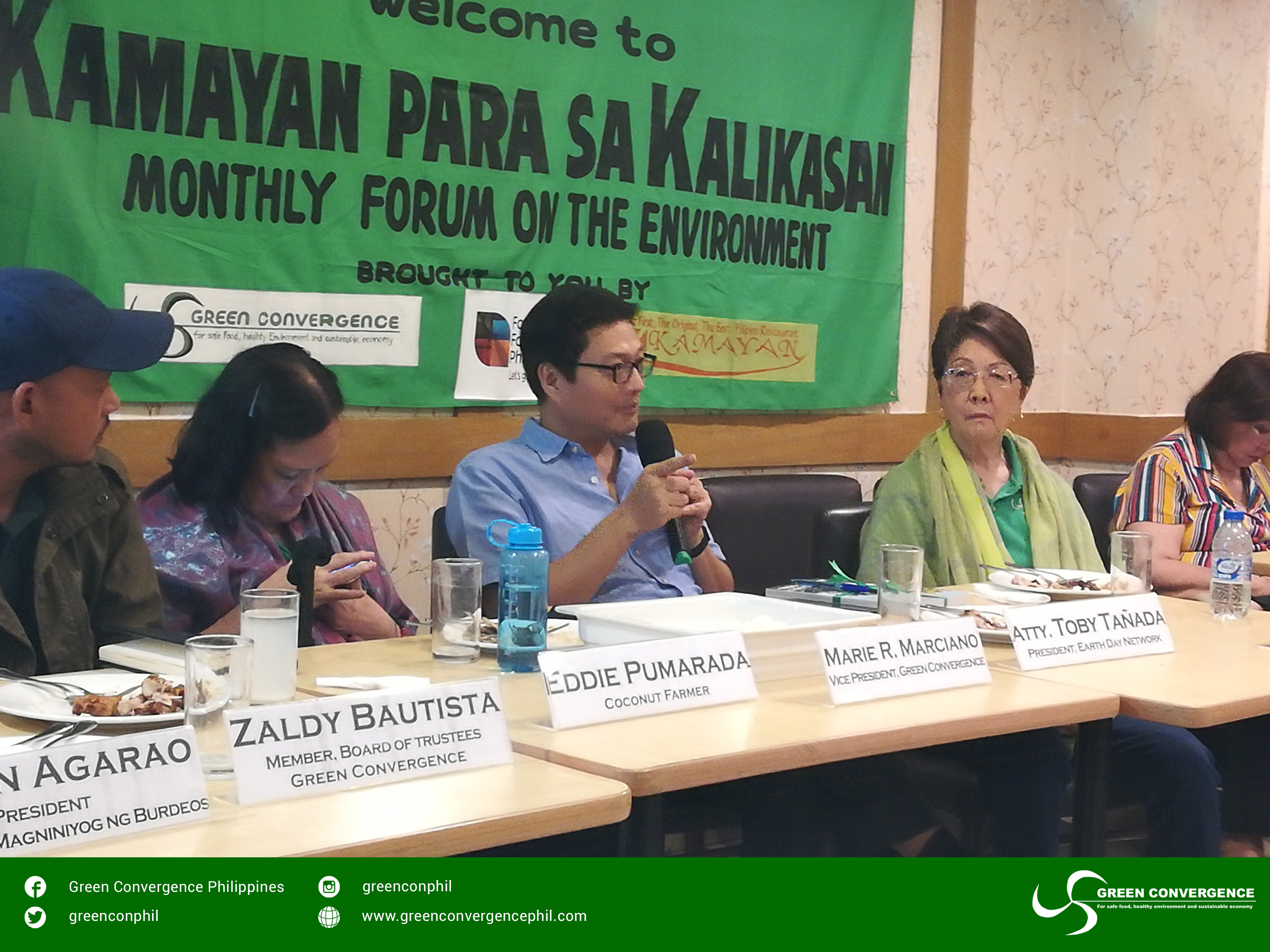
Environmental Coalition Green Convergence held the 351st installment of the monthly Kamayan Para sa Kalikasan Forum about the state of the Philippine coconut industry and alternatives to help the coconut farmers on June 21, 2019 (Friday) at Kamayan Restaurant, EDSA, Mandaluyong City.
Quezon Province’s Samahan ng Magniniyog ng Burdeos President Edison Agarao stressed, “Among the challenges being faced by the coconut farmers are the lowering of coconut product price, market inaccessibility, stiff competition versus other oil products especially palm oil, inaccessibility to technology, and lack of government support.”
The negative state is further aggravated when President Rodrigo Duterte vetoed the Coco Levy Law, one of his campaign promises when he was just running for presidency.
“The campaign for the Coco Levy Bill has gone a long way,” said Atty. Atty. Toby Tañada, President of Earth Day Network, who is one of the major advocates of the policy, “but our farmers were fooled by false promises of this administration.”
Tañada called for a new bill that will immediately address low copra prices. He also encouraged, “Buying from farmers’ cooperatives and [profit] will be used for higher value coco products.”
He also said that the Coco Levy Fund campaign must not stop, and emphasized that “Coconut farmers should not only be the beneficiaries of the coco levy fund, they should likewise be participants in the growth and development of the coconut industry.”
Green Convergence Board Member and coconut farmer himself, Zaldy Bautista introduced intercropping as a way to increase the current income of coconut farmers.
It is a multiple cropping practice that involves growing two or more crops in proximity. Due to profit-oriented agriculture, the method has lost its relevance to farmers.
“Madalas na itong ginagawa noong unang panahon ng ating mga ninuno,subalit hindi lang ito masyadong napahalagahan ng ibang mga magsasaka (This has often been done by our ancestors ever since, but this is not given importance by some farmers),” he explained.
Dr. Angelina Galang, Green Convergence President emphasized that the fight for food security is intertwined with the environmental struggle. She mentioned that achieving the ideal future for our common home is achieving the ideal future of the poor.
Since March 1990, Kamayan Para Sa Kalikasan Forum has become an institutionalized platform that enables NGO and government representatives, the media, students, teachers, church groups, and concerned citizens to discuss pressing environmental issues in the country. This month’s forum is organized by Green Convergence and is supported by Kamayan Restaurant EDSA with the assistance of the Forest Foundation Philippines.
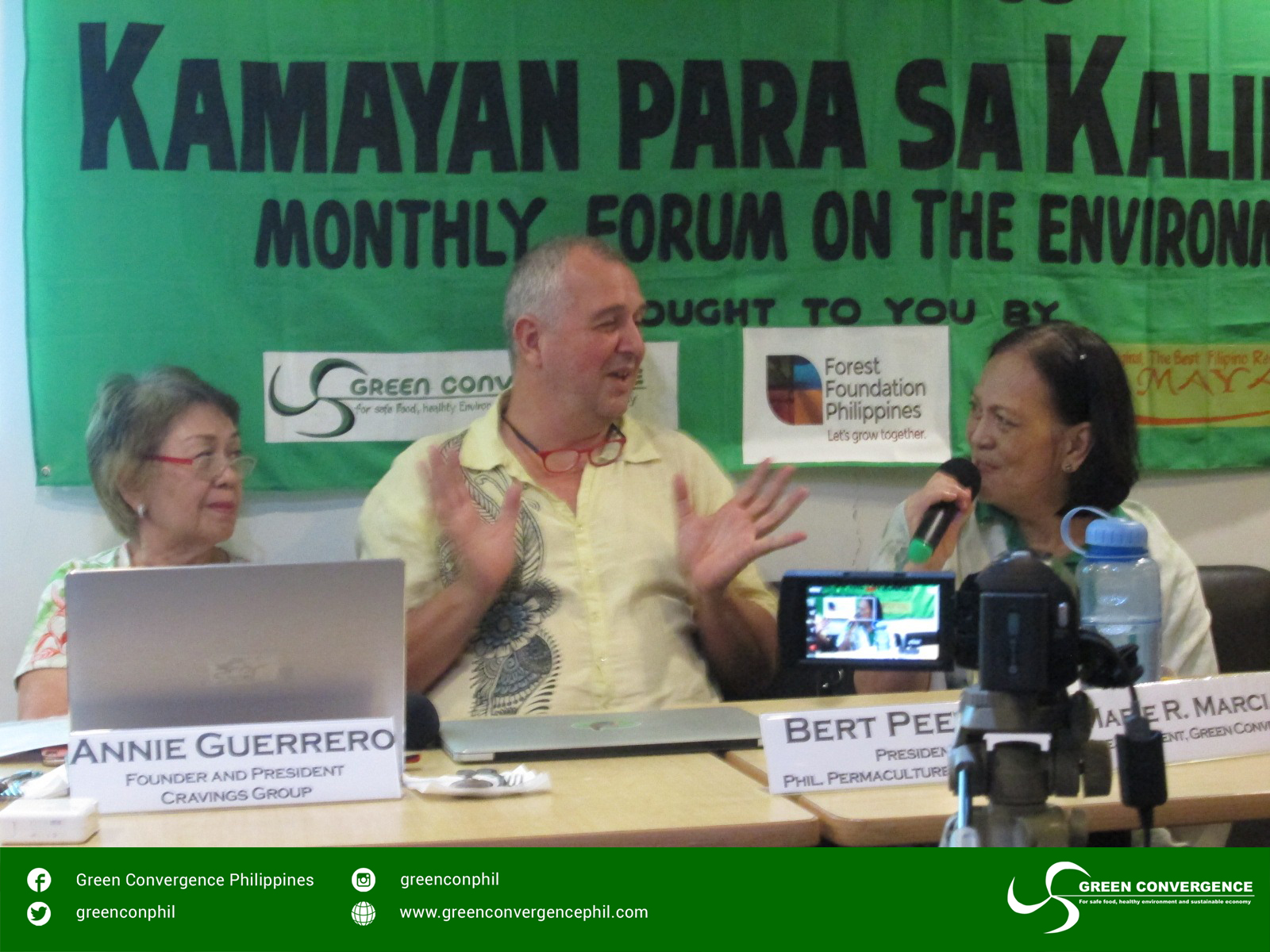
Environmental Coalition Green Convergence held the 350th installment of the monthly Kamayan Para sa Kalikasan Forum about alternatives to intensive agriculture and achieving food security on May 17, 2019 (Friday) at Kamayan Restaurant, EDSA, Mandaluyong City.
Green Convergence President Dr. Angelina Galang emphasized that “agriculture has almost permanently gone to mass farming methods.”
“While this has arguably contributed to food security,” Galang said, “it resulted in a common perception that plants used in farming and for food are for such purposes only.”
Intensive use of crops solely for mass farming led to “their fading role in maintaining the integrity of our ecology,” she further stressed.
President Bert Peeters of the Philippine Permaculture Association described this phenomenon’s impacts to people, “We are becoming individually more and more separated…our society is a growing ego-system, but a shrinking eco-system.”
To help regain the crops’ ecological role and human connection to the ecosystem, Annie Guerrero, President of Cravings Group introduced the idea of ‘green chefmanship.’ She explained, “Being green means organic, local and sustainable.”
“[It includes the] use of Bokashi technology, an anaerobic composting by fermentation, [and] a process of mixing beneficial microorganisms into kitchen wastes to create powerful yet inexpensive fertilizers,” Guerrero further described the idea.
Green chefmanship coincided with Peeters’ view that “We have to go smooth with biodiversity by connecting to the places where nature thrives…studying the energy flow…and understanding the beautiful shapes of living things.”
Peeters added, “All we need is a little wilderness.”
Since March 1990, Kamayan Para Sa Kalikasan Forum has become an institutionalized platform that enables NGO and government representatives, the media, students, teachers, church groups, and concerned citizens to discuss pressing environmental issues in the country. This month’s forum is organized by Green Convergence and is supported by Kamayan Restaurant EDSA with the assistance of the Forest Foundation Philippines.
Atty. Alex Lacson, Convener of People’s Choice Movement presents the 10 senatorial candidates who have ranked the highest in the organization’s assessment in terms of their (1) character and integrity, (2) competence and abilities, (3) faithfulness to public service and public office and (4) faithfulness to God, Constitution and the rule of law
“After Cory Aquino’s election, nagpabaya tayo, at kasalanan natin kung bakit nandito tayo ngayon (After Cory Aquino’s election, we were neglectful, and it is our fault why we are like this now),” was board member of Green Convergence Sr. Sonia Aldeguer’s assertion at the 349th session of the monthly Kamayan Para sa Kalikasan Forum on April 26, 2019 explaining how President Rodrigo Duterte came to power.
“It’s time to redeem ourselves (this election),” she further stated.
Atty. Alex Lacson, People’s Choice Movement Convenor stressed, “the 2019 Midterm Elections is the most dangerous in our history” and “Duterte may declare Martial Law or a Revolutionary Government” once he gets the validity of a majority vote from the Congress.
“If he declares Martial Law, he is still within the bounds of the Constitution, but if he declares a revolutionary government right after, he is now outside the bounds of the Constitution and nothing, no law can stop him [to do what he wants],” Lacson explained.
The shift to a federal government advocated by President Duterte himself is now being legislated in the Congress. The federalism version principally authored by former President and now House Speaker Gloria Arroyo was favored over the one drafted by Reynato Puno.
Lacson pointed out that Arroyo’s version is “anti-Filipino, anti-poor, anti-democracy, anti-life” given its features that removed provisions on anti-political dynasty and term limits of senators, congressmen and local officials, and also added ones that will allow foreigners to own or exploit the country’s resources.
For these features of the proposed Constitution to not be passed, at least 10 more members must be part of the opposition in the Senate since there are only currently three.
The People’s Choice Movement released a list of ten senatorial candidates that they assessed and have ranked the highest in terms of four categories – (1) character and integrity, (2) competence and abilities, (3) faithfulness to public service and public office and (4) faithfulness to God, Constitution and the rule of law. In order, they are:
Gary Alejano
Bam Aquino
Neri Colmenares
Chel Diokno
Samira Gutoc
Florin Hilbay
Romy Macalintal
Erin Tañada
Mar Roxas
Grace Poe
On the other hand, the Green Thumb Coalition, represented by Norie Garcia of Bantay Kita and Paeng Lopez of Health Care Without Harm, is yet to release their list of senatorial candidates that have been assessed and have ranked the highest in terms of their ‘green’ scores. As of the forum’s date, only nine candidates have completed their survey forms. They are Bam Aquino, Neri Colmenares, Leody de Guzman, Ding Generoso, Florin Hilbay, Grace Poe, Erin Tañada, Samira Gutoc and Chel Diokno.
EcoWaste Coalition, represented by National Coordinator Aileen Lucero, will also release their assessment after the Green Thumb Coalition releases theirs.
The session held at the Kamayan Restaurant, EDSA, Mandaluyong City ended with its participants initiating a campaign called #VoteIndependentSenate.
Green Convergence President Dr. Angelina Galang echoed this and reminded that the Philippines is so rich with natural resources yet they are not fully utilized for the country’s benefits due to the corruption of our politicians. “We can correct this if we elect an independent senate,” she said.
Since March 1990, Kamayan Para Sa Kalikasan Forum has become an institutionalized platform that enables NGO and government representatives, the media, students, teachers, church groups, and concerned citizens to discuss pressing environmental issues in the country. This month’s forum is organized by Green Convergence and is supported by Kamayan Restaurant EDSA with the assistance of the Forest Foundation Philippines.