Position paper on Manila Bay Beautification


POSITION PAPER ON MANILA BAY BEAUTIFICATION

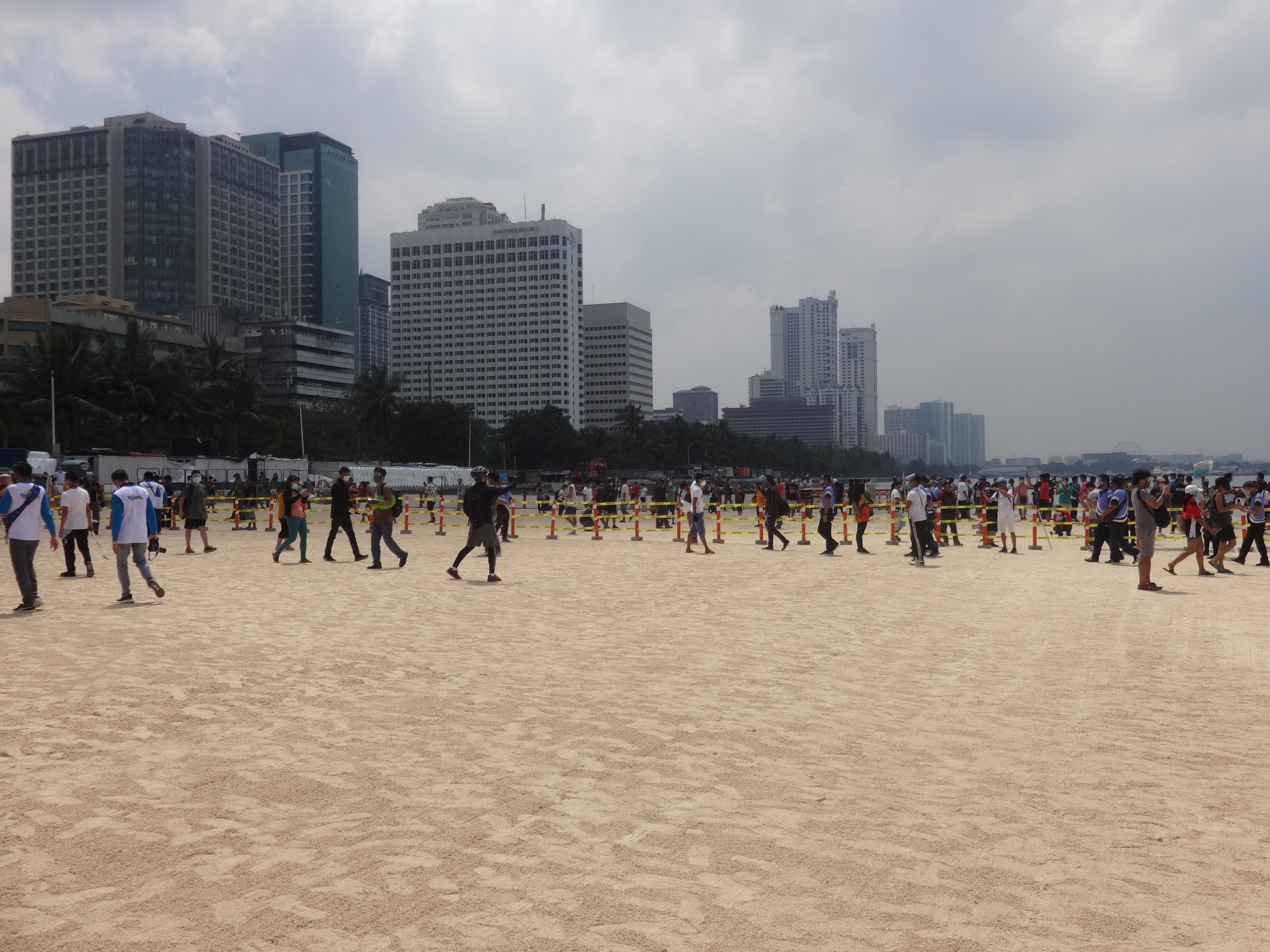
All human activities have an impact on nature to a greater or lesser extent.  Whether an activity should be undertaken depends on the balance between cost and benefit.  This is the rationale for the Environmental Impact Assessment Law (EIA). An EIA is required of any activity that is environmentally critical or in an environmentally critical area.  In the case of the Manila Bay beautification, do the benefits outweigh the environmental and economic cost? The cost includes the destruction of part of a mountain, the emission of large amounts of carbon dioxide from the fuel used to quarry, transport, pulverize and spread the dolomite. There is supposedly also a downside on health, that dolomite is harmful to our lungs.  Economically, the cost is huge; almost P400 million which makes it scandalously expensive especially when the amount could have been used for essential needs of our people.

What is/are the benefits?  Hardly any; a half-kilometer of white sand which, in fact, will be easily eroded away by the next strong typhoon.

The Supreme Court mandamus prescribed the rehabilitation of Manila Bay which meant removal of solid waste, dredging the toxic silt and ensuring that the Bay will henceforth be free of solid and liquid pollution.  The mandamus did not call for the Bay’s artificial beautification, if it can even be called beautification.

Beaches are formed from the interaction of land and water.  Sand is deposited on the coastal area either delivered by rivers or from some sources nearby.  White sand is formed from the fine particles of coral which come from a coral reef nearby and deposited on a particular stretch by the wind and waves.  A beaches formed by the dumping of material from just anywhere is not sustainable.

Had EIA been properly done, the dolomite should have remained in Cebu where it belongs.


Access the Position Paper here:
Postion Paper on Manila Bay Beautification

Anti-Terror law met with criticism at environmental forum

The Anti-Terror law and its implications on the environment was the subject of the 361st session of the monthly Kamayan Para sa Kalikasan Forum held on July 17, 2020 through an online webinar hosted by Green Convergence.

The law was criticized by human rights lawyer Neri Colmenares, who described the definition of terrorism as “very overboard”.

“In the first place, that is a very vague law” he said, and added “I am a lawyer, but I wouldn’t understand what act is prohibited [by that law]”.

(Ako, abogado po ako ah. But I wouldn’t understand kung anong act ang pinoprohibit niyan)

Atty. Colmenares gave an example where environmental activists who interfere with destructive mining activities can fall under the definition of terrorism. “In fact, under that definition, EDSA 1, People Power, is nothing more than a terrorist act” he also added.

“[The Anti-Terror law] is an act of state terrorism” asserted Sr. Mary John Mananzan, OSB, one of the oldest activists in the Philippines.

“Since President Duterte assumed office in 2016, at least 113 environmental and land activists were already murdered which is much higher than during the previous administration” cited Sr. Mananzan from Marlon Pareja, Associate Professor of Biology from De La Salle University Dasmarinas.

Under the new law, “this overbroad definition of terrorist acts will only worsen the current abuses environment defenders face in the Philippines…authorities can still find a way to use this law against environment defenders.” She said.

“Our Mother Earth will suffer when those who care for her are terrorized and killed.” She also added.

“The environmental defenders and environmental activists are now an endangered species” said Marie Marciano, Vice-President of Green Convergence.

“With this law, we can expect that the abuses will rise” she noted.

Since March 1990, Kamayan Para Sa Kalikasan Forum, held every 3rd Friday of each month, has become an institutionalized platform that enables NGO and government representatives, the media, students, teachers, church groups, and concerned citizens to discuss pressing environmental issues in the country. The forum is organized by Green Convergence and is supported by Kamayan Restaurant EDSA with the assistance of the Forest Foundation Philippines.

“Cha-Cha” gets heavy beating at forum

“The proposed Cha-Cha is anti-Filipino in the sense that it is removing protectionist provisions enshrined in the 1987 Constitution that ensure our right to be in control of our resources.” This was the opening salvo of Bayan Muna General Counsel Atty. Cris Yambot at the 348th session of the monthly Kamayan Para sa Kalikasan Forum, which tackled the proposed Charter Change (Cha-Cha) that would shift the Philippines to a federal form of government.

“Furthermore,” Yambot added, “it grants new and formidable powers to the President, giving him executive, legislative, and judicial control over the entire government. It opens the country wider to transnational corporations, and it dilutes or deletes the social justice and human rights provisions enshrined in the 1987 Constitution.”

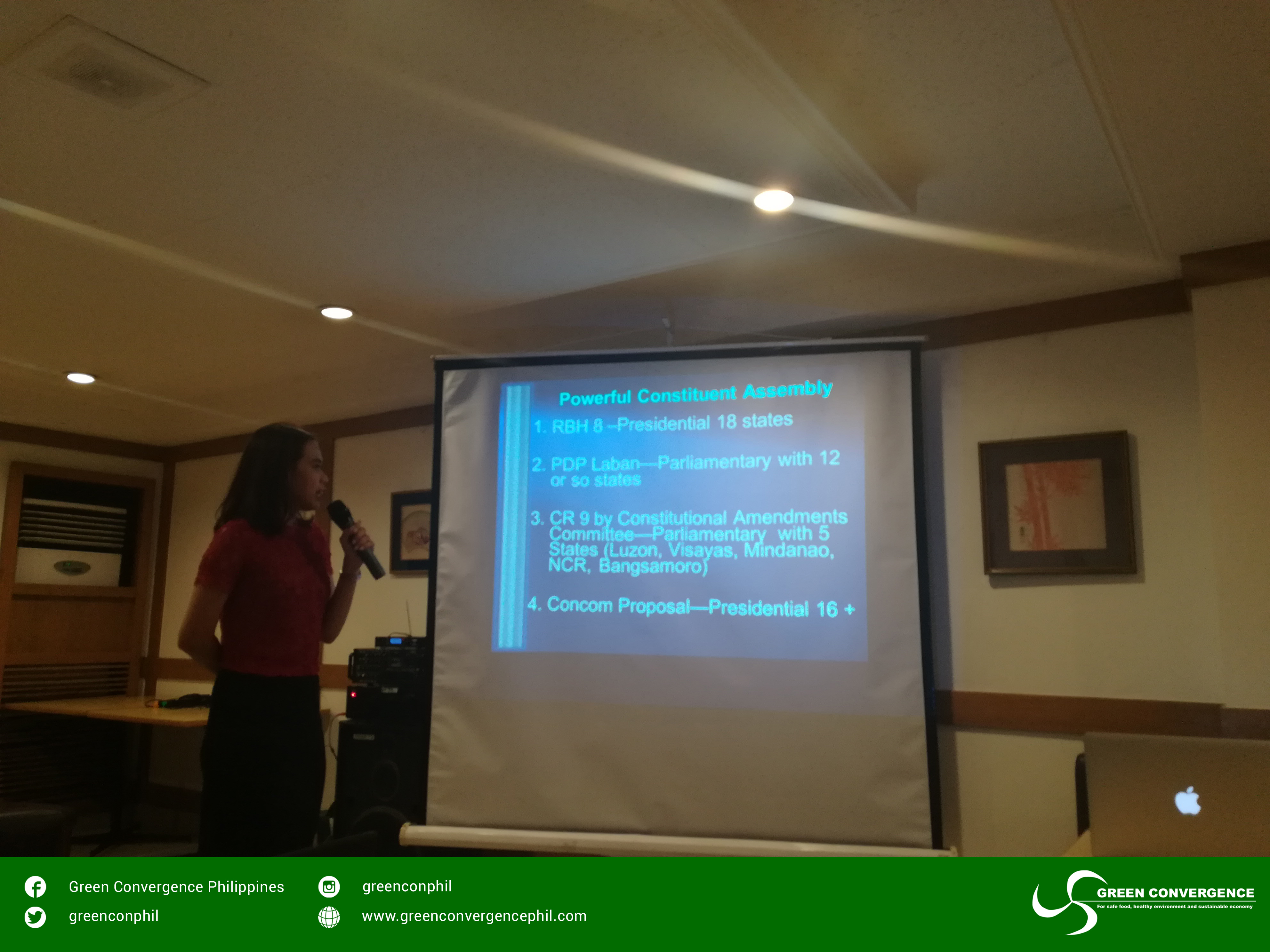
Atty. Cris Yambut, General Counsel of Bayan Muna discusses the different versions of Charter Change being proposed in the Congress. She noted that Resolution of Both Houses No. 8 or the version submitted by Former President Gloria Arroyo is the one that has been passed at the committee level. It is primarily because “they have the numbers.”

In relation to foreign ownership, Yambot emphasized that in the proposed versions, transnational corporations would in effect be allowed to own and control lands, including already scarce agricultural lands that produce our food supply, and would lift established limits on foreign ownership of mining companies.

She then pointed out specific provisions in the draft Constitution that would abridge the rights of the Filipino people and reduce or remove their protection against unfair competition from big foreign corporations.

For example, she explained, the right to freedom of expression is put in danger by changing it in the proposed charter to “freedom of ‘responsible’ expression.”

“Who is to decide what’s ‘responsible?’” Yambot asked. “Will criticizing government or attending a rally be deemed ‘irresponsible?’”

In an unusual turn of events, Yambot was the sole speaker in this month’s forum, which always strives to present different sides of an issue. Unfortunately, SAGIP Party-list Representative Rodante Marcoleta, one of the authors of the draft Cha-Cha failed to come. Although he had confirmed his attendance up to the day of the forum, he cancelled at the last minute, citing an unforeseen meeting.

Finally, Yambot warned that many of the draft provisions would impact negatively on the environment, and encouraged everyone to carefully study the draft Cha-Cha which is available at the Congress website.

In her closing remarks, Dr. Angelina Galang, President of forum organizer Green Convergence said, “Everything is connected to the environment. We should protect our environment, thus, ownership should be left to the Philippines.”

A bit of politics entered the discussion but Galang enjoined everyone to rise above personal ties, family, alliances and emotional preferences and vote as Filipinos, for the good of the country. She also encouraged citizens and environmental groups to work on influencing lawmakers to reject provisions harmful to the environment and the Filipino people.

Kamayan Para sa Kalikasan Forum has become an institutionalized platform since March 1990 that enables NGO and government representatives, the media, students, teachers, church groups, and concerned citizens to discuss pressing environmental issues in the country. This month’s forum is supported by Kamayan Restaurant EDSA with the assistance of the Forest Foundation Philippines.

You must be logged in to view this content. Free Virtual Library Registration Here

Federalism a major threat to the environment

By KIMBERLIE NGABIT-QUITASOL via Northern Dispatch Weekly

BAGUIO CITY — The Duterte administration’s push for a federal form of government is seen as among the major threats to the environment by green groups who spoke about mines, giant dams and forests at the State of Nature Assessment 2018 on August 20.

“For us charter change and federalism poses the biggest threat to environmental justice,” said Jaybee Garganera of Alyansa Tigil Mina (ATM).

Garganera spoke about how large corporate mines destroyed forests, mountains and rivers; and displaced indigenous communities, and that the present congress cannot be trusted to change the Constitution.

Garganera said this congress rejected the appointment of Gina Lopez as secretary of the Department of Environment and Natural Resources (DENR). He pointed out that many lawmakers have interests in mine corporations or were supported by mining firms during their campaign, including members of the Commission on Appointments.

“Our environmental problem is not a technical problem, not a financial problem even, it is a problem of political will,” Garganera said.

He said that the 10 months of Lopez as DENR secretary proved that environmental law can be strictly implemented if there is political will.

“These people who rejected the appointment of a DENR secretary who had the balls to implement environmental laws, this congress will change the constitution towards federalism,” he said.

Garganera further pointed out that in the draft federal constitution, environmental protection was delegated to the federated regions, which he said is problematic given the existense of political dynasties. “What do we expect when we let political dynasties decide on logging, mining and other extractives?” he said. He added that with the political record of these dynasties, the environment is in big danger.

Garganera also said that in the proposed federal constitution, a phrase ‘as provided by law’ was added to the 60-40 equity rule on foreign ownership provided under the present constitution. He said that with this phrase, congress can later enact a law that would reverse this protectionist provision.

Garganera said that under a federal government, the federated regions will scramble for resources for their states. He said the regions will now invite investors that would include mines, dams, plantations and other extractive industries.

“We join the concern on the new form of political governance being pushed today,” said Atty. Jose Andres Canivel executive director of the Forest Foundation Philippines.

Canivel talked about the state of the country’s forests and he identified the push for federalism as among the major threats to the remaining forests. He said that in the proposed federal constituion, forest management, protected areas and indigenous people concerns are also delegated to the federal regions. “For us it is a difficult situation,” he said.

Canivel cited as example Mount Apo, a protected area because it is a source of energy, home for IPs and habitat of the Philippine eagle. He said Mt. Apo spans three regions. “How will they manage it?” he said. “We asked this question to the members of the constitutional commission and to DILG as well and they told us to offer a suggestion instead,” he added.

Canivel said the proponents of federalism should have thought of this before pushing for a change in the form of government.

Canivel said that their successful forest restoration and protection projects are in IP ancestral lands. “In our experience IPs are doing a better job at forest management,” he said.

Based on the mapping of the Philippine Association for Inter-Cultural Development (PAFID), the remaining forests in the country are within IP ancestral domains, which are also the same areas where mining operations and applications are. PAFID has mapped out the agricultural areas, protected areas, mining operations and applications, remaining forests, IP ancestral domains and important bird areas in the country. Interestingly, the maps showed that mining operations and applications overlap with protected areas, IP ancestral domains and remaining forest areas. # nordis.net

Forum warns vs foreign resource ownership

August 04, 2018 at 10:00 pm by Rex Arcadio R. San Diego II via Manila Standard

Filipinos should be more careful and cautious concerning environmental conservation contained in the proposed Federalism constitution.

Participants in the recent Kamayan para sa Kalikasan Forum at the Kamayan Edsa came to this conclusion after a discussion on how the proposed Federal government affect the Philippines’ natural resources.

As lawyer Galahad Pe-Benito of Green Research noted that the Writ of Kalikasan is reinforced in the Federalism Constitution, the audience agreed that it would be to benefit of society to be wary of the “Trojan horses embedded in the proposed shift.”

“Under the proposed Federalism constitution, Congress has absolute power to change any law—particularly those concerning the environment—they wish. In effect, this proposed charter change is a war against the environment,” cautioned Leon Dulce of Kalikasan People’s Network.

Dulce noted that under Article XII on National Economy and Patrimony of the proposed Federal Constitution, foreigners are given opportunities to own properties in the Philippines 100 percent, a big difference from the 60/40 setup allowed under the 1987 Constitution.

“Even coastal areas are now open for foreign, private ownership. And 100 percent foreign ownership is detrimental to society” Dulce warned.

According to Dulce, most public lands—including timberlands, mineral lands, reclaimed lands, national parks and even mangroves—are open targets for reclassification to allow private ownership, which makes critical ecosystems “vulnerable” to exploitation.

Leasing of lands also exposes resources to overuse and overcapacity as businesses prioritize profits over resource conservation.

Citing the case of Boracay, Dulce also raised concerns about proper and independent monitoring.

“Instead of deploying hundreds of scientists, researchers and environmental experts to monitor developments in Boracay, the government sent 800 policemen. So, it is more difficult, even impossible to verify actions that are detrimental to the environment these days,” he pointed out.

Why the hurry to shift? Dr. Angelina P. Galang pointed out that modifying certain provisions in the 1987 Constitution would have the same, if not a better impact than the rushed shift.

“Perhaps there is little need to engage in a constitutional commission or charter change to address social, economic and environmental issues since the solutions are already available in the 1987 Constitution. What is lacking is proper implementation of the provisions,” explained Galang, Green Convergence convenor. “The 1987 Constitution can be improved, not necessarily changed to address environmental issues.

EXECUTIVE ORDER NO. 927

FURTHER DEFINING CERTAIN FUNCTIONS AND POWERS OF THE LAGUNA LAKE DEVELOPMENT AUTHORITYWHEREAS, the land and the waters of the Laguna Lake Region are limited natural resources requiring judicious management for their optimal utilization to insure renewability and to preserve the ecological balance;

WHEREAS, the increasing pressure of urban growth and development dictate the need for a more rational allocation of the limited land and lake resources of the region responsive to the demands of the various beneficial users thereof;

WHEREAS, the competing options for the USC of such resources and conflicting jurisdictions over such IISCS are creating undue contrasts on the constitutional capabilities of LLDA in the light of the limited powers vested in it by its charter:

WHEREAS, for LLDA to effectively perform its role, a thorough corporate reorganization aimed at: regrouping its various units for better administrative control and direction: expansion of its field offices; strengthening of its linkages with other government and private institutions: broadening of its financial base and revenue generations; and enlarging its prerogative of monitoring, licensing and enforcement, would be necessary.

NOW, THEREFORE, I FERDINAND E. MARCOS, President of the
Philippines, by virtue of the powers vested in me by the Constitution and the authority vested in me by the President Decree No. 1416, do hereby order and ordain:

Section 1. Reclassification. Is hereby classified among the industrial area development group (Class A) of corporations under Letter of Implementation No. 97 and for this purpose the Authority is hereby granted authority to modify its organization. Providing for the creation of the position of deputy general manager, upgrading the existing divisions into departments to be headed by directors and regrouping of these departments into offices coordinated by assistant general managers, and creating other offices its Board may deem necessary and appropriate to achieve its objectives and aims.
Section 2. Water Rights. Over Laguna de Bay and Other Bodies of Water within the Lake Region. To effectively regulate and monitor activities in the Laguna de Bay Region, the Authority shall have exclusive jurisdiction to issue permit for the use of all surface water for any projects or activities in or affecting the said region including navigation, construction, and operation of fishpens, fish enclosures, fish corrals and the like.

For the purpose of this Executive Order, the term “Laguna de Bay Region” shall refer to the Provinces of Rizal and Laguna; the cities of San Pablo, Pasay, Caloocan, Quezon, Manila and Tagaytay; the towns of Tanauan. Sto. Tomas and Malvar in Batangas Province, the towns of Silang and Carona in Cavite Province; the town of Lucban in Quezon Province, and the towns of Marikina, Pasig, Taguig, Muntinlupa, and Pateros in Metro Manila.

SECTION 3. Collection of Fees. The Authority is hereby empowered to collect fees for the use of the lake waters and its tributaries for all beneficial purposes including but not limited to fishery, recreation, municipal, industrial, agricultural navigation, irrigation, and waste disposal purpose: Provided, that the rates of the fees to be collected, and the sharing with other government agencies and political subdivisions, if necessary, shall be subject to the approval of the President of the Philippines upon recommendation of the Authority’s Board except fishpen fee which will be shared in the following manner: 20 percent of the fee shall go to the lakeshore local governments, 5 percent shall go to the Project Development Fund which shall be administered by a Council and the remaining 75 percent shall constitute the share of LLDA. However, after the implementation within the three-year period of the Laguna Lake Fishery Zoning and Management Plan, the sharing will modified as follows: 35 percent of the fishpen fee goes to the lakeshore local governments, 5 percent goes to the Project Development Fund and the remaining 60 percent shall be retained by LLDA: Provided, however, that the share of LLDA shall form part of its corporate funds and shall not be remitted to the “National Treasury as an exception to the provisions of Presidential Decree No. 1234.

SECTION 4. Additional Powers and Functions. The Authority shall have the following powers and functions:

a. Issue standards, rules and regulations to govern the approval of plans specification for sewage works and industrial waste disposal systems and the issuance of permits in accordance with the provisions of this Executive Order; inspect the construction and maintenance of sewage works and industrial waste disposal system for compliance to plans.

b. Adopt, prescribe, and promulgate rules and regulations governing the procedures of the Authority with the respect to hearings, plans waste disposal system, filing of reports, the issuance of permits and other rules and regulations for the proper implementation and enforcement of this executive order.
c. Issue orders or decision to compel compliance with the provisions of this Executive Order and its implementing rules and regulations only after proper notice of hearing.

d. Make, alter or modify orders requiring the discontinuance of pollution specifying the conditions and the time within which such discontinuance must be accomplished.

e. Issue, renew, or deny permits, under such conditions as it may determine to be reasonable for the prevention and abatement of pollution, for the discharge of sewage, industrial waste, or for the installation or operation of sewage works and industrial disposal system or parts thereof Provided, however.

f. After due notice and hearing, the Authority may also revoke, suspend or modify any permit issued under this Order whenever the same is necessary to prevent or abate pollution.

g. Deputize in writing or request assistance of appropriate government agencies or instrumentalities for the purpose of enforcing this Executive Order and its implementing rules and regulations and the order and decisions of the Authority

h. Authorize its representative to enter all reasonable times any property of the public dominion and private property devoted to industrial, manufacturing, processing or commercial use without doing damage, for the purpose of inspecting and investigating conditions relating to pollution or possible or imminent pollution.

i. Exercise such powers and performs such other functions as may be necessary to carry out its duties and responsibilities under this Executive Order.

SECTION 5. Board of Directors Composition. The corporate powers shall be vested in an exercised by the Board of Directors, herein after referred to as the Board which shall be composed of ten (10) members: to wit: Representative of the Office of the President: Minister of Economic Planning: Minister of Natural Resources: Minister of Trade and Industry: Representative of Laguna Province who shall be designated by the Provincial Board of Laguna; Representative of Rizal Province who shall be designated by the Provincial Board of Rizal; Representative of the Office of the Governor of the Metro Manila Commission; President of Laguna Lake Federation of Mayors. Inc.; General Manager of the Laguna Lake Development Authority to be appointed by the President of the Philippines; Representative of Private Investors, provided that incumbent representative of the private investors shall continue as members until the President appoints his successor. The Board of Directors shall elect annually from among their members, a Chairman and a Vice-Chairman. There shall be a Corporate Secretary who shall be appointed by the Board with a rank equivalent to a Department Director.
The officials next-in-rank to the above-mentioned members shall serve as permanent alternate members and shall attend meetings of the Board in the absence of their principal and receive the corresponding per diems.

SECTION 6. Capitalization and Financing. The Authority shall have an authorized capital of Seven Hundred Million Pesos (P700,000,000) of which the amount of THREE HUNDRED FIFTY ONE MILLION PESOS
(P351,000,000) shall be subscribed by the national government and THREE HUNDRED FORTY NINE MILLION PESOS (P341,000,000) shall be subscribed by the cities, provinces, municipalities, government corporations and private investors: Provided that at least twenty-five (25%) of the national government’s subscription shall be fully paid: Provided further that the authorized capital stock be Increased upon recommendation of the NEDA

The authorized capital stock of seven Hundred Million Pesos (P700,000,000) shall be divided into Seven Million (P7,000,000) shares of stock with a par value of One Hundred Pesos (P 100) per share.

The shares of stock of the Authority shall be divided into: 1) 4,900,000 common shares (voting) and 2) 2,100,000 preferred shares (non-voting) with such fished rates of 4,900,000 a minimum of 2,800,000 shares shall be subscribed by the national government and at least sixty percent (60%) of the balance shall be subscribed by the Provinces of Laguna and Rizal in such proportion as may be agreed upon by both provincial governments in accordance with their respective financial capacities. The remaining balance of the common shares shall be opened for subscription to cities, provinces, municipalities and private investors.

Of the preferred shares of stock of 2,100,000 a minimum of 770,000 shares shall be subscribed by the national government. The balance of the preferred shares shall be available for subscription to cities, provinces, municipalities, government corporations and private investors. Provided, however, that preferred shares, shall enjoy preference with respect to distribution of dividends and assets in case of dissolution.

SECTION 7. Repealing Clause. All laws, decrees, orders, proclamations, rules, regulations and issuances on parts. Thereof, which are inconsistent with any of the provisions of this Executive Order are hereby repealed or modified accordingly.

SECTION 8. Separabitv Clause. Any portion or provision of this Executive Order that may be declared unconstitutional shall not have the effect of nullifying the other provisions thereof; Provided that such remaining positions can still stand and be given effect on their entirety to accomplish the objectives of this Executive Order.

SECTION 9. Effectivity Clause. This Executive Order shall take effect immediately.

Done in the City of Manila, this 16th day of December in the Year of Our Lord, Nineteen Hundred and Eighty-Three.

(Sgd.) FERDINAND E. MARCOS
President
Republic of the Philippines

By the President:

(Sgd.) JUAN C. TUBIERA
President Executive Assistant

 

You must be logged in to view this content. Free Virtual Library Registration Here