

“Cha-Cha” gets heavy beating at forum

“The proposed Cha-Cha is anti-Filipino in the sense that it is removing protectionist provisions enshrined in the 1987 Constitution that ensure our right to be in control of our resources.” This was the opening salvo of Bayan Muna General Counsel Atty. Cris Yambot at the 348th session of the monthly Kamayan Para sa Kalikasan Forum, which tackled the proposed Charter Change (Cha-Cha) that would shift the Philippines to a federal form of government.

“Furthermore,” Yambot added, “it grants new and formidable powers to the President, giving him executive, legislative, and judicial control over the entire government. It opens the country wider to transnational corporations, and it dilutes or deletes the social justice and human rights provisions enshrined in the 1987 Constitution.”
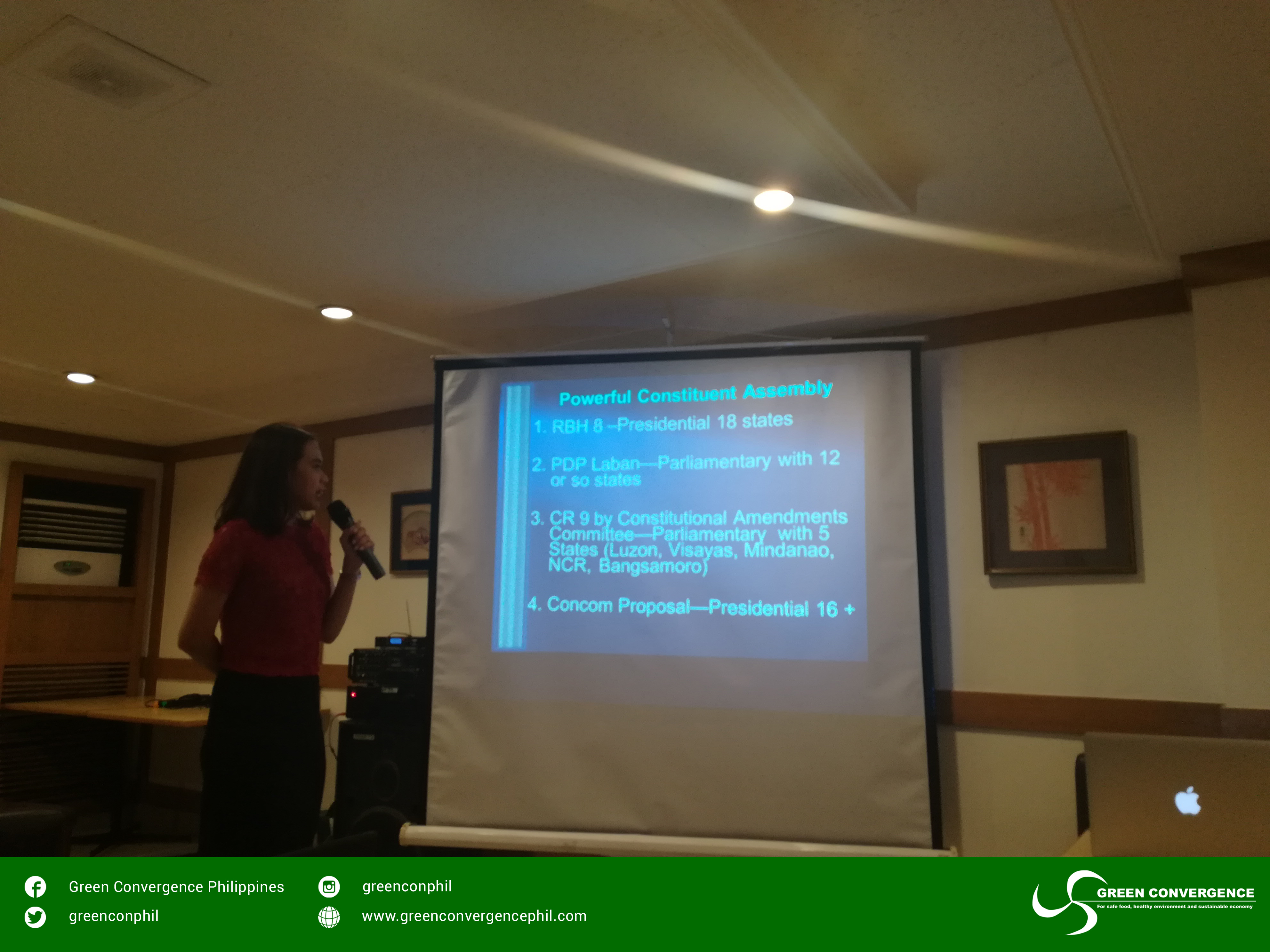
Atty. Cris Yambut, General Counsel of Bayan Muna discusses the different versions of Charter Change being proposed in the Congress. She noted that Resolution of Both Houses No. 8 or the version submitted by Former President Gloria Arroyo is the one that has been passed at the committee level. It is primarily because “they have the numbers.”

In relation to foreign ownership, Yambot emphasized that in the proposed versions, transnational corporations would in effect be allowed to own and control lands, including already scarce agricultural lands that produce our food supply, and would lift established limits on foreign ownership of mining companies.

She then pointed out specific provisions in the draft Constitution that would abridge the rights of the Filipino people and reduce or remove their protection against unfair competition from big foreign corporations.

For example, she explained, the right to freedom of expression is put in danger by changing it in the proposed charter to “freedom of ‘responsible’ expression.”

“Who is to decide what’s ‘responsible?’” Yambot asked. “Will criticizing government or attending a rally be deemed ‘irresponsible?’”

In an unusual turn of events, Yambot was the sole speaker in this month’s forum, which always strives to present different sides of an issue. Unfortunately, SAGIP Party-list Representative Rodante Marcoleta, one of the authors of the draft Cha-Cha failed to come. Although he had confirmed his attendance up to the day of the forum, he cancelled at the last minute, citing an unforeseen meeting.

Finally, Yambot warned that many of the draft provisions would impact negatively on the environment, and encouraged everyone to carefully study the draft Cha-Cha which is available at the Congress website.

In her closing remarks, Dr. Angelina Galang, President of forum organizer Green Convergence said, “Everything is connected to the environment. We should protect our environment, thus, ownership should be left to the Philippines.”

A bit of politics entered the discussion but Galang enjoined everyone to rise above personal ties, family, alliances and emotional preferences and vote as Filipinos, for the good of the country. She also encouraged citizens and environmental groups to work on influencing lawmakers to reject provisions harmful to the environment and the Filipino people.

Kamayan Para sa Kalikasan Forum has become an institutionalized platform since March 1990 that enables NGO and government representatives, the media, students, teachers, church groups, and concerned citizens to discuss pressing environmental issues in the country. This month’s forum is supported by Kamayan Restaurant EDSA with the assistance of the Forest Foundation Philippines.

You must be logged in to view this content. Free Virtual Library Registration Here

Federalism a major threat to the environment

By KIMBERLIE NGABIT-QUITASOL via Northern Dispatch Weekly

BAGUIO CITY — The Duterte administration’s push for a federal form of government is seen as among the major threats to the environment by green groups who spoke about mines, giant dams and forests at the State of Nature Assessment 2018 on August 20.

“For us charter change and federalism poses the biggest threat to environmental justice,” said Jaybee Garganera of Alyansa Tigil Mina (ATM).

Garganera spoke about how large corporate mines destroyed forests, mountains and rivers; and displaced indigenous communities, and that the present congress cannot be trusted to change the Constitution.

Garganera said this congress rejected the appointment of Gina Lopez as secretary of the Department of Environment and Natural Resources (DENR). He pointed out that many lawmakers have interests in mine corporations or were supported by mining firms during their campaign, including members of the Commission on Appointments.

“Our environmental problem is not a technical problem, not a financial problem even, it is a problem of political will,” Garganera said.

He said that the 10 months of Lopez as DENR secretary proved that environmental law can be strictly implemented if there is political will.

“These people who rejected the appointment of a DENR secretary who had the balls to implement environmental laws, this congress will change the constitution towards federalism,” he said.

Garganera further pointed out that in the draft federal constitution, environmental protection was delegated to the federated regions, which he said is problematic given the existense of political dynasties. “What do we expect when we let political dynasties decide on logging, mining and other extractives?” he said. He added that with the political record of these dynasties, the environment is in big danger.

Garganera also said that in the proposed federal constitution, a phrase ‘as provided by law’ was added to the 60-40 equity rule on foreign ownership provided under the present constitution. He said that with this phrase, congress can later enact a law that would reverse this protectionist provision.

Garganera said that under a federal government, the federated regions will scramble for resources for their states. He said the regions will now invite investors that would include mines, dams, plantations and other extractive industries.

“We join the concern on the new form of political governance being pushed today,” said Atty. Jose Andres Canivel executive director of the Forest Foundation Philippines.
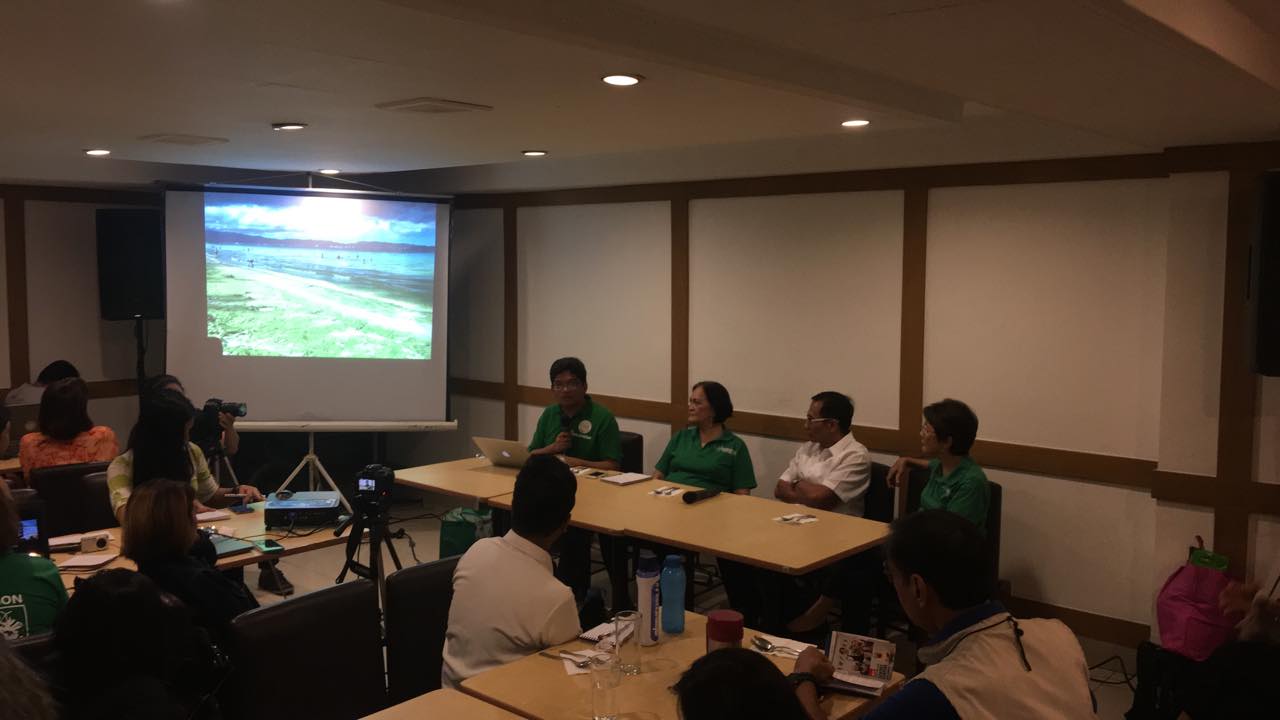
Canivel talked about the state of the country’s forests and he identified the push for federalism as among the major threats to the remaining forests. He said that in the proposed federal constituion, forest management, protected areas and indigenous people concerns are also delegated to the federal regions. “For us it is a difficult situation,” he said.

Canivel cited as example Mount Apo, a protected area because it is a source of energy, home for IPs and habitat of the Philippine eagle. He said Mt. Apo spans three regions. “How will they manage it?” he said. “We asked this question to the members of the constitutional commission and to DILG as well and they told us to offer a suggestion instead,” he added.

Canivel said the proponents of federalism should have thought of this before pushing for a change in the form of government.

Canivel said that their successful forest restoration and protection projects are in IP ancestral lands. “In our experience IPs are doing a better job at forest management,” he said.

Based on the mapping of the Philippine Association for Inter-Cultural Development (PAFID), the remaining forests in the country are within IP ancestral domains, which are also the same areas where mining operations and applications are. PAFID has mapped out the agricultural areas, protected areas, mining operations and applications, remaining forests, IP ancestral domains and important bird areas in the country. Interestingly, the maps showed that mining operations and applications overlap with protected areas, IP ancestral domains and remaining forest areas. # nordis.net

Forum warns vs foreign resource ownership

August 04, 2018 at 10:00 pm by Rex Arcadio R. San Diego II via Manila Standard

Filipinos should be more careful and cautious concerning environmental conservation contained in the proposed Federalism constitution.

Participants in the recent Kamayan para sa Kalikasan Forum at the Kamayan Edsa came to this conclusion after a discussion on how the proposed Federal government affect the Philippines’ natural resources.

As lawyer Galahad Pe-Benito of Green Research noted that the Writ of Kalikasan is reinforced in the Federalism Constitution, the audience agreed that it would be to benefit of society to be wary of the “Trojan horses embedded in the proposed shift.”

“Under the proposed Federalism constitution, Congress has absolute power to change any law—particularly those concerning the environment—they wish. In effect, this proposed charter change is a war against the environment,” cautioned Leon Dulce of Kalikasan People’s Network.

Dulce noted that under Article XII on National Economy and Patrimony of the proposed Federal Constitution, foreigners are given opportunities to own properties in the Philippines 100 percent, a big difference from the 60/40 setup allowed under the 1987 Constitution.

“Even coastal areas are now open for foreign, private ownership. And 100 percent foreign ownership is detrimental to society” Dulce warned.

According to Dulce, most public lands—including timberlands, mineral lands, reclaimed lands, national parks and even mangroves—are open targets for reclassification to allow private ownership, which makes critical ecosystems “vulnerable” to exploitation.

Leasing of lands also exposes resources to overuse and overcapacity as businesses prioritize profits over resource conservation.

Citing the case of Boracay, Dulce also raised concerns about proper and independent monitoring.

“Instead of deploying hundreds of scientists, researchers and environmental experts to monitor developments in Boracay, the government sent 800 policemen. So, it is more difficult, even impossible to verify actions that are detrimental to the environment these days,” he pointed out.

Why the hurry to shift? Dr. Angelina P. Galang pointed out that modifying certain provisions in the 1987 Constitution would have the same, if not a better impact than the rushed shift.

“Perhaps there is little need to engage in a constitutional commission or charter change to address social, economic and environmental issues since the solutions are already available in the 1987 Constitution. What is lacking is proper implementation of the provisions,” explained Galang, Green Convergence convenor. “The 1987 Constitution can be improved, not necessarily changed to address environmental issues.

Kamayan Forum scrutinizes Cha-Cha’s implications to Philippine environment

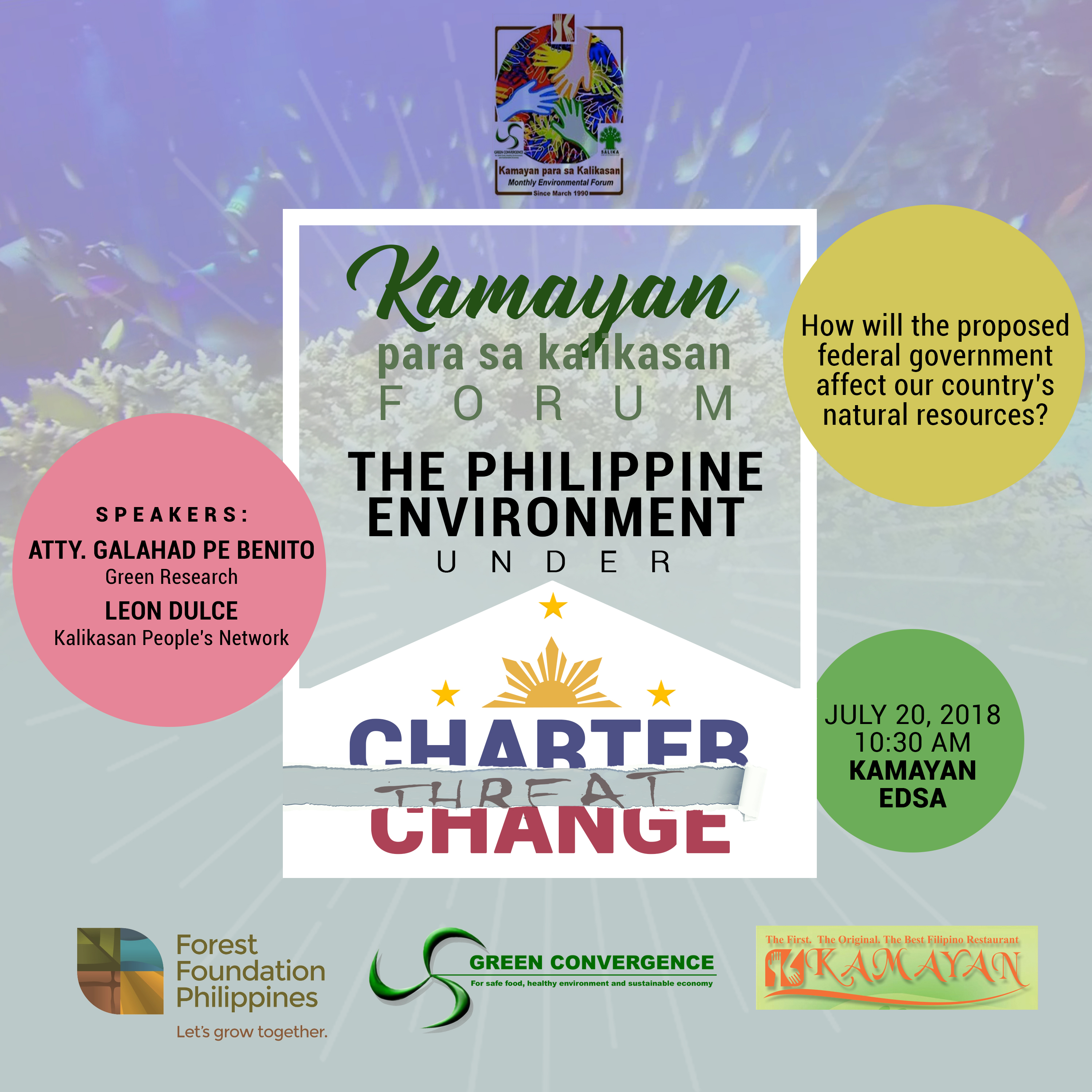
Environmental coalition Green Convergence held another installment of their monthly Kamayan Para sa Kalikasan Forum last July 20, 2018 at the Kamayan Restaurant EDSA, Mandaluyong City. The forum tackled the provisions on the environment in the proposed federal government under the Duterte administration.

Atty. Galahad Pe Benito of Greenresearch discussed the said provisions one by one and related them to the already established environmental laws that we have. Leon Dulce of Kalikasan People’s Network on the other hand, explained the direct impacts of the new provisions to the most marginalized groups connected to the environment like the small-scale miners, the farmers and the indigenous peoples.

Leon Dulce of the Kalikasan People’s Network and Atty. Galahad Pe Benito of Greenresearch discussed the implications of President Duterte’s proposed charter change to the Philippine environment

Now on its 29th year, Kamayan Para sa Kalikasan Forum has become an institutionalized platform since March 1990 that enables NGO and government representatives, the media, students, teachers, church groups, and concerned citizens to discuss pressing environmental issues in the country. This month’s forum is sponsored by Kamayan Restaurant and Forest Foundation.

You must be logged in to view this content. Free Virtual Library Registration Here