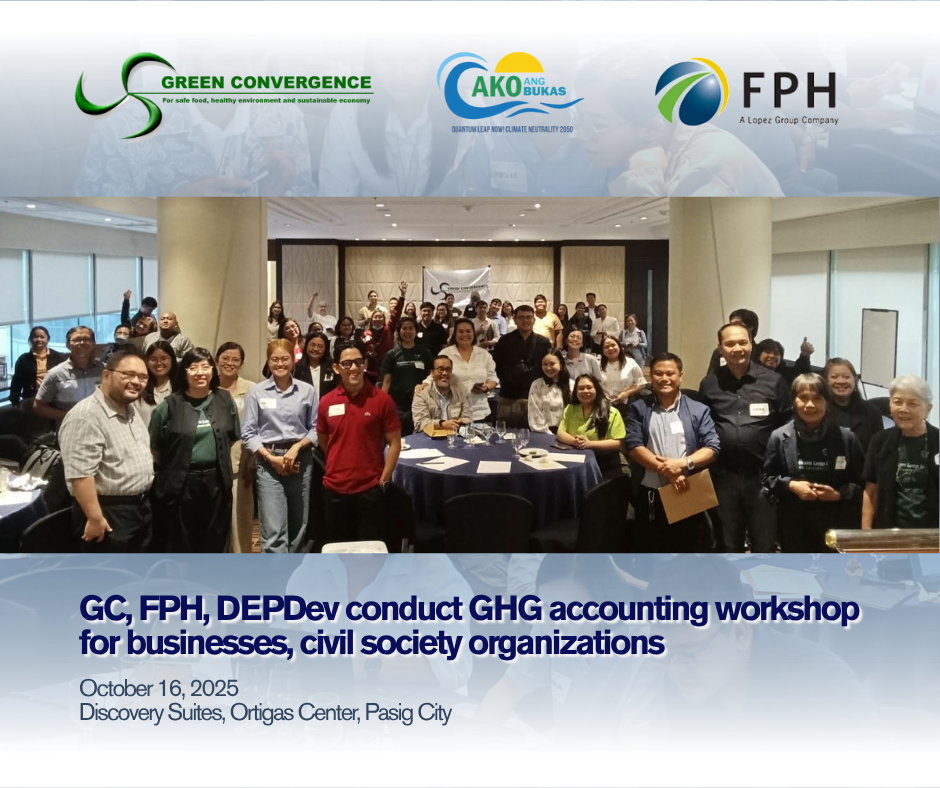
GC, FPH, DEPDev conduct GHG accounting workshop for businesses, civil society organizations

Green Convergence (GC) and First Philippine Holdings (FPH), through its Ako Ang Bukas (AAB) Advocacy Program, held a greenhouse gas (GHG) accounting workshop for businesses and civil society organizations (CSOs) on October 16, 2025, at Discovery Suites in Ortigas Center, Pasig City.

The workshop was co-organized with the environmental technical working group of the Sustainability Development Goals (SDG) Stakeholder Chamber of the Department of Economy, Planning and Development (DEPDev).

Jonas Dumdum of the environmental technical working group of DEPDev’s SDG Stakeholder Chamber echoed the sole purpose of the workshop, “you cannot report what you cannot measure, and you cannot measure if you do not identify,” linking it with how international reports still show that the Philippines is still number one in disaster risk-related issues.

Dr. Angelina Galang, Program Director of AAB and Founding Trustee of GC, kickstarted the workshop with a discussion of the ecological paradigm, anchored on the seven environmental principles: (1) Nature knows best, (2) All forms of life are important, (3) Everything is connected to everything else, (4) Everything changes, (5) Ours is a finite Earth, (6) Everything must go somewhere, and (7) Nature is beautiful and we are the stewards of God’s creation.

“We have disturbed, if not destroyed completely, the natural world. We have strayed further and further from nature to the extent that it imperils its ability to sustain our quality of life,” Dr. Galang emphasized the need to revert to nature through the principles, adding that it is the qualitative framework needed to understand the need for GHG accounting.

Agnes de Jesus, Chief Sustainability Officer of FPH and Business Task Force Head of AAB, then delved deeper into GHG accounting and its significant contribution to addressing climate change impacts.

De Jesus highlighted the Philippines’ commitment to reducing emissions under the Paris Agreement and introduced the AAB household GHG calculator web app as a practical tool to help households understand and track their carbon footprint.

She emphasized that ‘the choices we make will affect the climate,’ altogether suggesting to consume less power, consume less processed food, eat local and organic, minimize packaging, and shorten and plan travel routes through lifestyle change and tree planting.

On entity-level GHG accounting, de Jesus reviewed the boundaries and data needed to calculate for entities’ carbon footprint—scope 1 summed up as “burning fuel in your facility,” scope 2 or “buying power and steam” outside your facility, and scope 3 means “outside Scope 1 and 2”—and introduced the features of the AAB entity-level GHG calculator.

In line with the awareness of their carbon footprint through the calculator, she also introduced the mitigation hierarchy to guide decarbonization efforts—avoidance, minimization, reduction, and removing, and nature-based or man-made offsetting as last resort.

Milagros Serrana, Program Leader of AAB, led the workshop-proper on the use of the AAB household and entity-level GHG calculators. She demonstrated how to input data and how the calculator presents graphically the results which show the users’ hotspots.

Several participants were then able to share their results and reflections from the GHG calculation workshop.

Virgen Milagrosa University Foundation used their own data to try out the AAB entity-level GHG calculator and said that it was helpful for them to formulate action points for their university.

Airspeed International Corporation shared that knowing their emission hotspots through the calculator helped them validate their roadmap to promote and advocate sustainable framework up to year 2030.

DEPDev shared that the calculator was interactive and user-friendly.

Ako Ang Bukas (or “I am the future”) is a movement with a central campaign, “Quantum Leap NOW: Climate Neutrality 2050.” It seeks to involve all sectors and levels of society nationwide in taking urgent, concerted action to address the climate crisis facing the country and the world.

Be part of a bigger change by signing the pledge and joining the AAB program through this link: bit.ly/AKOANGBUKAS. Moreover, calculate your carbon footprint using the AAB household GHG calculator through this link: aab-household-ghg.web.app.
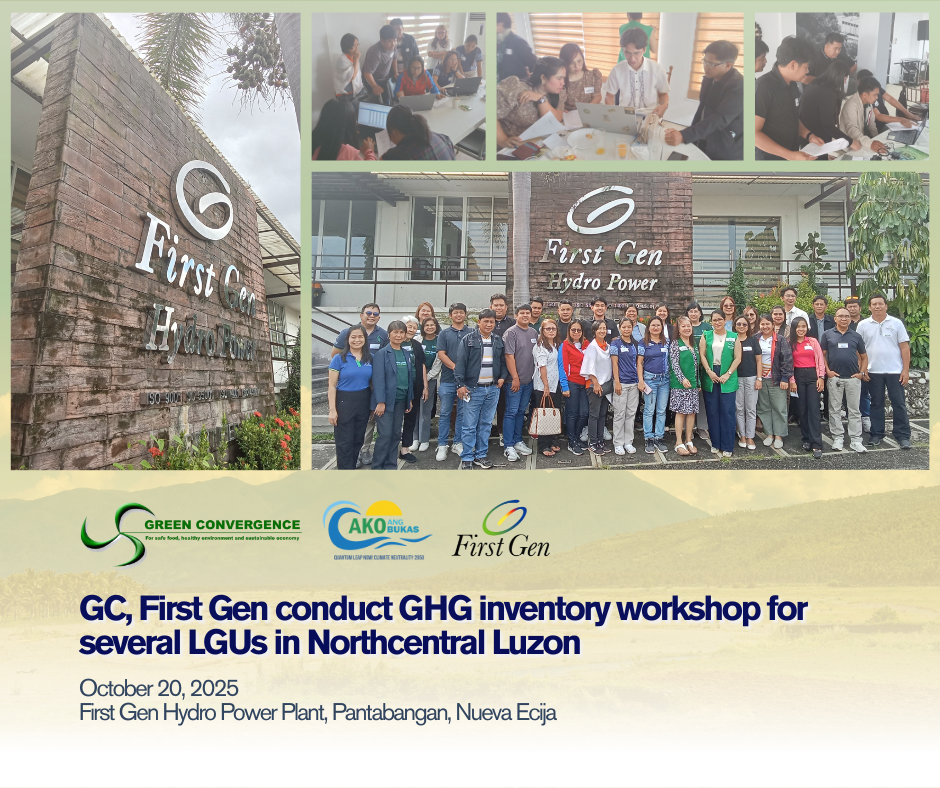
GC, First Gen conduct GHG inventory workshop for several LGUs in Northcentral Luzon

Green Convergence (GC), in partnership with First Gen’s Corporate Social Responsibility Group and through the Ako Ang Bukas (AAB) Advocacy Program, held a greenhouse gas (GHG) inventory workshop on October 20, 2025, at the First Gen Hydro Power Plant in Pantabangan, Nueva Ecija.

The workshop was held for the development of several local government units’ (LGUs) community-level GHG inventory in line with the enhanced Local Climate Change Action Plan (LCCAP) promotions and updating.

Participating LGUs were from Pantabangan and Carranglan of Nueva Ecija, Maria Aurora of Aurora, Alfonso Castaneda and Dupax del Sur of Nueva Vizcaya, and the province of Quirino.

Kickstarting the session, Agnes de Jesus, Chief Sustainability Officer of First Philippine Holdings, provided a situationer on climate change and the Philippines’ commitment to reducing GHG emissions under the Paris Agreement.

She outlined the GHG inventory journey for LGUs—learning the features of a GHG calculator and the practice of identifying GHG sources through the AAB household GHG calculator, applying these onto various entities’ value chains through the AAB entity-level GHG calculator, and using these fundamentals in transitioning to the entity and community-level calculators of the Climate Change Commission (CCC) which has extended parameters.

In line with preparing for the enhanced LCCAP, de Jesus explained that a GHG calculator is beneficial as it will serve as basis for climate action, given that it can identify the GHG hotspots that need intervention, and aid organizations in preparing for the future government requirement on GHG inventory and coming up with accurate data for green fund applications.

She then delved deeper into measuring an entity’s carbon footprint using the AAB calculator—covering scope 1, scope 2, and scope 3 emissions, coined as “buy,” “buy,” and “outside” as key words respectively.

De Jesus also emphasized cutting emissions through the mitigation hierarchy: avoid, minimize, reduce, and remove, with natural or manmade offsetting as the last resort.

As an example on how the AAB entity-level GHG calculator was used by an LGU, she shared the study done by AAB in Barangay Cogon, Ormoc, Leyte.

Also sharing their experience in GHG inventory, Rogelio Abalus Jr., Municipal Planning and Development Coordinator of Nagtipunan, Quirino, gave an overview of their municipality’s 2023 to 2028 enhanced LCCAP.

Nagtipunan’s planning framework consists of modules on stakeholder participation, vulnerability and risk assessment, GHG inventory using the CCC calculator, review of goals and setting of objectives, assessment of options and implementation, and monitoring and evaluation leading to adjustment and modification.

Abalus Jr. detailed the Climate Information and Situation Analysis of Nagtipunan from years 2036 to 2065 and anchored their Climate Change and Vulnerability Assessment on this, alongside efforts on GHG inventory, which involved planning, collecting of data, developing of a GHG inventory management plan, setting GHG emissions reduction targets, and tracking.

Upon implementation, following their 2022 baseline emission totaling 849,785.58 tons of carbon dioxide (from stationary and mobile combustion, purchased electricity, crops and livestock, solid waste, wastewater, and forestry and land use), they have removed 866,914.19 tons of carbon dioxide through carbon sequestration, recording a net emission of 17,128.61 tons of carbon dioxide.

Based on these data, the municipality’s planning team was able to identify technical findings, implications, objectives, potential options, and corresponding Programs, Projects, and Activities (PPAs) for their five priority sectors—social, infrastructure, institution and governance, economic, and environment.

They were also able to identify two decision areas for mitigation and adaptation actions: landslides and flooding.

Abalus Jr. said identifying these is needed for them to address identified local climate risks and enhance resilience and adaptive capacity, and in the future undergo monitoring and evaluation through reporting.

Subsequently, the workshop-proper on the AAB entity-level GHG calculator was then led by Milagros Serrana, AAB Program Leader, with an accompanying dummy data of an LGU for participating LGUs’ practice. After the workshop was a sharing of the LGUs’ ways forward, applying learnings from the session.

Ako Ang Bukas (or “I am the future”) is a movement with a central campaign, “Quantum Leap NOW: Climate Neutrality 2050.” It seeks to involve all sectors and levels of society nationwide in taking urgent, concerted action to address the climate crisis facing the country and the world.

Be part of a bigger change by signing the pledge and joining the AAB program through this link: bit.ly/AKOANGBUKAS. Moreover, calculate your carbon footprint using the AAB household GHG calculator through this link: aab-household-ghg.web.app.


Climate change, carbon footprint calculation seminar-workshop concludes, ecological literacy highlighted

Green Convergence (GC), through its Ako Ang Bukas (AAB) Advocacy Program, concluded the seminar-workshop on greenhouse gas (GHG) themed “Climate Change and Your Carbon Footprint” on September 29, at the National Museum of Fine Arts in Manila. The first session was held last July 21, 2025.

Opening the session, Senior Museum Researcher of the National Museum of the Philippines (NMP) Zoology Division Rolly C. Urriza acknowledged that the partnership for the seminar-workshop, as well as the collaboration with the participants from different sectors, is a step towards awareness in order to create informed decisions for the environment.

With the seminar-workshop being an extension of the Katumbalikwasan exhibition, National Coordinator of Aksyon Klima Pilipinas (AKP), John Leo Algo, explained the meaning behind the term “katumbalikwasan,” which was coined to redefine resilience in the Filipino context, emphasizing the interconnectedness of climate, nature, and people.

The exhibition was launched last April 28, 2025, and can be viewed at the National Museum of Natural History.

Moreover, as one of the sponsors of the seminar-workshop, Philippine Business for Social Progress (PBSP) Program Officer Hanna Relanes also reiterated in her remarks the importance of exploring green solutions and other decarbonization efforts not only to manage risk, but also reduce costs.

As one of the sponsors as well, Philippine Network of Educators on Environment (PNEE) President and GC Trustee Dr. Cecilia Navasero-Gascon talked about ecological literacy by applying Bloom’s Taxonomy to understand climate change and reduce carbon footprint.

Deriving from David Orr’s definition, ecological literacy is ‘not just about understanding the environment but about acting on that understanding; knowing how the world works, then using the knowledge to make choices that preserve its well-being.’

Navasero-Gascon shared that, though there is awareness on environmental issues, the Philippines still has a gap in terms of integrating climate change in the education systems, hence the difficulty in making and implementing informed decisions.

According to her, Bloom’s Taxonomy can be a framework to promote ecological literacy, designed to move learners from just mere knowledge to actual action—from remembering, understanding, applying, analysing, evaluating, all the way to creating.

“Climate change is no longer a distant threat, it is a present reality that touches every part of our lives—from the food we eat and the air we breathe, to the security of our communities and the future of our children,” Navasero-Gascon expressed.

Within the scope of the ecology, AAB Program Director and GC Trustee Dr. Angelina Galang kickstarted the session proper with a discussion of the seven environmental principles and their fundamental link to GHG accounting.

She stressed that humanity’s growing disconnect from nature has influenced today’s crises—from biodiversity loss to waste mismanagement and deforestation.

Tracing human cultural evolution from hunting and gathering all the way to globalization, she warned that rapid human-driven changes are worsening climate change, urging people to rethink their impact and question whether a sustainable balance with nature is still possible.

First Philippine Holdings (FPH) Chief Sustainability Officer Agnes de Jesus then discussed climate change in-depth—its impacts and how GHG accounting can help mitigate these.

De Jesus highlighted the Philippines’ commitment to reducing emissions under the Paris Agreement and introduced the AAB calculators as practical tools to help households and organizations understand and track their carbon footprint, mentioning also the pending requirement for enterprises to report on their carbon emissions in a few years time.

She also discussed GHG emission boundaries, the mitigation hierarchy and strategies, and natural and manmade carbon offsetting as key steps toward meeting the 2030 and 2050 climate goals—linked to offsetting is her discussion on how carbon dioxide is absorbed by trees.

Furthermore, de Jesus debunked climate myths such as climate change being nature’s process and not manmade, a few degrees of temperature not being a big deal, climate action solely being the government’s duty and not every individual’s, and climate solutions being expensive which disregard cheaper clean options.

These myths are then said to result in maladaptation of climate actions, harming the environment and impacting climate change more than resolving the issues.

Discussing the roles of the museums in addressing climate change, NMP Zoology Division Senior Museum Researcher Merlyn F. Geromiano shared their commitment to education and raising public awareness through learning sessions, community engagement and safe spaces, research and knowledge creation, sustainable practices and leadership and policy advocacy and global partnerships through multistakeholder collaborations, preservation of heritage and biodiversity at risk, and ultimately, inspiring action and change.

Linking these, Geromiano reiterated the importance of the use of a carbon footprint calculator to raise awareness about climate change, hence the partnership with AKP and GC through the AAB advocacy program for the Katumbalikwasan exhibition.

Lastly, AAB Program Leader Milagros Serrana led the workshop on the AAB entity and household-level GHG calculators. She walked through the household calculator web app, then the excel-based entity-level calculator.

With the use of prepared dummy data for schools and a manufacturing company, she demonstrated how to input data and how the calculator presents graphically the results which show the users’ hotspots. Participants, mostly from the academe and businesses, were able to collaborate on the workshop activities to altogether understand the AAB calculators’ use.

NMP’s OIC-Director II Maileen P. Rondal of the National Museum of Natural History then closed the seminar-workshop with a reflection that the connection between humanity and nature is inseparable, hence the need for stewardship rather than exploitation.

“Together, our small conscious decisions can lead to significant impacts. Together we can be part of the solution,” Rondal concluded.

Ako Ang Bukas (or “I am the future”) is a movement with a central campaign, “Quantum Leap NOW: Climate Neutrality 2050.” It seeks to involve all sectors and levels of society nationwide in taking urgent, concerted action to address the climate crisis facing the country and the world.

Be part of a bigger change by signing the pledge and joining the AAB program through this link: bit.ly/AKOANGBUKAS. Moreover, calculate your carbon footprint using the AAB household GHG calculator through this link: aab-household-ghg.web.app.

GC, AKP, NMP spearhead climate change, carbon footprint calculation seminar-workshop

In conjunction with the “Katumbalikwasan” exhibit, Green Convergence (GC), through its Ako Ang Bukas (AAB) Advocacy Program, kickstarted the first seminar-workshop session on greenhouse gas (GHG) accounting titled “Climate Change and Your Carbon Footprint” last July 21, 2025, at the National Museum of Fine Arts in Manila.

GC President Victoria Segovia opened the session and acknowledged that collaborating with museums in serving as a platform for addressing climate change issues is important.

As partners in the initiative, Senior Museum Researcher of the National Museum of the Philippines (NMP) Zoology Division Rolly C. Uriza said on behalf of the OIC – Director II of the National Museum of Natural History, Maileen P. Rondal that the collective climate action will help foster partnership and establish commitment towards significant progress.

On the other hand, the National Coordinator of Aksyon Klima Pilipinas (AKP), John Leo Algo, reiterated the vital role of the Katumbalikwasan exhibit in showing the interconnectedness of people, climate, and nature.

The Katumbalikwasan exhibit was launched last April 28, 2025, and can be viewed at the National Museum of Natural History for the whole year.

Moreover, as one of the sponsors of the seminar-workshops, Philippine Business for Social Progress (PBSP) Grant Management and Implementation Manager Amanda Bacani also delivered her welcome remarks and highlighted their intent to help businesses in their decarbonization efforts. Sponsors also include the First Philippine Holdings (FPH) and the Philippine Network for Educators on the Environment (PNEE).

AAB Program Director and GC Trustee Dr. Angelina Galang started the session-proper by discussing the seven environmental principles and their fundamental link to GHG accounting.

Dr. Galang highlighted the interconnectedness of ecosystems and how human activities have deviated from natural processes, leading to environmental degradation. With this, she urged to consider these principles in personal and collective actions to address environmental challenges.

On the renewable energy (RE) landscape in the Philippines, Senior Science Research Specialist of the National Renewable Energy Board Technical Services Management Division of the Renewable Energy Management Bureau (REMB) Angelica Delos Santos highlighted the country’s progress in installing RE projects, achieving 3,753 megawatts since 2009, as well as the target to increase the share of RE to 35% by 2030 and 50% by 2050.

Delos Santos also discussed investor-friendly policies such as 100% foreign ownership and offshore wind promotion, consumer programs such as net metering and green energy options, and upcoming RE auctions and voluntary remarketing of RE certificates.

Subsequently, FPH Chief Sustainability Officer Agnes de Jesus discussed climate change in-depth—its impacts and how GHG accounting can help mitigate these. She highlighted the Philippines’ commitment to reducing emissions under the Paris Agreement and introduced the AAB calculators as tools to raise awareness and determine the households’ and entities’ emissions. She discussed the GHG emissions’ boundaries, mitigation hierarchy and strategies, and carbon offsetting to meet the 2030 and 2050 climate targets.

NMP Zoology Division Senior Museum Researcher Merlyn F. Geromiano shared the museum’s commitment to the 13 Sustainability Development Goals (SDGs), and showcased their research initiatives to study the effects of climate change on biodiversity. She reiterated the importance of the use of a carbon footprint calculator to raise awareness about climate change.

The workshop on the use of the entity and household-level AAB calculators was led by AAB Program Leader Milagros Serrana. She gave a brief walk-through of the calculator. With the use of dummy data for schools and a manufacturing company, she demonstrated how to input data and how the calculator presents graphically the results which show the users’ hotspots.

Participants of the first session were from diverse sectors—mostly from businesses and academic institutions; socio-civic organizations, government offices, and more.

The next session will be on September 29, 2025, at the same venue. Interested participants may register through this link: bit.ly/GCAABSeminarWorkshop2025.

Ako Ang Bukas (or “I am the future”) is a movement with a central campaign, “Quantum Leap NOW: Climate Neutrality 2050.” It seeks to involve all sectors and levels of society nationwide in taking urgent, concerted action to address the climate crisis facing the country and the world.

Be part of a bigger change by signing the pledge and joining the AAB program through this link: bit.ly/AKOANGBUKAS. Moreover, calculate your carbon footprint using the AAB household GHG calculator through this link: aab-household-ghg.web.app.

GC, AAB continue decarbonization efforts with FPH through GHG accounting seminar-workshop

Green Convergence (GC), through its Ako Ang Bukas (AAB) Advocacy Program, held a seminar-workshop on greenhouse gas (GHG) accounting for the First Philippine Holdings (FPH) suppliers last June 16, 2025 at the Rockwell Business Center in Pasig City, with around 300 participants in attendance.

In his opening remarks, FPH and First Gen Corporation Procurement Head Adrian Anthony Co said that it is imperative that they, along with their partners, vendors, and suppliers, collaborate, following the pending requirement of the Securities and Exchange Commission (SEC) for publicly listed companies to quantify their carbon emissions.

“Our aim is twofold; Not only to prepare FPH for SEC’s compliance requirement to report our vendors’ emissions, but more importantly, to empower and assist each and everyone of our valued suppliers, vendors, and partners,” Co emphasized.

He also highlighted the importance of participating in the capacity-building workshop on GHG accounting in moving towards sustainable business practices.

As foundation, GC Trustee and AAB Program Director Dr. Angelina Galang tackled the seven environmental principles: (1) Nature knows best, (2) All forms of life are important, (3) Everything is connected to everything else, (4) Everything changes, (5) Ours is a finite Earth, (6) Everything must go somewhere, and (7) Nature is beautiful and we are the stewards of God’s creation.

Dr. Galang mentioned that these principles are the qualitative framework, while GHG accounting is the quantitative counterpart, in making corporate decisions in terms of climate action.

A significant discussion in Dr. Galang’s presentation was the excessive use of plastics, destroying the balance of nature, which was then echoed by First Gen Corporation’s Quality, Environment, and Safety Compliance Assurance Manager Engr. Patrick Correa.

Engr. Correa shared that FPH has started implementing its Single-Use Plastic (SUP) Policy since June 1 this year, given the global concern on plastic pollution and, ultimately, FPH’s commitment to decarbonize.

The SUP Policy simply implies that single-use plastics such as disposable plastic cups, drinking straws, coffee stirrers, plastic labo or thin-film sando bags, PET bottles and other plastic containers for beverages, and plastic packaging from delivery of purchased items are prohibited on FPH premises.

He also called for engagement of their suppliers for alternative packaging, noting the inevitability of the use of some single-use plastics, especially in terms of manufacturing processes.

“The challenge for all of us [is] to think of our children, the next, and the future generation. The choices that we make will determine our tomorrow,” Engr. Correa said, amplifying the need for GHG emission reduction efforts.

FPH Chief Sustainability Officer Agnes de Jesus then talked about the impacts of climate change, our Nationally Determined Contributions’ (NDCs) 75% reduction goal in line with the Paris Agreement, and the plan of the government to require submission of the carbon footprint of publicly listed and unlisted enterprises in a phased manner.

Linking these, De Jesus introduced the use of GHG emission calculators to aid not only in complying with the requirement for submission of GHG emissions report, but also to gauge how entities should mitigate their GHG emissions.

In terms of mitigation, she also introduced the mitigation hierarchy, which entities can use as reference—avoidance (zero energy, zero emissions), minimize, reduce, and remove (efficient activities mean less energy, less emissions), and the natural or man-made carbon offset as last resort.

Following De Jesus’ introduction to GHG accounting, AAB Program Leader Prof. Milagros Serrana ran through the AAB entity-level GHG calculator and led the workshop on how to use it.

Attendees were provided with dummy data for an electronics manufacturing company to accompany the calculator workshop.

Attendees attentively engaged in the workshop, making the exchange of insights productive with some expressing the big help that the AAB entity-level GHG calculator will provide them and their companies in their decarbonization efforts.

Ako Ang Bukas (or “I am the future”) is a movement with a central campaign, “Quantum Leap NOW: Climate Neutrality 2050.” It seeks to involve all sectors and levels of society nationwide in taking urgent, concerted action to address the climate crisis facing the country and the world.

Be part of a bigger change by signing the pledge and joining the AAB program through this link: bit.ly/AKOANGBUKAS. Moreover, calculate your carbon footprint using the AAB household GHG calculator through this link: aab-household-ghg-web.app.

Green Convergence, AAB hold GHG calculation seminar-workshop with PBSP

Green Convergence, in collaboration with Philippine Business for Social Progress (PBSP), held a seminar-workshop on greenhouse gas (GHG) accounting titled “Watt’s Up?: The Basics of Green Energy and Decarbonization” last May 28, 2025 at Citynet Central in Mandaluyong City.

The event was held in line with PBSP’s decarbonization efforts. As the largest business non-governmental organization (NGO), PBSP equips its members with the knowledge and tools to effectively mitigate climate change.

PBSP’s Grant Management and Implementation Manager Amanda Bacani said that climate change impacts businesses. She emphasized the advantages of “greening” the business, like going into renewable energy. Among the benefits are cost savings and consumer appeal.

As a framework for businesses’ decision-making on future actions, AAB Program Director and Green Convergence Trustee Dr. Angelina Galang discussed the seven environmental principles, most of which were adapted from the American biologist Barry Commoner: (1) Nature knows best, (2) All forms of life are important, (3) Everything is connected to everything else, (4) Everything changes, (5) Ours is a finite Earth, (6) Everything must go somewhere, and (7) Nature is beautiful and we are the stewards of God’s creation. Dr. Galang said that transgressions of these principles have brought about global warming, and eventually to our present state of “global boiling.”

Emphasizing interdependence and our dependence on nature, Dr. Galang remarked, “In spite of our intelligence [and] our technologies, ultimately, we still depend on nature—even businesses, which get their materials [and] fuels from nature.”

Delving deeper into the climate issues, the First Philippine Holdings’ (FPH) Chief Sustainability Officer and AAB Program’s Business Sector Head Agnes de Jesus discussed the global trajectory of GHG emissions and how it negatively impacts the planet.

Citing scientific studies, she said that the progressing global heating up to 4.40C can make the Philippines and the other countries along the equator uninhabitable. Considering that the emissions and temperature today is ten to 20 times higher than the last mass species extinction, there is the possibility that the same would occur, unless everyone takes action.

Thus, the Paris Agreement obliges all entities from countries down to organizations and individuals to target a 45% reduction in their GHG emissions by year 2030, and to be net zero by year 2050. De Jesus congratulated PBSP’s members and suppliers in attendance for being years ahead of the possible government requirement for small and medium enterprises (SMEs) to submit their carbon footprint for audit.

De Jesus then introduced GHG calculators as a basis for climate action, notably the AAB entity-level and household GHG calculators.

She then discussed the mitigation hierarchy—avoidance (zero energy, zero emissions), minimize, reduce, and remove (efficient activities mean less energy, less emissions), and the natural or man-made carbon offset as last resort.

De Jesus hoped that the GHG emissions audit is a process “to mobilize everyone and embrace the fact that we should act now.”

For the last part of the seminar-workshop, AAB Program Leader Milagros Serrana went into the details of the AAB entity-level GHG calculator and guided the attendees on how to use it.

A workshop followed where the participants tried out the entity calculator with the use of a logistics company dummy data. Some participants were also able to input their company’s data, making the subsequent sharing more productive.

The link to the AAB household GHG calculator web app was shared to the attendees to enable them to do carbon audits of their own household. Dummy data for a manufacturing company was also shared online for the attendees to work on as a take-home exercise.

Overall, the attendees shared that they found the seminar-workshop helpful and inspiring, as they embark into their own company’s and household’s GHG emissions accounting.

Ako Ang Bukas (or “I am the future”) is a movement with a central campaign, “Quantum Leap NOW: Climate Neutrality 2050.” It seeks to involve all sectors and levels of society nationwide in taking urgent, concerted action to address the climate crisis facing the country and the world.

Be part of a bigger change by joining the AAB program through this link: bit.ly/AKOANGBUKAS. Moreover, the AAB household GHG calculator can be accessed through this link: aab-household-ghg-web.app.

Knowing your carbon footprint is a leap towards climate neutrality

Are you aware of how much your carbon footprint is?

In this era of global boiling, the buzzword is to reduce carbon footprint to counter climate change, hence the many carbon footprint calculators that have rolled out all across the worldwide web. But what is “carbon footprint” and why do we need to calculate it?

Knowing your “carbon footprint”

Carbon footprint refers to the greenhouse gas (GHG) or carbon emissions that are produced by our daily activities, like “footprints” that we leave behind. Greenhouse gases trap and prevent heat from escaping to space, causing global warming.

GHG emissions include carbon dioxide, a primary GHG emitted through human activities, which is produced through burning of fossil fuels, solid waste, trees and other biological materials, and other chemical reactions. Methane is also a GHG emitted during production and transportation of coal, natural gases, and oil, as well as in livestock and other agricultural practices, land use, and decay of organic waste in solid waste landfills.

GHG emissions also result from agricultural and industrial activities like nitrous oxide from the use of fertilizers, and fluorinated gases (i.e. hydrofluorocarbons, perfluorocarbons, etc.) which are synthetic gases produced by a variety of household, commercial, and industrial practices.

Our daily activities such as cooking, driving,  commuting, producing waste, eating, and consuming  products all contribute to climate change.

“Ako Ang Bukas” household GHG calculator

For individuals, households, businesses, and other entities, knowing one’s carbon footprint tells us our contribution to atmospheric GHG and serves as a guide for climate action that lowers this contribution. For the government, it can identify emission “hotspots” or major GHG-emitting areas that need intervention.

With these in mind, Green Convergence’s “Ako Ang Bukas” (AAB) Advocacy Program introduces their household GHG calculator, as an initiative in achieving the goal of net zero carbon emissions by year 2050.

Activities that generate GHGs are inputted to the calculator—electricity use, transport fuel, and waste generated—and the tool calculates the carbon footprint. One’s carbon footprint will be graphically presented side-by-side to the average carbon footprint count of a Filipino.

A pie chart summarizes the household’s GHG emissions per source allowing one to identify one’s hotspots. The results also show the required number of trees the household should plant to offset its carbon footprint.

The GHG calculator is undoubtedly a vital tool in coming up with effective mitigation strategies to better manage our GHG emissions.

Quantum leap to climate neutrality with AAB

The AAB GHG emissions calculators for both households and for entities have been shared to local government units (LGUs) and various enterprises through trainings.

Among these are Ormoc City LGU, Bataan LGU, First Gen Corporation, First Balfour Suppliers, Cavite Provincial Environment and Natural Resources Office (PENRO), Mega Roja Corporation, and Infopro Business Solutions, Inc. The AAB calculators were used to determine Barangay Cogon’s contribution to the GHG emissions of Ormoc City.

“Ako Ang Bukas” (“I am the future”) is a movement with a central campaign, “Quantum Leap NOW: Climate Neutrality 2050.” It seeks to involve all sectors and levels of society nationwide in taking urgent, concerted action to address the climate crisis facing the country and the world.

This will be the Philippines’ contribution to the global effort to achieve net zero emissions by 2050 and to keep the rise in earth temperature within the 1.5°C limit set by climate scientists, beyond which climate change and its worst effects are predicted to become irreversible, putting humanity in real danger of extinction.

The AAB household GHG calculator can be accessed through this link: aab-household-ghg-web.app. The entity level calculator is shared upon request through greenconvergencephil@gmail.com.

Be a part of a bigger change. Join the AAB movement through this link: bit.ly/AKOANGBUKAS.


Be a climate-conscious household as we quantum leap to climate neutrality!

Journey to Decarbonization: First Gen, Green Convergence spearhead GHG calculator workshop

Green Convergence’s Ako Ang Bukas (AAB) Program led the workshop on the use of the entity level greenhouse gas (GHG) calculator in a forum organized by the First Gen Corporation titled The Green Shift: Mapping Your Decarbonization Journey on Wednesday, March 12, at the Rockwell Business Center in Pasig City.

Companies and businesses of various industries were invited to the forum, in line with First Gen’s objective to further educate industries on what climate actions to take on, identify their specific energy needs, and drive decarbonization roadmaps through First Gen’s renewable energy solutions.

Vincent Martin Villegas, First Gen’s Senior Vice President and Chief Revenue Officer and Pi Energy’s President and Chief Operating Officer, opened the forum by recalling last year’s leg of The Green Shift and how it set the stage for exploring a cleaner energy future through concepts presented by regulatory agencies in the Philippines.

Villegas emphasized that the forum then continues on its second leg by identifying steps and actions that businesses can navigate through towards decarbonization.

“The steps taken today, whether it’s energy efficiency or sustainability issues, are consequential and will help determine the future resilience of your businesses. We are today in a critical juncture as the latest climate data tells us that urgency is no longer a choice, but it is already a necessity,” Villegas said.

Moreover, the first session was steered by the First Philippine Holdings (FPH) Corporation’s Chief Sustainability Officer Agnes de Jesus. She delved into the current state of the climate and linked it with actions that businesses can do to alleviate their GHG emissions.

“This [climate change concepts] is important to know not only to comply with evolving regulations but, more importantly, we hope that, in the future, it will help you protect your family, your company, and your community,” De Jesus said.

She proceeded to detail climate issues that have been disrupting the planet, notably the Philippines, such as extreme hot temperatures that in turn cause worsening typhoons. De Jesus then connected these to the importance of action from the business sector, both within their operations and their general contributions as carbon emitters.

With this, De Jesus introduced the use of GHG calculators in monitoring and regulating the carbon footprint of businesses. “Carbon footprint” refers to the amount of GHG emissions that are produced by our daily activities.

She specifically showcased the AAB GHG calculator, both the household level and entity level, as well as how trainings on its usage has helped several offices and businesses, such as the Provincial Environment and Natural Resources Office (PENRO) of Cavite, Ormoc City, First Balfour’s Suppliers, and more.

In line with De Jesus’ discussion on GHG calculation, the demonstration workshop on the use of the entity level GHG calculator was then led by AAB Program’s Project Leader Milagros Serrana.

“The AAB movement actually was born out of the urgency to act now, and the first action that we have to really take is to determine our carbon footprint or our GHG emissions,” Serrana mentioned, also specially recognizing the support of FPH in developing the AAB household and entity level GHG calculators.

Following the walkthrough of the AAB entity level GHG calculator, Serrana led an interactive activity wherein participants of the forum were able to use and experience the AAB entity level GHG calculator firsthand through a provided dummy data.

Linking these concepts and interventions, First Gen’s Assistant Vice President for Power Marketing and Sales Arlene Soriano showcased an overview of First Gen’s products, services, and decarbonization programs that would help make operations more sustainable.

Soriano highlighted that First Gen currently owns the largest zero-coal portfolio and is the largest renewable energy (RE) producer in the Philippines. This is in line with FPH Chair and Chief Executive Officer Federico Lopez’ declaration a few years ago that First Gen will ‘never invest in any coal-fired power plants.’

Furthermore, First Gen’s Vice President and Chief Customer Engagement Officer Carlo Vega closed the seminar, expressing his excitement about observing more participants from the first leg of The Green Shift who are ‘pursuing the same decarbonization and regenerative future as First Gen.’

Vega acknowledged the AAB Program’s initiative in helping achieve a net zero carbon future. “I really believe that this [tool] is the missing link for us to be able to manage [and assess] our carbon footprint effectively,” he expressed.

He then concluded his closing remarks echoing FPH Chair and CEO Lopez’ words, “If at the end of all this, we find ourselves alone, it would have meant that we failed our mission,” emphasizing the importance of collaboration and partnership in climate actions—hence, the goal in which “The Green Shift” forum forwards.

The forum was wrapped up with an opportunity for the participants to network and build partnerships towards a net zero carbon future.

Ako Ang Bukas (or “I am the future”) is a movement with a central campaign, “Quantum Leap NOW: Climate Neutrality 2050.” It seeks to involve all sectors and levels of society nationwide in taking urgent, concerted action to address the climate crisis facing the country and the world.

Be part of a bigger change by joining the AAB program through this link: bit.ly/AKOANGBUKAS. Moreover, the AAB household GHG calculator can be accessed through this link: aab-household-ghg-web.app.

Quantum Leap to Climate Neutrality’: What it means and how we can achieve it

“Sustainable,” “eco-friendly,” “environment-safe”—these and more are terms that we often hear when we talk about the positive ways to quell the worsening climate change. Then, we are often told to reduce, reuse, recycle, plant more trees, pick up the trash on the floor, and many more practices that can collectively speed up climate action. 

These are unfailing ways that we can help our suffering planet. But, now more than ever, we are urged to ‘quantum leap to climate neutrality.’ What does the term “climate neutrality” mean and how can we reach it?

What is “climate neutrality?”

Climate neutrality refers to the goal of achieving net zero greenhouse gas (GHG) emissions. Normally, at this time and day, one might think that it sounds impossible to “reach net zero emissions” but this simply means that emissions are balanced in a way that emissions are equal to or less than the emissions removed. This way, there is assurance that our emissions have no net effect on our climate.

It was in 2015 that the “Climate Neutral Now” initiative was implemented by the United Nations Framework Convention on Climate Change (UNFCCC). This initiative was launched to encourage and support organizations and nations to achieve net zero emissions by 2050; a goal also enclosed in the Paris Agreement.

Naturally, it must be a collective goal not only as individuals but as nations to help reach this goal. However, we must first understand what exactly are GHG emissions and why they hinder our paths to a healthier environment and climate system.

GHG emissions refer to the harmful gasses and substances that damage our atmosphere, leading to its depletion which then causes what we know as “global warming.” The most common GHGs that we often hear (among many others) are carbon dioxide and methane. 

With this, an action always forwarded is reduction of carbon footprints. “Carbon footprints” are not literally footprints but are called so because they refer to the GHG emissions that are produced by our daily actions and activities, as if “footprints” that we leave behind. 

How can we reach climate neutrality?

An average person, worldwide, is said to produce about four tons of carbon dioxide each year—this includes how we use transportation, consume food, manage air circulation in our houses or buildings, and more activities that potentially emit carbon footprints.

Not only do we contribute individually, large-scale corporations who defy accountability and lack of climate control by the government are huge causes as to why we have not completely paved the way to climate neutrality. 

An evidence would be the discussions in the Conference of Parties (COP) 29 last November 2024 in Baku, Azerbaijan, where climate justice was given light and developed nations were urged to support vulnerable nations and communities more in the effort to achieve climate neutrality.

In line with this, our carbon footprints should therefore be controlled so as to help save our planet. How do we do this? There are many ways!

You can always start with planning your activities ahead to manage your travel and your time outside the house. It also is ideal to check on the appliances and lights that you use at home and make sure that they are green and environment-safe. It also is best to follow what we always were taught when we were younger—to reduce, reuse, recycle, protect the trees, and conserve water. 

Of course, echoing calls for climate justice is crucial in forwarding progressive climate actions without leaving the vulnerable communities behind.

Ako Ang Bukas

You can also be part of a bigger difference through the “Ako Ang Bukas” program! “Ako Ang Bukas” (or “I Am Tomorrow”) is a movement with a central campaign, “Quantum Leap NOW: Climate Neutrality 2050.” It seeks to involve all sectors and levels of society nationwide in taking urgent, concerted action to address the climate crisis facing the country and the world. 

This will be the Philippines’ contribution to the global effort to achieve net zero emissions by 2050 and to keep the rise in earth temperature within the 1.5°C limit set by climate scientists, beyond which climate change and its worst effects are predicted to become irreversible, putting humanity in real danger of extinction.

The AAB program is also set to launch a carbon footprint calculator, which will be a step forward in controlling and managing our carbon footprints. Several trainings have been convened by the AAB program for corporations and organizations who support the country’s efforts to achieve climate neutrality.

To join “Ako Ang Bukas,” visit this link: bit.ly/AKOANGBUKAS

Christmas is just around the corner. Are you still thinking of ways to celebrate the holidays the sustainable and eco-friendly way? Ako Ang Bukas (AAB) encourages you to try these seven ways to spend Christmas without the environmental guilt!

Get crafty with old papers

The practice of recycling old papers is always a great idea. Not only are you saving the environment, especially trees which are our carbon sinks, you also are saving more money—plus, you also get to experiment with different handicrafts! Do not throw away your old newspapers, magazines, boxes, or even last year’s gift bags. They all for sure have their eco-friendly purpose this Christmas.

Repurpose old clothes

Every year, around 92 million tons of old or unused garments end up in landfills.  Like recycling old papers, you also get to save the environment, save money, and acquire new skills (and, potentially, a new hobby!) by repurposing your old clothes. It would be a great idea to handcraft your Christmas gifts by using your old clothes—blankets, sweaters, tote bags, and other ideas that engrave your personal touch!

Channel your inner plantito and plantita

The recent years have definitely brought out a lot of plantitos and plantitas in us, especially when we all were in lockdown due to the COVID-19 pandemic. What special way to adore our plants more and add to the breezy Christmas atmosphere by going green and surrounding our homes with them this Christmas. 

Be wise with use of lights

We love our bright decorations during the holiday season, but now more than ever, it is important that we keep in mind the negative effects of using too many lights, especially the high intensity ones. Light is among the leading pollutants, affecting nocturnal and migrating animals. Using firecrackers also counts as a caution in our usage of lights during the holidays! Not only are they air pollutants that add to the disturbing smog, they also frighten animals. Lights and sparkles for sure look good during the holidays, but as the saying goes, too much good is bad.

Prevent excess food waste

Holiday season means feasting big, but regardless of the season, we must be responsible for the amount of food we prepare. When we waste food, not only do we waste the resources and the energy needed to produce them, we also let them pile up in landfills and rot. Rotten food produces methane, which is a greenhouse gas (GHG), and GHGs are the leading cause of global warming—ultimately, climate change. This Christmas, savor food to the bone and feast responsibly!

Patronize local shops

If you are running out of Christmas gift ideas, fret not because your local shops will always have the best options with quality, unique, and innovative concepts. There are many benefits in buying from local shops. You get to help with the local economy, support small business owners, promote genuine sustainability, save the environment, and reduce carbon footprints. 2024 is coming to an end but it is never too late to start patronizing local shops!

Be an early planner

Having mentioned reducing and managing your carbon footprints better, the ideal way to do so is to plan your holidays early. List down all the gifts and food you are to purchase, then plan ahead on where and when to purchase them. This way, you get to manage your travels and foresee days when there may be potential holiday traffic. Less time outside, less carbon footprints, more time to enjoy the cozy holidays at the comfort of your own homes.

Christmas is just around the corner, but climate change is a pressing issue that requires urgent action. There are different ways to enjoy the holidays while being mindful of our role as stewards of God’s creation. The seven listed ways above are just a few of them. Try these and make them a habit for more holidays to come!

Want to make a bigger difference? Join the Ako Ang Bukas (AAB), a Philippine multi-sectoral environmental movement with the focal campaign “Quantum Leap NOW to Climate Neutrality 2050!” by visiting this link: bit.ly/AKOANGBUKAS

[boxlink url=”https://youtube.com/shorts/YUXvQoUbE_Q?feature=share” boxlink_content=”7 Ways To Sustainable Christmas”]