

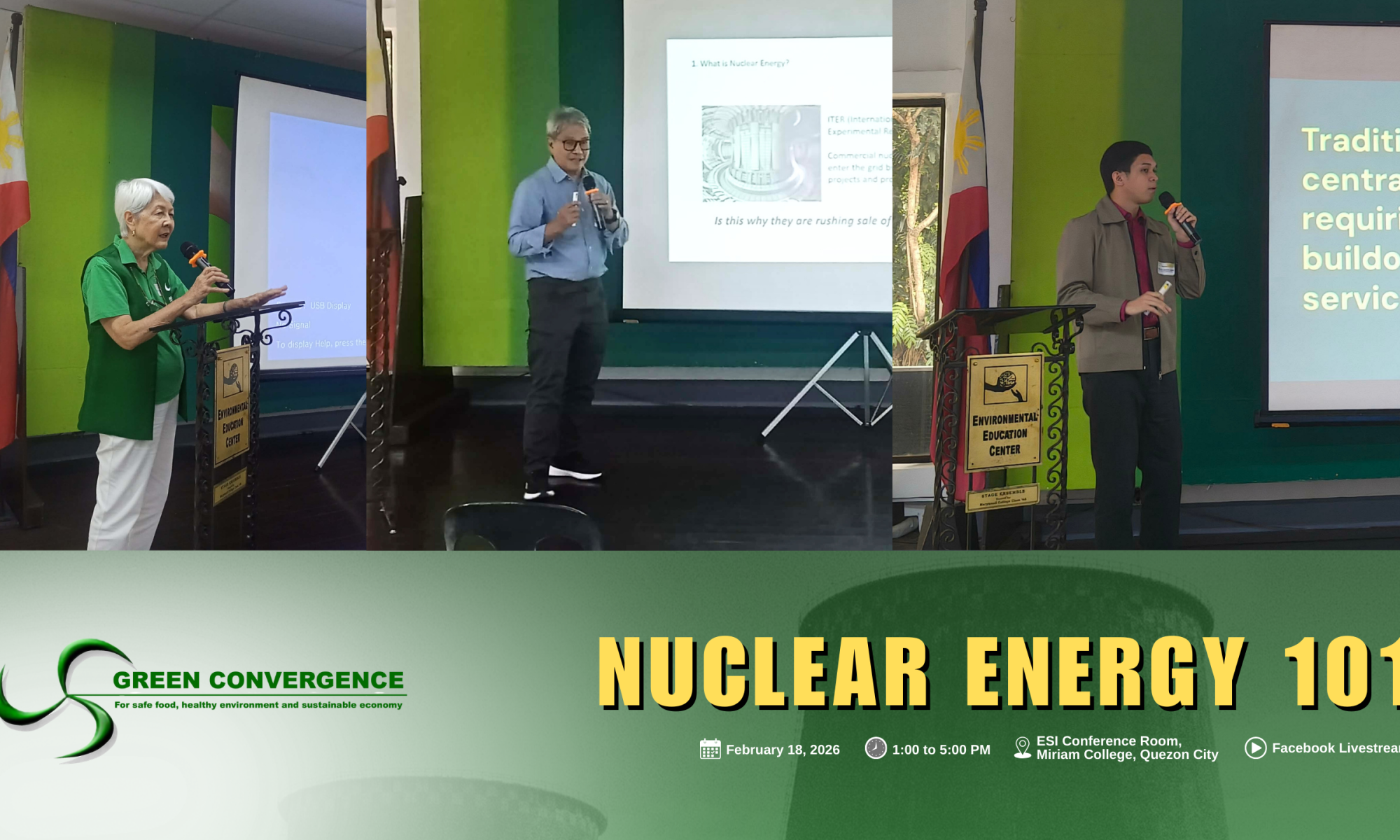
Green Convergence held its “Nuclear Energy 101” forum to increase among its members and allies the scientific knowledge of nuclear energy that would help them evaluate whether it is appropriate for the Philippines.
The forum was held last February 18, 2026, at the Environmental Studies Institute Conference Room of Miriam College in Quezon City, and via Facebook Live.
Invited experts were Dr. Fabian Dayrit, Professor Emeritus of the Ateneo de Manila University College of Science; Charles Jason Diaz, Senior Data Analyst of the Institute for Climate and Sustainable Cities; and Dr. Angelina Galang, Trustee of Green Convergence.
The forum clarified how nuclear energy works, assessed its economic and technical viability, discussed the structural and governance challenges, and placed everything into the local context considering the country’s energy needs, fiscal priorities, and sustainable development goals.
The speakers detailed the fundamentals of nuclear reactions and radioactive materials to ground participants in the science, while emphasizing strict safety standards and the long-term nuclear waste management demands.
Dr. Dayrit urged stakeholders to ask nuclear energy proponents whether the technology they are proposing is based on nuclear fission or nuclear fusion, noting that fission is what is commercially available today, and that it produces highly radioactive waste and carries long-term safety and storage risks.
He explained that while fusion is safer and more capable of supplying large amounts of energy with less ‘long-lived’ waste, it remains newly explored and will require more years of research and development before it can be used commercially.
The discussions also covered the country’s risks and vulnerability to earthquakes, typhoons, and rising sea levels, raising concerns about safety and on the long-term integrity of nuclear facilities and nuclear waste management systems.
Comparisons were made with Finland’s deep geological waste repository and our country’s own geological structure.
Information was shared that Finland’s project took 26 years from research on the proper siting (520 meters underground) to constructing the burial site.
It was also pointed out that the Bataan Nuclear Power Plant was reported to have around 40,000 defects—four times the average number of defects of nuclear power plants—and would require over six years and more than four billion dollars to rehabilitate, without assurance of full operational safety.
It also highlighted great strain in financing in terms of high upfront capital costs, extended construction timelines, added transmission requirements, decommissioning, waste management, and increased reserve margins that nuclear plants would entail.
Diaz stressed that nuclear energy is inflexible and may undermine grid reliability amid rising variable demand, adding that proposed Small Modular Reactors are too risky, still too early in its developmental stage, and economically unviable for the Philippines.
The above significantly rules out nuclear power as an immediate energy source option for the Philippines.
Renewable energy sources such as solar, wind, geothermal, and tidal power, which the Philippines is abundantly blessed with, are more scalable, can be decentralized, and are aligned and compatible with the country’s geography and rapidly evolving power needs.
Dr. Galang elaborated on the various points given by the previous speakers, adding that catastrophes caused by nuclear accidents are ‘in a league quite apart from those caused by other hazards such as typhoons, earthquakes, fires, and others.’
She stressed that after the latter occurs, people can go back to the sites and rebuild their lives; however, in the case of nuclear accidents, they cannot because of the intense radioactivity that the sites suffer.
Dr. Galang also emphasized that civil society organizations’ calls years back against nuclear energy reached decision-makers and were not a waste of effort. She encouraged everyone to persist in engaging the decision-makers and observing vigilance.
“Let’s invest in ecological sustainable development for our children’s future,” Dr. Dayrit said, adding that the Philippines can be a pioneering leader in renewable energy, especially ocean energy, and other safe energy alternatives.
#GreenConvergence #NuclearEnergy101 #NuclearEnergy