December 2025 Kamayan talks creation, nature in spiritual context

Green Convergence (GC) closed 2025 with the 426th session of Kamayan Para Sa Kalikasan themed “The Birth of Christ and the New Cosmology” last December 19, 2025, via Zoom and Facebook livestream, linking ecological understanding to spiritual meaning in the season of Christmas.

Sr. Marvie Misolas, Miriam College Environmental Studies Institute Executive Director and GC Trustee, opened the forum citing literature by Ilia Delio who acknowledged St. Augustine and St. Bonaventure as ‘observers of the cosmos’.

Quoting Bonaventure, Misolas said that it is important to return to the Book of Creation, as creation is not a backdrop of human drama, but the disclosure of God’s identity.

Laudato Si’ Movement Pilipinas Coordinator Sr. Elizabeth Carranza widened this idea by introducing the “new cosmology,” which she described as a way of understanding the universe that integrates science and spirituality and views creation as conscious, purposeful, and deeply interconnected.

Carranza traced the becoming of the cosmos—from the Big Bang, the birth of stars and galaxies, to the emergence of Earth as home to life, emphasizing that creation is not static but continuously evolving in communion.

She drew this idea from theologian Brian Swimme, who described gravity as a force of “union and communion,” reflecting God’s creative love at work in the universe.

Carranza said Earth became Mother and home to life through billions of years of transformation, giving birth to diverse species and, eventually, to humanity.

“It took billions of years for God to make us,” Carranza noted, underscoring the sacredness of both human life and the natural world.

Carranza then confronted the ecological crisis, pointing to destructive human activities such as mining, deforestation, pollution, and fossil fuel dependence that wound “Mother Earth.”

Quoting Pope Francis’ Laudato Si’, she reminded that creation ‘now cries out to us because of the harm we have inflicted on her.’

Carranza urged a collective response toward the “Ecozoic Era”—a time when humans live in the right relationship with Earth as a living, life-giving home.

Talking about deep incarnation, Carranza said God’s becoming flesh in Christ is inseparable from the whole of creation. “God is always needing to be born on Earth,” she said, calling on people to embody care, compassion, and responsibility in their own lives.

Carranza also led spiritual exercises to help audiences connect with Mother Earth and shared her self-written poem prayer titled ”I am Terra. I am Earth.”, reflecting on her inner connection to Earth, which she said she wrote while walking barefoot.

Understanding the new cosmology in the Philippine context, Bishop Gerardo Alminaza, head of the Catholic Bishops’ Conference of the Philippines’ National Laudato Si’ Program, expanded on the theological concept in his talk titled “Luntian na Pasko.”

Alminaza reframed the story of the birth of Christ as one rooted in vulnerability, displacement, and dependence on nature, which are realities familiar to many Filipinos today.

“Christ is born into a world marked by uncertainty and danger,” he said, noting parallels with communities facing climate disasters, environmental degradation, and development projects imposed without consent.

He cited mining permits, energy projects, and coastal reclamation that displace families and threaten livelihoods, particularly of fisherfolk, farmers, and Indigenous Peoples, which are realities that mirror the vulnerability of Christ’s birth, remarking that ecological issues are also questions of justice and responsibility.

“A luntiang pasko invites us to see the manger not as a decorative symbol but as a reminder that God chooses to enter the world where life is fragile and dependent on the integrity of creation,” Alminaza said.

He emphasized that the injustices faced by Filipinos are not merely technical issues but a moral one, shaped by decisions that determine who bears the cost of development.

Alminaza also added that when affected communities resist, they are often stigmatized or criminalized, prompting the necessary question—’development for whom and at what cost?’

Calling for solidarity, Alminaza urged communities, churches, civil society, and institutions to stand with farmers, fisherfolk, Indigenous Peoples, and urban poor families whose lives are dependent and directly tied to land and water.

“Care for creation and care for people are inseparable,” he said, adding that Christmas calls for both personal conversion and collective action.

Altogether, Carranza and Alminaza invited everyone to rediscover Christmas not only as a celebration, but as a commitment to honor creation, accompany the vulnerable, and allow faith to shape a more just and sustainable future.

Closing the forum, GC President Victoria Segovia reflected on the speakers’ talks through a deeper understanding of “Noel,” meaning joy and celebration, and “Emmanuel,” meaning “God is with us.

She said that “Noel” should remind everyone to choose and share joy amidst difficult times, even including the poor, the lonely, and the forgotten; it should remind hope that resists despair amidst crisis, conflict, and environmental harm.

Moreover, “Emmanuel” should remind that God is with those who suffer poverty, injustice, war, and climate disasters, and with creation that grooms under pollution and abuse.

“Christmas asks us to be God’s presence to stand with the vulnerable, protect life, and care for our common home that the incarnate Christ shared with us in his physical body. The Christmas season then makes us remember that the natural environment is a collective good, the patrimony of all humanity, and the responsibility of everyone,” Segovia expressed.

The next Kamayan session will be on January 16, 2026.

Kamayan Para Sa Kalikasan is a monthly initiative organized by Green Convergence that enables non-government organizations (NGOs) and government representatives, the media, students, teachers, church groups, and concerned citizens to discuss, analyze, and create solutions to pressing environmental issues in the country.

For those interested to be a member of Green Convergence, visit this link to register: bit.ly/GCMembershipRegForm

#GreenConvergence #KamayanParaSaKalikasan #BirthOfChrist #NewCosmology
November 2025 Kamayan CSO’s Say No to Nuclear Energy, WTE in Just Transition Efforts

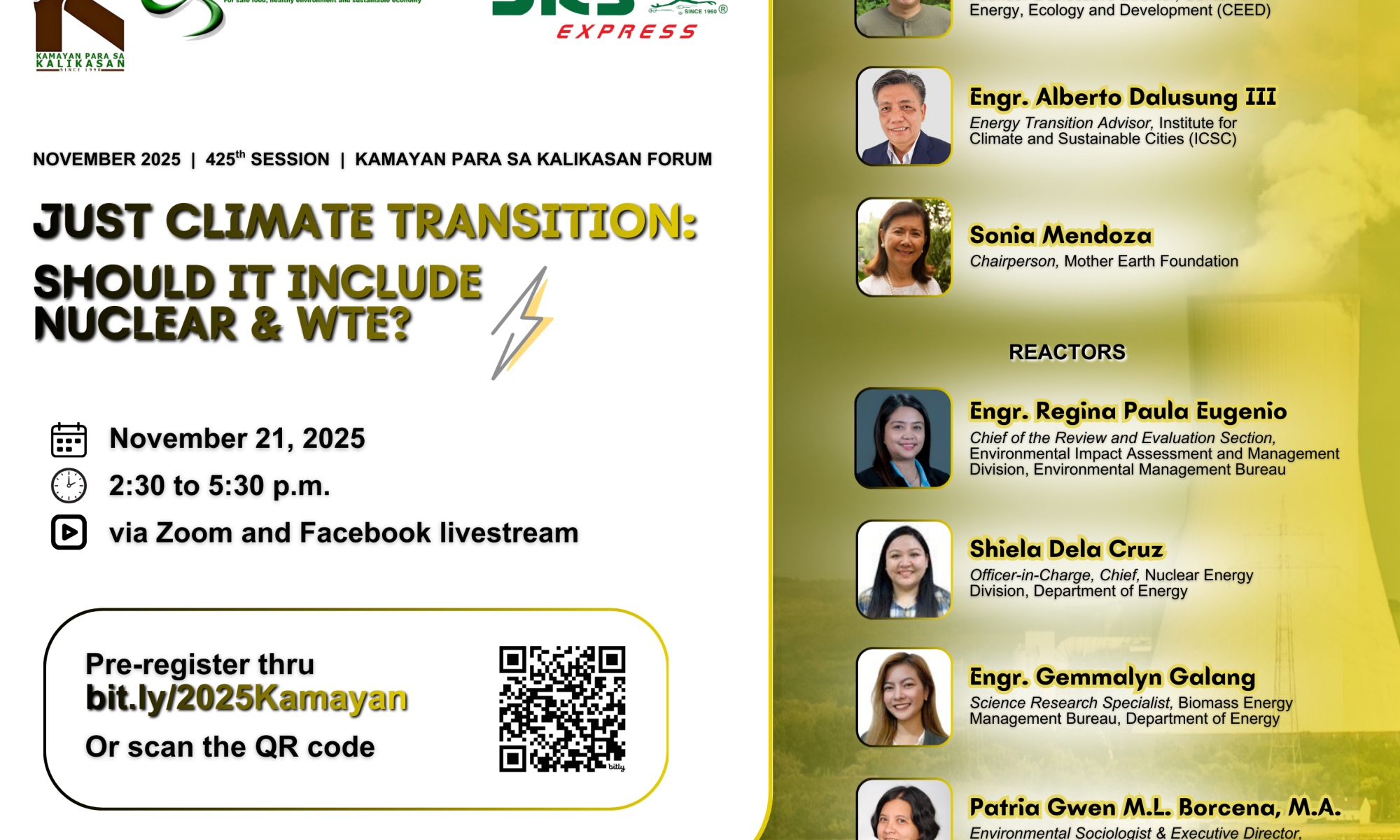
Green Convergence (GC) convened the 425th session of the Kamayan Para Sa Kalikasan forum themed “Just Climate Transition: Should it include Nuclear & WTE?” on November 21 via Zoom and Facebook livestream. The November forum was supported by JRS Express.

With stronger calls for the phase out of fossil fuels in the recently concluded Conference of Parties (COP 30) held in Belém, Brazil, GC President Victoria Segovia noted in her opening remarks that national leaders in the Philippines are now promoting the use of waste-to-energy (WTE) and nuclear technologies as alternatives.

Segovia however questioned these steps that the Philippine government is taking. “Is this toward the sustainable development of the Philippines?”

Jumping on this premise, Gerry Arances, Founder and Executive Director of the Center for Energy, Ecology, and Development, challenged the framing of the country’s transition.

“Just transition ?” he asked, stressing that communities already suffering the worst impacts of the climate crisis must be the priority.

Arances noted that, despite 15 years under the Renewable Energy Act, the country’s renewable energy (RE) share increased only from 34% to 35%, while coal now accounts for 62% of the power mix—one of the highest in the world.

Even with this, there are no concrete steps for a fossil fuel phaseout.

However, he said that approved RE capacity is already enough to power the country forward. The Green Energy Auctions awarded 21 to 22 gigawatts of new RE, representing more than 60% of the nation’s existing installed capacity.

If these are implemented as planned, Arances argued that there is no need for new fossil fuel plants, nuclear power, or WTE.

“We already have enough renewable energy in the pipeline for the next decade,” he said. “We do not need WTE. We do not need nuclear.”

Engr. Alberto Dalusung III, Energy Transition Advisor at the Institute for Climate and Sustainable Cities, delved deeper into an evidence-based analysis of nuclear power based on grid limitations, economic realities, and global trends.

He explained that the Philippines has the smallest grid among Southeast Asian countries. In the Philippines, the largest single generating unit in Luzon is under 700 megawatts (MW), and smaller units operate in Visayas and Mindanao.

Given these numbers, Dalusung explained that installing a 1,000-MW nuclear reactor, which is the smallest commercially available size, would overwhelm the Philippine grid and would require massive reserve capacity that the system currently cannot handle.

He also rejected the argument that the country needs more baseload, stressing that the real problem is an oversupply of coal and gas plants that are forced to ramp up and down, damaging equipment and causing outages.

In the open forum, he added that solar is variable and predictable, unlike the argued “stable” baseload plants that frequently trip.

On costs, Dalusung cited international data showing nuclear as one of the most expensive technologies, which entails that it would be even more expensive in the Philippines due to seismic upgrades and absent nuclear infrastructure.

Addressing whether small modular reactors (SMRs) would be the appropriate nuclear technology for the country, he said that SMRs remain experimental, with only two commercially operating worldwide.

On considering WTE technologies in the Philippines, Sonia Mendoza, Chairperson of Mother Earth Foundation, warned that WTE incineration actually worsens both the waste and climate crises despite being marketed as a modern solution.

She said that all thermal WTE processes—from combustion to pyrolysis—emit greenhouse gases (GHGs).

Studies show WTE facilities generate 1.7 times more GHGs per MWh than coal, and even more than oil and natural gas.

Mendoza added that WTE facilities undermine waste reduction, as they depend on a constant waste supply and often involve “put-or-pay” contracts that penalize local governments for failing to meet requirements on the amount of garbage.

Despite claims of reducing landfill use, WTE produces toxic ash requiring engineered landfills, and releases dioxins linked to cancer and reproductive harm.

She also raised legal questions, pointing out that WTE contradicts the Clean Air Act and the Ecological Solid Waste Management Act. In a global context, the European Union has withdrawn funding support for incineration due to its climate impacts.

Reactors from government agencies, Engr. Regina Paula Eugenio from the Environmental Impact Assessment and Management Division of the Department of Environment and Natural Resources Environmental Management Bureau, Shiela Dela Cruz, the Officer-in-Charge and Chief of the Department of Energy’s Nuclear Energy Division, and Engr. Gemmalyn Galang, Science Research Specialist from the Department of Energy Biomass Energy Management Bureau, addressed the issues raised by the plenary speakers.

They acknowledged concerns, but urged “open-mindedness” as government agencies assess nuclear and WTE in the national energy mix.

They also cited ongoing work on nuclear regulatory frameworks, radioactive waste planning, grid studies, public consultations, and coordination with both local and international counterparts.

However, Patria Gwen Borcena, Environmental Sociologist and Executive Director of Greenresearch Environmental Research Group Inc., underscored the longstanding civil society opposition to these technologies—from a recent statement signed by 38 organizations to pastoral letters from church leaders.

She also questioned the government’s claim of inclusivity in the transition process given the aforementioned strong opposition.

Borcena punctuated the forum, “. in the future. , monstrous WTE nuclear?”

As shown in the plenary and panel exchange, while government agencies express openness to nuclear and WTE, civil society organizations (CSOs) maintain that just transition must reject dangerous, costly, and polluting technologies and accelerate the RE transition already within reach.

Wrapping up the forum, Dr. Angelina Galang, Founding Trustee of GC and Program Director of the Movement, firmly stated in her closing remarks that nuclear and WTE are false solutions to the climate change emergency.

“If we go to these technologies when we ever have so much blessings from the Lord, we are shooting ourselves in the foot, in the mouth, and in the head … We’re already vulnerable to natural hazards. We will exacerbate our vulnerability by these technologies,” Dr. Galang expressed.

#GreenConvergence #KamayanParaSaKalikasan #JustTransition #NuclearPower #NuclearEnergy #WasteToEnergy


Part 1

Part 2

Part 3