“Cha-Cha” gets heavy beating at forum

“The proposed Cha-Cha is anti-Filipino in the sense that it is removing protectionist provisions enshrined in the 1987 Constitution that ensure our right to be in control of our resources.” This was the opening salvo of Bayan Muna General Counsel Atty. Cris Yambot at the 348th session of the monthly Kamayan Para sa Kalikasan Forum, which tackled the proposed Charter Change (Cha-Cha) that would shift the Philippines to a federal form of government.

“Furthermore,” Yambot added, “it grants new and formidable powers to the President, giving him executive, legislative, and judicial control over the entire government. It opens the country wider to transnational corporations, and it dilutes or deletes the social justice and human rights provisions enshrined in the 1987 Constitution.”
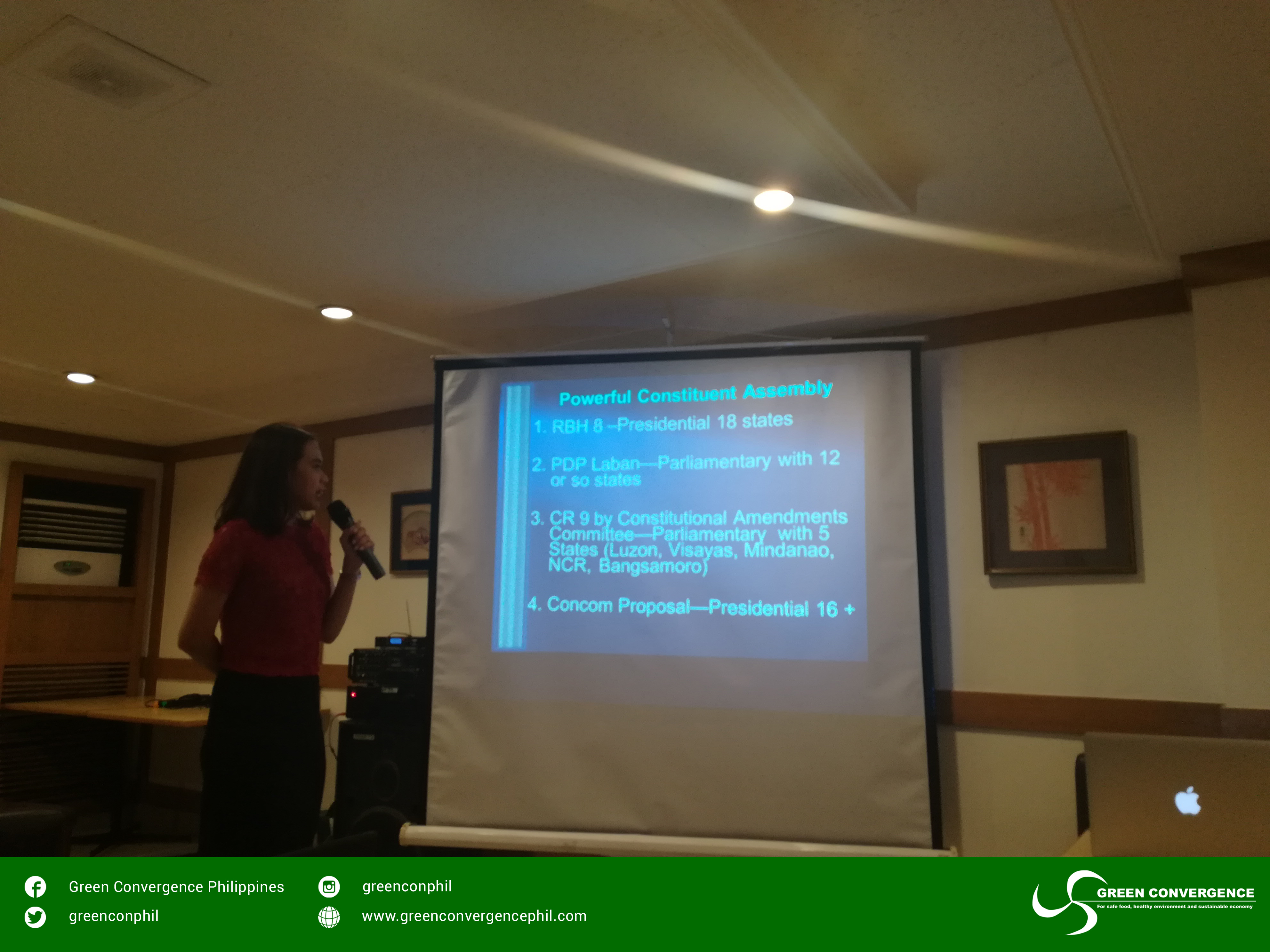
Atty. Cris Yambut, General Counsel of Bayan Muna discusses the different versions of Charter Change being proposed in the Congress. She noted that Resolution of Both Houses No. 8 or the version submitted by Former President Gloria Arroyo is the one that has been passed at the committee level. It is primarily because “they have the numbers.”

In relation to foreign ownership, Yambot emphasized that in the proposed versions, transnational corporations would in effect be allowed to own and control lands, including already scarce agricultural lands that produce our food supply, and would lift established limits on foreign ownership of mining companies.

She then pointed out specific provisions in the draft Constitution that would abridge the rights of the Filipino people and reduce or remove their protection against unfair competition from big foreign corporations.

For example, she explained, the right to freedom of expression is put in danger by changing it in the proposed charter to “freedom of ‘responsible’ expression.”

“Who is to decide what’s ‘responsible?’” Yambot asked. “Will criticizing government or attending a rally be deemed ‘irresponsible?’”

In an unusual turn of events, Yambot was the sole speaker in this month’s forum, which always strives to present different sides of an issue. Unfortunately, SAGIP Party-list Representative Rodante Marcoleta, one of the authors of the draft Cha-Cha failed to come. Although he had confirmed his attendance up to the day of the forum, he cancelled at the last minute, citing an unforeseen meeting.

Finally, Yambot warned that many of the draft provisions would impact negatively on the environment, and encouraged everyone to carefully study the draft Cha-Cha which is available at the Congress website.

In her closing remarks, Dr. Angelina Galang, President of forum organizer Green Convergence said, “Everything is connected to the environment. We should protect our environment, thus, ownership should be left to the Philippines.”

A bit of politics entered the discussion but Galang enjoined everyone to rise above personal ties, family, alliances and emotional preferences and vote as Filipinos, for the good of the country. She also encouraged citizens and environmental groups to work on influencing lawmakers to reject provisions harmful to the environment and the Filipino people.

Kamayan Para sa Kalikasan Forum has become an institutionalized platform since March 1990 that enables NGO and government representatives, the media, students, teachers, church groups, and concerned citizens to discuss pressing environmental issues in the country. This month’s forum is supported by Kamayan Restaurant EDSA with the assistance of the Forest Foundation Philippines.
You must be logged in to view this content. Free Virtual Library Registration Here

Green Convergence forum tackle effectiveness of ecobricks

Environmental coalition Green Convergence held the 347th installment of the monthly Kamayan Para sa Kalikasan Forum last February 15, 2019 at Kamayan Restaurant, EDSA, Mandaluyong City. Resource speakers included Lou Arsenio of Ecobricks Philippines, Chairman Rolly Datiles of Barangay Bagumbuhay, Quezon City and Juvy Serafin of the Solid Waste Management Division of the Department of Environment and Natural Resources.

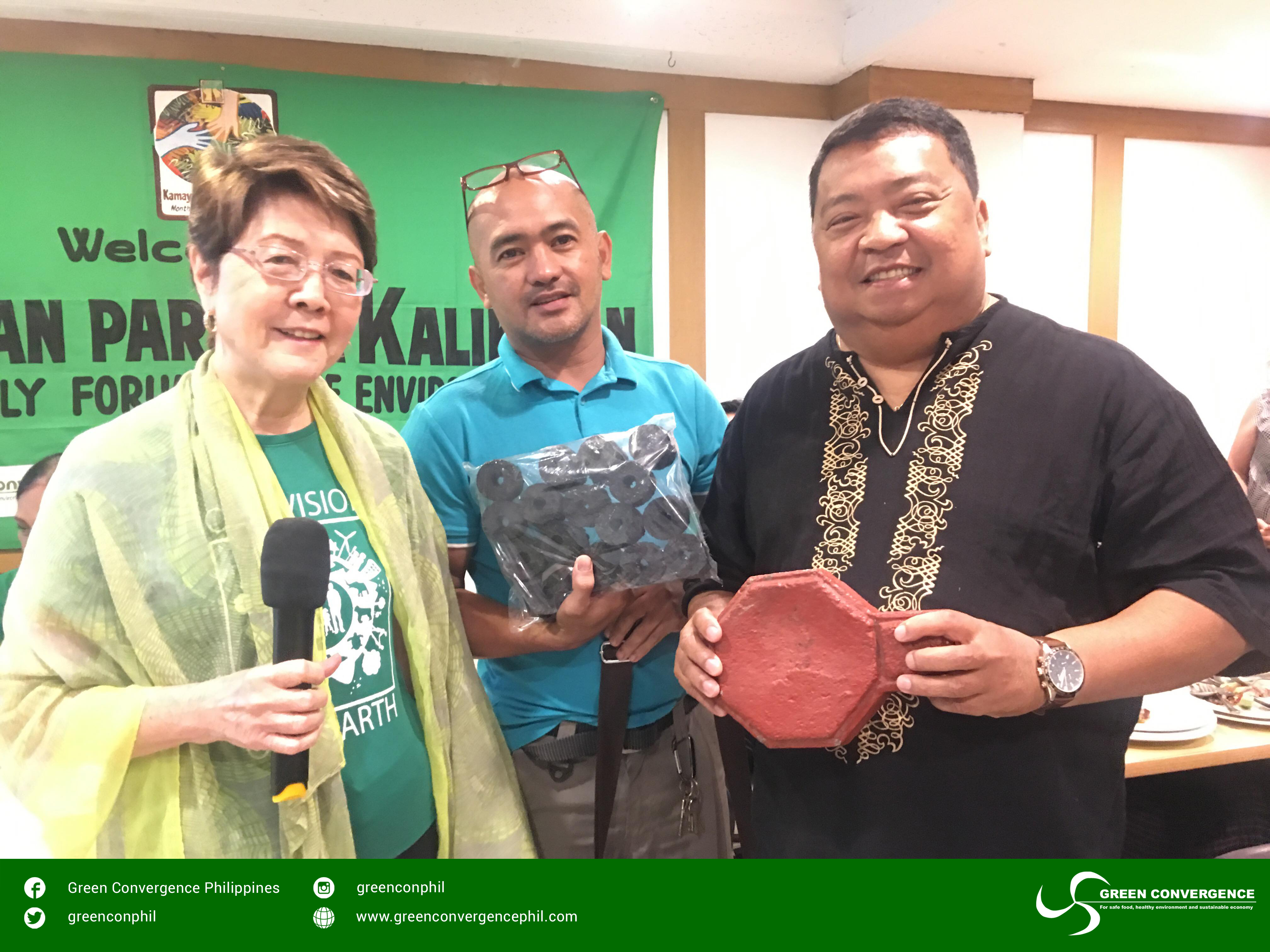
Dr. Angelina Galang (left) with Barangay Bagumbuhay Captain Rolly Datiles (right). Capt. Datiles is successful in implementing the ecological solid waste management law in his barangay with the ecobrick project that he innovated.

The forum scrutinized the two versions of ecobricks – (1) plastic bottle containers stuffed with dry plastic wastes which are used as filler bricks in building systems and (2) actual hollow blocks that are stronger than the former and are made by mixing wet cement and shredded plastic wastes.

Arsenio stressed that the said first version is supposed to be hard as a brick. “Dapat may proper training ang paggawa nito [ecobricks] dahil kung mali ang pagkakagawa, mahirap po itong ayusin (There should be a proper training for making ecobricks because if they are wrongly made, it would be difficult to fix them),” she followed.

On the other hand, Datiles explained that his community’s way of doing the second version is by processing non-biodegradable residual plastic wastes and mixing them with cement to be transformed into tiles and bricks. He presented the 4 E’s that supported his community’s ecobrick initiative and made their ecological solid waste management program successful:

“First you need education for the awareness campaign of the problem and proposed solutions. Second you need engineering so you would have proper equipment for realizing the solution. Third is enforcement. There needs to be a barangay ordinance for the program. Finally, economic sustainability where each household gain economic rewards by participating in the program.”

Serafin lauded the efforts of Chairman Datiles and mentioned, “Kung effective lang talaga ang management ng waste at the barangay level, wala sanang problema sa basura (If waste management is just effective at the barangay level, there could’ve been no problem with wastes).”

She further noted that “Ang dapat atakehin ay ang behavior ng mga tao…lifestyle kasi ng mga tao ngayon is convenience kaya management po ang approach natin (People’s behavior should be tackled…since our lifestyle is now is focused on convenience, that’s why our approach for this is management).”

Datiles said that the problem with wastes is global but the solution must be local. His barangay was also once like Payatas, heavily faced with waste problems. “Inimplement lang po namin ang RA 9003 [Ecological Solid Waste Management Act] na sinuportahan din ng aming [Quezon City] LGU…may City Ordinance No. 1203 po kasi na nagbibigay incentives sa mga barangay na may maayos na solid waste management program (We just implement RA 9003 which is supported by our LGU…there is City Ordinance No. 1203 that gives incentives to the barangays that have good solid waste management programs),” he shared.

However, Arsenio clarified that ecobricks are just a temporary solution. “Ang ecobricks na isinusulong namin ay para lang sa gardening at low walls kaya hindi naman siya kakalaban sa Building Code (The ecobricks that we promote are only for gardening and low walls, that’s why it would not go against the Building Code),” she claimed.

This contrasts with Datiles’ version, “Nagpatest kami sa UP at pumasa naman ang strength ng aming ecobricks…at may mga contractor na bumibili sa amin (We underwent a test at UP and the strength of our ecobricks passed…and we already have contractors that buy from us).”

Serafin discussed that “Kung nagproduce po tayo ng wastes, saan po mapupunta iyon? Ang DENR ay sumusunod sa waste management hierarchy kung saan ang first preferred option po natin ay waste avoidance…nasa efficiency po ‘yan ng LGUs (If we produce wastes, where will they go to? The DENR follows the waste management hierarchy where the first preferred option is waste avoidance…its efficiency lies on the LGUs)” implying that waste-to-energy initiatives like incineration depends on the LGUs’ effectiveness in solid waste management.

Dr. Angelina Galang, Green Convergence President concluded that “We have to look into our individual actions…take it upon ourselves to make them (LGUs) do their job properly. Management is the thing. These options are all open to us but we have to choose what is doable.”

Now on its 29th year, Kamayan Para sa Kalikasan Forum has become an institutionalized platform since March 1990 that enables NGO and government representatives, the media, students, teachers, church groups, and concerned citizens to discuss pressing environmental issues in the country. This month’s forum is supported by Kamayan Restaurant EDSA with the assistance of the Forest Foundation Philippines.

You must be logged in to view this content. Free Virtual Library Registration Here

Calendar of Activities: March 2019


GC CALENDAR OF EVENTS FOR MARCH 2019

DATE
ACTIVITY
March 6-8


Green Convergence Strategic Planning


March 12


Tribute for Gani Serrano of PRRM


4:00 pm

Earth Day Network

Mother Ignacia Street cor. Dr. Lascano Street, Quezon City

March 12


4th State of the Humanitarian System


1:00 PM-4:00 PM

Luxent Hotel, 51 Timog Avenue, Diliman, Quezon City

Contact Person: Loreine dela Cruz, Center for Disaster Preparedness

March 13


Kaliwa Dam Press Conference and NCR-based CSO Meeting


Philippine Movement for Climate Justice

1:00 PM-5:00 PM

Senyor Kumpadre, 117A Kalayaan Avenue, Quezon City

March 14


Partnership for Clean Air Board of Trustees Meeting


2:30 PM

March 15


Kamayan Para Sa Kalikasan Forum


Can we Cha-Cha our environment?

10:30 AM-2:00 PM

Kamayan Restaurant, Greenhills, EDSA, Mandaluyong City

March 18


URGENT Initiative’s Strategic Planning


8:30 AM-5:00 PM

March 18


Sustainable Forest Management Bill Meeting


3:00 PM

100 A. De Legaspi Street, Barangay Marilag, Project 4, Quezon City

March 26-27


Reclamation Summit: Restore the Coasts, Protect the People


Kalikasan People’s Network for the Environment

9:00 AM – 5:00 PM

Bayleaf Hotel, Intramuros, Manila


Letter of Support for the Mangyan Communities

January 22, 2019

HON. ROY A. CIMATU
Secretary
Department of Environment and Natural Resources

Dear Secretary Cimatu,

Isang makakalikasang pagbati!

We, participants of the Kamayan para sa Kalikasan Forum held last January 18, 2019 at Kamayan Restaurant on EDSA, echo the call of the Mangyans in Mindoro that they be involved in decision- making processes affecting their communities.

In 2015, when Typhoon Nona struck Mindoro, the towns of Naujan, Victoria and Baco suffered from massive floods and landslides. This resulted in loss of family members and sources of livelihood. It was later discovered that the negative impacts of the typhoon were worsened by the excessive blasting during the construction of a hydro power plant and its connecting tunnel by the Sta. Clara International Corporation. The blasting heavily deforested the area and weakened the rock substrate causing landslides and flooding.

Members of the communities including the Mangyans, insisted that mountain blasting was not agreed upon by involved stakeholders in the Memorandum of Agreement on the construction of the power plant. Asked by tribe leaders why this aspect of the agreement was invalidated, the corporation responded that it needed to meet certain deadlines; that mountain blasting was the faster method to finish the power plant’s construction.

While the local authorities have decided to halt the construction activities of the plant in 2016, a lot of damage and loss has already occurred. It will be hard for the affected communities to recover from the tragic experience. Therefore, we further support their appeal that community members be included in the monitoring of the rest of this project as well as other projects.

We call on your good office to review Republic Act 8371 or the Indigenous People’s Rights Act of 1997 and to uphold its provisions especially on “ensuring genuine exercise by Indigenous Cultural Communities of their right to Free and Prior Informed Consent (FPIC), whenever applicable” and on “protecting their rights in the introduction and implementation of plans, programs, projects, activities and other undertakings that will affect them and their ancestral domains to ensure their economic, social and cultural well-being.”

Indigenous peoples are crucial in the environmental struggle because they experience firsthand the dangers of the rapid destruction of the environment. We must learn from their perspective, they who live intimately with nature. Projects meant for development may ironically become tools for disasters and further lowering of people’s quality of life should they be implemented without consulting, engaging and involving all the stakeholders. Ensuring the rights of indigenous peoples means ensuring the integrity of the environment.

With DENR in the helm of protecting the environment, let us all work together towards the protection of our only home and the achievement of sustainable development!

Para sa kalikasan,

Green Convergence for Safe Food, Healthy Environment and Sustainable Economy

[distance1]Click the link below for the letter received by the DENR:
Letter of Support for the Mangyan Communities