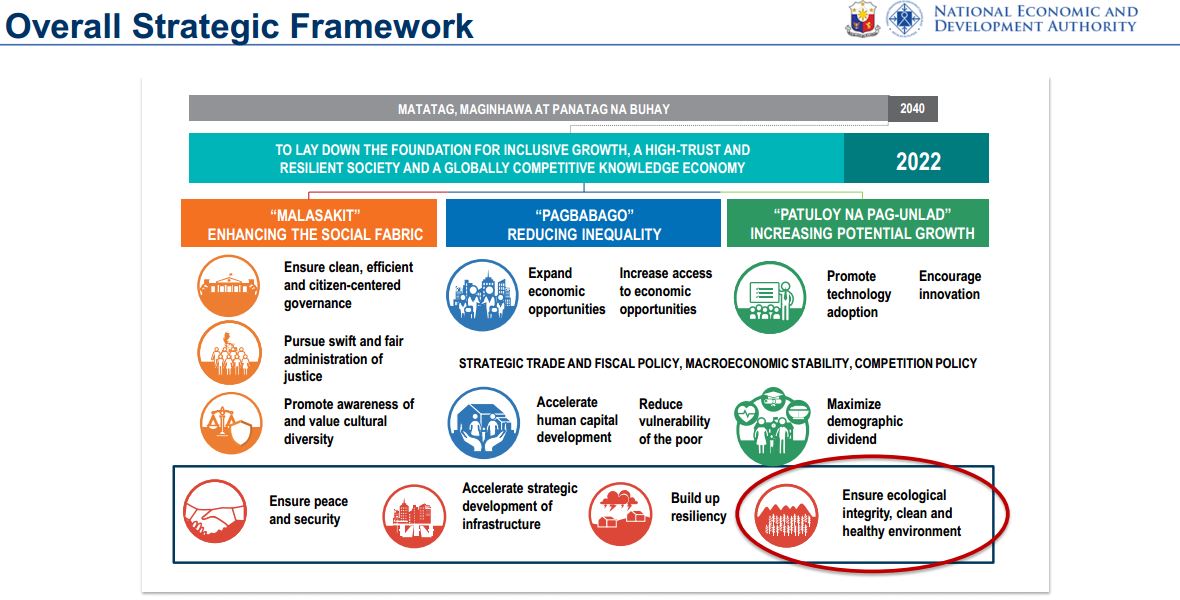
Ensuring Ecological Integrity, Clean and Healthy Environment

Priority Strategies

Subsector Outcome 1: Sustained Functioning of Ecosystem Services

  1. Intensify sustainable management of natural resources through adoption of ridge-to-reef approach and integrated area development

    • Reverse the loss of forest cover through sustained rehabilitation of degraded forest lands including critical watersheds & major river basins
    • Complete delineation of final forest limits and delineation/delimitation and zoning of watersheds and municipal waters
    • Effectively manage the protected areas and enforce law against illegal trade of wildlife species
    • Improve land administration and management (i.e. enhance access to land information, management of conflicts)
    • Strengthen enforcement of laws and management of coastal and marine
      areas
    • Complete Identify strategic economic zones for production of fish and
      other marine products
    • Intensify research on the country’s biodiversity including terrestrial and
      coastal and marine habitats and resources
    • Improve the management of priority inland wetlands and caves
    • Identify innovative sustainable financing schemes for resource
      management
    • Improve self-sufficiency in the country’s wood and non-timber requirements and making the forestry sector a significant contributor to the economy
  2. Expand development of resource-based enterprises/industries

    • Promote sustainable forest-based (timber and non-timber) and sustainable marine-based industries [refer to AFF and I&S Chapters]
    • Develop system for access and benefit sharing of wealth from genetic resources
    • Improve system of collection and increase share from appropriate fees and fines in areas covered by tenure (e.g. foreshore lease areas, SAPA, etc)
    • Promotion and development of ecotourism and cultural sites [refer to AFF, I&S, and Cultural Awareness Chapters]
  3. Mainstream ecosystem values into national and local development planning

    • Develop policy for Payments for Ecosystem Services (PES) and polluters pay
    • Institutionalization of natural resources monitoring
      system and environment and natural resources
      accounting

Subsector Outcome 2: Improved Environmental Quality

  1. Strengthen enforcement of environmental laws

    1. Air Quality Management
      • Promote environmentally-sustainable transport including clean fuels  and mass transport system
      • Strengthen enforcement of anti-smoke belching campaign and  vehicle emission testing
      • Increase quantity and efficiency of air quality monitoring stations
    2. Water Quality Management
      • Improve wastewater management by increasing the number of domestic and industrial wastewater treatment facilities in water districts/LGUs
      • Identify pollutants in priority river systems and implement appropriate management interventions
    3. Land Quality Management
      • Promote sustainable land management (SLM) to contribute to land degradation neutrality (i.e. soil fertility, soil & water conservation technologies, etc.)
      • Improve management of wastes including solid, toxic and hazardous wastes
      • Transform abandoned mines/mined-out areas into final land use beneficial to communities through implementation of environmental
        management plans
  1. Promote Sustainable Consumption and Production (SCP)

    • Establish sustainable market for recyclables and recycled products;
    • Develop, promote and transfer cleaner production technologies, including water and energy-efficient practices (e.g. rainwater catchment facility, cleaner fuels and engine, energy efficient facilities/green buildings) [cross refer to I&S, Infrastructure, STI Chapters]
    • Strengthen certification and establish information systems for green products and services
    • Promote green procurement in both private and public sectors;
    • Promote environmentally-sustainable transport (EST) including mass transport system [cross refer to I&S, Infrastructure, STI Chapters]
  2. Subsector Outcome 3: Increased adaptive capacities and resilience of ecosystems

    1. Strengthen implementation of CCA and DRR, particularly at the local level across sectors.
      • Develop, maintain and make available and accessible climate and geospatial information and services, including integrated risk information system in a standardized format/scale
      • Develop data protocol to facilitate access and sharing of available scientific researches/studies, geospatial information and climate projection
      • Continue to mainstream CC and DRRM in national and local development plans and policies and education system (cut across Chapters of the PDP)
      • Promote climate-resilient structures and designs following established measures and standards by DPWH, HLURB, DILG, DSWD and other government agencies (refer to infrastructure Development, AFF, I&S, Building Resiliency and Social Protection Chapters)
      • Identify technological and research priorities and capacity needs on CC and DRRM (refer to Expanding Economic Opportunities in Industry, STI, and Infrastructure Development Chapters)
      • Strengthen access to existing CC and DRRM financing and risk transfer mechanisms including promotion campaign (refer to Social Protection Chapter)
      • Promote preparation of business continuity planning (refer to I&S Chapter)
    2. Strengthen implementation of response, recovery and rehabilitation efforts.
      • Strengthen mechanism to conduct the Post/Rapid Disaster Needs Assessment (P/RDNA)
      • Revisit existing policies on post disaster housing and resettlement programs including those related to land development (refer to Social Protection Chapter)
    3. Strengthen Monitoring and Evaluation of effectiveness of CC and DRRM actions
      •  Identification of more appropriate indicator to measure adaptive capacity and resiliency (including indicator of resiliency of natural resources/ecosystems) vis-à-vis SDGs and SFDRR (cut across Chapters of the PDP)
      • Development of database that would measure emission reduction per sector (including aviation and maritime)

Private Agri Tourism: Malabing Valley Casibu, Nueva Viscaya

JOSEPHINE NAMUJHE is the founder of the Malabing Valley Sustainable Integrated Forest Farmer’s Association (MVSIFFA). The Malabing Valley Multipurpose Cooperative has ventured into non-traditional capacity building activities as a means to organize farmers in the valley, and as a way to protect its natural resources. The cooperative has joined forces with some NGOs and the government in preparing a land use framework for a community-based forest management program aimed at preventing uncontrolled conversion of open access forest lands into citrus and other agricultural activities.

The Malabing Valley Agritourism Project was started in 2013 and is being operated by MVSIFFA, Inc. Tied up with DENR under the NGP contract, the association was in- charge of establishing sustainable development plan to protect, enhance, and increase biodiversity and economic viability of the area. However, like any other association, the main constraint of MVSIFFA is its lack of financial resources to push through their short, medium and long-term plans. For now, the livelihood program of the association is focused on the production of fruit bearing trees like lanzones, durian, rambutan, and bugnay, among others. The medium and long-term projects will be focused on the production of high value crops and processing of forest products into furniture and other crafts.

Below is the presentation of Ms. Josephine Namujhe:


You must be logged in to view this content. Free Virtual Library Registration Here

SUSTAINABLE TOURISM

This session was moderated by DR. DONNA PAZ T. REYES, the Chair of the Graduate Program of the Department of Environment and the Executive Director of Environmental Studies Institute of Miriam College. A graduate of Ph.D from Royal Melbourne Institute of Technology in Australia, she is an authority in environmental education, including biodiversity conservation, environmental principles, ecology and community-based ecohistorical tourism.

Two (2) speakers shared their knowledge and experiences in this session. They are: Josephine Namujhe from Malabing Valley in Nueva Viscaya and Gina Lopez of ABS- CBN.

Recycled Products: HMR

CECILIA BANICOD, is the pollution control officer at the HMR Envirocycle Phils. Their environmental commitment recognizes that nature’s resources are finite. Thus, HMR Envirocycle Phils. Inc., the de-manufacturing branch of HMR group, is committed to undertake maximum recovery of useable commodities from end-of-Iife and by-products for reuse through the application of appropriate methods and technologies promoting gradual zero disposal to landfill.

Electric or electronic equipment is composed of 20 percent recyclable MV, 50 percent recyclable HV, 22 percent toxic material but recyclable and 0.5 percent toxic material. HMR Envirocycle Philippines, Inc. is the first and only full-service environmental processor of electronic and electrical equipment wastes in the country. The company provides services on waste management, e-waste and physical destruction, data destruction and refurbishing. Its client industries include banking, business and processing outsourcing (BPOs), electronic, institutions, automotive and consumer goods.

Extending product life through remarketing and remanufacturing reduces energy and raw material consumption more effectively than recycling. Only when these options are no longer feasible and economical, demanufacturing, material recovery and recycling are employed.

Here is the powerpoint presentation of Ms. Cecilia Banicod:


You must be logged in to view this content. Free Virtual Library Registration Here

The LGU Eco Champion Project: A Closer Look at LGUs Compliance to Environmental Laws and Regulations and Unique Efforts to Sustainability

Sr. Marvie Misolas, MM
Project Leader

The LGU Eco Champion is a national survey of LGU compliance to various Philippine environmental laws and regulations that aims to determine successes and gaps in its implementation. The project is a collaboration between EMB/DENR and Green Convergence.

Project Concept

  • Philippine environmental laws and regulations have varying levels of compliance.
  • Environmental Management Bureau’s mandate is to set and implement metrics for environmental standards.
  • LGUs are engines and enablers of growth.

Focus of Survey

  • Provide measurable data to measure level of compliance to environmental laws by LGUs.
  • Measurement of compliance to help assess the cost and effects of environmental degradation; benefits and advantages of environmental protection and improvement.
  • Provide data to LGUs’ excellent and unique efforts towards greening and sustainability.

Timeline Process

  • Survey – November 2014 – January 2015
  • Result – March 27, 2015
  • Shortlist – April 2015
  • Validation April – September 2015
  • Awarding of LGU Eco-champions – February 2016

Announcement of Awardees
Dr. Ruth De Guzman
Judge/ President, PATLEPAM

National Capital Region (NCR)

The City of Makati. As the Financial Center of the Philippines, the LGU of Makati gives high priority to environmental concerns. With the city’s limited resources, Makati has been successful in implementing its programs and projects for the environment. Its residents and non-residents alike nurture a growing consciousness and support to the environmental initiatives of the local government.

The City of Parañaque. The City of Parañaque envisions to be a model for academic excellence, public health and safety, environmental preservation and good governance, providing equal opportunities for all in a peaceful and business-friendly atmosphere through a God-centered leadership.”

The City of Pasig. It is a city with a green heart; progressive yet uncompromising in nurturing its environment; working towards climate change adaptation and mitigation. Its vision to make Pasig City a progressive city with clean air, safe water and healthy environment, outlines the importance that the Pasig City government has placed on the environment.

The City of Quezon. It envisions a “Future Perfect Quezon City,” by building a quality community that is a model of effective governance and responsible leadership, working in close partnership with its constituents. Aside from being one of the most competitive cities, Quezon City is known as the Green Lung of Metro Manila, the Philippines’ Knowledge Industry Capital and the Health and Wellness Center in Asia.

The City of Valenzuela. It upholds national decrees. Moreover, the liveable city of Valenzuela implements programs that are unique to the city and institutionalizes these through local legislation.

Cities

The City of Ligao, Albay. It envisions becoming a productive, ecologically balanced, safe and healthy environment, with diverse natural resources sustainably managed by empowered, God- fearing and resilient communities.

The City of San Fernando, La Union. It envisions to become the Center for Health and Wellness in Northern Luzon by 2020. In addition, it acknowledges that the conservation and protection of the environment plays a major role in achieving this vision.

The City of San Carlos, Negros Occidental. It city undertakes well-planned agro-industrial and socioeconomic development programs alongside environmental sustainability. With the government’s vision of becoming a Renewable Energy Hub in Asia, the city has set the tone in establishing various renewable-energy projects and other sustainable environmental practices.

Municipalities

The Municipality of Bacolod, Lanao del Norte. The municipality is geared towards the development of quality life that coexists with the environment. It believes that cleanliness is a strong requisite of Godliness. An unpolluted environment reduces the impacts of climate change which triggers natural disasters. A healthy environment also reduces conflicts and helps solve human-induced disasters.

The Municipality of Lucban, Quezon Province. Envisions itself as a prime cultural and eco-tourism destination and a center of education, trade and industry, with a committed and competent leadership and a God-loving and empowered people. Both government and people commit to a people-centered development of their community to sustain the progressive transformation of Lucban into a model for scientific agricultural production and vibrant tourism, among others.

The Municipality of San Mateo, Isabela. Envisions as the Agro-Ecological City in the Philippines with God-loving and healthy citizenry working harmoniously in an ecologically balanced environment where people and nature complement each other, thus providing the future generation a healthy and safe community to live in.

Provinces

First Philippine Environment Summit 201
The Province of Albay. A crucible of geologic and hydrometereologic hazards dramatically made evident in 2006 when Typhoon Reming brought mudslides from Mt. Mayon that caused the death of a thousand residents and millions of pesos in property damage. Ironically, battering from natural catastrophes has ingrained a culture of resilience among the people of Albay. In a few years, Albay has been transformed into a proactive model for disaster risk reduction and climate change adaptation – an acclaimed environment champion after Reming.

The Province of Aurora. Envisions as a Carbon Sink model of biodiversity and environmental conservation, populated by an empowered and united citizenry, under a system of responsive, effective and transparent governance, managed by development-oriented leaders aware and supportive of the needs its people as well as their right to a just and humane community that is resilient to climate change.

The Province of Negros Occidental. It is in pursuit of its vision, “Negros with a healthy environment where empowered communities enjoy sustainable economic growth.” It adopts integrated ecosystem management in managing its different ecosystems, endeavoring to conserve its natural resources from ridge to reef; empowers upland communities and coastal dwellers through capability–building activities, skills training, and provision of alternative livelihoods, to lessen dependency on forest and marine resources.



You must be logged in to view this content. Free Virtual Library Registration Here

Twin Phoenix Project: Climate Smart Planning

MA. SUSAN RACHEL JOSE is the chief technical advisor for the Project Climate Twin Phoenix, a project that envisioned to be the first stage of a more comprehensive and long term capacity development program for cities and municipalities to manage risks from climate change and climate-related natural hazards. With technical assistance from the United Nations Development Programme (UNDP) and the Australian Agency for International Development (AusAID), and implementation by the Climate Change Commission (CCC), the project aims to strengthen the stakeholders’ institutional capacity and individual competency on climate/disaster risk management and to put in place riverbasin-wide institutional networks to deal with increasing risks from climate change.

Development planning cycle involves planning, monitoring and evaluation; implementation, and investment programming; and revenue generation. The evaluation and development, budgeting and expenditure management are exercised in the implementation of program’s projects and activities. Outputs of the Development planning cycle are local plans such as City/Municipal Development Plan (CDP/MDP), City/Municipal Comprehensive Land Use Plan (CLUP), Provincial Development and Physical Framework Plan (PDPFP), and Local Development Investment Program (LDIP)/Annual Investment Program (AIP). Planning approach requires resources and must include development for the people. A planning unit has a unique set of physical resources defined by its specific location.

Mainstreaming Disaster Risk Reduction (DRR) into development considers and addresses risks emanating from natural hazards. It’s an integration of awareness of future climate change impacts into the existing and future policies and plans. The Mainstreaming Framework involves Disaster Risk Assessment and Development Planning.

Localizing GHG Inventory: Implications to LGUs

SANDEE G. RECABAR is a Senior Research Specialist of the Climate Change Office of the Philippine Climate Change Commission (CCC). She started working for the Commission in 2011 and serves as its lead technical focal person for climate change mitigation issues particularly GHG inventories, mitigation actions and MRV. She spearheaded the capacity building efforts for national government agencies on greenhouse gas inventories
in preparation for the implementation of the Executive Order 174: Institutionalizing the Philippine Greenhouse Gas Inventory Management and Reporting System. She led the technical consolidation and coordination for the INDC preparation and Philippine submission to the UNFCCC.

Mitigation is the human intervention to reduce sources or enhance sinks of Green House Gases (GHGs). The GHG Accounting and Inventory is the summary of sources of emissions and sinks and their corresponding quantities. Common GHGs that are accounted for are carbon dioxide (CO2), methane (CH4), nitrous oxide (N2O), sulfur exafluoride (SF6), perfluorocarbon (PFC). The GHG Inventory is based on relevance, accuracy, consistency, transparency and completeness.

The use of GHG Inventory can benefit local government units (LGUs) as it’s an initial step towards a low emission development pathway. It identifies sources of emissions and sinks. It serves as guide for LGUs to identify policy measures and activities to address climate change mitigation. It can address other benefits aside from reduction of GHG emissions and set targets and mitigation goals.

Local government units that have completed their community-level GHG Inventory are: the Province of Aurora, Batangas City, Iloilo City, Municipality of Kalayan, Makati City and Sta. Rosa City in Laguna.


You must be logged in to view this content. Free Virtual Library Registration Here

Budget Tagging for CCA / DRRM Projects

RONALDO U. TOLEDO is the Director of the Fiscal Planning Bureau (FPB) Department of Budget and Management (DBM). As the Director, he supervises the operations of the bureau in its conduct of fiscal policy research and planning, development of fiscal and budgeting frameworks, (including multi-year and annual budget ceilings and forward estimates), formulation of annual and quarterly whole-of-government allotment and cash release programs, and monitoring of macroeconomic developments and their impact on the budget. He also supervises the policy analysis being undertaken by the bureau to underpin budgetary policy recommendations towards the efficient allocation of resources subject to a fair distribution of income and stable macroeconomic environment.

In the Philippines, the key sectors affected by climate change are agriculture, water and coastal resources, infrastructure, forestry and human health. Through climate budgeting, we can invest in climate change adaptation and mitigation, and build risk resilient communities. The country’s response to climate change is a transformative agenda. These are: Climate Change Commission (CCC) and Cabinet Cluster on Climate Change Adaptation (CCA) and Mitigation; and mobilizing the budgetary process. Climate budgeting is included in the annual budget call and the Budget Priorities Framework.

Climate budgeting classifies public expenditures through a process called climate change expenditure tagging. This process uses a typology of the climate responses as identified in government policies. It integrates climate response across the planning and budget cycles to improve accountability and transparency in climate action. Climate change expenditures represent a small portion of the national budget, only six percent (6%), are climate change expenditures. From the total climate change expenditures, 78 percent (78%) are for sustainable energy and water sufficiency.

Program Convergence Budgeting provides a vehicle for strengthening and scaling up the government’s climate response. It aims to improve coordination and convergence among national government agencies in planning, prioritizing, budgeting and implementing programs. This is done by focusing on expenditures in support of expected achievements within the available fiscal space.


You must be logged in to view this content. Free Virtual Library Registration Here

CLIMATE CHANGE ADAPTATION & MITIGATION & DISASTER RISK REDUCATION & MANAGEMENT (CCA – DRRM

The breakout session on Climate Change Adaptation and Mitigation Measures was led by ATTY. ANGELA CONSUELO IBAY, head of Climate Change and Energy Program, WWF and the Program Coordinator of the Klima Climate Change Center. DR. MARY JEAN CALEDA, Associate Dean for Research and Governance Practice, Ateneo School
of Government moderated the session.

We live in the anthropocene, a period in which human actions play a major role in shaping the biosphere and its processes. Human processes have become the dominant driver in shaping the biosphere. Everything is connected. Ecosystems sustain societies that create economies. Humanity’s global footprint is 50 percent beyond the planet’s sustainable limits.

The Asia Pacific’s footprint is 77 percent beyond the region’s sustainable limits. The Philippine ecological footprint per capita is 117 percent beyond sustainable limits. El Niño and La Niña are likely to continue as a significant source of inter-annual climate variability in the Coral Triangle region. Sea surface temperatures are likely to be between 1 to 4 degrees Celsius warmer by the end of this century resulting to coral bleaching, ocean acidification, sea level rise, intensified typhoons, decreases in agricultural productivity and recurring infrastructure damage. This will be the new normal. Thus, climate change mitigation and adaptation is imperative. According to the Intergovernmental Panel on Climate Change (IPCC) the risks from climate change depend on cumulative carbon dioxide emissions which depend on the annual Greenhouse Gas (GHG) emissions over the next decades. Limiting warming to 2 degrees Celsius involves substantial technological, economic and institutional challenges. Without additional mitigation, global mean surface temperature is projected to increase by 3.7 to 4.8 °C over the 21st century.

Milestones in the fight against climate change are: United Nations Climate Change Conference 2015 in Paris (COP21), new Sustainable Development Goals (SDGs), Sendai Framework for Disaster Risk Reduction (DRR), disaster-climate change-development linkages and World Wildlife Fund’s (WWF) One Planet Perspective.
The mainstreaming of DRR and CCA into plans lead to a better appreciation of planning the environment through detailed information on natural hazards, climate change, and disaster risks and vulnerabilities. Integration of all national and local plans must be considered in the development planning cycle including the allocation of budgets. There is also a need of adopting a system of rice intensification system and greenhouse gas (GHG) inventory and accounting at the local levels.


You must be logged in to view this content. Free Virtual Library Registration Here

E vehicle: Filipino Investment Model

JOHN TAN LEE is the president of Applied Machining Corporation and Nito Seiki Manufacturing Corporation. He is also the Director of the Philippine Utility Vehicle Inc. and the current President of Aerospace Industries Association of the Philippines. He is a Board Member of the Electric Vehicle Association of the Philippines which holds the annual Philippine Electric Vehicle Summit.

The collaboration between the Philippine Utility Vehicle Incorporated (PhUV) and Green Renewable Independent Power Producer (GRIPP) created the Makati Green Route. This started the electric green revolution. Similar projects were done but were not sustained. In 2008, the various electric vehicle players formed the Electric Vehicle Association of the Philippines (eVAP) which aims to promote electric vehicles. In 2010, the First Electric Vehicle (EV) Summit was organized that gave the electric vehicles the much needed attention. This was followed by two more EV summits that started local and international partnerships. Later the 1,000 EVs by 2020 Movement was launched. At the same time the Asian Development Bank announced their etrike project. Other eVAP members followed and started their own projects.

The use of EV has several benefits for the country. It creates new jobs, more taxes for the government, multiplier effect, carbon credits, dollar savings from oil importation, savings from pollution related health expenses, net value added tax (VAT) gain on EV sales, VAT collection from additional energy demand and net revenue gain with all things considered.

Things to consider in starting an EV program in your area include traffic congestion, range, terrain, power cost in the area, power availability, customer support, effective operator and local government support. Lastly, a successful EV program must have a reliable EV manufacturer with ongoing parts and support service, effective operator, funding, government policy and industry standardization.


You must be logged in to view this content. Free Virtual Library Registration Here